


Who Pays? Lebanon Faces Tough Question in IMF Bailout Bid

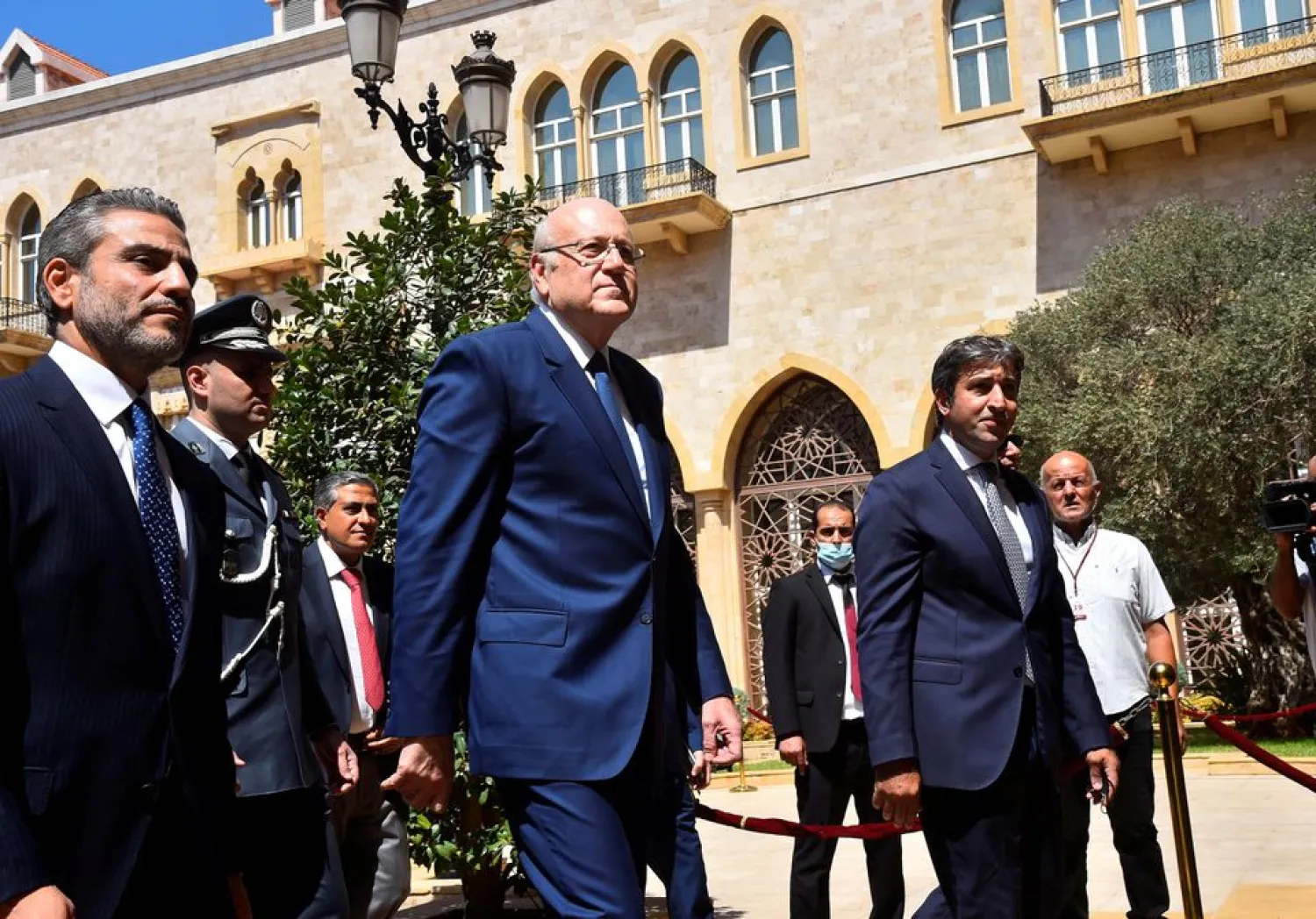
Lebanon's new Prime Minister Najib Mikati walks during an official ceremony to mark his assumption of duties at the Government Palace in Beirut, Lebanon September 13, 2021. Dalati Nohra/Handout via REUTERS
TT

Who Pays? Lebanon Faces Tough Question in IMF Bailout Bid

Lebanon's new Prime Minister Najib Mikati walks during an official ceremony to mark his assumption of duties at the Government Palace in Beirut, Lebanon September 13, 2021. Dalati Nohra/Handout via REUTERS

In its bid for IMF support, Lebanon must address a question it has evaded since the economy imploded two years ago: how should it distribute the huge losses caused by its financial collapse?

Till now, the answer has been brutally simple: ordinary Lebanese have paid the price as they watched savings evaporate, the currency crumble and basic goods disappear from the shelves, Reuters said.

When a plan was drawn up last year that identified a $90 billion hole in the financial system, it was shot down by banks which complained it made them foot too much of the bill and by the ruling elite who had driven Lebanon into its crisis.

Since then, Lebanon has sunk deeper into trouble with no plan and no government until its fractious sectarian politicians ended a year of bickering and agreed a new cabinet this month.

The new prime minister, billionaire tycoon Najib Mikati, and his government need to acknowledge the scale of losses and work out how to share them out to deliver on a promise to secure International Monetary Fund assistance with economic reforms.

The financial system collapsed in 2019 because of decades of corruption and waste in the state and the unsustainable way it was financed. The trigger was slowing inflows of hard currency into the banking system, which lent heavily to the government.

Mikati may have a better shot in IMF talks than his predecessor partly because there is now broader political recognition – including, it seems, within Iran-backed Shi'ite group Hezbollah - that an IMF deal is the inescapable path to aid.

From crippling shortages of fuel and other basics to a de facto "hair cut" of up to 80% on the value of savings in a zombie banking system, many argue the crisis has inflicted more pain than even the toughest imaginable IMF adjustment program.

Several reforms the IMF would likely seek, including cutting subsidies and unifying the numerous exchange rates in Lebanon's chaotic cash economy, are already becoming realities as hard currency dries up, political sources say.

'CRITICAL OBSTACLE'
Yet many analysts are deeply skeptical about whether the government can embark on significant reforms, even if it can start IMF negotiations, or fix problems like the fuel shortage.

The government was picked by the same elite that led Lebanon into its mess and allowed it to fester. The World Bank has criticized Lebanon for "a deliberate" lack of policy.

Moreover, the government has just eight months before elections that will preoccupy the main parties.

The World Bank says the depression is one of the most severe since the mid-19th century: gross domestic product shrank by 40% between 2018 and 2020. Even during Lebanon's 1975-1990 civil war, the banks remained solvent and functional.

Clearing the first hurdle to an IMF deal - agreeing on the distribution of losses - will be tough. Last year's plan encountered opposition from stakeholders including the banks.

In a report, Goldman Sachs said reaching an agreement on the issue would likely "prove difficult to achieve, representing a critical obstacle along the path to recovery".

A financial source familiar with the IMF process in Lebanon said there was room for compromise on the losses and significant momentum for an IMF deal, which meant there was a "much higher" likelihood of reaching an agreement.

While some banks still hoped their debts would evaporate by converting US dollar deposits into pounds, the source said banks were more ready to acknowledge the need for "a proper restructuring".

"We don't have to turn into Finland or Sweden to conclude an IMF program," the source said. "We have to do the minimum required, including acknowledging losses in the banking sector and central bank and agreeing a fair allocation of these losses."

A capital control law must also be passed and the exchange rates unified, the source added.

READY TO ENGAGE
The IMF has said it has had courtesy calls with members of the new government and stands ready to engage.

The government has said it will renew and develop last year's plan, which included figures endorsed by the IMF.

That plan had enraged the banks, partly because of provisions for a shareholder bail-in that would wipe out their capital. The banks countered with their own proposals including a $40 billion state asset fund to help settle debts.

Riad Salameh, central bank governor since 1993, also dug in his heels last year over the losses, and lawmakers representing the factions within the ruling elite came up with figures that were between a quarter and a half of the amount in the plan.

The new finance minister is Youssef Khalil, a former central bank official.

The finance ministry and central bank are now expected to work better together to agree on the losses, said Alain Aoun, a senior member of the Free Patriotic Movement, which was founded by his uncle, President Michel Aoun.

"What changed? The team changed," he told Reuters. "Last year some parties said 'never touch subsidies', and look where we are today. Everyone is surrendering progressively to the reforms, whether voluntarily or because they are being forced to."

"We are desperate to get dollars, the IMF is promising aid, but conditioned to get into a financial plan. Everybody will be forced to (agree) this time," he said.

But the government faces enormous skepticism.

Its policy program gave scant detail on major reforms sought by donors, including fixing the state-run electricity sector which has drained the public purse yet still produces barely any power.

Nadim Houry, executive director of Arab Reform Initiative, doubted the new government would engage seriously with the IMF.

"I call this the government of restoration - the government that is supposed to improve the image of the traditional parties ahead of the upcoming elections," he said, saying it would be able to spend more than $1 billion issued to Lebanon as part of a general allocation of IMF Special Drawing Rights.

"They will stabilize the country and sell that under the name of reforms."


Italy Arrests 7 Accused of Raising Millions for Hamas

Palestinian Hamas members secure the area as Egyptian workers accompanied by members of the International Committee of the Red Cross (ICRC) search for the remains of the last Israeli hostage in the Zeitoun neighborhood of Gaza City on December 8, 2025. (Photo by Omar AL-QATTAA / AFP)
TT

Italy Arrests 7 Accused of Raising Millions for Hamas

Palestinian Hamas members secure the area as Egyptian workers accompanied by members of the International Committee of the Red Cross (ICRC) search for the remains of the last Israeli hostage in the Zeitoun neighborhood of Gaza City on December 8, 2025. (Photo by Omar AL-QATTAA / AFP)

Italian police said Saturday that they have arrested seven people suspected of raising millions of euros for Palestinian group Hamas.

Police also issued international arrests for two others outside the country, said AFP.

Three associations, officially supporting Palestinian civilians but allegedly serving as a front for funding Hamas, are implicated in the investigation, said a police statement.

The nine individuals are accused of having financed approximately seven million euros ($8 million) to "associations based in Gaza, the Palestinian territories, or Israel, owned, controlled, or linked to Hamas."

While the official objective of the three associations was to collect donations "for humanitarian purposes for the Palestinian people," more than 71 percent was earmarked for the direct financing of Hamas" or entities affiliated with the movement, according to police.

Some of the money went to "family members implicated in terrorist attacks," the statement said.

Among those arrested was Mohammad Hannoun, president of the Palestinian Association in Italy, according to media reports.

Interior Minister Matteo Piantedosi posted on X that the operation "lifted the veil on behavior and activities which, pretending to be initiatives in favor of the Palestinian population, concealed support for and participation in terrorist organizations."


Türkiye Holds Military Funeral for Libyan Officers Killed in Plane Crash

The Libyan national flag flies at half-mast in Tripoli on December 24, 2025, after the head of Libya's armed forces and his four aides died in a plane crash in Türkiye. (AFP)
TT

Türkiye Holds Military Funeral for Libyan Officers Killed in Plane Crash

The Libyan national flag flies at half-mast in Tripoli on December 24, 2025, after the head of Libya's armed forces and his four aides died in a plane crash in Türkiye. (AFP)

Türkiye held a military funeral ceremony Saturday morning for five Libyan officers, including western Libya’s military chief, who died in a plane crash earlier this week.

The private jet with Gen. Muhammad Ali Ahmad al-Haddad, four other military officers and three crew members crashed on Tuesday after taking off from Ankara, Türkiye’s capital, killing everyone on board. Libyan officials said the cause of the crash was a technical malfunction on the plane.

Al-Hadad was the top military commander in western Libya and played a crucial role in the ongoing, UN-brokered efforts to unify Libya’s military.

The high-level Libyan delegation was on its way back to Tripoli, Libya’s capital, after holding defense talks in Ankara aimed at boosting military cooperation between the two countries.

Saturday's ceremony was held at 8:00 a.m. local time at the Murted Airfield base, near Ankara, and attended by the Turkish military chief and the defense minister. The five caskets, each wrapped in a Libyan national flag, were then loaded onto a plane to be returned to their home country.

Türkiye’s military chief, Selcuk Bayraktaroglu, was also on the plane headed to Libya, state-run news agency TRT reported.

The bodies recovered from the crash site were kept at the Ankara Forensic Medicine Institute for identification. Justice Minister Yilmaz Tunc told reporters their DNA was compared to family members who joined a 22-person delegation that arrived from Libya after the crash.

Tunc also said Germany was asked to help examine the jet's black boxes as an impartial third party.


Syrian Foreign Ministry: Talks with SDF Have Not Yielded Tangible Results

SDF fighters are seen at a military parade in Qamishli. (Reuters file)
TT

Syrian Foreign Ministry: Talks with SDF Have Not Yielded Tangible Results

SDF fighters are seen at a military parade in Qamishli. (Reuters file)

A source from the Syrian Foreign Ministry said on Friday that the talks with the Kurdish Syrian Democratic Forces (SDF) over their integration into state institutions “have not yielded tangible results.”

Discussions about merging the northeastern institutions into the state remain “hypothetical statements without execution,” it told Syria’s state news agency SANA.

Repeated assertions over Syria’s unity are being contradicted by the reality on the ground in the northeast, where the Kurds hold sway and where administrative, security and military institutions continue to be run separately from the state, it added.

The situation “consolidates the division” instead of addressing it, it warned.

It noted that despite the SDF’s continued highlighting of its dialogue with the Syrian state, these discussions have not led to tangible results.

It seems that the SDF is using this approach to absorb the political pressure on it, said the source. The truth is that there is little actual will to move from discussion to application of the March 10 agreement.

This raises doubts over the SDF’s commitment to the deal, it stressed.

Talk about rapprochement between the state and SDF remains meaningless if the agreement is not implemented on the ground within a specific timeframe, the source remarked.

Furthermore, the continued deployment of armed formations on the ground that are not affiliated with the Syrian army are evidence that progress is not being made.

The persistence of the situation undermines Syria’s sovereignty and hampers efforts to restore stability, it warned.
