


Sudan Needs New Date for Civilian Leadership Handover, Says Sovereign Council Member

Sudanese protesters shout slogans and wave their country's national flag as they march in the capital Khartoum, on June 3, 2021. (AFP)
TT

Sudan Needs New Date for Civilian Leadership Handover, Says Sovereign Council Member

Sudanese protesters shout slogans and wave their country's national flag as they march in the capital Khartoum, on June 3, 2021. (AFP)

The date for the handover of the leadership of Sudan's highest authority, the Transitional Sovereign Council, from the military to civilians is still unclear and requires discussion and a new legal decree, said a civilian member on Friday.

A failed coup attempt on Tuesday laid bare the tensions between the two sides who make up the 11-member Sovereign Council following a sensitive power-sharing agreement in 2019 and has for the first time brought public controversy over when the current council head is replaced.

Council member and former journalist Mohamed Al-Faki Suleiman described the relationship between civilian and military council members as “unwell” in an interview on state television, noting that joint meetings on various topics have become unproductive in recent weeks, Reuters reported.

Renewed political discussions and a decree from the Justice Ministry were needed to decide a handover date, he said.

In a speech on Wednesday, current council head General Abdel Fattah al-Burhan criticized Suleiman and other civilian leaders. Al-Burhan described the military as a guardian for the transition, a description Suleiman rejected.

“The goal of this is to produce a political situation where the military component is dominant and that is unacceptable,” Suleiman said, adding that military members need to become comfortable with the discussion and criticism inherent to politics.

The country's constitutional declaration, signed following a 2018-2019 uprising that resulted in the removal of former President Omar al-Bashir, set a date for handover of leadership of the Sovereign Council for May 2021. However, a peace agreement signed in October reset the clock on the transition without specifying a new date for handover.

“The transition to civilians is not secondary and shouldn't be left to fate,” Suleiman said, noting that he favored a proposal to carry out the handover in November. A simple reset of the clock would set a handover of July 2022.

In a phone call with civilian Prime Minister Abdalla Hamdok, US national security adviser Jake Sullivan said that any attempts by military actors to undermine the civilian transition “would have significant consequences for the US-Sudan bilateral relationship and planned assistance,” the White House said.

In a tweet, the US Senate Foreign Relations Committee chair Sen. Bob Menendez said the US could re-impose sanctions in the case of a coup. “The military must stay in the barracks,” he added.

Sudanese authorities say the coup attempt was carried out by current military members loyal the former regime.



Hamas Sources Acknowledge Differences with Mediators on Disarmament Plan

Gunmen from Hamas’ Izz ad-Din al-Qassam Brigades in Nuseirat refugee camp, central Gaza, February 2025 (EPA)
TT

Hamas Sources Acknowledge Differences with Mediators on Disarmament Plan

Gunmen from Hamas’ Izz ad-Din al-Qassam Brigades in Nuseirat refugee camp, central Gaza, February 2025 (EPA)

At a time when Palestinian sources told Asharq Al-Awsat that Egypt, Qatar, and Türkiye helped draft a plan submitted by the Board of Peace to disarm factions in Gaza, Hamas sources acknowledged “differences” with mediators over the proposal.

Sources familiar with the Gaza Administration Committee said mediators involved in ceasefire talks had been fully briefed on the Board of Peace plan before it was presented to Hamas and other factions.

A document published by Reuters and other media outlets last week showed that the Board of Peace, formed by US President Donald Trump, had proposed that Hamas dismantle its tunnel network in the Gaza Strip and give up weapons in stages over eight months.

The plan lays out a timeline starting with a national committee taking over security in Gaza and ending with a full Israeli withdrawal once “final verification” that the enclave is free of weapons is achieved.

Sources close to the Gaza Committee said the three mediating countries, working with the United States, helped shape the proposal, introducing amendments and comments during drafting.

After confirming receipt of the proposal last week, Hamas officials voiced anger at the Board of Peace’s High Representative for Gaza, Nickolay Mladenov, after he told the Security Council that reconstruction could not begin until disarmament phases were verified.

Mediator backing

Two Hamas sources in Gaza said they were unaware of any direct involvement by mediators in drafting the plan, but suggested that the mediators likely knew its details before it was presented.

A senior Hamas source outside Gaza said the group had not received clear confirmation of such involvement, but that the proposal’s language and mediator support indicated prior knowledge.

The senior source said the plan had been discussed internally and that some provisions were reviewed with mediators during meetings in Egypt and Türkiye in recent days.

They said a unified Palestinian position would be presented within a clear framework aimed at amending key clauses, rejecting any link between disarmament and progress on other steps.

They stressed “the need to obligate Israel to fulfill its commitments,” saying the current plan allows it to maneuver and pressure what he described as the “resistance” to achieve its core aim of keeping Gaza demilitarized while retaining security control.

“Differences are normal”

Asked about gaps between Hamas and mediators, the three sources agreed there were “differences,” one describing them as “normal.”

The senior source said the proposal does not fully meet Palestinian demands and requires factions to surrender weapons without a meaningful return from Israel.

They pointed to earlier ceasefire talks, when mediators showed responsiveness to faction demands, prompting them and the United States to engage positively with proposals, an approach factions hope will be repeated.

Hamas is likely to struggle to reject the plan outright and may instead seek amendments to secure what it sees as Palestinian gains. Israel has clearly rejected such changes and has signaled a possible return to war.

The plan calls for full disarmament, light and heavy weapons, factional, tribal, and personal, under a framework of “one law and one weapon,” while ensuring Hamas has no role in governing Gaza, either civilly or in security.

An Egyptian source told Asharq Al-Awsat about a week ago that Egypt’s Interior Ministry will receive thousands of candidates for a Palestinian police force tasked with maintaining security in Gaza under a ceasefire deal.

Recruits will undergo six weeks of training, with others set to train in Jordan.

The Gaza Administration Committee has recently opened applications for security roles in the new force, drawing tens of thousands of applicants, although the initial target is about 5,000 officers.

The United States, working with Israel, aims to start reconstruction in southern Gaza, particularly in Rafah, areas under Israeli control, before moving to Hamas-held areas.

Under the plan, reconstruction is tied to disarmament, a condition Hamas has consistently rejected.


Israeli Strikes Kill 5 in the Gaza Strip

Palestinians walk through a flooded area in a temporary tent camp after heavy rainfall in Gaza City, Thursday, March 26, 2026 (AP Photo/Jehad Alshrafi)
TT

Israeli Strikes Kill 5 in the Gaza Strip

Palestinians walk through a flooded area in a temporary tent camp after heavy rainfall in Gaza City, Thursday, March 26, 2026 (AP Photo/Jehad Alshrafi)

Israeli strikes killed at least five people in the Gaza Strip in two separate attacks on Tuesday, health officials said, in the latest violence overshadowing a fragile five-months-old US-brokered ceasefire deal.

Medics said an Israeli airstrike in Jabalia, north of the enclave, killed at least three people earlier in the day, while another airstrike killed two others in ⁠Khan Younis, in ⁠the south.

There was no Israeli comment on either of the two incidents.

Hamas and Israel have traded blame for violations of a ceasefire agreed last October. The Gaza health ⁠ministry said Israeli fire has killed at least 700 people since the ceasefire. Israel said four soldiers were killed by militants in Gaza over the same period.

Israel, along with the US, is also now engaged in a conflict with Iran, while Israeli forces have also invaded southern Lebanon in a new campaign ⁠against ⁠Iran-backed Hezbollah.


Israel's Katz on Lebanon: to Maintain Control Over Entire Area Up to Litani River

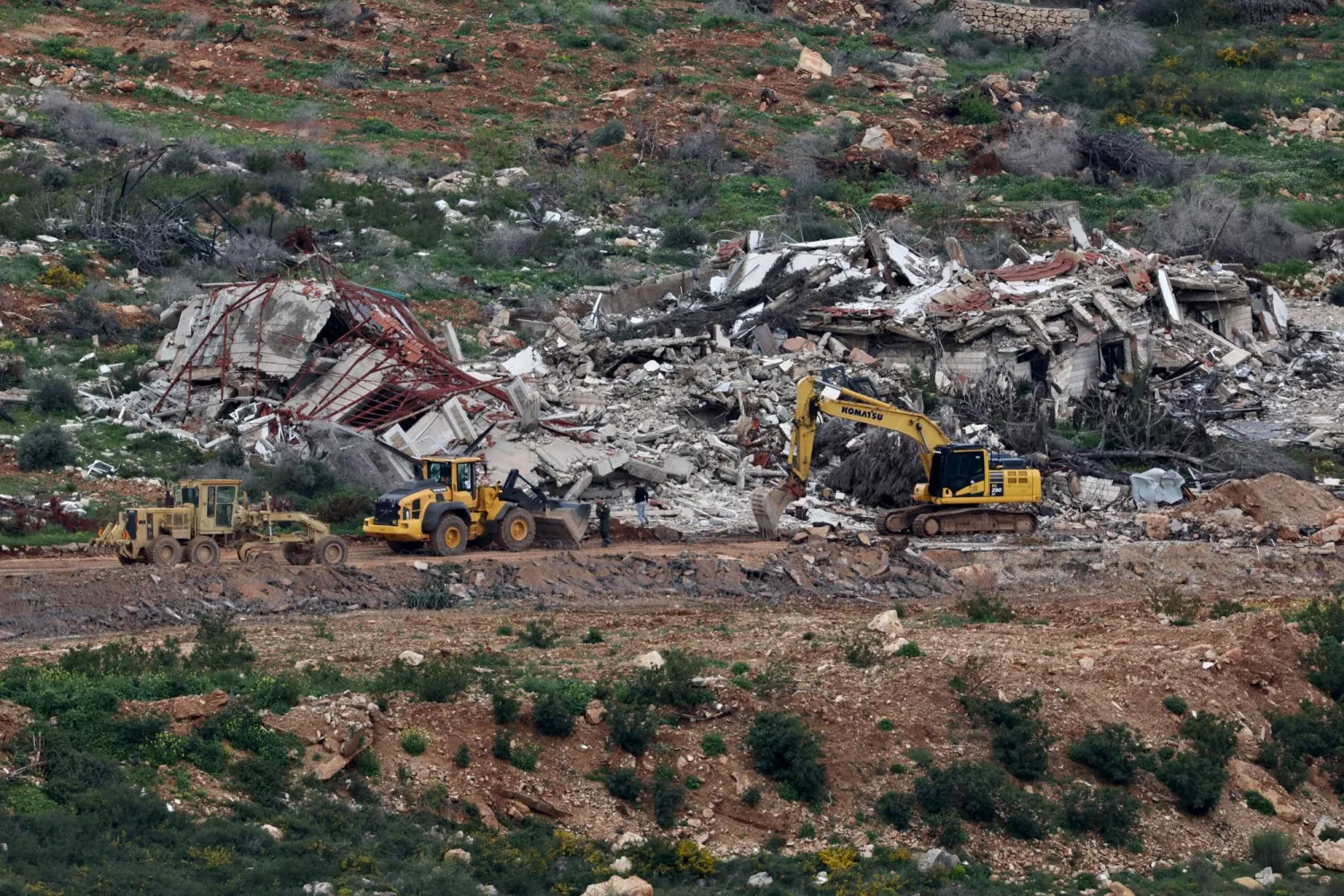
Israeli heavy machinery operates in the southern Lebanese village of Adeisseh, as seen from the Israeli side of the border in the Upper Galilee, northern Israel, 30 March 2026. EPA/ATEF SAFADI
TT

Israel's Katz on Lebanon: to Maintain Control Over Entire Area Up to Litani River

Israeli heavy machinery operates in the southern Lebanese village of Adeisseh, as seen from the Israeli side of the border in the Upper Galilee, northern Israel, 30 March 2026. EPA/ATEF SAFADI

Israel will establish a buffer zone inside southern Lebanon and maintain control over the entire area up to the Litani River once the conflict with Hezbollah ends, Israel's defense minister said on Tuesday.

"At the end of the operation, the IDF would control ⁠the area up to ⁠the Litani River, including the remaining Litani bridges, while eliminating Radwan forces that infiltrated the area and destroying all weapons there," Israel Katz ⁠said in a statement following a security assessment, calling it a "security zone.”

Radwan forces are an elite military unit of Hezbollah.

Katz said that the more than 600,000 Lebanese residents who have been evacuated northward would be barred from returning south of the Litani ⁠until ⁠the safety of residents in northern Israel is guaranteed.

To that end, "all homes in villages near the border in Lebanon would be destroyed, according to the model of Rafah and Beit Hanoun in Gaza, in order to permanently remove threats near the border to northern residents" in Israel, Katz said.

Israeli military spokesperson ⁠Lieutenant Colonel Nadav Shoshani said that Hezbollah had fired almost 5,000 drones, rockets and missiles at Israel during the conflict. The Israeli military also announced a new wave of strikes it said were targeting Hezbollah infrastructure in Beirut's southern suburbs.