


Airport Closed as La Palma Volcano Eruption Intensifies

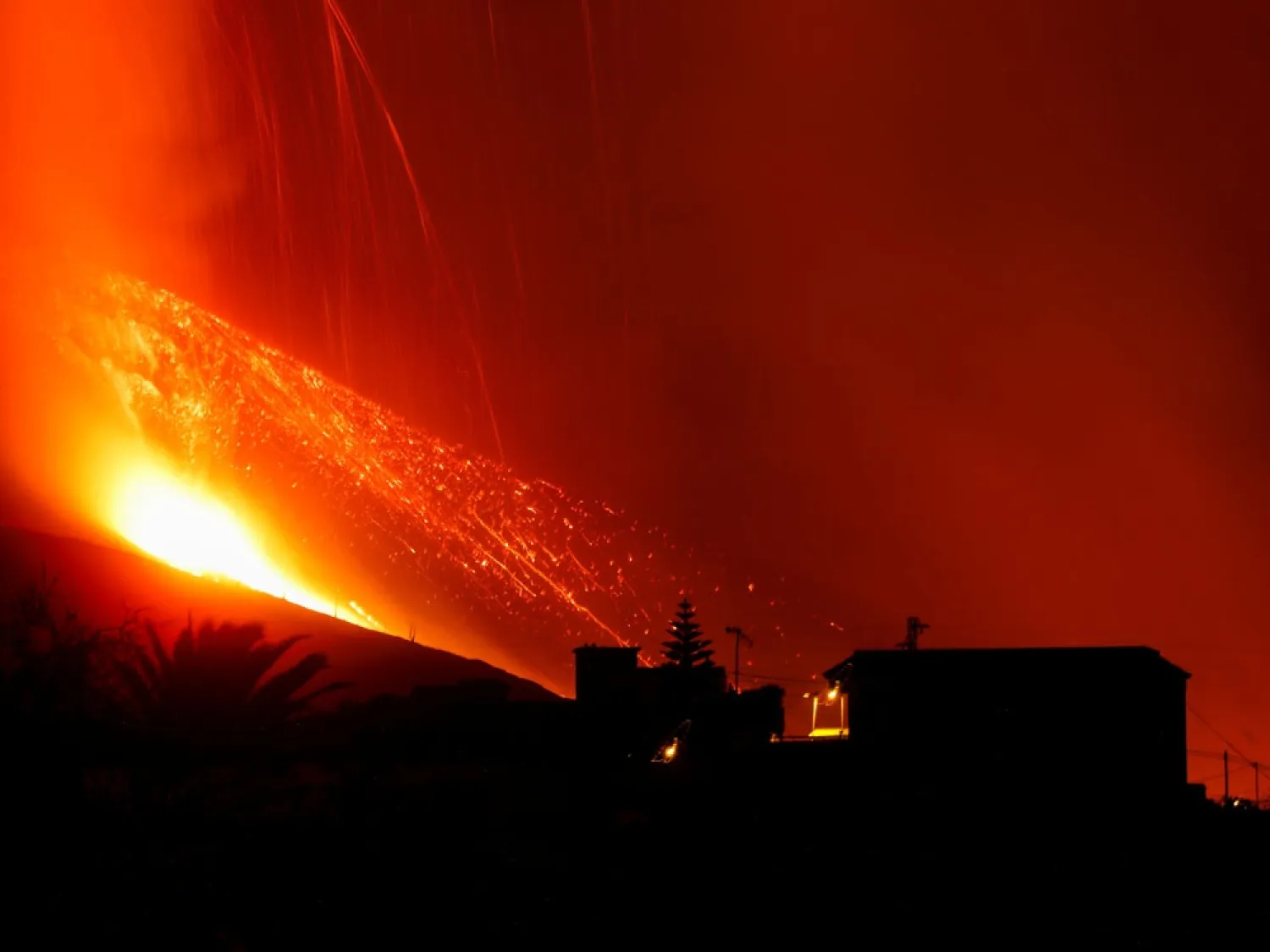
Lava and smoke rise after a volcano erupts on the Canary Island of La Palma in El Paso, Spain on September 25, 2021. (Reuters)
TT

Airport Closed as La Palma Volcano Eruption Intensifies

Lava and smoke rise after a volcano erupts on the Canary Island of La Palma in El Paso, Spain on September 25, 2021. (Reuters)

Volcanic explosions spewed red hot lava high into the air on La Palma on Saturday as a new emission vent opened, forcing the small Spanish island to close its airport and causing long queues for boats off the island.

The Cumbre Vieja volcano, which began erupting last Sunday, is entering a new explosive phase. The Canary Islands Volcanology Institute, Involcan, said the new emission vent that had opened was to the west of the principal vent.

The national Geographical and Mining Institute said its drones had shown the volcano’s cone had broken.

“It is not unusual in this type of eruption that the cone of the volcano fractures. A crater is formed that does not support its own weight and ... the cone breaks,” Miguel Angel Morcuende, director of volcano response committee Pevolca, told a news conference on Saturday. “This partial rupture happened overnight.”

Morcuende said the evacuations currently in place would be maintained for another 24 hours as a precaution.

The volcano has spewed out thousands of tons of lava, destroyed hundreds of houses and forced the evacuation of nearly 6,000 people since it began erupting last Sunday. La Palma, with a population of over 83,000, is one of an archipelago making up the Canary Islands in the Atlantic.

Spanish airport operator Aena said the island’s airport had closed.

“La Palma airport is inoperative due to ash accumulation. Cleaning tasks have started, but the situation may change at any time,” it tweeted.

Workers swept volcanic ash off the runway, electronic boards showed cancelled flights and the departures hall was quiet as some people arriving at the airport discovered they would not be able to fly out.

Queues at the port
There were long queues at La Palma’s main port as people, some whose flights had been cancelled, tried to get ferries off the island.

“I am going to Barcelona. But because we can’t fly we are taking the ferry to Los Cristianos (on Tenerife island) and from there we will go to the airport and fly to Barcelona,” said Carlos Garcia, 47.

People evacuated from three more towns on Friday will not be able to return to their homes to retrieve their belongings because of the “evolution of the volcanic emergency,” local authorities said.

“Volcanic surveillance measurements carried out since the beginning of the eruption recorded the highest-energy activity so far during Friday afternoon,” emergency services said.

At the quiet port of Tazacorte, fishermen described the devastating effect the eruption has had on their livelihoods.

“We haven’t been out fishing in a week, the area is closed,” said Jose Nicolas San Luis Perez, 49, who lost his house in the eruption.

“About half the people I know have lost their homes,” he told Reuters. “I run into friends on the street and we start crying.”

On Friday, authorities evacuated the towns of Tajuya, Tacande de Abajo and the part of Tacande de Arriba that had not already been evacuated after the new vent opened up in the flank of the volcano.

No fatalities or serious injuries have been reported in the volcano’s eruption, but about 15% of the island’s economically crucial banana crop could be at risk, jeopardizing thousands of jobs.



Moscow Bets on Tehran’s Resilience, Western Rift

The Russian President attends events marking “Defender of the Fatherland Day” in Moscow on February 23 (AP)
TT

Moscow Bets on Tehran’s Resilience, Western Rift

The Russian President attends events marking “Defender of the Fatherland Day” in Moscow on February 23 (AP)

The Kremlin’s expectations appeared markedly pessimistic in the fourth week of the Iran war, as confidence grew that Russia’s ability to influence the conflict was waning and that the repercussions for one of its key partners could be severe.

With limited leverage, the Kremlin’s main options now seem to be avoiding direct involvement while closely monitoring the fallout, particularly signs of widening divisions between Washington and European capitals — and what one veteran Russian diplomat described as “driving the final wedge” into transatlantic relations.

Kremlin spokesman Dmitry Peskov summed up the mood: “No reasonable person would dare predict how the situation in the Middle East will evolve, but it is clear that things are moving toward the worse.”

From the outset, Russian assessments have focused on two key assumptions: that air strikes alone cannot topple Iran’s political system, regardless of their scale, and that ending the war without a costly ground intervention would be difficult for the attacking parties.

A second assumption is that any cessation of hostilities would resemble the outcome of the brief 12-day war of 2025, with each side claiming success without achieving its ultimate objectives, particularly Israel’s stated goal of dismantling Iran’s ruling system.

Such a scenario would suit Moscow, even if Iran were to emerge weakened but still cohesive under its leadership.

Despite increasingly pessimistic forecasts about a potential geographic expansion of the conflict, Moscow believes Tehran has so far absorbed the initial blow and shifted the confrontation into a war of attrition. Russian officials are also banking on possible internal developments within Washington and Tel Aviv, as well as growing divergences with European allies.

Peskov has repeatedly stressed that military operations against Iran have led to greater cohesion among the Iranian people around their leadership, adding that attempts at regime change tend to produce the opposite effect.

He also condemned ongoing assassination campaigns targeting Iranian leaders, calling the situation “abnormal” and warning of “serious consequences.” In a pointed remark, he added that Iran is “actively defending itself against attacks on its territory.”

These statements underline Russia’s primary bet: that Iran’s internal stability will hold, while divisions deepen among its adversaries.

Putin’s mediation effort

President Vladimir Putin initially sought to use the crisis to bolster Russia’s diplomatic standing by proposing rapid mediation to halt the war.

During the first week, he held a series of calls with regional leaders, criticizing Iranian strikes on Gulf countries while emphasizing Moscow’s ability to send “direct messages” to Tehran.

Russia also revived earlier proposals discussed in Oman concerning Iran’s nuclear capabilities and missile program. Moscow offered to take control of enriched uranium and transfer it to Russian territory, while guaranteeing that Iran’s missile capabilities would not be used against Israel or neighboring states.

The proposal was also raised during Putin’s only call with US President Donald Trump in the second week of the war. However, it failed to gain traction in either Tel Aviv — which insists on a military solution — or Washington, where Trump signaled that Putin should first resolve the Ukraine conflict before seeking a role elsewhere.

Limited support for Iran

Against this backdrop, the Kremlin’s options for meaningful intervention appear extremely limited. Complicating matters are accusations that Moscow has provided valuable intelligence support to Iran.

These claims gained weight when US presidential envoy Steve Witkoff reportedly issued a strong warning to Moscow, and the issue was raised directly during the Trump-Putin call.

Nevertheless, Russian circles argue that Moscow has little choice but to continue offering indirect assistance to Tehran while avoiding provoking Washington.

According to Russian media sources, this support takes two main forms: sharing limited intelligence on Israeli movements — carefully calibrated to avoid harming US interests — and providing indirect backing through private companies specializing in cyber technologies, an area where Russia and China have made significant advances.

European repercussions

Another key aspect of Russia’s strategy is its close monitoring of how the war is affecting Ukraine and European positions, which Moscow still sees as the main obstacle to ending the conflict on its terms.

There is little concealment of Russian satisfaction at Europe’s difficulties amid the war, particularly fears over rising oil and gas prices and the prospect of easing sanctions on Moscow to offset supply shortages.

Kremlin commentary suggests that European priorities are shifting, with energy costs replacing Ukraine at the top of government agendas.

Veteran Russian diplomat Alexander Yakovenko argued that the Middle East crisis, combined with the fallout from Ukraine, is intensifying tensions within the transatlantic alliance.

He pointed to German Chancellor Friedrich Merz rejecting a US request to help secure the Strait of Hormuz as evidence of deepening strains. Trump, he noted, responded by describing NATO as a “paper tiger.”

According to Yakovenko, the coming weeks will be decisive for the Iran conflict and its broader consequences. He added that transatlantic relations are facing a severe crisis, with disagreements over Ukraine fueling European opposition to Trump, a factor that could influence the US midterm elections in November.

More broadly, he warned that a US setback in Iran would weaken Washington’s position vis-à-vis Beijing, noting that China has already used export controls on rare earth minerals to counter US trade pressure.

In this context, Yakovenko sees the emergence of three dominant global powers — the United States, China and Russia — with Europe increasingly sidelined.

Such a shift, he suggested, would echo the post-World War II Yalta-Potsdam order, albeit with China replacing Britain, marking the end of two centuries of Western containment of Russia.


Greek PM Announces New Mideast War Fallout Relief Measures

Greek Prime Minister Kyriakos Mitsotakis speaks during a joint press conference with Cyprus' and France's presidents at Paphos military airport, in Paphos, Cyprus, 09 March 2026, (EPA)
TT

Greek PM Announces New Mideast War Fallout Relief Measures

Greek Prime Minister Kyriakos Mitsotakis speaks during a joint press conference with Cyprus' and France's presidents at Paphos military airport, in Paphos, Cyprus, 09 March 2026, (EPA)

Greek Prime Minister Kyriakos Mitsotakis on Monday announced a raft of additional measures to mitigate the energy cost of the Middle East war.

In a televised address, Mitsotakis said the government had earmarked 300 million euros ($346 million) in relief for households and farmers in April and May, said AFP.

The subsidies are targeted at reducing the cost of diesel fuel, petrol and fertilizer. Part of the initiative is aimed at holding back price hikes in ferry fares to the islands, Mitsotakis said.

Oil prices rose on Monday after the United States and Israel warned at the weekend that the war against Iran -- which has disrupted oil deliveries through the Strait of Hormuz -- would continue for several more weeks.

Greece had already announced a first batch of measures on March 11, capping profit margins on gasoline and foodstuffs for three months.

Mitsotakis on Monday said the government was keeping additional funds on tap.

"Since no one knows how long this war will last, we are obviously keeping reserves in case the global economic situation deteriorates significantly," the conservative leader said.


Russia Opposes Hormuz Blockade, Interfax Reports

The reactor building of Iran's nuclear power plant and electricity poles are seen, at Bushehr, Iran, 750 miles (1,245 kilometers) south of the capital Tehran, Iran, Feb. 27, 2005. (AP Photo/Vahid Salemi, File)
TT

Russia Opposes Hormuz Blockade, Interfax Reports

The reactor building of Iran's nuclear power plant and electricity poles are seen, at Bushehr, Iran, 750 miles (1,245 kilometers) south of the capital Tehran, Iran, Feb. 27, 2005. (AP Photo/Vahid Salemi, File)

Russia opposes any blockade of the Strait ‌of ‌Hormuz but ‌says ⁠such issues must ⁠be viewed in ⁠the context ‌of ‌the broader ‌global ‌situation, Interfax reported ‌on Monday, citing the ⁠Russian Foreign ⁠Ministry.

In a statement the Ministry said: “We hope the United States acts wisely and not threaten Bushehr nuclear power plant”.

US President Donald Trump and Iranian leaders traded threats over the key Strait of Hormuz Monday, amid threats that the US-Israel war on Iran could last several more weeks.

With the conflict now in its fourth week and showing no sign of ending, the head of the International Energy Agency warned of the worst global energy crisis in decades and said the world economy was under "major threat" from it.

Observers, meanwhile, have also raised the prospect of a surge in inflation that could force central banks to hike interest rates, while the choking off of fertilizer shipments has also fanned concerns about global food security.

The US president on Saturday gave Iran 48 hours to reopen the Strait of Hormuz to shipping or face the destruction of its energy infrastructure.

The ultimatum, made just a day after the US leader said he was considering "winding down" military operations, came as the waterway -- through which a fifth of global oil and gas flows -- remained effectively closed.