Severe Droughts Dry Up Dreams of Turkish Farmers

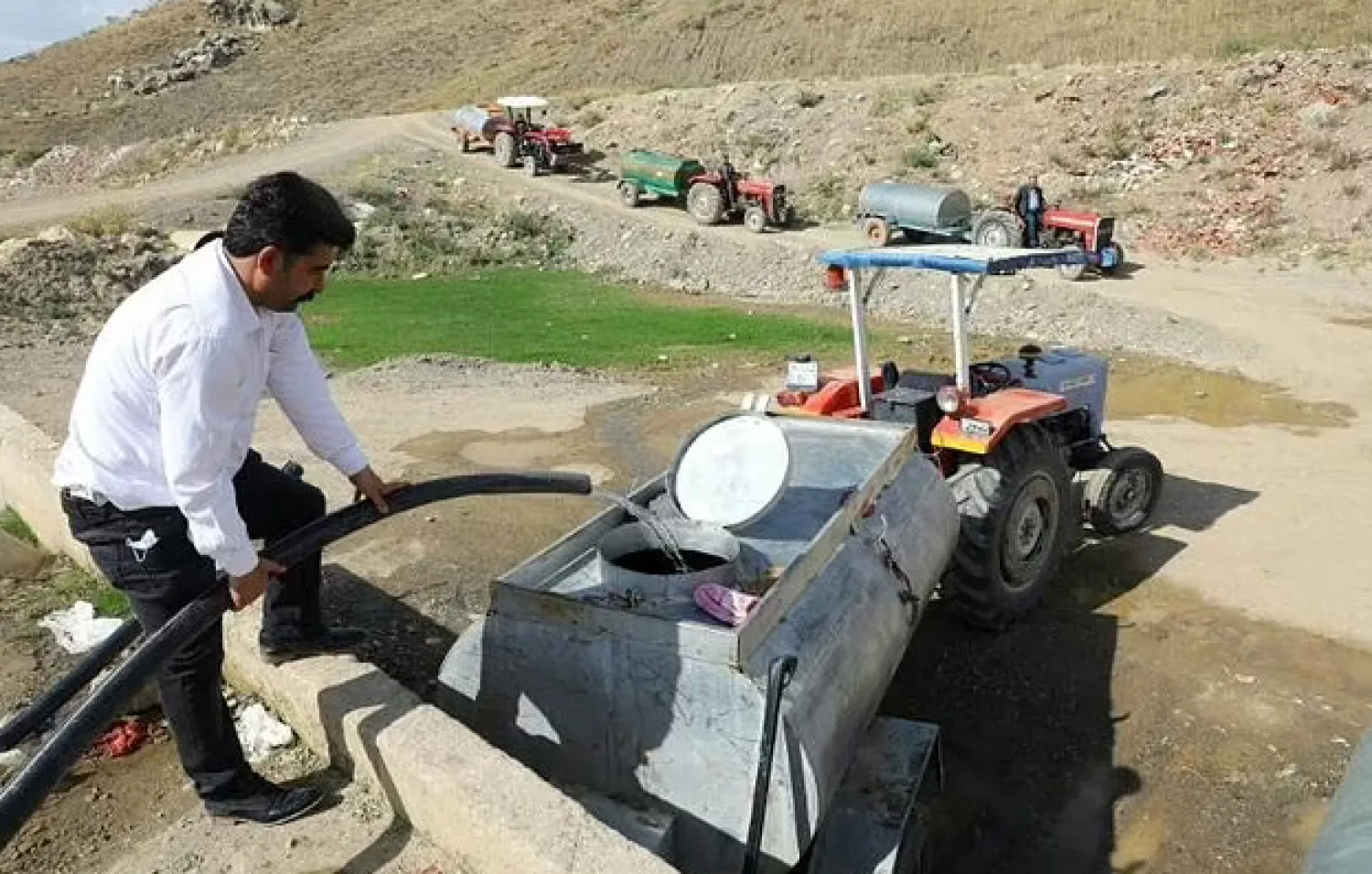
Severe droughts in Turkey have forced farmers to fill tanks with water - AFP
TT

Severe Droughts Dry Up Dreams of Turkish Farmers

Severe droughts in Turkey have forced farmers to fill tanks with water - AFP

Turkish farmer Hava Keles stares inconsolably at withered vines of rotting tomatoes in a field that has been devastated by a series of droughts blamed on climate change.

"My tomatoes, my beans, my peppers are ruined. My watermelons didn't even grow. The cucumbers I planted have shriveled up on the branches," lamented Keles, 58, standing in an arid Anatolian plot in Akkuzulu, north of Ankara, AFP reported.

Keles is among thousands of farmers across Turkey whose livelihoods have been ravaged as little rain has fallen to nourish their crops for the past two years.

Some experts accuse President Recep Tayyip Erdogan -- whose popularity has relied on prosperity driven by fast urban development -- of failing to do enough to address pressing environmental issues in the country.

But Erdogan has promised Turkey would ratify the 2015 Paris Agreement in October before a pivotal UN climate summit next month in Glasgow. Turkey signed the deal in 2016.

Environmental issues had never topped the political agenda in Turkey, but everything changed after a summer of extreme weather events, including forest fires on the Mediterranean coast and devastating floods in the north.

Action cannot come soon enough for indebted farmers like Keles in a country where droughts have spread to more than of the territory.

"My husband says leave the garden. But I can't. I've worked too hard for this. What can I do with it now?" she asks, despite having debts worth thousands of dollars.

This summer, farmers in her neighborhood were unable to dig deep enough to find groundwater, so they had to fetch it in large tanks pulled by tractors.

- 'Serious events coming' -

Agriculture is a major sector of the Turkish economy, accounting for around six percent of GDP and employing 18 percent of the workforce.

Turkey is self-sufficient in food production and is the world's seventh largest agricultural producer, exporting everything from hazelnuts to tea, olives to figs.

But the country's import of wheat has already risen exponentially in nearly two decades from $150 million to $2.3 billion in 2019, according to the agriculture ministry.

Such figures add to fears Turkey will move from producer to becoming a country reliant on the outside to meet its food needs.

"Turkey has a lot to adapt to, especially in terms of agriculture because serious drought events are coming. What we have seen is nothing," warned Levent Kurnaz, director of Bogazici University's centre for climate change and policy studies in Istanbul.

Drought is forcing some farmers to quit while others opt to grow different crops that demand less water, leaving the consumer out of pocket as food prices rise alongside a weakening Turkish lira.

Food inflation hit 29 percent in August from last year, and in a bid to ease the pain, Erdogan cut import customs duties to zero for basics such as wheat, chickpeas and lentils until the end of the year.

Experts say the government has failed in its water management policies, exacerbating the problem.

Farmers are impacted by significantly reduced water levels in dams across Turkey, which put the water needs of every citizen at risk as well, while lakes are drying up.

"We need to build our cities in a way that allows underground water levels to rise," said Ceyhun Ozcelik, associate professor in the water resources department at Mugla Sitki Kocman University.

"If we don't take the necessary measures, if the urban infrastructure is not enough, then I can say we face difficult days in the years ahead," he added.

- 'Transform lifestyles' -

In the west of the country on the Aegean coast, green olive groves coat the hills in Milas, famous for its olive oil which gained European Union protected status in December. But the fruit is also at risk.

Ismail Atici, Milas agricultural chamber chief, said rain had not fallen at all in 2021.

"If there is still no rain for one, or two more months, the trees will not be able to nourish the fruits," he added.

Farmers' costs are spiraling.

Ferdun Cetinceviz, 41, who tends to some 200 cows and corn fields among the mountains, said he is losing up to 40,000 lira per month ($4,500, 3,900 euros).

Surrounded by dry, flat land and green mountains in the distance, Cetinceviz estimated up to 50 percent of his crop yield including corn was lost this year due to drought.

Farmers in Milas used to grow cotton, but it requires vast quantities of water, so they switched to corn.

"If I can't water my crops which my animals also need, they will be left hungry," Cetinceviz said.


Missing Teen Found Alive After 6 Days in Australian Woodlands

In this image made from video and provided by the Victoria State Police 17-year-old William, center right, is embraced by his mother Elizabeth, only first names were provided by police, while in a helicopter in Cowwarr, Australia, Thursday, Nov. 12, 2026, after William spent six days lost in eastern Australian woodlands. (Victoria Police via AP)
TT

Missing Teen Found Alive After 6 Days in Australian Woodlands

In this image made from video and provided by the Victoria State Police 17-year-old William, center right, is embraced by his mother Elizabeth, only first names were provided by police, while in a helicopter in Cowwarr, Australia, Thursday, Nov. 12, 2026, after William spent six days lost in eastern Australian woodlands. (Victoria Police via AP)

A 17-year-old boy with autism was found alive Thursday after six days lost in eastern Australian woodlands.

The boy, whom police identified only as William, had begun camping with a teenage friend when he disappeared last Friday near Walhalla, a former gold-mining town 185 kilometers (115 miles) east of Melbourne, police said.

A police helicopter crew found him surrounded by wilderness lying asleep on a flat rock beside a creek, and he was later reunited with his mother. William was in good spirits and mostly in good health, the police statement said.

Video shot from the rescue helicopter showed he was shirtless and sunburned. He was wearing shorts and boots and was using towels as blankets.

“I’m just over the moon that he’s alive,” his mother, Elizabeth, told reporters.

The AP has decided not to provide her family name to avoid identifying her son.

“And he’s never leaving the house again. He’s grounded for life. He’s not going anywhere ever again,” she joked.

William was later taken to a hospital for his health to be monitored, police said.

William's family have said he has Level 2 autism. That requires “substantial support,” according to the Australian advocacy group Autism360.

Such a person may have marked deficits in verbal and non-verbal social communication and rely heavily on routines and predictable activities.

Disruption can cause significant distress.

The Southern Hemisphere spring weather had been mild for the past week in the alpine region where William was lost and there had been little rain.

Elizabeth had dropped off her son and his friend last Friday for a weekend of camping. William walked a short distance from the campsite to the drop-off location to collect more camping equipment but never returned to his friend, police said.

After becoming lost, William trekked for days up and down “some very steep terrain,” Acting Police Inspector Jason Benbow said.

He spent the last two days where he was found at the creek, trapped by the steepness of his surrounds 2 kilometers (1.2 miles) from his camp site, Benbow said.

“He woke up to the sound of the helicopter, gave them a thumbs up and they winched him to safety,” Benbow told reporters.

The extensive police search for him involved more than 100 emergency services personnel and volunteers.


Europe’s Hera Spacecraft Begins Close Inspections of an Asteroid Rammed by NASA in a 2022 Test

This undated image provided by the European Space Agency on Nov. 5, 2026 and taken by the Hera spacecraft, shows asteroid Didymos. (European Space Agency via AP)
TT

Europe’s Hera Spacecraft Begins Close Inspections of an Asteroid Rammed by NASA in a 2022 Test

This undated image provided by the European Space Agency on Nov. 5, 2026 and taken by the Hera spacecraft, shows asteroid Didymos. (European Space Agency via AP)

A European spacecraft has begun close inspections of an asteroid rammed by NASA four years ago in a planetary defense test.

The European Space Agency announced Wednesday that the Hera spacecraft is now studying Didymos and its moonlet Dimorphos from just 15 miles to 18 miles (25 kilometers to 30 kilometers) away, The AP news reported.

NASA’s Dart spacecraft deliberately slammed into little Dimorphos in 2022 to see whether such a defensive move might help save Earth from a killer space rock one day.

The impact shortened the moonlet’s orbit around Didymos. More importantly, it nudged the moonlet into a slightly different path around the sun.

Next month, the small car-sized Hera, launched in 2024, will venture even closer — just 12 miles (20 kilometers) away.

ESA officials consider this a “crash site investigation” worthy of its finest robotic detective. Hera is carrying 25 science instruments as well as a pair of shoebox-sized Cubesats to survey Dimorphos even more closely and attempt to land on it.

The Dart spacecraft — short for Double Asteroid Redirection Test — sent rubble and even boulders flying off Dimorphos, providing an extra kick to the impact’s momentum. The debris trail extended thousands of miles (more than 10,000 kilometers) into space for months.

Some of that debris could still be in the vicinity, according to scientists.

Dimorphos is an estimated 500 feet (151 meters) in diameter. Didymos is roughly 2,560 feet (780 meters) in diameter.


Euclid Mission Data Release Spans More than 900 Million Galaxies

Looking across vast distances means peering into the past because of the time needed for light from distant objects to reach us (Reuters)
TT

Euclid Mission Data Release Spans More than 900 Million Galaxies

Looking across vast distances means peering into the past because of the time needed for light from distant objects to reach us (Reuters)

The European Space Agency has released its first big collection of data from the orbiting Euclid telescope's mission to map the universe's large-scale structure, including observations of more than 900 million galaxies, as scientists investigate the puzzling cosmic components dark matter and dark energy.

The data unveiled on Thursday covered a survey of the sky equal to about 9,500 times the size of the moon as viewed from Earth. The mission's goal is to complete the largest-ever three-dimensional atlas of the cosmos, spanning more than a third of the sky, in 2031.

Thursday's release encompassed around 13 months of Euclid observations, totaling an enormous 1.7 petabytes — 1.7 million gigabytes — of data, Reuters reported.

"It marks a major milestone for ESA's Euclid mission and for everyone involved," said astrophysicist Valeria Pettorino, ESA's Euclid project scientist.

Euclid, launched from Florida in 2023, is gathering data on how the universe has expanded and how its structure has formed over time while amassing information about the nature of dark energy and dark matter and the role of gravity on large scales.

"Euclid will not just take images of galaxies in the sky, in two dimensions, but will also measure their distance, the third dimension. This will tell us where galaxies are in space and time, across 10 billion years, and in all directions beyond our galactic plane," Pettorino said.

"Galaxies cluster along filaments, surrounded by empty space, and form a network that we call the cosmic web. Euclid will reconstruct the cosmic web and how it has grown over time. This is important because the exact configuration of the cosmic web, how many clusters or voids are there, how fast it changed, depend on the properties of dark energy and dark matter," Pettorino said.

The universe's contents include ordinary matter as well as dark matter and dark energy.

Ordinary matter — stars, planets, gas, dust and all the familiar stuff on Earth — represents about 5% of the contents. Dark matter, known from the gravitational effects it exerts on galactic scales, is invisible material that may make up about 27% of the cosmos. Dark energy, thought to be responsible for the accelerated expansion of the universe, may account for 68%.

Dark matter and dark energy do not emit or absorb light and cannot be directly observed.

Previous Euclid data releases covered only a few days of observations. The newly released dataset includes more than a year of data and still spans only 14% of the total sky area Euclid is due to survey in visible and near-infrared light over six years. This data release will be completed next year with the first results on dark energy and dark matter.

GRAVITATIONAL LENSING

Light traveling toward Earth from faraway galaxies can be bent and distorted by normal matter and dark matter in the foreground, an effect called gravitational lensing. Thus, the nearer galaxy's gravity warps the light coming from the one behind.

Gravitational lensing is one of the tools being used to study dark matter's distribution. The new Euclid data includes about 15,000 strong gravitational lens candidates, exceeding the total number discovered in the previous half century.

"Gravitational lenses are nature's own weighing scales," said Natalie Lines, a doctoral student in astrophysics at the University of Portsmouth in England and a member of the Euclid Consortium of scientists.

"How strongly the light is bent tells us how much matter a galaxy contains, including invisible components like dark matter. With thousands of lenses, we can study how dark matter is spread through galaxies and understand how galaxies form and evolve over cosmic time," Lines said.

Lines noted the sharpness of the Euclid images over a huge area of the cosmos.

"Telescopes on Earth can cover large areas of the night sky, but their view is blurred by the atmosphere. The Hubble and James Webb space telescopes take beautifully sharp images, but only of tiny patches of sky. Euclid does both at once, and that is crucial for finding things that are small and rare, like strong gravitational lenses," Lines said.

Looking across vast distances means peering into the past because of the time needed for light from distant objects to reach us. The most distant objects Euclid has viewed are quasars, the brilliant cores of galaxies powered by supermassive black holes. The telescope has pinpointed 60 million of them.

"Euclid has found some dating back to when the universe was just 5% of its current age, so their light set off around 13 billion years ago," Lines said.