


In Brazen Attack by Settlers, Palestinians See Larger Threat

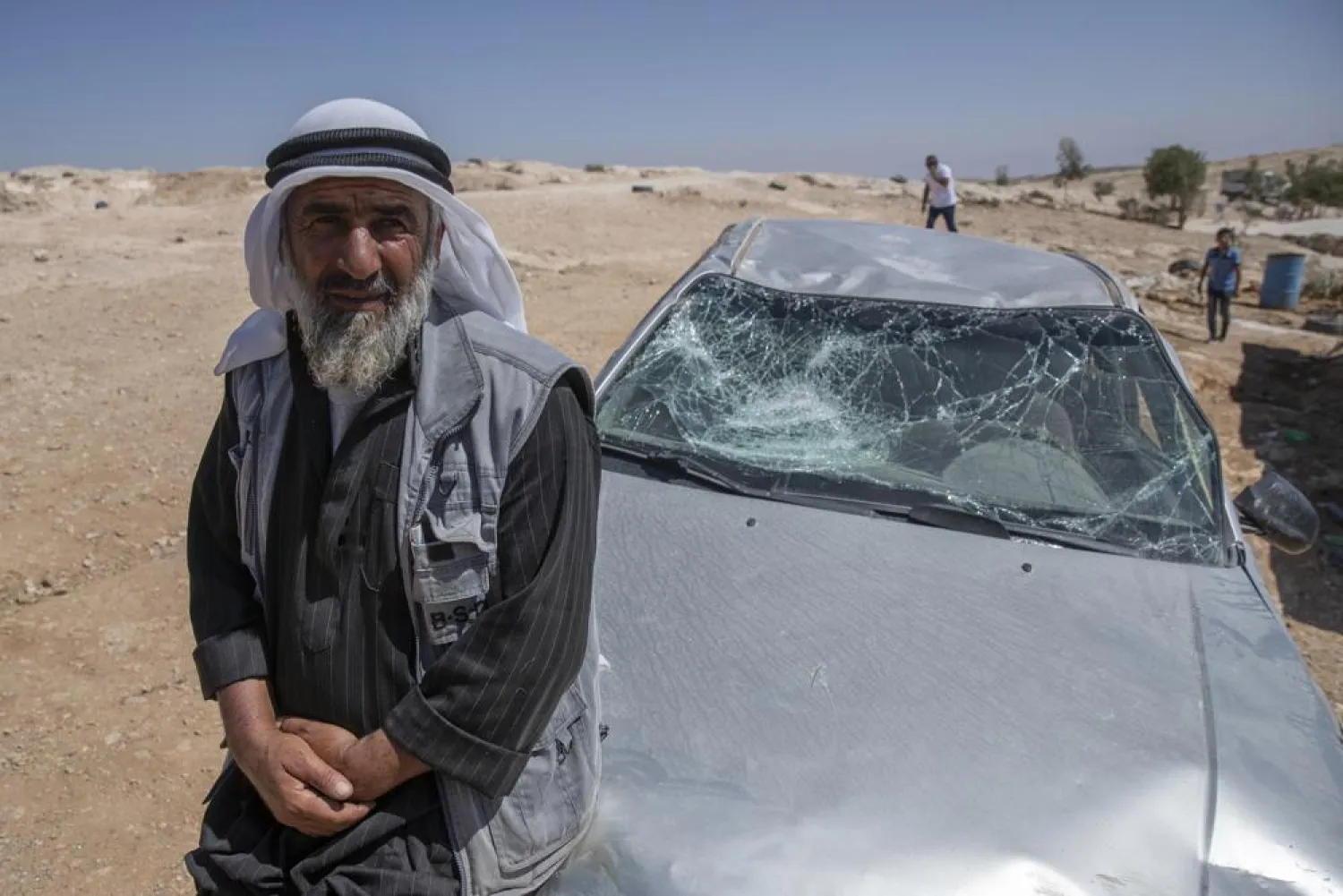
A Palestinian man leans on his smashed vehicle following a settlers attack from nearby settlement outposts on his Bedouin community, in the West Bank village of al-Mufagara, near Hebron, Thursday, Sept. 30, 2021. An Israeli settler attack last week damaged much of the village’s fragile infrastructure. (AP Photo/Nasser Nasser)
TT

In Brazen Attack by Settlers, Palestinians See Larger Threat

A Palestinian man leans on his smashed vehicle following a settlers attack from nearby settlement outposts on his Bedouin community, in the West Bank village of al-Mufagara, near Hebron, Thursday, Sept. 30, 2021. An Israeli settler attack last week damaged much of the village’s fragile infrastructure. (AP Photo/Nasser Nasser)

Dozens of Jewish settlers swept down from the dusty hills, hurling rocks at a small Palestinian village in broad daylight, smashing windows, cars and water cisterns as families hid inside their homes and Israeli soldiers looked on.

Palestinians in this rural part of the occupied West Bank say last week’s attack was especially violent but not unusual. They view it as part of a much larger effort by Israel to force them off their land, including by cutting off vital water resources in a parched region.

Days after the attack — in which a 4-year-old boy was hospitalized after being struck in the head by a stone as his family hid inside their home — residents of the village of Al-Mufagara surveyed the damage. It included the smashed water cisterns on which the Bedouin community and its livestock rely, The Associated Press reported.

“They attacked everything we have, our water containers, our animals, our trees, our houses,” said Mohammed Rahbi, deputy head of the rural Yatta regional council. “It was an attack on humanity itself.”

The hardscrabble region is in what’s known as Area C, the 60% of the West Bank that is under full Israeli military control, according to agreements reached in the 1990s. Palestinians say it’s nearly impossible to secure building permits, even for basic infrastructure like water and electricity. The military has designated an area that includes Al-Mufagara as a firing range, making it even harder for residents to remain on the land.

Israeli authorities have meanwhile tolerated the construction of two nearby settlement outposts that are illegal even under Israeli law, where those who took part in last Wednesday’s attack are believed to have come from.

After ambushing a local shepherd and killing a number of his sheep, the settlers — shirtless with scarves wrapped around their faces — rampaged through the small cluster of stone homes and animal pens.

Footage released by the Israeli rights group B’Tselem showed Israeli soldiers standing among the settlers as they hurled the stones. At one point a soldier threw a tear gas grenade and shoved the Palestinian who was filming the attack. “This is our home,” the Palestinian shouted.

Israeli police said they arrested five Israeli suspects, including a teenager. All have since been released.

The military declined a request for an interview. But its top commander overseeing the West Bank, Maj. Gen. Yehuda Fuchs, last week held a rare meeting with Palestinian residents and said Israel is committed to the security of everyone in the area.

Israeli Foreign Minister Yair Lapid condemned the attack as “terror” and blamed it on a “violent and dangerous fringe” that he said should be brought to justice. The US State Department also condemned the violence.

But rights groups say settlers have launched several similar attacks over the past year, with the military doing little to stop them.

“This is happening all the time,” said Hagai El-Ad, the head of B’Tselem. “Soldiers sometimes even participate directly in such assaults on Palestinians. And this is part of that bigger state project of forcible transfer of Palestinians from their communities in large parts of the West Bank.”

Israel captured the West Bank in the 1967 war and has granted the Palestinian Authority limited autonomy in cities and towns that make up less than 40% of the territory. The Palestinians want the entire West Bank to form the main part of their future state.

Around 500,000 Jewish settlers live in the West Bank amid more than 2.5 million Palestinians. Most settlers live in the more than 120 settlements authorized by the Israeli government, but more radical settlers have built dozens of outposts without state permission in rural areas.

The nationalist parties that dominate Israel’s political system view the West Bank as the biblical heartland of the Jewish people and support the settlers. Israel’s current prime minister, Naftali Bennett, is a longtime supporter of settlements who is opposed to a Palestinian state.

Israeli authorities are reluctant to evacuate outposts because doing so ignites clashes between soldiers and settlers, and successive governments have retroactively authorized 15 outposts. Israel subsidizes settlements and provides water and electricity to many outposts.

The Palestinians view all settlements as illegal and an obstacle to peace, a position with wide international support.

Even as the settlements develop largely unchecked, the 1,300 Palestinians living in Al-Mufagara and the surrounding area, known as Masafer Yatta, are unable to build or maintain basic infrastructure. According to statistics published by Peace Now, an anti-settlement Israeli monitoring group, Israeli authorities approved around 1% of Palestinian requests for Area C construction permits submitted between 2009 and 2016.

“Israel is just trying to empty Masafer of the communities that have lived there for generations,” said Quamar Mishirqi-Assad, director of Haqel, a rights group that works with local communities.

Rahbi said he has submitted dozens of applications for new housing and irrigation projects that have been rejected. He says Israel only approves such projects in the nearby community of Al-Tuwani, which is outside its declared firing range.

A spokesman for COGAT, the Israeli defense body that grants the permits, said the refusals in the military zone were for the safety of the residents. Speaking on condition of anonymity under military guidelines, he could not explain why settler communities, including unauthorized outposts, do not face the same barriers.

This was not the first time local sources of water have been harmed.

Over the last two years, the military has destroyed nearly all the pipelines linking Masafer to Israel’s national water carrier, as well as more than 20 local wells, according to Al-Haq, a Palestinian human rights group. COGAT had no immediate comment.

Rural Palestinian communities often struggle with shortages. A report released Friday by the UN High Commissioner for Human Rights said 660,000 Palestinians have “limited access to water” and denounced Israel’s recent destruction of vital water sources in Masafer. Israel refused to comment on the report, saying the UN is biased against it.

According to Rahbi, most communities have built small pipes that connect to al-Tuwani, the only village in the area connected to Israel’s water supplier, Mekorot.

But Rahbi said it isn’t enough. Residents collect rainwater during the winter months in plastic cisterns and purchase expensive water tankers from nearby cities. Suppliers often charge extra because of the poor roads.

During the settler attack on Wednesday, many of the plastic cisterns and pipes were damaged and will be costly to replace.

Despite the growing hardships, the Palestinians say they are determined to stay.

“People here are rooted, in love with the land,” Rahbi said.


Israel Military Says Soldier Killed in Gaza 

A drone view shows the destruction in a residential neighborhood, after the withdrawal of the Israeli forces from the area, amid a ceasefire between Israel and Hamas in Gaza, in Gaza City, October 21, 2025. (Reuters)
TT

Israel Military Says Soldier Killed in Gaza 

A drone view shows the destruction in a residential neighborhood, after the withdrawal of the Israeli forces from the area, amid a ceasefire between Israel and Hamas in Gaza, in Gaza City, October 21, 2025. (Reuters)

The Israeli military announced that one of its soldiers had been killed in combat in southern Gaza on Wednesday, but a security source said the death appeared to have been caused by "friendly fire".

"Staff Sergeant Ofri Yafe, aged 21, from HaYogev, a soldier in the Paratroopers Reconnaissance Unit, fell during combat in the southern Gaza Strip," the military said in a statement.

A security source, however, told AFP that the soldier appeared to have been "killed by friendly fire", without providing further details.

"The incident is still under investigation," the source added.

The death brings to five the number of Israeli soldiers killed in Gaza since a ceasefire took effect on October 10.


Syria: SDF’s Mazloum Abdi Says Implementation of Integration Deal May Take Time

People sit outdoors surrounded by nature, with the Tigris river flowing in the background, following a long atmospheric depression, near the Syrian-Turkish border in Derik, Syria, February 16, 2026 REUTERS/Orhan Qereman
TT

Syria: SDF’s Mazloum Abdi Says Implementation of Integration Deal May Take Time

People sit outdoors surrounded by nature, with the Tigris river flowing in the background, following a long atmospheric depression, near the Syrian-Turkish border in Derik, Syria, February 16, 2026 REUTERS/Orhan Qereman

Mazloum Abdi, commander of the Syrian Democratic Forces, said the process of merging the SDF with Syrian government forces “may take some time,” despite expressing confidence in the eventual success of the agreement.

His remarks came after earlier comments in which he acknowledged differences with Damascus over the concept of “decentralization.”

Speaking at a tribal conference in the northeastern city of Hasakah on Tuesday, Abdi said the issue of integration would not be resolved quickly, but stressed that the agreement remains on track.

He said the deal reached last month stipulates that three Syrian army brigades will be created out of the SDF.

Abdi added that all SDF military units have withdrawn to their barracks in an effort to preserve stability and continue implementing the announced integration agreement with the Syrian state.

He also emphasized the need for armed forces to withdraw from the vicinity of the city of Ayn al-Arab (Kobani), to be replaced by security forces tasked with maintaining order.


Israeli Far-Right Minister to Push for ‘Migration’ of West Bank, Gaza Palestinians 

A Palestinian man checks leather belts as people prepare for Ramadan, in the old city of Hebron in the Israeli-occupied West Bank, February 17,2026. (Reuters)
TT

Israeli Far-Right Minister to Push for ‘Migration’ of West Bank, Gaza Palestinians 

A Palestinian man checks leather belts as people prepare for Ramadan, in the old city of Hebron in the Israeli-occupied West Bank, February 17,2026. (Reuters)

Israel's far-right Finance Minister Bezalel Smotrich said he would pursue a policy of "encouraging the migration" of Palestinians from the occupied West Bank and Gaza Strip, Israeli media reported Wednesday.

"We will eliminate the idea of an Arab terror state," said Smotrich, speaking at an event organized by his Religious Zionism Party late on Tuesday.

"We will finally, formally, and in practical terms nullify the cursed Oslo Accords and embark on a path toward sovereignty, while encouraging emigration from both Gaza and Judea and Samaria.

"There is no other long-term solution," added Smotrich, who himself lives in a settlement in the West Bank.

Since last week, Israel has approved a series of measures backed by far-right ministers to tighten control over the West Bank, including in areas administered by the Palestinian Authority under the Oslo Accords, in place since the 1990s.

The measures include a process to register land in the West Bank as "state property" and facilitate direct purchases of land by Jewish Israelis.

The measures have triggered widespread international outrage.

On Tuesday, the UN missions of 85 countries condemned the measures, which critics say amount to de facto annexation of the Palestinian territory.

"We strongly condemn unilateral Israeli decisions and measures aimed at expanding Israel's unlawful presence in the West Bank," they said in a statement.

"Such decisions are contrary to Israel's obligations under international law and must be immediately reversed.

"We underline in this regard our strong opposition to any form of annexation."

UN Secretary-General Antonio Guterres on Monday called on Israel to reverse its land registration policy, calling it "destabilizing" and "unlawful".

The West Bank would form the largest part of any future Palestinian state. Many on Israel's religious right view it as Israeli land.

Israeli NGOs have also raised the alarm over a settlement plan signed by the government which they say would mark the first expansion of Jerusalem's borders into the occupied West Bank since 1967.

The planned development, announced by Israel's Ministry of Construction and Housing, is formally a westward expansion of the Geva Binyamin, or Adam, settlement situated northeast of Jerusalem in the West Bank.

The current Israeli government has fast-tracked settlement expansion, approving a record 52 settlements in 2025.

Excluding Israeli-annexed east Jerusalem, more than 500,000 Israelis live in West Bank settlements and outposts, which are illegal under international law.
