


Analysis: Beirut Street Battles May Spell Even Darker Times

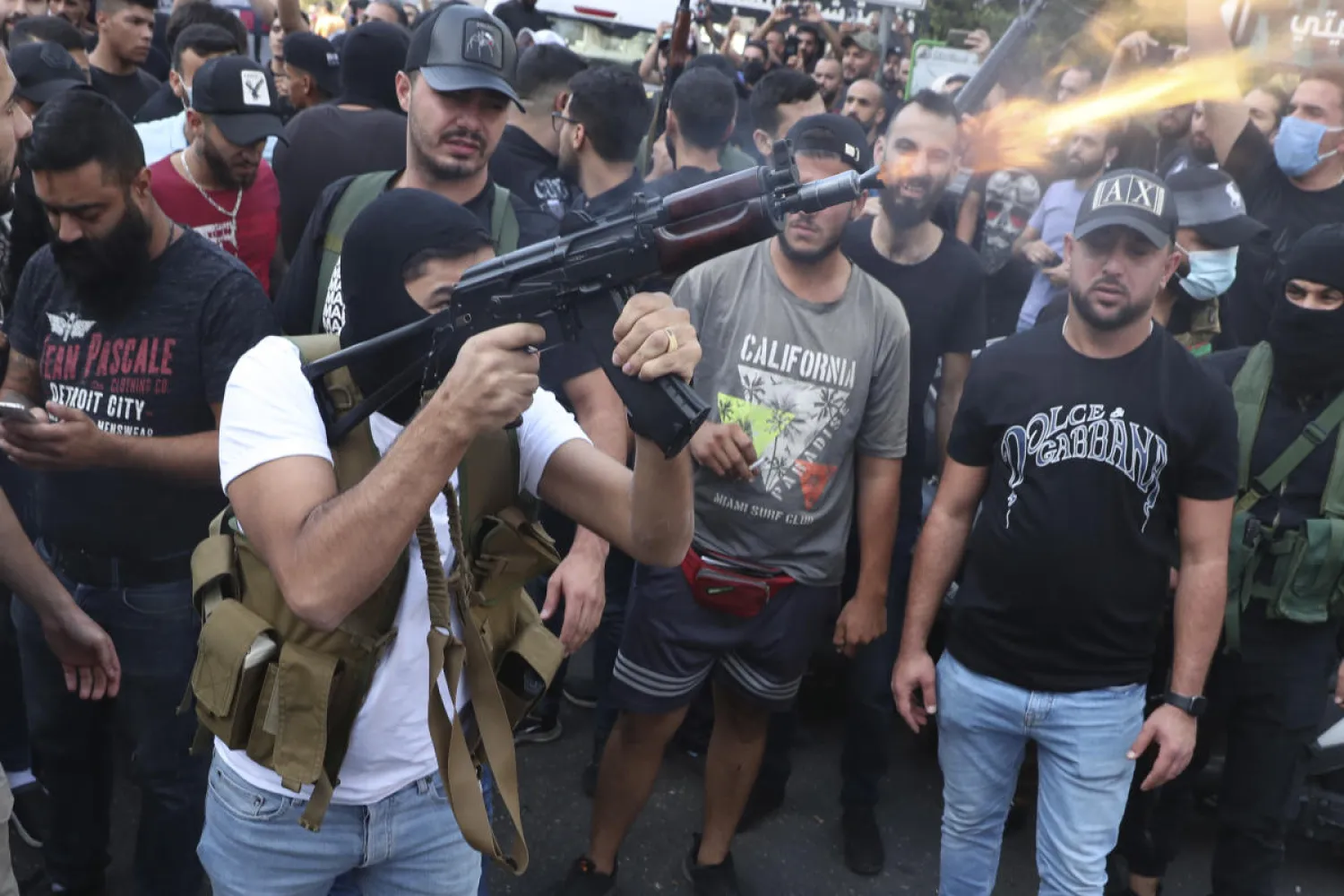
Supporters of the Shiite Amal group fire weapons in the air during the funeral processions of Hassan Jamil Nehmeh, who was killed during Thursday's clashes, in the southern suburbs of Beirut, Lebanon, Friday, Oct. 15, 2021. (AP Photo/Bilal Hussein)
TT

Analysis: Beirut Street Battles May Spell Even Darker Times

Supporters of the Shiite Amal group fire weapons in the air during the funeral processions of Hassan Jamil Nehmeh, who was killed during Thursday's clashes, in the southern suburbs of Beirut, Lebanon, Friday, Oct. 15, 2021. (AP Photo/Bilal Hussein)

The most powerful men in Lebanese politics have been in charge for decades, some since the early 1970s. They’ve survived civil war, assassinations, uprisings and other turmoil, hanging on to power for decades in a turbulent, unforgiving region.

Now, they’re in a desperate fight to cling to positions and wealth as Lebanon takes hit after hit, grappling with one of the world’s worst economic meltdowns in decades and the aftermath of an explosion that ripped through the capital a year ago, killing more than 215 people.

The gunbattles that raged for hours on the streets of Beirut this week were the latest manifestation of the willingness by members of the country's ruling class to fight for political survival at any cost, The Associated Press reported.

Unhappy with where the investigation into last year's port explosion is going, they have closed ranks to make sure they are untouched by the fallout.

On Thursday, Hezbollah and Amal Movement organized a protest demanding the removal of the judge leading the probe. Armed, they marched into predominantly Christian neighborhoods of the Lebanese capital, some shouting “Shiite, Shiite!”

Hezbollah and Amal, two Shiite parties that fought pitched battles against each other in the ’80s but are now close allies, accused the Lebanese Forces — a Christian party that had a powerful militia during the 1975-90 civil war — of opening fire first. The Lebanese Forces denied it, blaming the violence on Hezbollah’s incitement of its supporters against Judge Tarek Bitar, who is leading the port investigation.

The two sides clashed for hours, demonstrating to the nation once again that the Lebanese must choose: justice and accountability, or civil peace.

For many, it exemplified why Lebanon is trapped in today's quagmire.

“They instigate the people against one another, then they sit at a table together to make deals,” said Hanan Raad, whose sister-in-law was killed in Thursday’s fighting. A mother of five, Mariam Farhat was shot by a sniper bullet as she sat near the balcony of her second floor apartment, her family said Friday.

The probe into the port explosion is at the heart of the current tensions — as is Lebanon's culture of impunity, one in which the judiciary has never gone after those in power, despite widespread corruption and crimes.

That is until the August 2020 explosion at Beirut's port drew international attention to the massive corruption and negligence behind it. Within a few days of the explosion, it emerged from documents that several senior politicians and security chiefs knew of the hundreds of tons of highly combustible ammonium nitrate stored haphazardly in a port warehouse and did nothing about it.

Entrenched politicians who lock horns and bicker over just about everything else, closed ranks to undermine the investigation.

Rival politicians, including former Prime Minister Saad Hariri, Hezbollah's leader Hassan Nasrallah, Parliament Speaker Nabih Berri, and several religious figures launched a campaign to discredit Bitar, accusing him of bias.

When the judge began summoning officials, they used parliamentary immunity and various legal challenges to avoid having to show up for questioning.

Defiantly, the 46-year-old judge issued arrest warrants, including for former ministers of finance and public works, both Amal members and close Hezbollah allies.

Now Thursday’s street clashes have further thrown into doubt both the future of the investigation and whether Bitar can continue leading it.

“We are dealing with a new equation: either Tarek Bitar leaves, or the country will be ruined,” said Youssef Diab, a political analyst. “We are in front of this new and dangerous equation.”

The establishment parties have collectively worked to block any serious opposition and attempts at reform that might harm them, observers say.

They have hampered a forensic audit of the country's central bank, a key demand of the international community to restore confidence in the crisis-struck Mideast nation, protecting the bank’s longtime governor even as he faces corruption charges in Switzerland and France and accusations of gross mismanagement at home.

Lebanon’s sectarian power-sharing system has proved impossible to bring down. Protests have been quashed. Warlords have cast themselves as their sect’s protectors, granting favors to their followers.

A revolt against the status quo would mean breaking up the sectarian patronage network, cultivated by the ruling elite and one that many in the divided population benefit from. Many Lebanese politicians have a large — even blind — following. They are quick to blame other factions for the country’s myriad problems and eagerly stoke fears among their supporters that another sect could gain power over them.

Hundreds of thousands thronged streets in Beirut and across Lebanon in late 2019 in some of the largest protests the country has seen. For a few months, the demonstrations unified an often-divided public in revolt against entrenched leaders who have brought the economy to the brink of bankruptcy.

The protests were met with violence, arrests and intimidation, and eventually fizzled out.

Some are banking that elections next spring will bring a degree of change. But the opposition has no viable political program or candidates who can challenge the political elite. And as the economic crisis has thrown three quarters of the population into poverty, vote-buying will be much cheaper, AP said.

With pent-up anger among many Lebanese, growing sectarian tensions and a political class desperate to cling to its privileged role, a descent into further violence becomes even more possible.

Michael Young, a senior editor at the Malcolm H. Kerr Carnegie Middle East Center in Beirut, says there could be serious consequences if Hezbollah and Amal manage to derail the port investigation.

“The sudden escalation in violence could provoke new developments in Lebanon that lead to a cancellation of elections, and take the country into a much darker period than the one that exists today,” Young wrote Friday in Diwan, Carnegie's Mideast blog.



Iranians Have Long Sought Work and Relative Stability in Türkiye. The War Could Force Some to Return

Iranian Serdar Taghizade speaks to a customer inside his currency exchange business in Istanbul on Monday, April 13, 2026. (AP Photo/Khalil Hamra)
TT

Iranians Have Long Sought Work and Relative Stability in Türkiye. The War Could Force Some to Return

Iranian Serdar Taghizade speaks to a customer inside his currency exchange business in Istanbul on Monday, April 13, 2026. (AP Photo/Khalil Hamra)

Sadri Haghshenas spends her days selling borek — a layered, savory pastry — at a shop in Istanbul, but her mind is on her daughter in Tehran.

The family had to send her home to Iran after they ran into difficulties renewing her visa, despite fears that a shaky ceasefire could soon collapse.

For years, short-term residency permits have allowed tens of thousands of Iranians to pursue economic opportunities and enjoy relative stability in neighboring Türkiye. But it's a precarious situation, and the war has raised the stakes.

“I swear, I cry every day,” Haghshenas said, raising her hands from behind the counter of the pastry shop. “There is no life in my country, there is no life here, what shall I do?”

Haghshenas and her husband moved to Türkiye five years ago with their then-teenage daughters and have been living on tourist visas renewable every six months to two years.

They could not afford a lawyer this year, because her husband is out of work due to health problems. As a result, they missed the deadline to apply for a new visa for their 20-year-old daughter, Asal, who is still in her final year of high school.

Asal was detained at a checkpoint earlier this month and spent a night at an immigration facility. Her mother found a friend to take her back to Tehran rather than face deportation proceedings that could complicate her ability to return to Türkiye. They hope she can come back on a student visa.

Haghshenas has been unable to talk to her daughter since she left because of a monthslong internet blackout in Iran.

A man walks past an Iranian grocery shop in Istanbul on Tuesday, April 14, 2026. (AP Photo/Khalil Hamra)

Türkiye has not seen an influx of refugees, as most Iranians have sought safety within their country. Many who have crossed the land border were transiting to other countries where they have citizenship or residency.

Nearly 100,000 Iranians lived in Türkiye in 2025, according to the Turkish Statistical Institute. Around 89,000 have entered Türkiye since the start of the war, while around 72,000 have departed, according to the United Nations' refugee agency.

Some Iranians have used short-term visa-free stays to wait out the war, but there are few options for those who want to stay longer.

Sedat Albayrak, of the Istanbul Bar Association’s Refugee and Migrant Rights Center, said that getting international protection status can be difficult, and the system encourages Iranians to apply for short-term permits instead.

“There are people who have lived on them for over 10 years," The Associated Press quoted him as saying.

Nadr Rahim, right, sits with a friend at an Iranian coffee shop in Istanbul on Tuesday, April 14, 2026. (AP Photo/Khalil Hamra)

If the war continues, more may have to return Nadr Rahim came to Türkiye for his children’s education 11 years ago. Now, the war may force him to go home.

Because of the difficulty of getting a permit to start a business or work legally in Türkiye, he lived off the profits of his motorcycle salesroom in Iran. But there have been no sales since the war started, and international sanctions — and the internet outage — make it extremely difficult to transfer funds.

His family only has enough money to stay in Türkiye a few more months. His children grew up in Türkiye and don't read Farsi or speak it fluently. He worries about how they would adapt to living in Iran, but said “if the war continues, we will have no choice but to return.”

In the meantime, he spends most of his days scrolling on his phone, waiting for news from his parents in Tehran or discussing the war over waterpipes with Iranian friends.

A 42-year-old Iranian woman came to Türkiye eight months ago, hoping to make money to support her family. She and her daughter registered as university students to get study visas.

She attends classes in the morning to keep her legal status before rushing to service jobs, sometimes working until 3 a.m.

They share a room with six other people at a women's boarding house, she said, speaking on condition of anonymity out of fear for her security should she return to Iran.

“I truly love Iran. If necessary, I would even go and defend it in war,” she says. But she sees no future there, while in Türkiye, she’s barely scraping by and only able to send small amounts of money to her parents.

“I have a bad life in Türkiye, and my parents have a bad life in Iran,” she said. “I came to Türkiye with so much hope, to support my parents and build a future. But now I feel hopeless.”

A 33-year-old freelance architect from Tehran traveled to Türkiye during Iran's violent crackdown on mass protests in January. She had planned to return after the situation calmed down, but then the United States and Israel went to war with Iran at the end of February.

“I started to believe that it’s a very bad situation, worse than I expected,” she said, speaking on condition of anonymity for fear of persecution if she returns to Iran.

She has been unable to work for her usual clients back in Iran because of the internet blackout. With the end of her 90-day visa-free window approaching, she can't afford to apply for a longer stay in Türkiye.

Instead, she has decided to go to Malaysia, where she will get free accommodation in return for building shelters during a month of visa-free stay.

She has no plan for what comes next.


Strait of Hormuz Blockade Step by Step: What Do We Know?

A view of Iranian-flagged cargo ship M/V Touska as the US Navy Arleigh Burke-class Aegis guided missile destroyer USS Spruance conducts its interception in a location given as the north Arabian Sea, in this screen capture from a video released April 19, 2026. (CENTCOM/Handout via Reuters)
TT

Strait of Hormuz Blockade Step by Step: What Do We Know?

A view of Iranian-flagged cargo ship M/V Touska as the US Navy Arleigh Burke-class Aegis guided missile destroyer USS Spruance conducts its interception in a location given as the north Arabian Sea, in this screen capture from a video released April 19, 2026. (CENTCOM/Handout via Reuters)

Shipping traffic through the Strait of Hormuz remained mostly at a standstill on Monday, with just three vessels crossing the vital waterway, according to Kpler, a maritime data firm.

On Sunday, a US Navy destroyer attacked and seized an Iranian-flagged cargo ship that US President Donald Trump said had tried to evade the US blockade on ships traveling to and from Iranian ports.

In a separate incident, the United Kingdom Maritime Trade Operations center, which is administered by Britain’s Royal Navy, said that two vessels had been hit while trying to cross the Strait of Hormuz, according to a notice published on Saturday.

In one instance, gun ships operated by Iran’s Revolutionary Guards Corps fired at a tanker without radio warning, the British organization said. In the second incident, a container ship was hit by “an unknown projectile” that damaged some of the containers.

On Tuesday, the US military said it had seized an Iran-linked tanker in international waters, in what appears to be the latest move to enforce a blockade as the ceasefire deadline looms.

The US military said it had boarded the tanker Tifani “without incident.”

The ship, capable of carrying 2 million barrels of crude, last reported its position on Tuesday morning near Sri Lanka in the Indian Ocean, according to MarineTraffic tracking data. It was close to fully loaded and had signaled Singapore as its destination.

A two-week ceasefire between the US and Iran is set to expire early Wednesday.

Latest developments

The US Navy has turned back 27 ships trying to enter or exit Iranian ports since an American blockade outside the contested Strait of Hormuz began about a week ago, the military’s Central Command said on Monday.

On Sunday, a Navy destroyer disabled and seized the Touska, an Iranian cargo ship, in the Gulf of Oman after it tried to evade the blockade. It was the first time a vessel was reported to have tried to evade the US-imposed blockade on any ship entering or exiting Iranian ports since it took effect last week.

The guided-missile destroyer Spruance, one of more than a dozen Navy warships enforcing the US blockade, ordered the vessel’s crew to evacuate its engine room.

The Spruance then fired several rounds from its Mk-45 gun into the ship’s propulsion system as it steamed toward the port of Bandar Abbas in Iran, Central Command said in a statement that included a video of the firing.

American officials will determine what to do with the disabled vessel once the search is completed, a US military official said on Monday, speaking on the condition of anonymity to discuss operational matters, according to the New York Times. One option would be to tow the stricken ship to Oman, independent specialists said. An alternative would be to let the Touska steam to an Iranian port, if it can.

A spokesman for Iran’s military reiterated a threat on Monday to “take the necessary action against the US military” in response to the ship’s seizure, Iran’s state broadcaster reported.

How is the US imposing the blockade?

According to CENTCOM, more than 10,000 US personnel, including sailors, marines, and airmen, are participating in the operation, supported by over a dozen warships and dozens of aircraft. The effort spans key waterways surrounding Iran, including the Arabian Gulf and the Gulf of Oman.

The US blockade on Iranian ports does not have a defined geographic boundary, and the United States can interdict vessels almost anywhere in international waters until they arrive at their final port.

Analysts say modern technology allows blockade enforcement at great distances.

Can ships evade the blockade?

Maritime intelligence experts say that more ships in and around the Strait of Hormuz seem to be adopting “spoofing” tactics to avoid detection.

Under international maritime law, most large commercial vessels travel with a transponder that automatically transmits the ship’s name, location, route and other identifying information. That includes a nine-digit number with a country code, which serves as a digital fingerprint for a ship.

The tactics were used by Russian “shadow fleet” vessels evading sanctions related to the invasion of Ukraine in 2022.

When a ship is engaged in spoofing, its captain can type in a false origin or destination or can pretend to be piloting another ship altogether. Vessels can also temporarily turn off their transponders, seeming to disappear in one place and reappear in another.

The strait is “a contested information environment,” said Erik Bethel, a partner at Mare Liberum, a maritime technology venture capital fund.

Still, whatever ruses they employ, vessels going to and from Iran may get only so far. It is difficult to pass between the open ocean and a waterway as narrow as the Strait of Hormuz without being detected.

“My expectation is that the US Navy can sit out in the Gulf of Oman,” said Ami Daniel, the chief executive of Windward, a maritime intelligence data provider. “I don’t think there’s a way to breach the blockade.”

What are the US and Iranian strategies?

The US blockade sets up a significant test in the Iran war: Which side can endure more economic pain?

Instead of directing missiles and bombs, Trump is trying to choke off Iran’s oil exports, which make up just about all of the government’s revenue.

Some experts questioned whether the US blockade would work.

“Iran is already hurting, and they have shown that they are willing to take more than a couple of hits,” said Ahmet Kasim Han, a professor of international relations at TED University in Ankara, Türkiye.

Iran’s strategy appears to be using its leverage over global energy markets, where Tehran has discovered new powers that can cause pain in the US economy through spikes in the price of gasoline and other staples.

Why is the strait so important?

The Strait of Hormuz is a strategic waterway connecting the Gulf to the Gulf of Oman and the Indian Ocean. It is the only sea route for moving oil, natural gas and other cargo out of the Gulf. Iran’s coastline runs along the entire route.

At the strait’s narrowest and most vulnerable point — between Iran to the north and the Musandam Peninsula of Oman to the south — the navigable channel is about two miles wide each for inbound and outbound traffic, according to the International Energy Agency.

The legal status of the strait is complex. It lies within the territorial waters of Iran and Oman, but under international law it is treated as an international waterway where ships are generally guaranteed passage.

Iran has signed but not ratified that framework and has disputed the extent of those rights.

Before the war, about 20% of global oil and liquid natural gas passed through the strait. Most of the fossil fuels are bound for Asia, especially China, India, Japan and South Korea.

Other large vessels also use the strait, including car carriers and container ships.

Crucial industrial goods traveling through Hormuz include helium from Qatar, fertilizer from Oman and Saudi Arabia, and plastic feedstocks from Saudi Arabia and Emirati petrochemical plants.

How does Iran control the strait?

Iran’s military can threaten shipping traffic throughout the Strait of Hormuz, even though much of its navy has been destroyed by US and Israeli strikes.

The United States and Israel launched their war against Iran on the argument that if Iran one day got a nuclear weapon, it would have the ultimate deterrent against future attacks.

It turns out that Iran already has a deterrent: geography.

“The Iranians have thought a lot about how to utilize the geography to their benefit,” said Caitlin Talmadge, a professor at the Massachusetts Institute of Technology who studies Gulf security.

*The New York Times


US-Iran Talks Test Power Balances in Tehran as National Security Council Comes to the Forefront

Qalibaf (L) at a meeting of the regime's Expediency Discernment Council, with Supreme National Security Council secretary Mohammad Bagher Zolghadr. (Qalibaf’s official site)
TT

US-Iran Talks Test Power Balances in Tehran as National Security Council Comes to the Forefront

Qalibaf (L) at a meeting of the regime's Expediency Discernment Council, with Supreme National Security Council secretary Mohammad Bagher Zolghadr. (Qalibaf’s official site)

After US-Israeli bombardment eliminated Iran’s supreme leader and much of its top echelons, the country’s leadership didn’t fall apart — but negotiations to end the war offer a new test.

For decades, the supreme leader successfully managed several powerful factions, bringing to heel those who challenged his authority while listening to rival opinions. It’s now unclear who wields that kind of authority over the collection of civilian figures and powerful generals from the Revolutionary Guard who appear to be in charge.

They have found unity — for now — by taking a tough line. But disagreements over how much to concede in negotiations with the United States could reveal fault lines, as Pakistani mediators try to host a new round of talks this week, according to The Associated Press.

Who is in charge?

In the past, Supreme Leader Ali Khamenei was able to impose his will on the country's disparate power centers. After Israeli strikes killed him on the first day of the war, his son Mojtaba Khamenei succeeded him.

But doubts continue to swirl over the younger Khamenei’s role after reports he was wounded in the strikes. Still in hiding, he has not appeared in public since becoming supreme leader and how he gives orders to top leaders is a mystery.

At the center of power now is a politburo-like body known as the Supreme National Security Council, which includes Iran’s top civilian and military officials. Mohammad Bagher Qalibaf, the parliament speaker and a veteran insider with strong contacts on all sides, has emerged as its face and the chief negotiator with the US.

The late Khamenei began giving more authority to the council before his death, but the war has consolidated its power.

The council contains a range of political opinions and often acute rivalries. A political rival of Qalibaf and uncompromising opponent of the US, Saeed Jalili, represents the supreme leader on the council, while the body’s nominal head is reformist President Masoud Pezeshkian.

Hard-liner members include the Guard’s new chief commander, Ahmad Vahidi, and the council’s new secretary, Mohammad Bagher Zolghadr, also a commander in the Guard.

But Israel’s strategy of eliminating top leaders points to a misreading of how the Iranian regime works, experts say.

Iran’s leadership survived “precisely because there are multiple power centers with overlapping authorities,” said Ali Vaez, Iran director at the International Crisis Group. “Factionalism is just built into the DNA of this system.”

But since the war, the Guard’s growing clout on the council has also stoked speculation that a fundamental change could be coming.

Negotiations with the US will stress test the power structure

The council now faces potentially divisive questions over how far to go to reach a deal with the US, which is demanding Iran make major concessions aimed at ensuring it is never able to develop a nuclear weapon. Iran has long insisted its program is peaceful while saying it has the right to uranium enrichment.

In an interview with Iranian state TV on Sunday, Qalibaf said Iran wants a comprehensive accord that brings “a lasting peace” where the US no longer attacks the country.

“This dangerous loop needs to be cut,” he said. The US has twice launched strikes on Iran during high-level negotiations: once in the 12-day war in June, then again in the current conflict.

Council members have projected confidence that Iran holds the upper hand now, particularly because its grip on the Strait of Hormuz — a crucial passage for the world’s oil — enables it to drive up fuel prices, thus threatening the global economy and exerting political pressure on US President Donald Trump back home.

Senior officials have insisted they can hold out for assurances that Iran won’t be attacked again — even risking the war reigniting — because they believe Iran can endure the pain longer than the United States and its allies.

But ultimately, the leadership’s priority remains its own survival. The war and the US blockade, which is threatening Iran’s oil trade, are tightening the screws on the country’s cratering economy.

Economic hardship has fueled waves of unrest over the past two decades, including protests in January that openly called for the regime’s overthrow. A deal with the West lifting sanctions could help it keep its grip at home.

Signs of disagreement

Events over the weekend surrounding the Strait of Hormuz gave an indication of serious differences over how much to concede in negotiations. Engagement with Washington has long divided Iran’s top ranks, despite a shared deep mistrust of the US.

On Friday, Foreign Minister Abbas Araghchi announced in a posting on X that Iran was opening the strait to commercial traffic as part of the ceasefire agreement with the US. Hours later, Trump proclaimed that the US would continue its blockade to keep pressure on Iran to reach a deal over its nuclear program.

On Saturday morning, Iran’s military announced that it was reclosing the strait in retaliation for the blockade.

Some Iranian media criticized Araghchi, suggesting his post created the impression Iran was showing weakness and revealing the differing positions behind the scenes. A report by the Tasnim news agency, seen as close to the Guard, said the position on the strait should have come from the National Security Council itself.

Araghchi’s office pushed back, saying the Foreign Ministry “does not take any action without coordinating with higher-level institutions.”

In his interview Sunday, Qalibaf tried to paper over any divisions, emphasizing that everyone in the leadership was on the same page on Iran’s strategy in US talks.

A possible bridge builder

The 64-year-old Qalibaf is best positioned to bridge divides among Iran’s factions.

Qalibaf is a former general in the Guard and national police chief and kept close to the Guard throughout his long political career. As Tehran’s mayor from 2005 to 2017, Qalibaf gained a reputation as a pragmatist able to get things done, like overhauling an ailing public transport system, even as he faced major corruption and human rights abuse allegations.

Ali Rabie, a well-known reformist and an assistant to the president, wrote last week in a newspaper editorial that Qalibaf was “the representative of the country and the regime.”

At the same time, Qalibaf is close to the Khamenei family both hailing from the area of the eastern city of Mashhad, said Mohsen Sazegara, one of the founders of the Revolutionary Guard in the 1980s who is now an opposition figure living in the US.

During his father’s rule, Mojtaba Khamenei backed Qalibaf’s several unsuccessful attempts to run for president.

Qalibaf is also close to the senior Guard figures who stepped in to replace those killed by Israel and who are widely seen as holding the key to any future agreement with the US. His cross-factional backing could enable him to ensure support at home for a deal against blowback from ideologues who will resist compromise.