EU Calls for ‘Separation of Powers’ in Tunisia

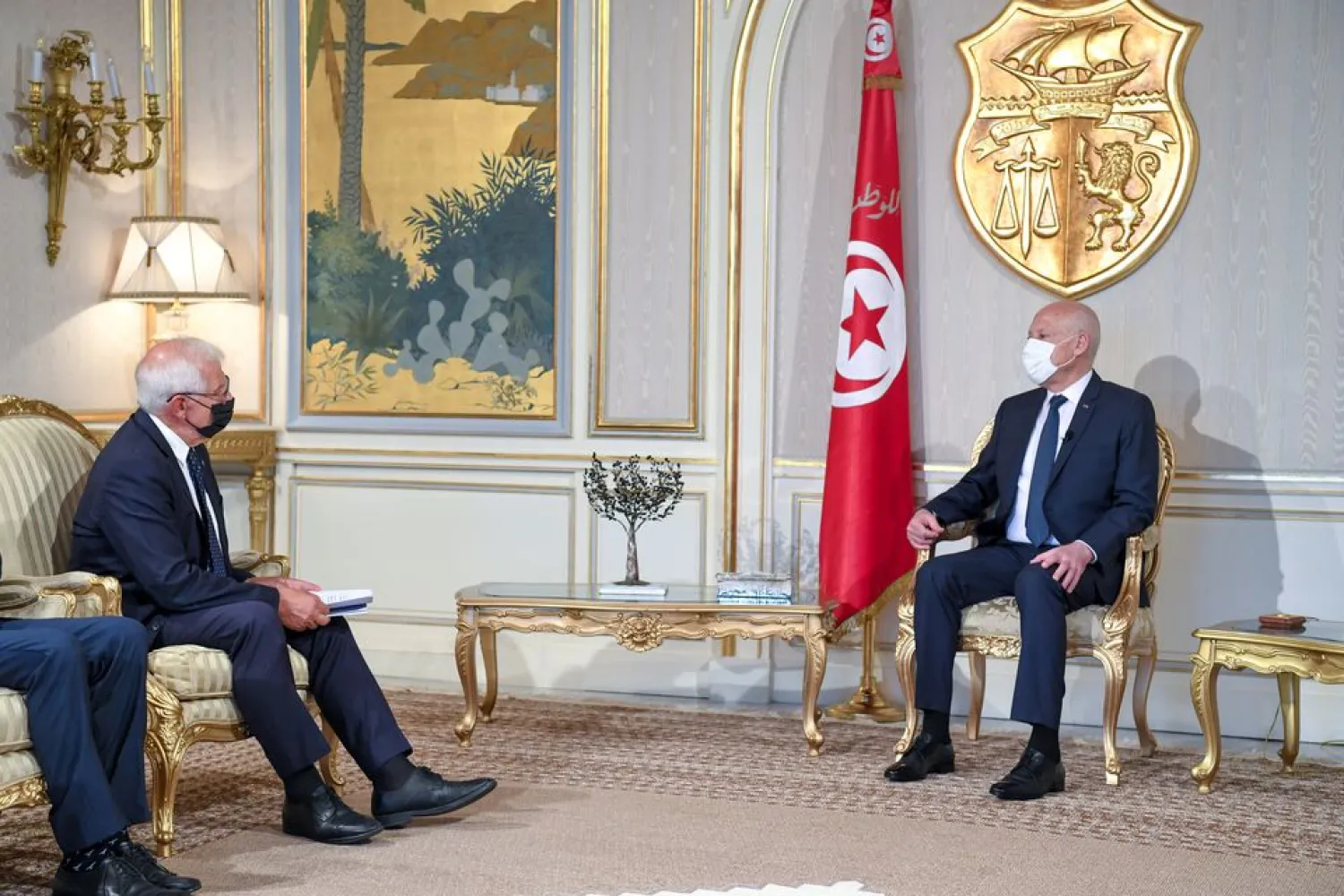
File photo: European Union Foreign Policy Chief Josep Borrell meets with Tunisia's President Kais Saied during his visit to Tunis, Tunisia. Tunisian Presidency/Handout via REUTERS
TT

EU Calls for ‘Separation of Powers’ in Tunisia

File photo: European Union Foreign Policy Chief Josep Borrell meets with Tunisia's President Kais Saied during his visit to Tunis, Tunisia. Tunisian Presidency/Handout via REUTERS

The European Union’s foreign policy chief, Josep Borrell, has called on Tunisia's President Kais Saied to establish a clearly-defined timeline for the country’s return to a constitutional order based on the separation of powers.

Saied suspended parliament and seized near total control in July.

“I spoke again to President Saied, from Washington before coming back to Europe, to pass a clear message about the importance of preserving the democratic acquis, respecting separation of power and resuming institutional normalcy,” Borrell told lawmakers in a debate at the European Parliament in Strasbourg.

The EU official added: “Yes, there is a new Head of Government [Najla Bouden Romdhane] and a new set of Ministers, but with different powers that the ones that the Constitution grants them.”

Saied is under international pressure to announce a clear road map for a return to constitutional politics. Last week, he announced a new government but gave no indication that he was ready to relinquish control.

“We need a clear schedule, in order to go back to the normal Constitutional provisions and we will follow closely the impact of the decisions, based on concrete facts,” Borrell concluded.

Meanwhile, German Minister of State at the Federal Foreign Office Niels Annen kicked off a visit to Tunisia for talks with high-ranking officials and civil society activists.

A source from Germany’s embassy in Tunis told the German News Agency (dpa) that Annen’s visit aims to discuss with all political parties and civil society representatives ways to end the country’s crisis.
Annen is also expected to discuss economic and financial issues.


Lebanon Abolishes Death Penalty in Landmark Parliament Vote

Lebanese lawmakers attend a parliamentary session to discuss a proposed general amnesty law, the abolition of the death penalty and the salaries of retired members of Lebanon’s security forces in Beirut, Lebanon, 11 August 2026. (EPA)
TT

Lebanon Abolishes Death Penalty in Landmark Parliament Vote

Lebanese lawmakers attend a parliamentary session to discuss a proposed general amnesty law, the abolition of the death penalty and the salaries of retired members of Lebanon’s security forces in Beirut, Lebanon, 11 August 2026. (EPA)

Lebanon's parliament Tuesday abolished the death penalty, making it the first country in the Arab world to replace the sentencing with life imprisonment with aggravated hard labor.

The country has committed to an unofficial moratorium on executions since January 2004. However, dozens of death sentences since then have been issued, but later suspended or commuted.

A majority of Lebanon's 128-member parliament voted in favor of ending the death penalty, with the exception of the parliamentary bloc of Hezbollah.

Justice Minister Adel Nassar, who was in Parliament, called it a “historic step” for the country.

Rights groups that have called for formalizing the moratorium or ending the death penalty altogether have also celebrated the vote.

Ramzi Kaiss, Lebanon Researcher at Human Rights Watch, says Lebanon is “marking a final break from a cruel sentence that should never be imposed.”

“Capital punishment is unique in its cruelty and finality and is plagued with arbitrariness, prejudice, and error,” he said.

It's unclear how aggravated hard labor would be enforced, as some legislators said the terms of the new punishment are not yet clear. Lebanon does have the punishment of hard labor written into law and court decisions, but even those have been rarely enforced in recent years due to cash-strapped Lebanon's lack of resources and capacity within its overcrowded prisons.

Lebanon's abolition of the death penalty comes as parliament is debating a controversial general amnesty law, the largest since the end of its 15-year civil war in 1990, that could reduce sentences or even release convicted militants and drug dealers, with some exceptions.

Family members of Lebanese soldiers and servicemen killed or attacked by extremist militant groups have repeatedly protested against the law, some saying they had hoped to see the perpetrators who killed their family members executed rather than be issued reduced prison sentences.

Hezbollah did not immediately issue a comment about the landmark vote. Neither did Lebanon's diverse religious institutions, where the death penalty is considered legal in some their respective court systems.


Lebanon Says Israeli Strike on South Wounds Two, Damages Ambulance

Smoke rises following an Israeli airstrike in the town of Deir Seryan as seen from the 'pilot zone' village of Zawtar al-Gharbiyah, Nabatieh Governorate, southern Lebanon, 31 July 2026, following a US-brokered security agreement between Lebanon and Israel. EPA/STRINGER
TT

Lebanon Says Israeli Strike on South Wounds Two, Damages Ambulance

Smoke rises following an Israeli airstrike in the town of Deir Seryan as seen from the 'pilot zone' village of Zawtar al-Gharbiyah, Nabatieh Governorate, southern Lebanon, 31 July 2026, following a US-brokered security agreement between Lebanon and Israel. EPA/STRINGER

An Israeli double-tap strike on southern Lebanon wounded two people on Tuesday and damaged an ambulance, the Lebanese health ministry said, condemning the "continued targeting" of rescuers. 

The incident is the latest Israeli strike despite an ongoing truce in the war between Israel and Iran-backed Hezbollah. 

Lebanon's state-run National News Agency said the strike targeted a vehicle in the southern city of Nabatieh, with the health ministry reported two wounded. 

The ministry said the Israeli military struck again when rescuers from the Risala Scouts Association, linked to the Hezbollah-allied Amal movement, came to the scene, damaging the ambulance. 

"The ministry reiterates its condemnation of the enemy's continued targeting of rescue teams, which constitutes an unacceptable violation of international humanitarian law and all international norms," it said. 

Lebanon's civil defense meanwhile said that its personnel were targeted by an Israeli drone strike while they were trying to extinguish a bushfire, also in the Nabatieh area. 

No one was wounded, but the incident forced them to leave. 

Hezbollah drew Lebanon into the Middle East war in March with rocket fire at Israel in support of its backer Iran. 

Israel responded with heavy air strikes and a ground invasion that Lebanon says have killed more than 4,300 people. 

While violence has significantly decreased since the signing of a US-Iran memorandum of understanding in June and a framework agreement between Lebanon and Israel days later, Beirut still reports intermittent Israeli strikes and demolitions. 

The Israel-Lebanon deal involves the disarmament of Hezbollah, a gradual withdrawal of Israeli forces from south Lebanon and the deployment of the Lebanese army to the region, starting in two "pilot zones". 

Hezbollah rejects the deal and refuses to disarm. 


Syria Sentences Bashar Al-Assad to Death in Absentia Over Atrocities

A woman uses her mobile phone near a damaged picture of ousted Syrian ruler Bashar al-Assad as people celebrate, after the Syrian opposition announced that they have ousted President Bashar al-Assad, in Qamishli, Syria December 8, 2024. REUTERS/Orhan Qereman
TT

Syria Sentences Bashar Al-Assad to Death in Absentia Over Atrocities

A woman uses her mobile phone near a damaged picture of ousted Syrian ruler Bashar al-Assad as people celebrate, after the Syrian opposition announced that they have ousted President Bashar al-Assad, in Qamishli, Syria December 8, 2024. REUTERS/Orhan Qereman

A Syrian court on Tuesday sentenced former ruler Bashar al-Assad to death after a trial in absentia, convicting him of atrocities committed during the country's nearly 14-year civil war. 

It is the first such ruling under Syria's transitional leaders who ousted Assad in December 2024, vowing to provide justice and accountability for crimes committed under his rule. 

Assad fled to Moscow as opposition forces closed in on Damascus after a lightning offensive. 

At a court in Damascus, Judge Fakhr al-Din al-Aryan convicted Assad for crimes including "premeditated murder, the intentional killing of more than one person, the intentional killing of children under 15 years... torture, torture leading to death, and deprivation of liberty on multiple occasions -- classified as crimes against humanity and war crimes". 

"He is therefore sentenced to death." 

Syria in April began proceedings against Assad and other officials accused in person and in absentia of atrocities during the country's civil war, which erupted with the former authorities' brutal repression of peaceful pro-democracy protesters. 

More than half a million people were killed and millions displaced, while tens of thousands of people disappeared, many into the country's brutal prison system. 

The court also sentenced six former military and security officials in absentia to death including Assad's brother Maher, who ran the army's elite Fourth Division and also fled the country. 

Those convicted included former defense minister Fahd al-Freij and Louay al-Ali, who headed military intelligence in Daraa province in 2011. 

- Torture - 

The court convicted the officials for crimes including murder, incitement to murder, torture leading to death and repeated deprivation of liberty, also considered "crimes against humanity" and "war crimes". 

Former security official Atif Najib -- the only one in the dock -- was also sentenced to death for "crimes against humanity" committed when he was head of political security in Daraa province, the cradle of the country's 2011 uprising. 

Najib, a cousin of Assad who was arrested in January last year, was convicted for crimes including murder, "the intentional killing of children under 15", and "torture leading to death". 

The acts attributed to him are "crimes against humanity", the court said as it handed down "the harshest punishment against him, which is the death penalty". 

Syria's uprising began in Daraa in March 2011, after 15 students were arrested for allegedly writing anti-government slogans on the city's walls. 

Residents said the students were tortured, leading to a protest to demand their release that ended in bloodshed. 

Security personnel suppressed peaceful demonstrations with force and fired live ammunition to disperse sit-ins at several locations. 

Najib was dismissed after the crackdown, as the protests spread to other provinces. 

Aryan said Najib had denied the charges against him and showed "no remorse". 

Assad took the Syrian presidency in 2000 after the death of his father Hafez.