


Vaccine Reluctance in Eastern Europe Brings High COVID Cost

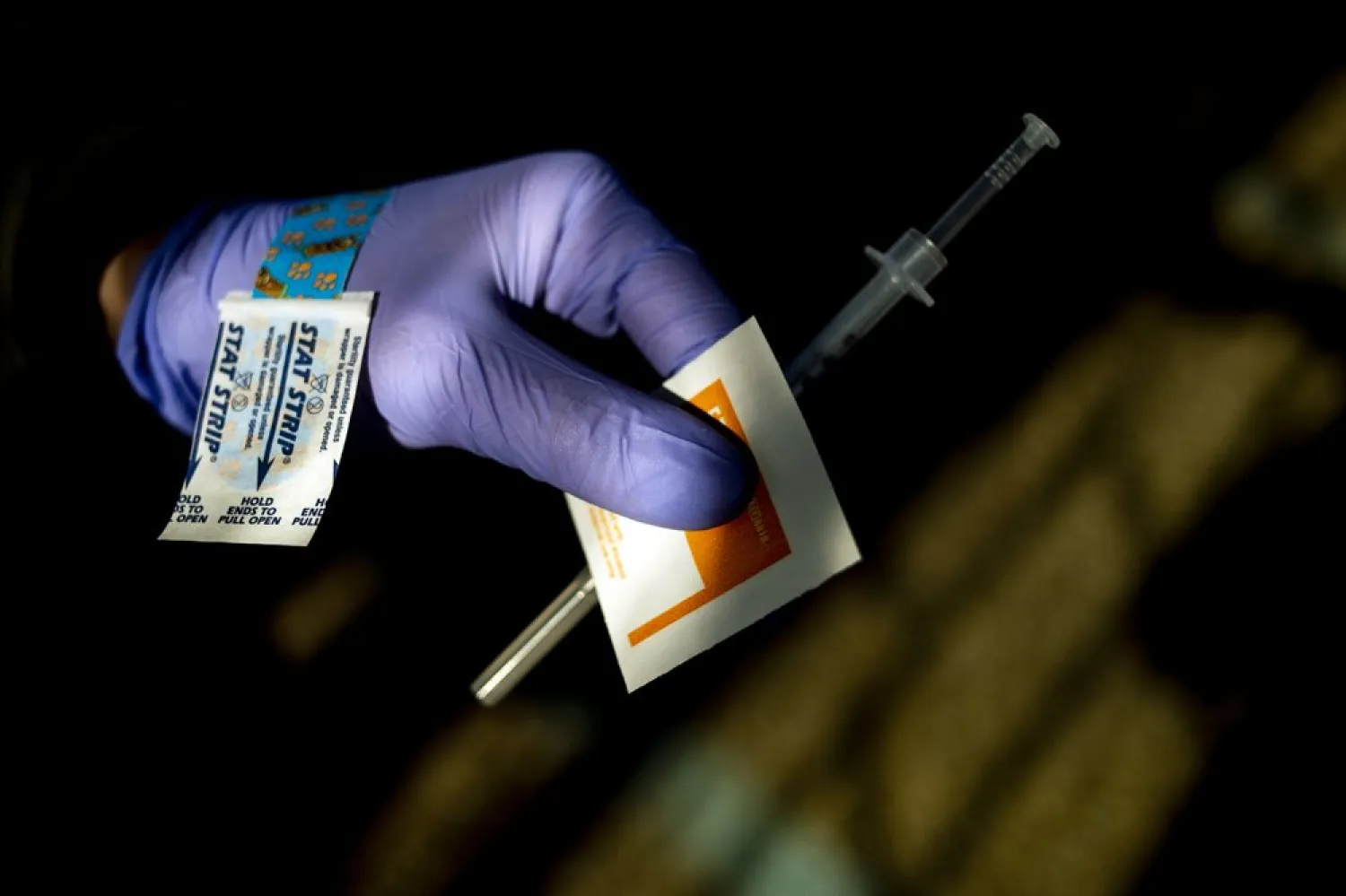
FILE - In this March 29, 2021, file photo, UM-Flint nursing student Michaela Dimello helps administer the first dose of the Moderna COVID-19 vaccine to Genesee County residents at Bishop Airport in Flint, Mich. (Jake May/The Flint Journal via AP, File)
TT

Vaccine Reluctance in Eastern Europe Brings High COVID Cost

FILE - In this March 29, 2021, file photo, UM-Flint nursing student Michaela Dimello helps administer the first dose of the Moderna COVID-19 vaccine to Genesee County residents at Bishop Airport in Flint, Mich. (Jake May/The Flint Journal via AP, File)

Truck driver Andriy Melnik never took the coronavirus seriously. With a friend, he bought a fake vaccination certificate so his travel documents would appear in order when he hauled cargo to other parts of Europe.

His view changed after the friend caught COVID-19 and ended up in an intensive care unit on a ventilator, said The Associated Press.

“It's not a tall tale. I see that this disease kills, and strong immunity wouldn't be enough -- only a vaccine can offer protection,” said Melnik, 42, as he waited in Kyiv to get his shot. “I'm really scared and I'm pleading with doctors to help me correct my mistake."

He added: "Death from coronavirus appears much closer than I imagined."

Ukraine is suffering through a surge in coronavirus infections, along with other parts of Eastern Europe and Russia. While vaccines are plentiful, there is a widespread reluctance to get them in many countries — though notable exceptions include the Baltic nations, Poland, the Czech Republic, Slovenia and Hungary.

The slow pace of vaccinations in Eastern Europe is rooted in several factors, including public distrust and past experience with other vaccines, said Catherine Smallwood, WHO Europe COVID-19 incident manager.

“At the end of the day, we’re seeing low vaccine uptake in a whole swath of countries across that part of the region,” she told The Associated Press. “Historical issues around vaccines come into play. In some countries, the whole vaccine issue is politicized, in any case."

Russia on Thursday recorded 1,159 deaths in 24 hours — its largest daily toll since the pandemic began — with only about a third of the country’s nearly 146 million people fully vaccinated. The Kremlin ordered a national nonworking period starting this week and lasting until Nov. 7.

In Ukraine, only 16% of the adult population is fully vaccinated — the second-lowest share in Europe after Armenia's rate of slightly over 7%.

Authorities in Ukraine are requiring teachers, government employees and other workers to get fully vaccinated by Nov. 8 or face a suspension of their pay. In addition, proof of vaccination or a negative test is now needed to board planes, trains and long-distance buses.

This has created a booming black market in counterfeit documents. Fake vaccination certificates sell for the equivalent of $100-$300. There's even a phony version of the government's digital app, with bogus certificates already installed, said Mykhailo Fedorov, minister for digital transformation.

Last week, President Volodymyr Zelenskyy chaired a meeting on how to combat the counterfeits. Police said they suspect workers at 15 hospitals of being involved in issuing false vaccination documents.

Police have opened 800 criminal cases into such fakes and deployed 100 mobile units to track down their holders, said Interior Minister Denys Monastyrsky. They even caught a former lawmaker who had produced a fake vaccination document upon returning to Ukraine last week.

The low vaccination rate has led to the rapid spread of COVID-19, putting new stress on the country's already overworked health care system.

The surgical ward of a hospital in the town of Biliaivka, near the Black Sea port of Odesa, is now treating only coronavirus patients, with 50 of its 52 beds filled. Drugs and oxygen are in short supply, and some hospital personnel are leaving their jobs.

“We are on the verge of catastrophe, pushed by aggressive opponents of vaccination and the lack of funds,” said Dr. Serhiy Shvets, the head of the ward. “Regrettably, five workers of my ward have quit over the past week.”

The situation looks similar at a 120-bed hospital in the western city of Chernivtsi, where Dr. Olha Kobevko says she has 126 patients in grave condition.

“I’m weeping in despair when I see that 99% of patients in serious condition with COVID-19 are unvaccinated, and those people could have protected themselves,” the infectious disease specialist told AP. “We are left struggling to save them without sufficient amount of drugs and resources.”

The current surge seems especially lethal, Kobevko said, with 10-23 patients dying daily at her hospital, compared with fewer than six per day last spring. The share of patients in their 30s and 40s has grown considerably, she added.

She blames widespread vaccine skepticism, influenced by social media and religious beliefs.

“Fake stories have spread widely, making people believe in microchips and genetic mutations,” Kobevko said. “Some Orthodox priests have openly and aggressively urged people not to get vaccinated, and social networks have been filled with the most absurd rumors. Ukrainians have learned to distrust any authorities' initiatives, and vaccination isn't an exclusion.”

Lidia Buiko, 72, chose to get the Chinese Sinovac shot, citing a falsehood that the Western vaccines contained microchips to control the population.

“Priests have urged us to think twice about getting immunized — it would be impossible to get rid of the chip,” she said as she waited in Kyiv.

Vaccine hesitancy exists even among medical workers. Shvets said 30% of the employees at his hospital in Biliaivka have refused the shots, and Health Minister Viktor Lyashko admitted that about half of Ukrainian medical workers are still reluctant to get them.

Murat Sahin, UNICEF representative in Ukraine, said false and misleading information about COVID-19 poses a growing threat.

“The risks of misinformation to vaccination have never been higher — nor have the stakes," he said.

Similar skepticism has been seen elsewhere in Eastern Europe, fueled by online misinformation, religious beliefs, distrust of government officials, and reliance on nontraditional treatments.

In Romania, where about 35% of adults are fully immunized, tighter restrictions took effect this week requiring vaccination certificates for many daily activities, such as going to the gym, the movies or shopping malls. There's a 10 p.m. curfew, shops close at 9 p.m., bars and clubs will close for 30 days, and masks are mandatory in public.

So many are “afraid of the vaccines because of the immense (amount of) fake information that has flooded social media and TV,” said Dr. Dragos Zaharia of Bucharest’s Marius Nasta Institute of Pneumology.

“Every day, we see people arriving with shortness of breath and most of them are feeling sorry for not being vaccinated,” he told AP. “Every day we see people dying in our ward. We see scared people.”

Bulgaria, with only a quarter of the adult population fully vaccinated, also reported record infections and deaths this week. According to official data, Bulgaria has had the highest COVID-19 mortality rate in the 27-nation European Union in the past two weeks, and 94% of those deaths were of unvaccinated people.

Only 33% of Georgia's population has been fully vaccinated, and authorities launched a lottery with cash prizes for those getting shots. Still, Dr. Bidzina Kulumbegov bemoaned the slow pace of vaccinations.

The government's information campaign "was not designed according to the peculiarities of our country. The emphasis should have been done, for instance, on the Georgian Orthodox Church, because we have many instances when priests are saying that vaccination is a sin,” Kulumbegov said in televised remarks.

For Melnik, the Ukrainian truck driver, the fear of getting COVID-19 outweighed all his other concerns.

“You can't cheat this illness,” he said. “You can buy a counterfeit certificate, but you can't buy antibodies. Ukrainians are slowly starting to realize that there is no alternative to vaccination.”



Türkiye Says Greece-Chevron Activity off Crete Unlawful 

A Chevron gas station sign is pictured at one of their retain gas stations in Cardiff, California October 9, 2013. REUTERS/Mike Blake/File Photo
TT

Türkiye Says Greece-Chevron Activity off Crete Unlawful 

A Chevron gas station sign is pictured at one of their retain gas stations in Cardiff, California October 9, 2013. REUTERS/Mike Blake/File Photo

Türkiye said on Thursday it opposed Greece's "unilateral activities" in energy fields south of Crete with a consortium led by US major Chevron as a violation of international law and good neighbourly relations.

Athens responded that its policies abide international law.

The Chevron-led consortium signed exclusive lease agreements on Monday to look for natural gas off southern Greece, expanding US presence in the eastern Mediterranean.

"We oppose this unlawful activity, which is being attempted in violation of the 2019 Memorandum of Understanding on Maritime Jurisdiction between Libya and our country," the Turkish Defense Ministry said at a press briefing.

It said the activity, while not directly impacting Türkiye's continental shelf, also violated Libya's maritime jurisdiction that was declared to the United Nations in May last year.

"We continue to provide the necessary support to the Libyan authorities to take action against these unilateral and unlawful activities by Greece," the ministry said.

A 2019 agreement signed by Türkiye and Libya set out maritime boundaries in the Mediterranean Sea. It was rejected by Greece as it ignored the presence of the Greek island of Crete between the coasts of Türkiye and Libya. The Chevron deal doubles the amount of Greek maritime acreage available for exploration and is the second in months involving a US energy major, as the European Union seeks to phase out supplies from Russia and the US seeks to replace them.

Asked about the Turkish objections later on Thursday, Greek government spokesman Pavlos Marinakis told a press briefing that Athens followed an "active policy" and "exercises its rights in accordance with international law and respects international law steadfastly - and I think no one questions that, period."

There was no immediate comment from Chevron.

Neighbors and NATO members Türkiye and Greece have been at odds over a range of issues for decades, primarily maritime boundaries and rights in the Aegean, an area widely believed to hold energy resources and with key implications for airspace and military activity.

A 2023 declaration on friendly relations prompted a thaw between the sides and leaders have voiced a desire to address remaining issues.


Andrew Mountbatten-Windsor Arrested on Suspicion of Misconduct in Public Office

FILE - Britain’s Andrew Mountbatten-Windsor, formerly known as Prince Andrew, looks round as he leaves after attending the Easter Matins Service at St. George's Chapel, Windsor Castle, England, April 20, 2025. (AP Photo/Kirsty Wigglesworth, File)
TT

Andrew Mountbatten-Windsor Arrested on Suspicion of Misconduct in Public Office

FILE - Britain’s Andrew Mountbatten-Windsor, formerly known as Prince Andrew, looks round as he leaves after attending the Easter Matins Service at St. George's Chapel, Windsor Castle, England, April 20, 2025. (AP Photo/Kirsty Wigglesworth, File)

UK police arrested Andrew Mountbatten-Windsor on Thursday on suspicion of misconduct in public office.

The Thames Valley Police, an agency that covers areas west of London, including Mountbatten-Windsor’s former home, said it was “assessing” reports that the former Prince Andrew sent trade reports to convicted sex offender Jeffrey Epstein in 2010. The assessment followed the release of millions of pages of documents connected to a US investigation of Epstein.

The police force did not name Mountbatten-Windsor, as is normal under UK law. But when asked if he had been arrested, the force pointed to a statement saying that they had arrested a man in his 60s. Mountbatten-Windsor is 66.

“Following a thorough assessment, we have now opened an investigation into this allegation of misconduct in public office,’’ the statement said. “It is important that we protect the integrity and objectivity of our investigation as we work with our partners to investigate this alleged offence."

“We understand the significant public interest in this case, and we will provide updates at the appropriate time,” the statement added.

Pictures circulated online appearing to show unmarked police cars at Wood Farm on the Sandringham Estate in Norfolk, with plainclothes officers appearing to gather outside the home of Mountbatten-Windsor.


Georgia Arrests Two Foreigners Trying to Purchase Uranium

FILE PHOTO: A block with the symbol, atomic number and mass number of Uranium (U) element, in this illustration taken January 21, 2026. REUTERS/Dado Ruvic/Illustration/File Photo
TT

Georgia Arrests Two Foreigners Trying to Purchase Uranium

FILE PHOTO: A block with the symbol, atomic number and mass number of Uranium (U) element, in this illustration taken January 21, 2026. REUTERS/Dado Ruvic/Illustration/File Photo

Georgia has ‌detained two people who attempted to purchase $3 million worth of uranium and a cache of a radioactive isotope found in nuclear weapons testing programs, the national security service said on Thursday.

Two foreign nationals from unspecified countries were arrested in the city of Kutaisi, the State Security Service said in a statement.

"They were planning to ‌illegally purchase ‌nuclear material uranium and radioactive ‌substance ⁠Cesium 137 for $3 ⁠million and illegally transport it to the territory of another country," Reuters quoted it as saying.

It said other foreigners had been arriving in Georgia in recent weeks with the aim of purchasing and transporting the nuclear and ⁠radioactive materials, without elaborating further.

The ‌statement did ‌not specify the quantity of materials the individuals were ‌attempting to procure. There were ‌no details on the substances' origin or potential destination.

Cesium 137 is a radioactive isotope present primarily in the aftermath of nuclear weapons testing ‌and nuclear power plant accidents such as the Chernobyl disaster in ⁠then-Soviet ⁠Ukraine in 1986.

The security of nuclear materials was one of the biggest concerns after the 1991 fall of the Soviet Union, of which Georgia was part. There have been several serious incidents involving the illicit trade in nuclear materials in Georgia over recent decades.

Most recently, three Chinese citizens were arrested in the capital Tbilisi for attempting to purchase two kilograms of "nuclear material" uranium.