

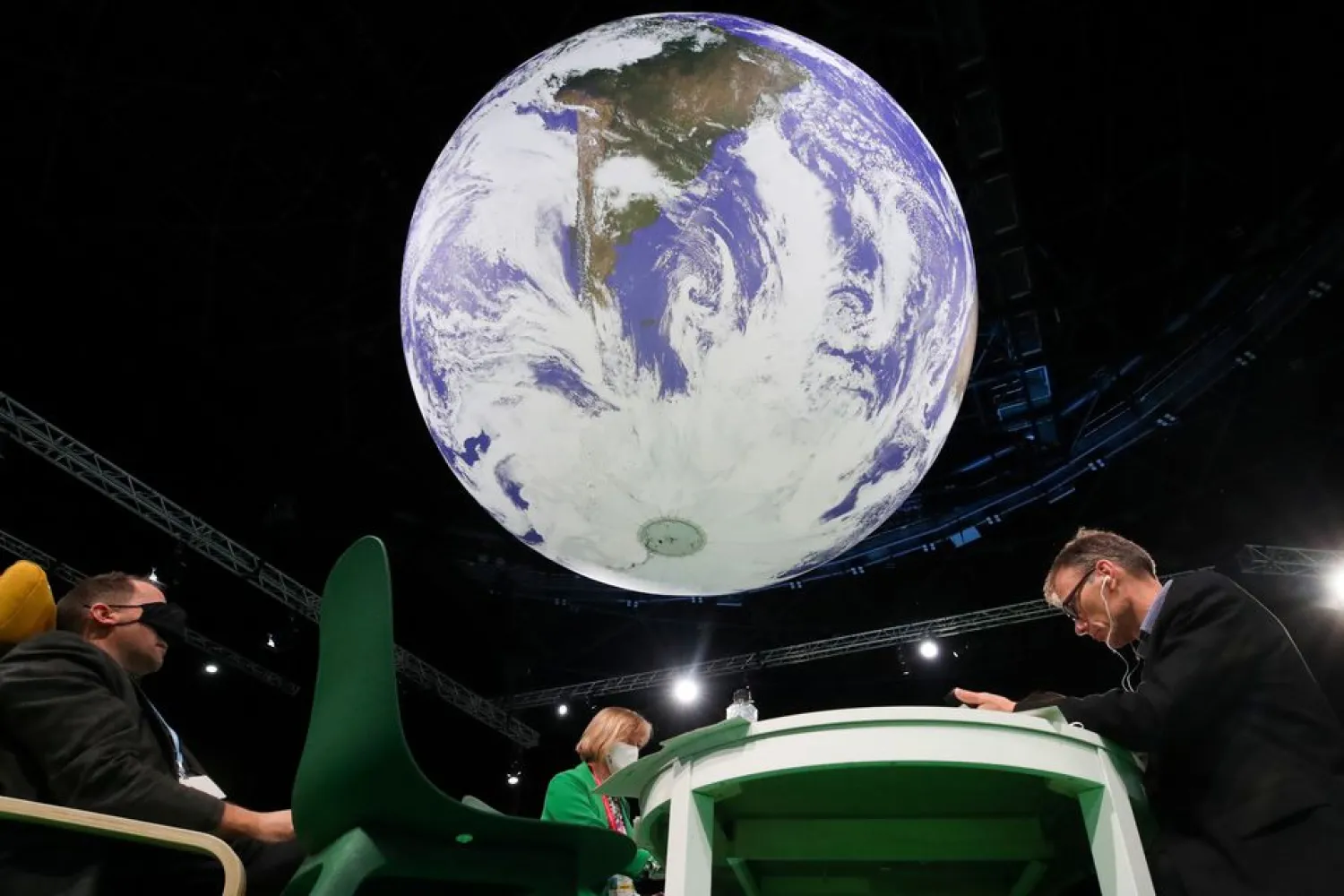

UN Climate Conference Heads Tentatively Towards a Deal

UN climate talks in Scotland appeared to be tentatively heading for a deal on Saturday that conference host Britain said would keep alive a goal of capping global warming at 1.5 degrees Celsius. (Reuters)
TT

UN Climate Conference Heads Tentatively Towards a Deal

UN climate talks in Scotland appeared to be tentatively heading for a deal on Saturday that conference host Britain said would keep alive a goal of capping global warming at 1.5 degrees Celsius. (Reuters)

UN climate talks in Scotland appeared to be tentatively heading for a deal on Saturday that conference host Britain said would keep alive a goal of capping global warming at 1.5 degrees Celsius to maintain a realistic chance of avoiding catastrophe.

Alok Sharma, the conference chairman, urged the almost 200 national delegations present in Glasgow to accept a deal that seeks to balance the demands of climate-vulnerable nations, big industrial powers, and those whose consumption or exports of fossil fuels are vital to their economic development.

"Please don't ask yourself what more you can seek but ask instead what is enough," he told them, in the closing hours of a two-week conference that has already overrun by a day. "Is this package balanced? Does it provide enough for all of us?"

"Most importantly - please ask yourselves whether ultimately these texts deliver for all our people and our planet."

The final agreement will require the unanimous consent of the countries present, ranging from coal- and gas-fuelled superpowers to oil producers and Pacific islands being swallowed by the rise in sea levels.

The meeting's overarching aim is to keep within reach the 2015 Paris Agreement's target to cap global warming at 1.5 degrees Celsius (2.7 Fahrenheit) above pre-industrial levels.

US climate envoy John Kerry said the conference was poised to make a "remarkable step".

A draft deal circulated early on Saturday in effect acknowledged that existing commitments to cut emissions of planet-heating greenhouse gases are nowhere near enough, and asked nations to set tougher climate pledges next year, rather than every five years, as they are currently required to do.

In a public check-in round with key delegations, there was encouragement for Sharma from China, the world's biggest producer and consumer of the dirtiest fossil fuel, coal, but also a country yet to develop its full economic potential.

"We noted that there are still differences on some issues and currently this text is by no means perfect, but we have no intention to open the text again," Chinese negotiator Zhao Yingmin told the conference hall.

‘Don’t kill this moment'

The West African state of Guinea, which had pressed hard on behalf of the G77 group of developing countries for greater commitments from rich countries to compensate them for "loss and damage" from unpredictable climate disasters, also indicated that the group would accept what had been achieved.

However, India, whose energy needs are heavily dependent on its own cheap and plentiful coal, signaled unhappiness.

"I am afraid ... the consensus remained elusive," Environment and Climate Minister Bhupender Yadav told the forum, without spelling out whether or not India would block a vote on the package.

EU Climate Commissioner Frans Timmermans, speaking after Yadav, asked if the marathon conference was at risk of stumbling just before the finish line and urged fellow delegates:

"Don't kill this moment by asking for more texts, different texts, deleting this, deleting that."

Scientists say that to go beyond a rise of 1.5C would unleash extreme sea level rise and catastrophes including crippling droughts, monstrous storms and wildfires far worse than those the world is already suffering.

But national pledges made so far to cut greenhouse emissions - mostly carbon dioxide from burning coal, oil and gas - would only cap the average global temperature rise at 2.4 Celsius.

However, Saturday's draft, published by the United Nations, called for efforts to reduce the huge subsidies that governments around the world give to the oil, coal and gas that power factories and heat homes.

Previous UN climate conferences have failed to single out fossil fuels for their harm to the climate.

Britain tried to unblock the issue of climate finance, one of the thorniest, by proposing mechanisms to make sure the poorest nations finally get more of the financial help they have been promised.

Developing countries argue that rich nations, whose historical emissions are largely responsible for heating up the planet, must pay more to help them adapt to its consequences as well as reducing their carbon footprints.

More money?
The draft urged rich countries to double finance for climate adaptation by 2025 from 2019 levels, offering funding that has been a key demand of small island nations at the conference.

Adaptation funds primarily go to the very poorest countries and currently take up only a small fraction of climate funding.

Britain also said a UN committee should report next year on progress towards delivering the $100 billion per year in overall annual climate funding that rich nations had promised by 2020 but failed to deliver. And it said governments should meet in 2022, 2024 and 2026 to discuss climate finance.

Even $100 billion a year is far short of poorer countries' actual needs, which could hit $300 billion by 2030 in adaptation costs alone, according to the United Nations, in addition to economic losses from crop failure or climate-related disasters.

Vulnerable nations have argued for decades that rich countries owe them compensation for the "loss and damage" from climate events that cannot be avoided.

But wealthy countries fear being found liable for such disasters and opening the door to bottomless payments.

As a result, no UN climate conference has yet yielded any funding under this heading for the countries most affected - and Saturday's Glasgow draft also made no firm commitment.

Negotiators were, however, closing in on a deal to settle rules for carbon markets - mechanisms that put a price on emissions to allow countries or companies to buy and sell "permits to pollute", or credits for absorbing emissions.



Andrew Mountbatten-Windsor Arrested on Suspicion of Misconduct in Public Office

FILE - Britain’s Andrew Mountbatten-Windsor, formerly known as Prince Andrew, looks round as he leaves after attending the Easter Matins Service at St. George's Chapel, Windsor Castle, England, April 20, 2025. (AP Photo/Kirsty Wigglesworth, File)
TT

Andrew Mountbatten-Windsor Arrested on Suspicion of Misconduct in Public Office

FILE - Britain’s Andrew Mountbatten-Windsor, formerly known as Prince Andrew, looks round as he leaves after attending the Easter Matins Service at St. George's Chapel, Windsor Castle, England, April 20, 2025. (AP Photo/Kirsty Wigglesworth, File)

UK police arrested Andrew Mountbatten-Windsor on Thursday on suspicion of misconduct in public office.

The Thames Valley Police, an agency that covers areas west of London, including Mountbatten-Windsor’s former home, said it was “assessing” reports that the former Prince Andrew sent trade reports to convicted sex offender Jeffrey Epstein in 2010. The assessment followed the release of millions of pages of documents connected to a US investigation of Epstein.

The police force did not name Mountbatten-Windsor, as is normal under UK law. But when asked if he had been arrested, the force pointed to a statement saying that they had arrested a man in his 60s. Mountbatten-Windsor is 66.

“Following a thorough assessment, we have now opened an investigation into this allegation of misconduct in public office,’’ the statement said. “It is important that we protect the integrity and objectivity of our investigation as we work with our partners to investigate this alleged offence."

“We understand the significant public interest in this case, and we will provide updates at the appropriate time,” the statement added.

Pictures circulated online appearing to show unmarked police cars at Wood Farm on the Sandringham Estate in Norfolk, with plainclothes officers appearing to gather outside the home of Mountbatten-Windsor.


Georgia Arrests Two Foreigners Trying to Purchase Uranium

FILE PHOTO: A block with the symbol, atomic number and mass number of Uranium (U) element, in this illustration taken January 21, 2026. REUTERS/Dado Ruvic/Illustration/File Photo
TT

Georgia Arrests Two Foreigners Trying to Purchase Uranium

FILE PHOTO: A block with the symbol, atomic number and mass number of Uranium (U) element, in this illustration taken January 21, 2026. REUTERS/Dado Ruvic/Illustration/File Photo

Georgia has ‌detained two people who attempted to purchase $3 million worth of uranium and a cache of a radioactive isotope found in nuclear weapons testing programs, the national security service said on Thursday.

Two foreign nationals from unspecified countries were arrested in the city of Kutaisi, the State Security Service said in a statement.

"They were planning to ‌illegally purchase ‌nuclear material uranium and radioactive ‌substance ⁠Cesium 137 for $3 ⁠million and illegally transport it to the territory of another country," Reuters quoted it as saying.

It said other foreigners had been arriving in Georgia in recent weeks with the aim of purchasing and transporting the nuclear and ⁠radioactive materials, without elaborating further.

The ‌statement did ‌not specify the quantity of materials the individuals were ‌attempting to procure. There were ‌no details on the substances' origin or potential destination.

Cesium 137 is a radioactive isotope present primarily in the aftermath of nuclear weapons testing ‌and nuclear power plant accidents such as the Chernobyl disaster in ⁠then-Soviet ⁠Ukraine in 1986.

The security of nuclear materials was one of the biggest concerns after the 1991 fall of the Soviet Union, of which Georgia was part. There have been several serious incidents involving the illicit trade in nuclear materials in Georgia over recent decades.

Most recently, three Chinese citizens were arrested in the capital Tbilisi for attempting to purchase two kilograms of "nuclear material" uranium.


Former South Korean President Yoon Receives Life Sentence for Imposing Martial Law

FILE PHOTO: South Korea’s impeached President Yoon Suk Yeol attends the fourth hearing of his impeachment trial over his short-lived imposition of martial law at the Constitutional Court in Seoul, South Korea, 23 January 2025. JEON HEON-KYUN/Pool via REUTERS/File Photo
TT

Former South Korean President Yoon Receives Life Sentence for Imposing Martial Law

FILE PHOTO: South Korea’s impeached President Yoon Suk Yeol attends the fourth hearing of his impeachment trial over his short-lived imposition of martial law at the Constitutional Court in Seoul, South Korea, 23 January 2025. JEON HEON-KYUN/Pool via REUTERS/File Photo

Former South Korean President Yoon Suk Yeol was sentenced to life in prison for his brief imposition of martial law in a dramatic culmination to the country’s biggest political crisis in decades.

Yoon was ousted from office after a baffling attempt to overcome an opposition-controlled legislature by declaring martial law and sending troops to surround the National Assembly on Dec. 3, 2024, The Associated Press said.

Judge Jee Kui-youn of the Seoul Central District Court said he found Yoon guilty of rebellion for mobilizing military and police forces in an illegal attempt to seize the liberal-led Assembly, arrest politicians and establish unchecked power for a “considerable” time.

Martial law crisis recalled dictatorial past Yoon’s martial law imposition, the first of its kind in more than four decades, harkened back to South Korea’s past military-backed governments when authorities occasionally proclaimed emergency decrees that allowed them to station soldiers, tanks and armored vehicles on streets or at public places such as schools to prevent anti-government demonstrations.

As lawmakers rushed to the National Assembly, Yoon’s martial law command issued a proclamation declaring sweeping powers, including suspending political activities, controlling the media and publications, and allowing arrests without warrants.

The decree lasted about six hours before being lifted after a quorum of lawmakers managed to break through a military blockade and unanimously voted to lift the measure.

Yoon was suspended from office on Dec. 14, 2024, after being impeached by lawmakers and was formally removed by the Constitutional Court in April 2025. He has been under arrest since last July while facing multiple criminal trials, with the rebellion charge carrying the most severe punishment.

Yoon's lawyers reject conviction Yoon Kap-keun, one of the former president’s lawyers, accused Jee of issuing a “predetermined verdict” based solely on prosecutors’ arguments and said the “rule of law” had collapsed. He said he would discuss whether to appeal with his client and the rest of the legal team.

Yoon Suk Yeol told the court the martial law decree was only meant to raise public awareness of how the liberals were paralyzing state affairs, and that he was prepared to respect lawmakers if they voted against the measure.

Prosecutors said it was clear Yoon was attempting to disable the legislature and prevent lawmakers from lifting the measure through voting, actions that exceeded his constitutional authority even under martial law.

In announcing Yoon and Kim’s verdicts, Jee said the decision to send troops to the National Assembly was key to his determination that the imposition of martial law amounted to rebellion.

“This court finds that the purpose of (Yoon’s) actions was to send troops to the National Assembly, block the Assembly building and arrest key figures, including the National Assembly speaker and the leaders of both the ruling and opposition parties, in order to prevent lawmakers from gathering to deliberate or vote,” Jee said. “It’s sufficiently established that he intended to obstruct or paralyze the Assembly’s activities so that it would be unable to properly perform its functions for a considerable period of time.”

Protesters rally outside court

As Yoon arrived in court, hundreds of police officers watched closely as Yoon supporters rallied outside a judicial complex, their cries rising as the prison bus transporting him drove past. Yoon’s critics gathered nearby, demanding the death penalty.

There were no immediate reports of major clashes following the verdict.

A special prosecutor had demanded the death penalty for Yoon Suk Yeol, saying his actions posed a threat to the country’s democracy and deserved the most serious punishment available, but most analysts expected a life sentence since the poorly-planned power grab did not result in casualties.

South Korea has not executed a death row inmate since 1997, in what is widely seen as a de facto moratorium on capital punishment amid calls for its abolition.

Other officials sentenced for enforcing martial law

The court also convicted and sentenced several former military and police officials involved in enforcing Yoon’s martial law decree, including ex-Defense Minister Kim Yong Hyun, who received a 30-year jail term for his central role in planning the measure and mobilizing the military.

Last month, Yoon was sentenced to five years in prison for resisting arrest, fabricating the martial law proclamation and sidestepping a legally mandated full Cabinet meeting before declaring the measure.

The Seoul Central Court has also convicted two members of Yoon’s Cabinet in other cases. That includes Prime Minister Han Duck-soo, who received a 23-year prison sentence for attempting to legitimize the decree by forcing it through a Cabinet Council meeting, falsifying records and lying under oath. Han has appealed the verdict.

Yoon is the first former South Korean president to receive a life sentence since former military dictator Chun Doo-hwan, who was sentenced to death in 1996 for his 1979 coup, a bloody 1980 crackdown on pro-democracy protesters in Gwangju that left more than 200 people dead or missing, and corruption.

The Supreme Court later reduced his sentence to life imprisonment, and he was released in late 1997 under a special presidential pardon. He died in 2021.