


‘Sesame Street’ Debuts Ji-Young, First Asian American Muppet

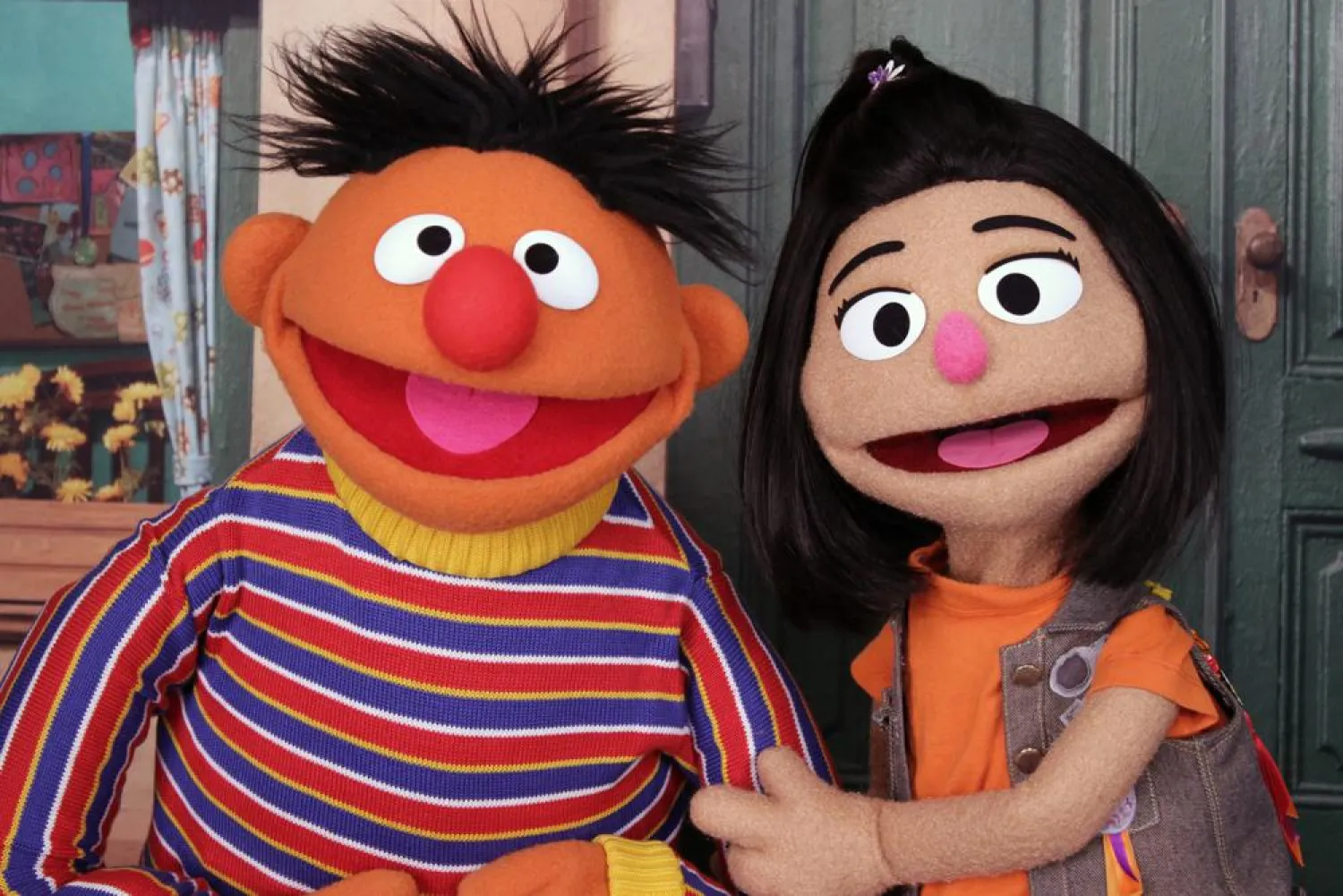
Ernie, a muppet from the popular children's series "Sesame Street," appears with new character Ji-Young, the first Asian American muppet, on the set of the long-running children's program in New York on Nov. 1, 2021. (AP)
TT

‘Sesame Street’ Debuts Ji-Young, First Asian American Muppet

Ernie, a muppet from the popular children's series "Sesame Street," appears with new character Ji-Young, the first Asian American muppet, on the set of the long-running children's program in New York on Nov. 1, 2021. (AP)

What's in a name? Well, for Ji-Young, the newest muppet resident of “Sesame Street,” her name is a sign she was meant to live there.

“So, in Korean traditionally the two syllables they each mean something different and Ji means, like, smart or wise. And Young means, like, brave or courageous and strong,” Ji-Young explained during a recent interview. “But we were looking it up and guess what? Ji also means sesame.”

At only 7 years old, Ji-Young is making history as the first Asian American muppet in the “Sesame Street” canon. She is Korean American and has two passions: rocking out on her electric guitar and skateboarding. The children’s TV program, which first aired 52 years ago this month, gave The Associated Press a first look at its adorable new occupant.

Ji-Young will formally be introduced in “See Us Coming Together: A Sesame Street Special.” Simu Liu, Padma Lakshmi and Naomi Osaka are among the celebrities appearing in the special, which will drop Thanksgiving Day on HBO Max, “Sesame Street” social media platforms and on local PBS stations.

Some of Ji-Young’s personality comes from her puppeteer. Kathleen Kim, 41 and Korean American, got into puppetry in her 30s. In 2014, she was accepted into a “Sesame Street” workshop. That evolved into a mentorship and becoming part of the team the following year. Being a puppeteer on a show Kim watched growing up was a dream come true. But helping shape an original muppet is a whole other feat.

“I feel like I have a lot of weight that maybe I’m putting on myself to teach these lessons and to be this representative that I did not have as a kid,” Kim said. But fellow puppeteer Leslie Carrara-Rudolph — who performs Abby Cadabby — reminded her, “It’s not about us ... It’s about this message.”

Ji-Young’s existence is the culmination of a lot of discussions after the events of 2020 — George Floyd’s death and anti-Asian hate incidents. Like a lot of companies, “Sesame Street” reflected on how it could “meet the moment,” said Kay Wilson Stallings, executive vice-president of Creative and Production for Sesame Workshop, the nonprofit organization behind “Sesame Street.”

Sesame Workshop established two task forces — one to look at its content and another to look at its own diversity. What developed was Coming Together, a multi-year initiative addressing how to talk to children about race, ethnicity and culture. One result was 8-year-old Tamir. While not the show's first Black muppet, he was one of the first used to talk about subjects like racism.

“When we knew we were going to be doing this work that was going to focus on the Asian and Pacific Islanders experience, we of course knew we needed to create an Asian muppet as well,” Stallings said.

These newer muppets — their personalities and their looks — were remarkably constructed in a matter of a months. The process normally takes at least a couple of years. There are outside experts and a cross-section of employees known as the “culture trust” who weigh in on every aspect of a new muppet, Stallings said.

For Kim, it was crucial that Ji-Young not be “generically pan-Asian.”

“Because that’s something that all Asian Americans have experienced. They kind of want to lump us into this monolithic ‘Asian,'" Kim said. “So it was very important that she was specifically Korean American, not just like, generically Korean, but she was born here.”

One thing Ji-Young will help teach children is how to be a good “upstander.” “Sesame Street” first used the term on its “The Power of We” TV special last year, which featured Tamir.

“Being an upstander means you point out things that are wrong or something that someone does or says that is based on their negative attitude towards the person because of the color of their skin or the language they speak or where they’re from,” Stallings said. “We want our audience to understand they can be upstanders.”

In “See Us Coming Together,” Sesame Street is preparing for Neighbor Day where everyone shares food, music or dance from their culture. Ji-Young becomes upset after a kid, off screen, tells her “to go back home,” an insult commonly flung at Asian Americans and Pacific Islanders. But she feels empowered after Sesame Street's other Asian American residents, guest stars and friends like Elmo assure her that she belongs as much as anyone else.

The fact that Ji-Young was created to counter anti-Asian sentiment makes her more special to Kim in some ways.

“I remember like the Atlanta shootings and how terrifying that was for me,” Kim said. “My one hope, obviously, is to actually help teach what racism is, help teach kids to be able to recognize it and then speak out against it. But then my other hope for Ji-Young is that she just normalizes seeing different kinds of looking kids on TV.”

Vanessa Leung, co-executive director of Coalition for Asian American Children and Families, is excited about Ji-Young. The organization was not involved in Ji-Young's creation but previously consulted on anti-racism content for Sesame Workshop. It matters when Asian American families, especially with many of them being immigrant families, can see themselves reflected in an institution like “Sesame Street," Leung said.

“It sparks curiosity and early understanding of the diversity of our community, the beauty in the diversity of our community,” Leung said.

Ji-Young will be heavily present throughout the show's 53rd season next year, Stallings reassured. She also won't just be utilized for content related to racial justice. She will pop up in various digital programs, live-action and animated.

As the new kid on the street, Ji-Young is looking forward to showing her friends and neighbors aspects of Korean culture such as the food. She loves cooking dishes like tteokbokki (chewy rice cakes) with her halmoni (grandmother). And she already has one “Sesame Street” friend who wants a sample.

“I would love to try it,” said Ernie, who joined Ji-Young's interview. “You know, I’ve tried bulgogi. I really like bulgogi. I’m gonna guess that maybe old buddy Bert has not tried Korean food.”

Having already made several famous friends on “Sesame Street,” is there anyone Ji-Young still really wants to meet?

“The Linda Lindas because they're so cool,” Ji-Young said, referring to the teenage punk rock band. “And they rock out and they’re cool girls and most of them are Asian. They’re my heroes. If we can get the Linda Lindas on ‘Sesame Street,’ I would show them around.”



Berlin Film Festival Rejects Accusation of Censorship on Gaza

Berlinale Festival Director Tricia Tuttle speaks during the Berlinale Camera award ceremony honoring British composer Max Richter during the 76th Berlin International Film Festival, in Berlin, Germany, 18 February 2026. (EPA)
TT

Berlin Film Festival Rejects Accusation of Censorship on Gaza

Berlinale Festival Director Tricia Tuttle speaks during the Berlinale Camera award ceremony honoring British composer Max Richter during the 76th Berlin International Film Festival, in Berlin, Germany, 18 February 2026. (EPA)

The director of the Berlin Film Festival on Wednesday rejected accusations from more than 80 film industry figures that the festival had helped censor artists who oppose Israel's actions in Gaza.

In an open letter published on Tuesday, Oscar-winning actors Javier Bardem and Tilda Swinton were among dozens who criticized the Berlinale's "silence" on the issue and said they were "dismayed" at its "involvement in censoring artists who oppose Israel's ongoing genocide against Palestinians in Gaza".

In an interview with Screen Daily, the Berlinale's director, Tricia Tuttle, said the festival backs "free speech within the bounds of German law".

She said she recognized that the letter came from "the depth of anger and frustration about the suffering of people in Gaza".

However, she rejected accusations of censorship, saying that the letter contained "misinformation" and "inaccurate claims about the Berlinale" made without evidence or anonymously.

The row over Gaza has dogged this year's edition of the festival since jury president Wim Wenders answered a question on the conflict by saying: "We cannot really enter the field of politics."

The comments prompted award-winning novelist Arundhati Roy, who had been due to present a restored version of a film she wrote, to withdraw from the festival.

Tuttle said the festival represents "lots of people who have different views, including lots of people who live in Germany who want a more complex understanding of Israel's positionality than maybe the rest of the world has right now".

German politicians have been largely supportive of Israel as Germany seeks to atone for the legacy of the Holocaust.

However, German public opinion has been more critical of Israeli actions in Gaza.

Commenting on the row to the Welt TV channel, German Culture Minister Wolfram Weimer defended Wenders and Tuttle from criticism, saying they were running the festival "in a very balanced way, very sensitively".

"Artists should not be told what to do when it comes to politics. The Berlinale is not an NGO with a camera and directors," Weimer said.

Gaza has frequently been a topic of controversy at the Berlinale in recent years.

In 2024, the festival's documentary award went to "No Other Land", which follows the dispossession of Palestinian communities in the Israeli-occupied West Bank.

German government officials criticized "one-sided" remarks about Gaza by the directors of that film and others at that year's awards ceremony.


Over 80 Berlin Film Festival Alumni Sign Open Letter Urging Organizers to Take Stance on Gaza 

12 February 2026, Berlin: President of the Berlinale jury Wim Wenders waves to the audience on the opening night of the 76th Berlin International Film Festival, before the premiere of the opening film "No Good Men" at the Berlinale Palast. (dpa)
TT

Over 80 Berlin Film Festival Alumni Sign Open Letter Urging Organizers to Take Stance on Gaza 

12 February 2026, Berlin: President of the Berlinale jury Wim Wenders waves to the audience on the opening night of the 76th Berlin International Film Festival, before the premiere of the opening film "No Good Men" at the Berlinale Palast. (dpa)

More than 80 actors, directors and other ‌artists who have taken part in the Berlin Film Festival, including Tilda Swinton and Javier Bardem, signed an open letter to the organizers published on Tuesday calling for them to take a clear stance on Israel's war in Gaza.

"We call on the Berlinale to fulfil its moral duty and clearly state its opposition to Israel's genocide, crimes against humanity and war crimes against Palestinians," said the open letter, which was published in full in entertainment industry magazine Variety.

Multiple human rights experts, scholars and a UN inquiry say Israel's assault on Gaza amounts to genocide. Israel calls its actions self-defense after Hamas' October 2023 attack on Israel.

"We are appalled by Berlinale's institutional silence," ‌said the letter, which ‌was also signed by actors Adam McKay, Alia Shawkat and ‌Brian ⁠Cox, and director ⁠Mike Leigh.

It said organizers had not met demands to issue a statement affirming Palestinians' right to life and committing to uphold artists' right to speak out on the issue.

"This is the least it can - and should - do," the letter said.

The festival did not immediately respond to an emailed request for comment.

THE MOST POLITICAL FESTIVAL

The Berlin Film Festival is considered the most political of its peers, Venice and Cannes, and ⁠prides itself on showing cinema from under-represented communities and young ‌talent. However, it has been repeatedly criticized by pro-Palestinian activists ‌for not taking a stand on Gaza, in contrast to the war in Ukraine ‌and the situation in Iran.

Calls have also previously been made for the ‌entertainment industry to take a stance on Gaza.

Last year, over 5,000 actors, entertainers, and producers, including some Hollywood stars, signed a pledge to not work with Israeli film institutions that they saw as being complicit in the abuse of Palestinians by Israel.

Paramount studio later condemned that ‌pledge and said it did not agree with such efforts.

ROY PULLS OUT

Tuesday's letter also condemned statements by this year's ⁠jury president, German director ⁠Wim Wenders, that filmmakers should stay out of politics, writing: "You cannot separate one from the other."

Wenders' comments prompted Indian novelist Arundhati Roy, winner of the Booker Prize in 1997 for her novel "The God of Small Things", to pull out of the festival earlier this week.

Roy, who had been due to present "In Which Annie Gives It Those Ones", a 1989 film which she wrote, in the Berlinale's Classics section, characterized Wenders' comments as "unconscionable."

In response, festival director Tricia Tuttle issued a note on Saturday defending artists' decision not to comment on political issues.

"People have called for free speech at the Berlinale. Free speech is happening at the Berlinale," she said.

"But increasingly, filmmakers are expected to answer any question put to them," she wrote, and are criticized if they do not answer, or answer "and we do not like what they say."


‘Godfather’ and ‘Apocalypse Now’ Actor Robert Duvall Dead at 95 

Actor Robert Duvall arrives at the 72nd Golden Globe Awards in Beverly Hills, California January 11, 2015. (Reuters)
TT

‘Godfather’ and ‘Apocalypse Now’ Actor Robert Duvall Dead at 95 

Actor Robert Duvall arrives at the 72nd Golden Globe Awards in Beverly Hills, California January 11, 2015. (Reuters)

Robert Duvall, who played the smooth mafia lawyer in "The Godfather" and stole the show with his depiction of a surfing-crazed colonel in "Apocalypse Now," has died at the age of 95, his wife said Monday.

His death Sunday was confirmed by his wife Luciana Duvall.

"Yesterday we said goodbye to my beloved husband, cherished friend, and one of the greatest actors of our time. Bob passed away peacefully at home," she wrote.

Blunt-talking, prolific and glitz-averse, Duvall won an Oscar for best actor and was nominated six other times. Over his six decades-long career, he shone in both lead and supporting roles, and eventually became a director. He kept acting in his 90s.

"To the world, he was an Academy Award-winning actor, a director, a storyteller. To me, he was simply everything," Luciana Duvall said. "His passion for his craft was matched only by his deep love for characters, a great meal, and holding court."

Duvall won his Academy Award in 1983 for playing a washed-up country singer in "Tender Mercies."

But his most memorable characters also included the soft-spoken, loyal mob consigliere Tom Hagen in the first two installments of "The Godfather" and the maniacal Lieutenant Colonel William Kilgore in Francis Ford Coppola's 1979 Vietnam War epic "Apocalypse Now."

"It was an honor to have worked with Robert Duvall," Oscar winner Al Pacino, who acted alongside Duvall in "The Godfather" films, said in a statement.

"He was a born actor as they say, his connection with it, his understanding and his phenomenal gift will always be remembered. I will miss him."

As Colonel Kilgore, Duvall earned an Oscar nomination and became a bona fide star after years playing lesser roles, in a performance where he utters what is now one of cinema's most famous lines.

"I love the smell of napalm in the morning," his war-loving character -- bare chested, cocky and sporting a big black cowboy hat -- muses as low-flying US warplanes bomb a beachfront tree line where he wants to go surfing.

That character was originally created to be even more over the top -- his name was at first supposed to be Colonel Carnage -- but Duvall had it toned down, demonstrating his meticulous approach to acting.

"I did my homework," Duvall told veteran talk show host Larry King in 2015. "I did my research."

Cinema giant Francis Ford Coppola -- who directed Duvall in "Apocalypse Now" and "The Godfather" -- called his loss "a blow."

"Such a great actor and such an essential part of American Zoetrope from its beginning," Coppola said in a statement on Instagram.

- A 'vast career' -

Duvall was sort of a late bloomer in Hollywood -- he was already 31 when he delivered his breakout performance as the mysterious recluse Boo Radley in the 1962 film adaptation of Harper Lee's novel "To Kill a Mockingbird."

He would go on to play myriad roles -- a bullying corporate executive in "Network" (1976), a Marine officer who treats his family like soldiers in "The Great Santini" (1979), and then his star turn in "Tender Mercies."

Duvall often said his favorite role, however, was one he played in a 1989 TV mini-series -- the grizzled, wise-cracking Texas Ranger-turned-cowboy Augustus McCrae in "Lonesome Dove," based on the novel by Larry McMurtry.

British actress Jane Seymour, who worked with Duvall on the 1995 film "The Stars Fell on Henrietta," took to Instagram to share a heartfelt tribute to the star.

"We were able to share in his love of barbecue and even a little tango," Seymour captioned a photo of herself with Duvall. "Those moments off camera were just as memorable as the work itself."

US actor Alec Baldwin made a short video tribute to Duvall, speaking about the star's "vast career."

"When he did 'To Kill A Mockingbird' he just destroyed you with his performance of Boo Radley, he used not a single word of dialogue, not a single word, and he just shatters you," Baldwin said.

Film critic Elaine Mancini once described Duvall as "the most technically proficient, the most versatile, and the most convincing actor on the screen in the United States."