Yemen Human Rights Center Documents 70 Abuses Against Civilians in Taiz Last Month

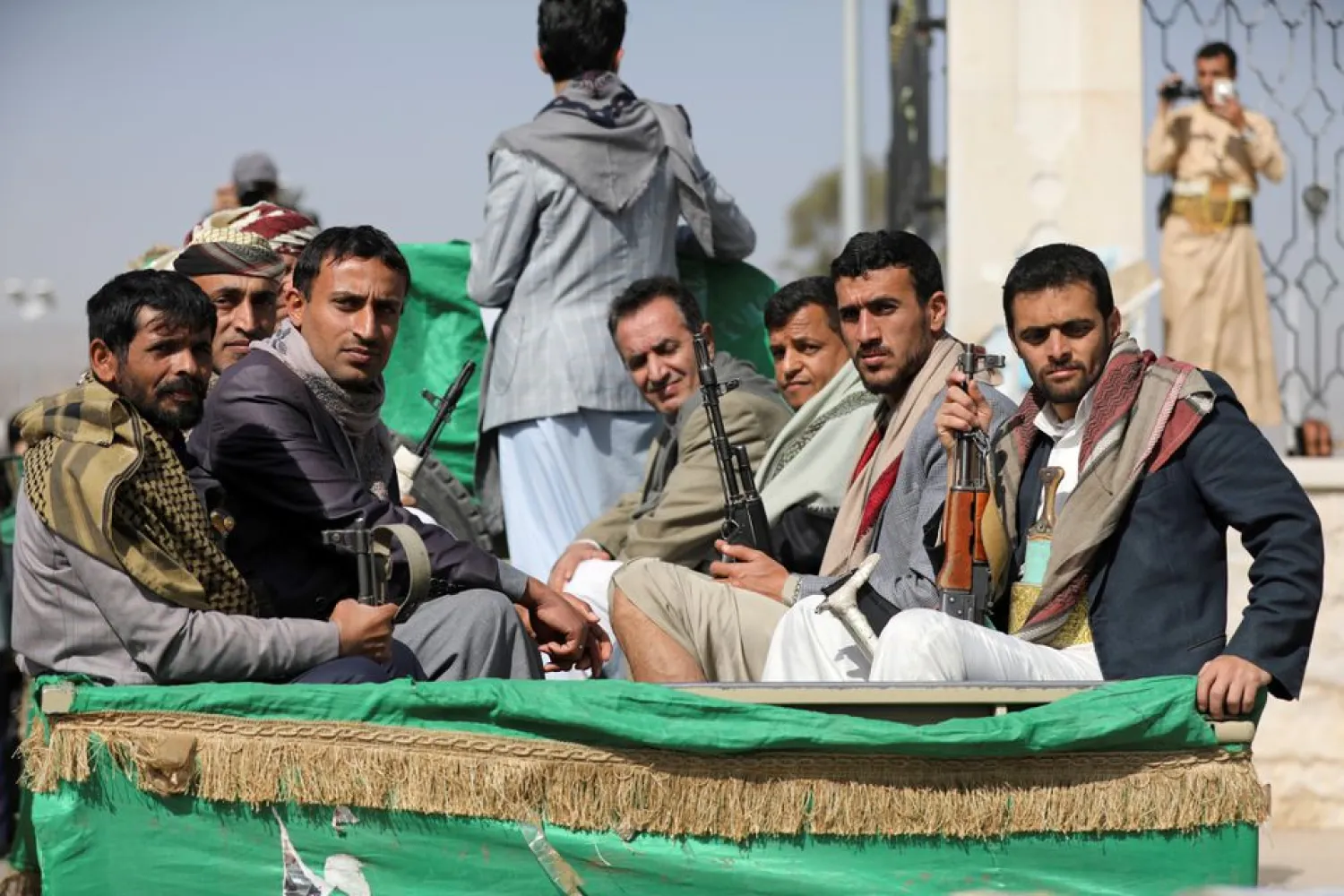
Armed Houthi followers ride on the back of a truck after participating in a funeral of Houthi fighters killed in recent fighting against government forces in Yemen's oil-rich province of Marib, in Sanaa, Yemen February 20, 2021. REUTERS/Khaled Abdullah
TT

Yemen Human Rights Center Documents 70 Abuses Against Civilians in Taiz Last Month

Armed Houthi followers ride on the back of a truck after participating in a funeral of Houthi fighters killed in recent fighting against government forces in Yemen's oil-rich province of Marib, in Sanaa, Yemen February 20, 2021. REUTERS/Khaled Abdullah

In its latest report, the Human Rights Information and Training Center (HRITC) has documented 70 violations committed by Iran-backed Houthi militia against civilians in Taiz in the country’s south, during the month of October.

The center said that its field team was able to document the killing of 20 civilians, including two women and 6 children. The Houthi militia alone caused the deaths of 12 civilians, including two women and 5 children, it noted.

Also, six civilians were killed by the militia’s artillery shells. One civilian was killed by direct fire, another civilian was killed by a landmine explosion, and two civilians were killed by an explosive device explosion.

HRITC added that one woman was killed by a sniper’s bullets, while a child was executed by members of the Houthi militia.

The report said two civilians were killed by direct fire, and two others, one of whom was a child, were killed in the explosion of an explosive device planted by gunmen outside the framework of the state. Four civilians were killed by direct bullets by unknown gunmen.

The field center team was able to monitor the injury of 15 civilians, including two women and three children. The Houthi militia directly injured 10 civilians, including a woman and two children.

Four civilians, including two children, were wounded by various artillery shells, while three civilians, including a woman, were wounded by a militia sniper, a civilian was injured by a landmine explosion, and two civilians were injured by an explosive device explosion.

The report highlighted the levies imposed by Houthi leaders under various pretexts and names. It also pointed to the constant assassination attempts of military figures in the liberated areas.


Iraqi PM-Designate Offers Baghdad’s Mediation Between Iran, US

A photo released by the Iraqi presidency on April 27, 2026, shows President Nizar Amedi, center, shaking hands with Prime Minister-designate Ali al-Zaidi, right, in Baghdad
TT

Iraqi PM-Designate Offers Baghdad’s Mediation Between Iran, US

A photo released by the Iraqi presidency on April 27, 2026, shows President Nizar Amedi, center, shaking hands with Prime Minister-designate Ali al-Zaidi, right, in Baghdad

Iraqi Prime Minister-designate Ali al-Zaidi has affirmed Baghdad’s readiness to mediate between Iran and the United States during contacts with Iranian President Masoud Pezeshkian, as conflicting messages from both sides reach Iraq’s new government.

Al-Zaidi’s media office said in a statement issued on Tuesday that he had received a phone call from Pezeshkian, who congratulated him on being tasked with forming the government. The two discussed ways to strengthen bilateral relations.

The statement said al-Zaidi stressed Iraq’s support for diplomacy and dialogue to resolve disputes, affirming Baghdad’s ability to contribute to mediation between Tehran and Washington.

Al-Zaidi’s offer builds on Iraq’s previous role in hosting indirect channels of communication between Iran and the United States, as well as regional talks hosted by Baghdad in recent years, in an effort to ease tensions and promote stability, drawing on its ties with both sides and its geographic and political position.

Observers say Tehran has chosen to wage a diplomatic battle with Washington through Baghdad, sending “loaded” messages to al-Zaidi parallel to similarly “loaded” messages he received from Washington, beginning with Trump’s post, followed by his phone call of congratulations and remarks about al-Zaidi’s rise with American “help.”

The exchanges point to early signs of friction between the two sides over the new government in Baghdad.

By contrast, the Iranian president's comments on X took a more hardline tone. He called for the “removal of the military threat from the region,” saying “Muslims cannot be subjugated.”

This highlights a divergence in rhetoric between an Iraqi approach focused on de-escalation and diplomacy and an Iranian position emphasizing deterrence amid pressure.

The development comes as al-Zaidi’s government has yet to win parliament’s confidence, making any potential mediation role tied to the domestic political process and to Iraq’s balance in its relations with both Tehran and Washington.

“Iran’s strength”

In Tehran, the Fars News Agency, citing a statement from the Iranian presidency, reported that al-Zaidi said during the call that “Iran’s strength today is not exclusive to Iran, but represents support for all Muslims and Shiites.” He added that Iraq “will never accept that this strength be taken away from Iran.”

According to the statement, al-Zaidi linked that strength to the support Iraq received in confronting ISIS, saying, “This strength is what helped us in the war against terrorism.”

He added, according to the agency, that Iraq “needs Iran’s support,” saying “Iran’s strength is Iraq’s strength, and Iran’s weakness is Iraq’s weakness as well.” The remarks reflect the level of convergence in the two sides’ security outlook, especially on shared regional challenges.

The agency also reported that Pezeshkian affirmed Iran’s readiness to develop relations with Iraq, describing the two countries as “more than neighbors.” He stressed Tehran’s support for Baghdad in various fields, while also expressing readiness to settle disputes with countries in the region.

According to the agency, al-Zaidi expressed his desire to raise bilateral relations to advanced levels in the economic, political, and security spheres. He also affirmed Iraq’s readiness to host talks between Iran and the US, describing this as a “humanitarian and political duty.”


Senior Hezbollah Commander Reportedly Killed by Israel in Beirut Suburbs Strike

The scene following an Israeli airstrike on Dahieh, Beirut, Lebanon, 06 May 2026. EPA/WAEL HAMZEH
TT

Senior Hezbollah Commander Reportedly Killed by Israel in Beirut Suburbs Strike

The scene following an Israeli airstrike on Dahieh, Beirut, Lebanon, 06 May 2026. EPA/WAEL HAMZEH

A senior commander from Hezbollah's elite force was killed in an Israeli strike on Beirut's southern suburbs on Wednesday, the first on the area in nearly a month, a source close to the group said.

At least 11 other people were killed in strikes across the south and east, according to the Lebanese health ministry.

Israeli Prime Minister Benjamin Netanyahu said his military had targeted "the commander of Hezbollah's Radwan force.”

The source close to Hezbollah told AFP on condition of anonymity that "Malek Ballout, the operations commander in the Radwan force" was killed.

Lebanon's state-run National News Agency had reported that "Israeli warplanes launched an attack, targeting Ghobeiri" in the southern suburbs, a Hezbollah stronghold.

An AFP correspondent saw a building covered in rubble following the strike, as people left the area with their belongings.

Many of the southern suburbs' residents had already left after Hezbollah drew Lebanon into the Middle East war in March, and have not returned despite the truce in force since April 17.

A Lebanese security source told AFP on condition of anonymity that the strike hit an apartment in which Radwan leaders were holding a meeting.

Beirut and its southern suburbs had been spared Israeli attacks since April 8, when massive Israeli strikes across the country killed more than 350 people.

Wednesday's attack came as US President Donald Trump said there was "a very good chance" of sealing a peace deal with Iran.

First responders gather at the site of an Israeli airstrike in Beirut's southern suburbs on May 6, 2026. (Photo by AFP)

Israel has repeatedly bombed Lebanon, particularly the south, since the truce, with Hezbollah retaliating by launching attacks on Israeli troops.

The Israeli military said in a statement Thursday that an "explosive drone impact" wounded four soldiers -- one severely -- in southern Lebanon the previous day.

At least 11 people were killed in earlier Israeli strikes on southern and eastern Lebanon, the Lebanese health ministry said.

In Saksakiyeh, four people were killed and 33 wounded, including six children and four women.

The NNA also reported strikes across the south, including several on the town of Yater.

Israeli strikes on Lebanon have killed more than 2,700 people and displaced more than a million, particularly from southern and eastern Lebanon and Beirut's southern suburbs, since March 2.

World Health Organization chief Tedros Adhanom Ghebreyesus said on Wednesday it had "verified 152 attacks on healthcare that resulted in 103 deaths and 241 injuries.”

"These attacks have resulted in the closure of three hospitals and 41 primary health centers and caused damage to a further 16 hospitals."

The terms of the ceasefire allow Israel to act against "planned, imminent or ongoing attacks" by Hezbollah.

Visiting troops in southern Lebanon, where Israel has established a "yellow line,” Israeli army chief Eyal Zamir said they will "seize every opportunity to deepen the dismantling of Hezbollah and continue weakening it.”


Israeli Court Rejects Flotilla Activists’ Appeal Challenging Detention

 Brazilian Activist Thiago Avila, who was detained aboard the Gaza-bound Global Sumud Flotilla, which was intercepted by Israeli forces in international waters, appears at a court in Beersheba, southern Israel May 6, 2026. (Reuters)
Brazilian Activist Thiago Avila, who was detained aboard the Gaza-bound Global Sumud Flotilla, which was intercepted by Israeli forces in international waters, appears at a court in Beersheba, southern Israel May 6, 2026. (Reuters)
TT

Israeli Court Rejects Flotilla Activists’ Appeal Challenging Detention

 Brazilian Activist Thiago Avila, who was detained aboard the Gaza-bound Global Sumud Flotilla, which was intercepted by Israeli forces in international waters, appears at a court in Beersheba, southern Israel May 6, 2026. (Reuters)
Brazilian Activist Thiago Avila, who was detained aboard the Gaza-bound Global Sumud Flotilla, which was intercepted by Israeli forces in international waters, appears at a court in Beersheba, southern Israel May 6, 2026. (Reuters)

An Israeli court on Wednesday rejected an appeal contesting the detention of two foreign activists seized by Israeli forces from a Gaza-bound flotilla, with the rights group representing them denouncing the ruling as "unlawful."

Saif Abu Keshek, a Spanish national of Palestinian origin, and Brazilian Thiago Avila were among dozens of activists aboard a flotilla intercepted in international waters off the coast of Greece on Thursday.

The two were seized by Israeli forces and brought to Israel for questioning, while the others were taken to the Greek island of Crete and released.

On Tuesday, an Israeli court extended their detention until Sunday to allow police more time to interrogate them, according to their lawyers.

The lawyers then filed an appeal at the Beersheva district court against the detention, but it was rejected.

"Today, the district court of Beersheva denied our appeal and basically accepted all of the arguments that the state or the police have represented before the court and kept the previous decision," lawyer Hadeel Abu Salih said.

The two activists, who are on a hunger strike, had appeared in the district court with their feet shackled, an AFP journalist saw.

Abu Keshek looked exhausted and sat with his hands clasped in his lap, while Avila appeared calm.

Abu Salih said her clients had been subjected to "an illegal arrest that took place in international waters where the activists were kidnapped by the Israeli navy without any authority".

She went on to accuse the courts of "giving a free hand for the Israeli forces... to do it again and again".

- 'Unlawful and unreasonable' -

Israeli rights group Adalah, which is representing the pair, called Wednesday's court decision "unlawful and unreasonable".

"This is especially egregious given that the activists were abducted from an Italian-flagged vessel, placing them under Italian jurisdiction," it said.

Adalah has also accused the authorities of subjecting the men to continuous abuse in detention, including keeping Avila in a cold cell.

Abu Salih said Abu Keshek reported giving up water, as well as food, and that the two men said authorities "keep interrogating them for most of the time, most of the day" about the flotilla, she added.

Israeli authorities have rejected the allegations of abuse but have filed no charges against the men.

Adalah said authorities have accused the pair of "assisting the enemy during wartime" and "membership in and providing services to a terrorist organization".

Israel says both men were affiliated with the Popular Conference for Palestinians Abroad (PCPA), a group accused by Washington of "clandestinely acting on behalf of" Palestinian militant group Hamas.

Spain, Brazil and the United Nations have called for their swift release.

"It is not a crime to show solidarity and attempt to bring humanitarian aid to the Palestinian population in Gaza, who are in dire need of it," UN rights office spokesman Thameen Al-Kheetan said in a statement.

The flotilla had set sail from France, Spain and Italy with the aim of breaking Israel's blockade of Gaza and delivering humanitarian aid to the war-ravaged Palestinian territory.

Israel controls all entry points into Gaza, which has been under an Israeli blockade since 2007.