


Turkish Lira on Eight-Day Spiral to All-Time Lows

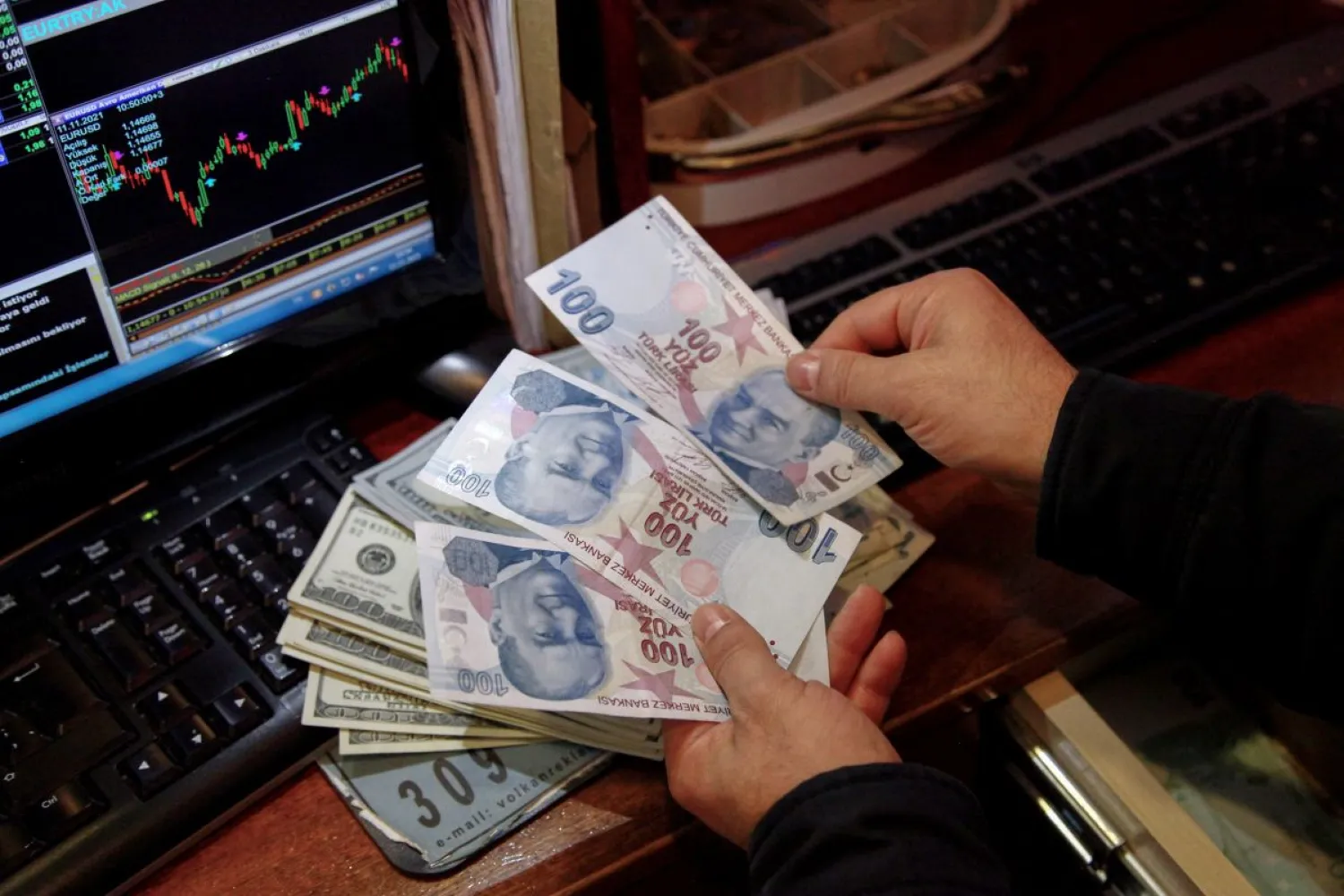
A money changer counts Turkish lira banknotes at a currency exchange office in Ankara, Turkey November 11, 2021. (Reuters)
TT

Turkish Lira on Eight-Day Spiral to All-Time Lows

A money changer counts Turkish lira banknotes at a currency exchange office in Ankara, Turkey November 11, 2021. (Reuters)

Turkey's lira gave up earlier gains and dropped as much as 2% to a new record low on Friday, a day after crashing 6% when the central bank, under pressure from President Recep Tayyip Erdogan, slashed rates and signaled more risky easing was on the way.

The lira first rallied to 10.83 against the dollar before fizzling to 11.32, notching an eighth straight session of all-time lows. It was worth 11.2 at 1632 GMT, raising risks for the economy and for Erdogan's political future.

The worst performer in emerging markets, the lira has plunged some 12% this week alone, propelled by the central bank's decision to cut its policy rate by 100 basis points to 15% despite inflation running near 20%.

Thursday's crash marked the biggest daily drop for the lira since Erdogan, a self-described enemy of interest rates, sacked former hawkish central bank chief Naci Agbal in March.

Turkey's central bank is seen as bowing to Erdogan's calls for stimulus as it forges on with what analysts see as a reckless easing cycle given the lira's meltdown and expected inflation pressure through mid-2022.

The currency selloff stokes prices via imports. It sharpened dramatically as the central bank turned dovish in September and later began slashing rates by a total 400 basis points.

Emre Cayirli, manager at ALB Forex research department, said the lira selloff could reach 11.5 on expectations of another cut in December and continue due to a strengthening dollar.

"Inflation could continue to rise in relation to the increase caused by the rise in the exchange rate, a potential rise in demand in the economy and higher import prices," he said, citing a 2.19% uptick in loans since the October rate cuts.

State banks followed the central bank's lead on Friday, lowering interest rates on loans by up to 100 basis points, state-owned Anadolu news agency reported.

Policy mix

The soaring living costs and 65% lira depreciation in four years have eaten into Turks' earnings and hit Erdogan's opinion polls ahead of elections no later than mid-2023.

Opposition leaders have called for early polls to quickly redirect economic policy. Erdogan on Wednesday pledged to keep battling interest rates "to the end" to stoke exports, investment and jobs.

The central bank said much of the price pressure was temporary and would persist through mid-2022, adding it has some room for another possible rate cut next month.

The monetary easing leaves Turkey's real yields sharply negative and runs against the grain of a world in which central banks are raising rates to head off global price rises.

Economists had predicted last week that the central bank would cut rates but some later said the sharp lira slump could stay its hand.

A jump in benchmark bond yields suggests the bank will be forced to reverse course in coming months. Goldman Sachs predicted it will hike rates in the second quarter of 2022 after another 100-basis-point cut next month.

"The current policy mix is not sustainable (and) likely to quickly translate into inflation, rather than growth," analysts at the Wall Street bank said.

They added that the lira depreciation is likely to keep inflation above 20% through mid-2022.

The lira has lost as much as 39% this year after touching a high water mark of 6.9 in February.



SAUDI EXPORTS, Heritage Commission Launch 'Saudi Crafts' Brand at Made in Saudi Expo 

The launch of Saudi Crafts took place during the third annual Made in Saudi Expo held at the Riyadh. (SPA)
TT

SAUDI EXPORTS, Heritage Commission Launch 'Saudi Crafts' Brand at Made in Saudi Expo 

The launch of Saudi Crafts took place during the third annual Made in Saudi Expo held at the Riyadh. (SPA)

The Saudi Export Development Authority (SAUDI EXPORTS), through its “Made in Saudi” program, announced on Monday the official launch of the “Saudi Crafts” sub-brand in cooperation with the Heritage Commission.

The launch of Saudi Crafts, part of the national Saudi Made brand, took place during the third annual Made in Saudi Expo held at the Riyadh from December 15 to 17, coinciding with the Year of Handicrafts.

Saudi Crafts was unveiled during “Banan: The Saudi International Handicrafts Week” in November, marking a new step in efforts to develop the handicrafts sector, empower male and female artisans, and strengthen the integration of their products within the national industrial ecosystem.

The Saudi Crafts sub-brand will highlight Saudi handicrafts as products that embody creativity, authenticity, and quality, presenting them in a contemporary manner that boosts their competitiveness in local and global markets under the umbrella of the national Saudi Made brand.

This year's Made in Saudi Expo allocated dedicated spaces to showcase artisans' products, introduce national handicraft skills, and connect artisans with supporting entities and potential buyers, thus expanding growth opportunities. It reinforces the presence of Saudi handicrafts as a key element of the Kingdom's cultural and economic identity.

The official launch of the Saudi Crafts sub-brand represents a key milestone in joint national efforts to develop creative industries, support the sustainability of local crafts, and increase the visibility of Saudi products in domestic and international markets.


13th Saudi Smart Grid Conference Opens in Riyadh

The three-day conference brings together experts and specialists from 25 countries and features 28 panel discussions and technical sessions. (SPA)
TT

13th Saudi Smart Grid Conference Opens in Riyadh

The three-day conference brings together experts and specialists from 25 countries and features 28 panel discussions and technical sessions. (SPA)

The 13th Saudi Smart Grid Conference (SASG 2025), and its accompanying exhibition, opened in Riyadh on Monday under the patronage of the Saudi Ministry of Energy.

Held the theme “Innovation Today for a Sustainable Tomorrow,” the three-day conference brings together experts and specialists from 25 countries and features 28 panel discussions and technical sessions presenting 225 scientific papers on global advancements in smart grid systems.

In an opening address, Assistant Minister of Energy for Electricity Affairs, Eng. Nasser Al-Qahtani highlighted the continued support extended to the energy sector by the Kingdom’s leadership.

He commended the Minister of Energy’s support for convening and sponsoring the conference, noting its importance in advancing dialogue on smart grid technologies.

“Smart grid technologies are a cornerstone of the global energy transition,” Al-Qahtani said. “They enable improvements across electricity generation, transmission, and distribution, while strengthening grid security and reliability.”

In line with Saudi Vision 2030, the Ministry of Energy is advancing long-term planning to optimize the use of the Kingdom’s diverse energy resources, with the aim of strengthening grid security and resilience and improving generation efficiency, he added.

These efforts reinforce Saudi Arabia’s leadership in this vital sector, position the Kingdom as a global hub for electricity interconnection and renewable power exports, and support the development of a regional electricity trading market, an optimal energy mix, and national emissions-reduction targets, he remarked.

Al-Qahtani stressed that the Kingdom’s electricity sector has undergone significant transformation in recent years, including major upgrades to grid infrastructure to enhance readiness for renewable energy integration and energy-storage systems.

“Smart grids are a fundamental component of electricity sector development,” he said. “They enhance incident response, accelerate system recovery, and improve service reliability by analyzing smart-meter data through the use of artificial intelligence to support proactive, data-driven decision-making.”

He noted that distribution network automation in the Kingdom reached approximately 40% by the end of 2025, an optimal level in line with international best practices in terms of return on investment.

He also highlighted the development of renewable power projects with a combined capacity of nearly 64 gigawatts, of which 12.3 gigawatts have already been connected to the national grid.

Additionally, battery energy-storage systems with a total capacity of 30 gigawatt-hours are under development, with 8 gigawatt-hours already grid-connected. These projects, he said, play a critical role in enabling the grid to balance real-time fluctuations between supply and demand resulting from the variable nature of renewable energy sources.

The opening ceremony included the recognition of the Energy Hackathon winners, the exchange of agreements, and the inauguration of the accompanying exhibition.

The conference provides a global platform for sharing expertise and forging partnerships in smart grids and the digital economy, and convenes international experts, decision-makers, researchers, and specialists.

Discussions will address key challenges and opportunities across the power sector, renewable energy, regulation and the future of smart grids, with emphasis on technology localization, capacity building and technical partnerships to strengthen smart infrastructure and support a sustainable, investment-friendly and innovation-enabling energy ecosystem.

The conference will also explore the integration of renewable energy sources, the latest developments in electricity storage solutions and smart load-management systems, as well as the role of cybersecurity in protecting energy infrastructure and strengthening system reliability.


Saudi Industry Minister, Syrian Counterpart Visit Made in Saudi Expo 

Saudi Minister of Industry and Mineral Resources Bandar Alkhorayef and Syrian Minister of Economy and Industry Mohammad Nidal al-Shaar at the Ministry of Interior’s pavilion at the Made in Saudi Expo 2025 in Riyadh. (SPA)
TT

Saudi Industry Minister, Syrian Counterpart Visit Made in Saudi Expo 

Saudi Minister of Industry and Mineral Resources Bandar Alkhorayef and Syrian Minister of Economy and Industry Mohammad Nidal al-Shaar at the Ministry of Interior’s pavilion at the Made in Saudi Expo 2025 in Riyadh. (SPA)

Saudi Minister of Industry and Mineral Resources Bandar Alkhorayef and Syrian Minister of Economy and Industry Mohammad Nidal al-Shaar visited the Ministry of Interior’s pavilion at the third annual Made in Saudi Expo 2025 in Riyadh, reported the Saudi Press Agency on Tuesday.

The event is being held from December 15-17.

The ministers reviewed efforts to localize spending on military and technological systems and promote national products and solutions in security and service sectors, including the Saudi armored vehicle “Al-Dahna,” the ministry’s e-platform “Absher,” and the “ASEF II” drone for environmental security and sustainability.

They also explored electronic services for citizens, residents, and visitors, as well as key developmental projects within the ministry and its security sectors.