Tunisian Parties Denounce US 'Meddling' in Political Affairs

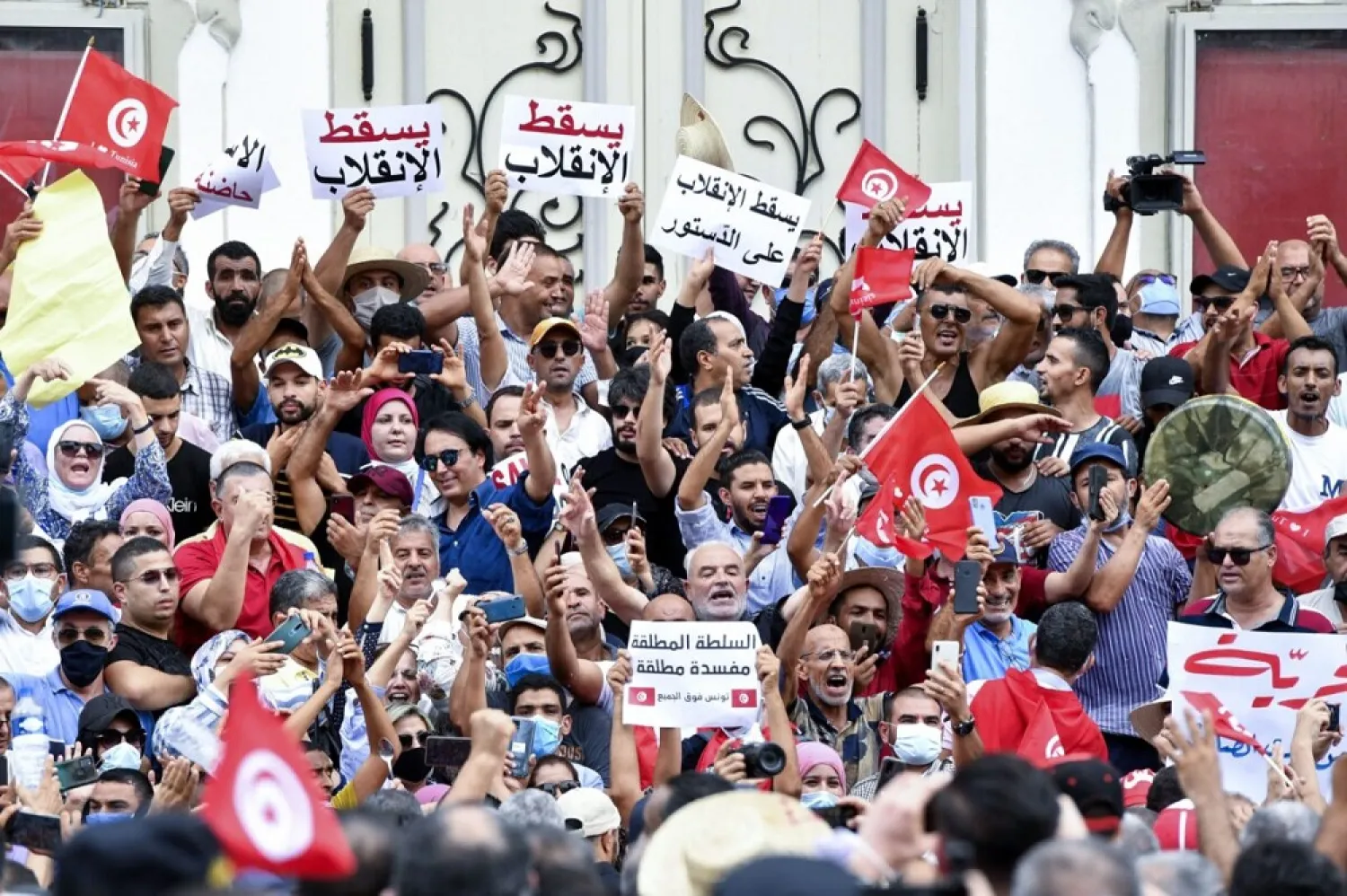
Tunisian demonstrators shout slogans against President Kais Saied. (AFP via Getty Images)
TT

Tunisian Parties Denounce US 'Meddling' in Political Affairs

Tunisian demonstrators shout slogans against President Kais Saied. (AFP via Getty Images)

Tunisian political parties, including the Free Destourian party, led by Abir Mossi, and the Movement Party chaired by Moncef Marzouki, denounced the perceived US interference in their country's political affairs.

Tunisian President Kais Saied had held telephone talks with US Secretary of State Antony Blinken on Sunday. Blinken encouraged Saied to make reforms to respond to Tunisians' hopes for "democratic progress"

The parties accused the presidency of undermining Tunisia, saying it is publishing inaccuracies and shameful insults and degrading the Tunisian state and people.

The US embassy in Tunisia revealed that Blinken spoke with Saied to discuss recent developments in Tunisia, including the formation of the new government and steps to alleviate the economic situation.

The American official encouraged a transparent and inclusive reform process to address Tunisia's significant political, economic, and social challenges and respond to the Tunisian people's aspirations for continued democratic progress.

Meanwhile, security forces used tear gas to disperse the Environment, Plantation, and Gardening Company workers' protests in Qibili (south).

The workers gathered at the entrances of the state, expressing their anger over unpaid wages over the past two months.

Residents said the use of gas was "excessive," stressing that the tear gas bombs fell near and inside some houses, which led to the suffocation of some residents.

According to a statement by Lhadi Lahmar, head of the Gardening Syndicate, they were forced to leave their homes.

Unemployed university graduates also organized similar protests after Saied backtracked on Law 38 which calls for hiring them in the public sector.


Lebanese Health Ministry Says Two People Wounded in Israeli Drone Strike on Nabatieh

Smoke rises following an Israeli airstrike in the town of Deir Seryan as seen from the 'pilot zone' village of Zawtar al-Gharbiyah, Nabatieh Governorate, southern Lebanon, 31 July 2026, following a US-brokered security agreement between Lebanon and Israel. EPA/STRINGER
TT

Lebanese Health Ministry Says Two People Wounded in Israeli Drone Strike on Nabatieh

Smoke rises following an Israeli airstrike in the town of Deir Seryan as seen from the 'pilot zone' village of Zawtar al-Gharbiyah, Nabatieh Governorate, southern Lebanon, 31 July 2026, following a US-brokered security agreement between Lebanon and Israel. EPA/STRINGER

Lebanon's health ministry said on Tuesday that an ‌Israeli ‌drone strike ‌in ⁠the city of ⁠Nabatieh wounded two civilians.

The ministry ⁠added ‌that ‌a second strike ‌targeted ‌a rescue team from ‌the Al-Risala Association, damaging ⁠an ⁠ambulance.


Former Syrian President Assad Sentenced to Death in Absentia

A woman uses her mobile phone near a damaged picture of ousted Syrian ruler Bashar al-Assad as people celebrate, after the Syrian opposition announced that they have ousted President Bashar al-Assad, in Qamishli, Syria December 8, 2024. REUTERS/Orhan Qereman
TT

Former Syrian President Assad Sentenced to Death in Absentia

A woman uses her mobile phone near a damaged picture of ousted Syrian ruler Bashar al-Assad as people celebrate, after the Syrian opposition announced that they have ousted President Bashar al-Assad, in Qamishli, Syria December 8, 2024. REUTERS/Orhan Qereman

A Syrian court sentenced in absentia ousted Syrian President Bashar al-Assad along with his younger brother to death on Tuesday for crimes against humanity and war crimes during Syria’s 14-year conflict that left about half a million people dead. 

Also sentenced to death in the same case was Assad’s maternal cousin Atef Najib for leading the crackdown in the southern province of Daraa that led to the uprising and later the civil war. 

Amid tight security, Najib stood inside a cage wearing a prisoner’s uniform as the judge read the sentence. 

Assad and his brother Maher fled to Russia after insurgents marched into Damascus in December 2014. 

Najib was later detained and became one of the highest-ranking officials to be put on trial. 

Najib is a former Syrian army brigadier general who was head of the Political Security Branch in southern Syria’s Daraa province under Assad in 2011. 


Lebanon’s Ali al-Taher Back at Center of Escalation

The Ali al-Taher Heights, located east of the city of Nabatieh in southern Lebanon, with the towns of Kafr Tebnit and Nabatieh al-Fawqa in the foreground. (Asharq Al-Awsat).
TT

Lebanon’s Ali al-Taher Back at Center of Escalation

The Ali al-Taher Heights, located east of the city of Nabatieh in southern Lebanon, with the towns of Kafr Tebnit and Nabatieh al-Fawqa in the foreground. (Asharq Al-Awsat).

Intensified Israeli operations have thrust the Ali al-Taher Heights back to the forefront of tensions in southern Lebanon, days after the town of Mansouri came under Israeli attack.

Repeated artillery fire and strikes have targeted the heights and surrounding areas amid Israeli claims of underground military facilities in the area.

Israeli Prime Minister Benjamin Netanyahu announced Sunday that his army was carrying out a “highly important operation” in Lebanon, specifically citing the targeting of operatives at Ali al-Taher.

Some assessments link the intensity of Israeli operations to the area’s strategic importance and the possibility that Israel may seek to expand its control there. Others view the developments within the broader issue of Hezbollah’s weapons, while the US position remains a key factor in determining the scope and timing of any wider Israeli action.

Heavy shelling

Ali al-Taher came under intense Israeli artillery fire overnight Sunday into Monday, continuing until dawn. Local reports said that more than 70 shells struck the area. The attacks continued Monday morning with drone strikes, while shelling hit the area between Zawtar and Mayfadoun.

Netanyahu adviser Dmitry Gendelman maintained that “Israel would remain in the security zone and act independently to dismantle Hezbollah’s military infrastructure.

Gendelman said Ali al-Taher contained a Hezbollah command center, and claimed the destruction of a tunnel complex beneath Beaufort Castle, along with operations targeting the group’s infrastructure, personnel and weapons.

Israeli claims of having seized the hill come amid conflicting accounts over the nature of its presence there and underground facilities in the area. Reports have suggested that operatives remain inside a facility and that efforts are underway to encircle them and cut supply routes.

Missed opportunity

Retired Brig. Gen. Yaarob Sakher said Lebanon missed a “golden opportunity” at Ali al-Taher, arguing that Hezbollah could have handed the area over to the Lebanese Army as an additional pilot zone.

“There was a golden opportunity for Lebanon at Ali al-Taher,” Sakher told Asharq Al-Awsat. “Hezbollah could have handed it over to the Lebanese Army, which would enter and take control, but the party refused.”

In his assessment, the refusal gave Israel an opportunity to harden its position. He added that Hezbollah is unlikely to surrender the area because of its military significance.

“We do not know everything that is there, but Ali al-Taher appears to contain what could be described as a major operations room, alongside an extensive tunnel network believed to connect with other areas,” he explained.

Sakher added that circulating information points to the possible presence of weapons and ammunition depots and senior personnel, noting that Hezbollah’s determination to hold the area suggests it carries considerable importance.

Beyond Ali al-Taher

Retired Brig. Gen. Khaled Hamadeh, by contrast, cautioned against reducing the escalation to the fate of the heights, viewing the intensified bombardment as part of a broader Israeli course of action.

“The issue goes beyond Ali al-Taher, and we are heading toward further escalation,” Hamadeh told Asharq Al-Awsat, linking the developments to Israeli operations in other southern areas, including Mansouri and Zawtar.

In his view, Israel “will not allow any security or military surprise in areas it considers sensitive,” and the operations are intended to send a message beyond any single position on the ground.

“The fundamental issue is not Ali al-Taher or any particular military position, but Hezbollah’s weapons,” he stressed.

Israel is acting on the premise that the framework agreement with Lebanon requires the weapons to be addressed and that the current situation will leave the door open to further strikes, he remarked.

“The main problem lies in the lack of political will to disarm Hezbollah,” he added.