


Can World Powers Curb Iran in New Nuclear Talks?

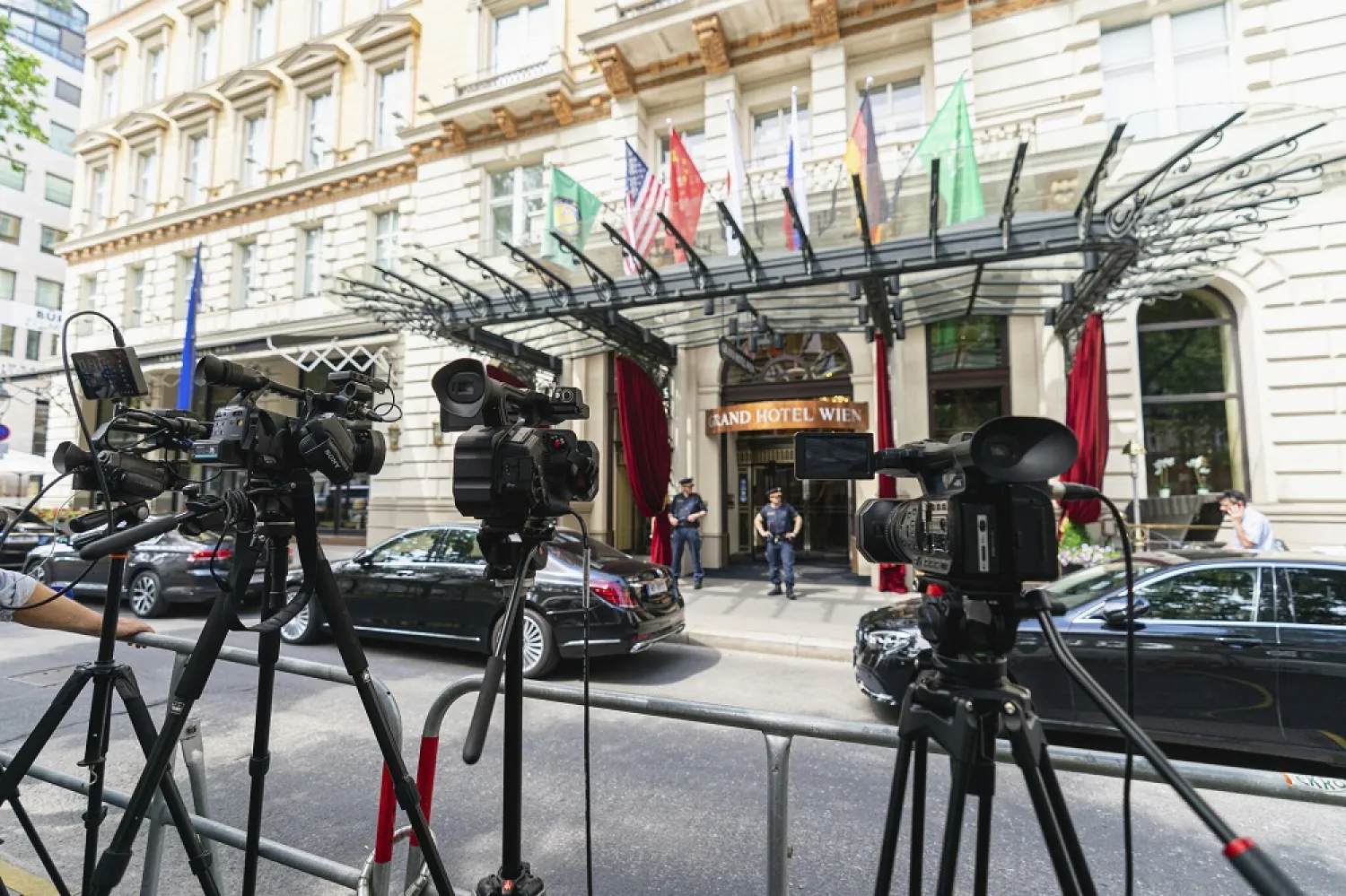
TV cameras in front of the Grand Hotel Vienna where closed-door nuclear talks take place in Vienna, Austria, June 20, 2021. (AP)
TT

Can World Powers Curb Iran in New Nuclear Talks?

TV cameras in front of the Grand Hotel Vienna where closed-door nuclear talks take place in Vienna, Austria, June 20, 2021. (AP)

Can the 2015 nuclear deal between Iran and world powers be restored? As Iran and six global powers gather in Vienna Monday to discuss the tattered treaty, the answer appears to be no.

Since then-President Donald Trump withdrew from the agreement in 2018, Iran has raced forward with its nuclear program, making it all but impossible to simply turn back the clock. The election of a hard-line leader in Iran, coupled with a US administration seen as weak in the region, have further dampened prospects for a breakthrough.

The outlook appears so grim that prominent voices in Israel, which pushed Trump to withdraw from the deal, are now saying the move was a huge mistake.

Former Israeli Defense Minister Moshe Yaalon, who fiercely opposed the original deal, was one of the rare Israeli voices to argue against withdrawal at the time. He now says the US pullout has turned out to be the “main mistake” in the region of the past decade.

A flawed deal, he told a security conference last week, “probably was better than not having the agreement and to allow the Iranians to use the withdrawal as an excuse to go ahead with the project.”

“Now they are in the closest stage they have been ever to become a (nuclear) threshold state,” he said.

The Associated Press takes a closer look at the deal and what to expect this week:

Why did the original deal collapse?

The 2015 agreement between Iran and world powers -- spearheaded by President Barack Obama -- aimed to prevent Iran from being able to build a nuclear bomb. It offered Iran relief from crippling economic sanctions in exchange for curbs of 10 to 15 years on its nuclear activities. Iran says its nuclear program is solely for peaceful purposes.

Critics, led by then-Israeli Prime Minister Benjamin Netanyahu, assailed the deal because the restrictions on Iran were temporary. They also complained it did not address Iran’s non-nuclear military activity -- such as its support for hostile militant groups and development of long-range missiles.

When Trump withdrew, with strong urging from Netanyahu, he promised a campaign of “maximum pressure” on Iran. However, the approach appears to have backfired. Despite increased U.S. sanctions, Iran’s government remains firmly in power, and the country has raced forward with nuclear research banned by the original deal.

Can’t the deal just be reinstated?

Iran began exceeding the limits of the agreement after the US withdrawal, and now enriches small amounts of uranium up to 60% purity — a short step from weapons-grade levels of 90%. Iran also spins advanced centrifuges once barred by the accord and its uranium stockpile now far exceeds the accord’s limits.

Experts say that even if Iran were forced to give up its uranium stockpile or halt its research, the expertise it has gained cannot be taken away.

What are the prospects for this week’s talks?

In the short term, it does not look encouraging. Heading into the talks, Iran’s hard-line president, Ebrahim Raisi, has made maximalist demands, including calls for the US to unfreeze $10 billion in assets as an initial goodwill gesture.

The tough line might be an opening gambit. European negotiators remain confident a deal will be reached in the short to medium term.

But US officials do not appear optimistic. President Joe Biden and his top advisers have held a series of meetings in recent weeks with key allies and negotiating partners to prepare for the possible failure of talks.

Because of Trump's withdrawal, the Americans won't even be in the negotiating room. Instead, they will be nearby and work through mediators.

In an interview broadcast Friday, chief US negotiator Rob Malley said signs from Iran “are not particularly encouraging.”

Speaking to NPR, he said the US prefers a diplomatic solution. But if that is impossible, he said the US will respond accordingly.

“The options that are at America’s disposal are, you know, they’re familiar to all,” he said.

Given the tepid US response to alleged Iranian military activity in the region, including attacks on civilian shipping in the Gulf and a strike on a US base in Syria, US military action does not seem to be a serious threat. The United States’ bungled pullout from Afghanistan has further eroded American credibility in the region.

“I’m very pessimistic,” said Yoel Guzansky, a former official in the Israeli prime minister’s office who is now a senior fellow at the Institute for National Security Studies in Tel Aviv. “Iran shows patience, resilience, determination. I’m sorry to say the Americans don’t show that, and we don’t have a lot of time.”

What can Israel do?

Israel is not a party to the talks, but it has a huge stake in the outcome.

It considers Iran to be its No. 1 enemy and views a nuclear-armed Iran as an existential threat. Israel is believed to be the only nuclear-armed state in the region, though it does not publicly acknowledge its own arsenal.

Netanyahu's successor, Naftali Bennett, has been careful not to clash with Biden in public. But his positions are similar to Netanyahu’s. He has expressed hope an improved deal would emerge from the talks but reiterated Israel’s longstanding threat to take unilateral action if necessary.

“We will maintain our freedom to act,” he said last week. On Sunday, he said Israel is “very disturbed” by what he sees as a willingness by the global powers to lift sanctions and reinstate “insufficient restrictions in the nuclear sphere.” He said Israel has been passing this message to all concerned parties.

Despite such threats, Israel might hesitate. Iran has spent the past decade scattering its nuclear sites and hiding them deep underground. Plus, Israel might be reluctant to sabotage a global diplomatic effort.

Is Iran overplaying its hand?

China and Russia, two important Iranian outlets for trade and parties to the deal, could grow impatient with Tehran, especially if a now-shaky system of international nuclear inspections falls apart. Economic pressure continues to squeeze Iranians, who have seen their savings evaporate with the free-fall of the country’s currency.

If talks drag on, the US might turn to new sanctions or even military action. There’s also the risk of a military intervention by Israel.

“We’ll see in the coming days what exactly” Iran's approach will be, State Department spokesman Ned Price said last week. “But we’ve also been very clear that this is not a process that can go on indefinitely."



Independent UN Body Condemns ‘Vicious Attacks’ on UN Expert on Palestinian Rights

United Nations (UN) Special Rapporteur on the occupied Palestinian territories Francesca Albanese looks on at the end of a press conference on the human rights situation in Gaza in Geneva on September 15, 2025. (AFP)
TT

Independent UN Body Condemns ‘Vicious Attacks’ on UN Expert on Palestinian Rights

United Nations (UN) Special Rapporteur on the occupied Palestinian territories Francesca Albanese looks on at the end of a press conference on the human rights situation in Gaza in Geneva on September 15, 2025. (AFP)

An ‌independent United Nations body on Tuesday condemned what it described as vicious attacks based on disinformation by several European ministers against the organization's special rapporteur for Palestine, Francesca Albanese.

In the past week several European countries, including Germany, France and Italy, called for Albanese’s resignation over her alleged criticism of Israel. Albanese, an Italian lawyer, denies making the remarks.

On Friday, the Czech Republic's Foreign Minister Petr Macinka quoted Albanese on X as having called Israel a "common enemy of humanity", and he ‌also called for ‌her resignation.

A transcript of Albanese's remarks ‌made ⁠in Doha on ⁠February 7 seen by Reuters did not characterize Israel in this way, although she has consistently criticized the country in the past over the Gaza conflict.

The UN Coordination Committee - a body of six independent experts which coordinates and facilitates the work of Special Rapporteurs - accused European ministers of relying on "manufactured ⁠facts".

"Instead of demanding Ms. Albanese's resignation ‌for performing her mandate...these government representatives ‌should join forces to hold accountable, including before the International Criminal Court, ‌leaders and officials accused of committing war crimes and ‌crimes against humanity in Gaza," the Committee said.

It said the pressure exerted on Albanese was part of an increasing trend of politically motivated and malicious attacks against independent human rights experts, UN officials ‌and judges of international courts.

US President Donald Trump's administration imposed sanctions on Albanese after she wrote ⁠letters ⁠to US companies accusing them of contributing to gross human rights violations by Israel in Gaza and the West Bank.

UN experts are commissioned by the Geneva-based Human Rights Council to monitor and document specific human rights crises but are independent of the organization itself.

There is no precedent for removing a special rapporteur during their term, although diplomats said that states on the 47-member council could in theory propose a motion to do so.

However, they said strong support for Palestinian rights within the body means that such a motion was unlikely to pass.


US Plans to Deploy More Missile Launchers to the Philippines Despite China’s Alarm 

A US M142 High Mobility Artillery Rocket System (HIMARS) fires a missile during a Combined Joint Littoral Live Fire Exercise at the joint military exercise called "Balikatan", Tagalog for shoulder-to-shoulder in a Naval station in Zambales province, northern Philippines on Wednesday, April 26, 2023. (AP)
TT

US Plans to Deploy More Missile Launchers to the Philippines Despite China’s Alarm 

A US M142 High Mobility Artillery Rocket System (HIMARS) fires a missile during a Combined Joint Littoral Live Fire Exercise at the joint military exercise called "Balikatan", Tagalog for shoulder-to-shoulder in a Naval station in Zambales province, northern Philippines on Wednesday, April 26, 2023. (AP)

The United States plans to deploy more high-tech missile systems to the Philippines to help deter aggression in the South China Sea, where the treaty allies on Tuesday condemned what they called China’s "illegal, coercive, aggressive, and deceptive activities."

Beijing has repeatedly expressed alarm over the installation in the northern Philippines of a US mid-range missile system called the Typhon in 2024 and of an anti-ship missile launcher last year. It said the US weapons were aimed at containing China’s rise and warned that these were a threat to regional stability.

China has asked the Philippines to withdraw the missile launchers from its territory, but officials led by President Ferdinand Marcos Jr. have rejected the demand.

US and Philippine officials held annual talks Monday in Manila on broadening security, political and economic engagements and boosting collaboration with regional security allies.

The US and the Philippines outlined in a joint statement Tuesday specific defense and security plans for this year, including joint military exercises, Washington's support to help modernize the Philippine military and efforts "to increase deployments of US cutting-edge missile and unmanned systems to the Philippines."

The longtime allies "underscored their support for preserving freedom of navigation and overflight, unimpeded lawful commerce and other lawful uses of the sea for all nations," the statement said.

"Both sides condemned China’s illegal, coercive, aggressive and deceptive activities in the South China Sea, recognizing their adverse effects on regional peace and stability and the economies of the Indo-Pacific and beyond," it added.

Confrontations between Chinese and Philippine coast guard forces have spiked in the disputed waters in recent years. Vietnam, Malaysia, Brunei and Taiwan are also involved in the territorial standoffs.

Neither side elaborated on the planned missile deployments but Philippine ambassador to Washington, Jose Manuel Romualdez, who took part in Monday’s talks, said US and Filipino defense officials discussed the possible deployment this year of "upgraded" types of US missile launchers that the Philippines may eventually decide to purchase.

"It’s a kind of system that’s really very sophisticated and will be deployed here in the hope that, down the road, we will be able to get our own," Romualdez told The Associated Press.

The Typhon missile system that the US Army deployed to the main northern Philippine region of Luzon in April 2024 and an anti-missile launcher called the Navy Marine Expeditionary Ship Interdiction System that was deployed in April last year also to Luzon have remained in the Philippines, Romualdez said.

During joint drills, US forces have exhibited the missile systems to batches of Filipino forces to familiarize them with the weapons’ capabilities and usage, military officials said.

Romualdez said the US missile deployments to the Philippines did not aim to antagonize any country.

"It’s purely for deterrence," he said. "Every time the Chinese show any kind of aggression, it only strengthens our resolve to have these types."

The Typhon missile launchers, a land-based weapon, can fire the Standard Missile-6 and the Tomahawk Land Attack Missile. Tomahawk missiles can travel over 1,000 miles (1,600 kilometers), which places China within their target range, from the northern Philippine region of Luzon.

Last year, the US Marines deployed the anti-ship missile launcher, the Navy Marine Expeditionary Ship Interdiction System, to Batan island in the northernmost Philippine province of Batanes, which faces the Bashi Channel just south of Taiwan.

The sea passage is a critical trade and military route that the US and Chinese militaries have tried to gain strategic control of.


France's Macron Eyes Fighter Jet Deal in India

France's President Emmanuel Macron (C-R) and his wife Brigitte Macron (C) are welcomed by India's officials upon their arrival in Mumbai on February 17, 2026. (Photo by Ludovic MARIN / AFP)
TT

France's Macron Eyes Fighter Jet Deal in India

France's President Emmanuel Macron (C-R) and his wife Brigitte Macron (C) are welcomed by India's officials upon their arrival in Mumbai on February 17, 2026. (Photo by Ludovic MARIN / AFP)

French President Emmanuel Macron will meet Indian Prime Minister Narendra Modi in Mumbai on Tuesday, as he begins a three-day visit to India focused on artificial intelligence cooperation and a potential multibillion dollar fighter jet deal.

France is seeking to expand its military partnership with New Delhi, with discussions expected on a possible contract for 114 additional French Dassault Rafale fighter jets, said AFP.

Modi, in a statement on social media addressed to his "dear friend" Macron, after he began his trip with his wife Brigitte in India's financial capital, said he looked forward to "advancing our bilateral ties to new heights".

Modi, who will meet Macron later on Tuesday afternoon, said he was "confident that our discussions will further strengthen cooperation".

Macron, on his fourth visit to India since taking office in 2017, began on Tuesday with a program including honoring the victims of the 2008 Mumbai attacks, and meeting Bollywood film stars, including Shabana Azmi and Manoj Bajpayee.

He also called Modi his "dear friend", in post on X, saying they will "go even further" in cooperation.

The visit follows New Delhi's confirmation last week that it intends to place a major order for Rafale jets, as well as the signing of a landmark free trade agreement between India and the European Union in January.

Macron will travel to New Delhi for an artificial intelligence summit on Wednesday and Thursday.

- 'Contract of the century' -

New Delhi has sought over the past decade to reduce its dependence on Russia, its traditional main supplier of military equipment, turning to other countries while also pushing for more domestic production.

An Indian defense ministry statement last week said the proposed purchase of Rafale jets had been cleared -- with "the majority" of them to be manufactured in India.

Christophe Jaffrelot, an India specialist at Sciences Po Center for International Studies in Paris, described the potential EUR30 billion ($35 billion) deal for 114 Rafales as the "contract of the century".

If finalized, the jets would add to the 62 Rafales that India has already purchased.

The French presidency has voiced optimism that what it calls a "historic" agreement could be reached.

- 'Good chemistry' -

Modi and Macron will also inaugurate on Tuesday, via videoconference, India's first helicopter final assembly line, a joint venture between India's Tata Group and Airbus.

The facility in Vemagal, in the southern state of Karnataka near the tech hub of Bengaluru, will manufacture the Airbus H125, the company's best-selling single-engine helicopter.

France has emerged as one of India's most important defense and economic partners in the last decade.

"Through this visit, we seek to further strengthen cooperation" with India, and to "diversify" France's economic and trade partnerships, Macron's office said.

India, the world's most populous country with 1.4 billion people, is on track to become the fourth-largest economy globally.

This week's talks are also expected to address global economic uncertainty triggered by tariff policies under US President Donald Trump, as well as China's influence in the region.

Bilateral trade between France and India, driven largely by defense and aerospace -- India's commercial fleet includes a substantial number of Airbus aircraft -- stands at around EUR15 billion ($18 billion) annually.

French foreign direct investment in India totals nearly EUR13 billion ($15 billion).

The two leaders will also be keen to nurture close personal ties.

"There is apparently a good chemistry, a good personal rapport," Jaffrelot said.

One sensitive issue remains Ukraine: India has not condemned Russia's 2022 invasion and has continued buying oil from Moscow.

US President Donald Trump has said India had committed to halting the purchases, though that has not been formally confirmed by New Delhi.

"If the Indians stop buying Russian oil, they won't be blamed for abstaining at the UN," Jaffrelot added.