

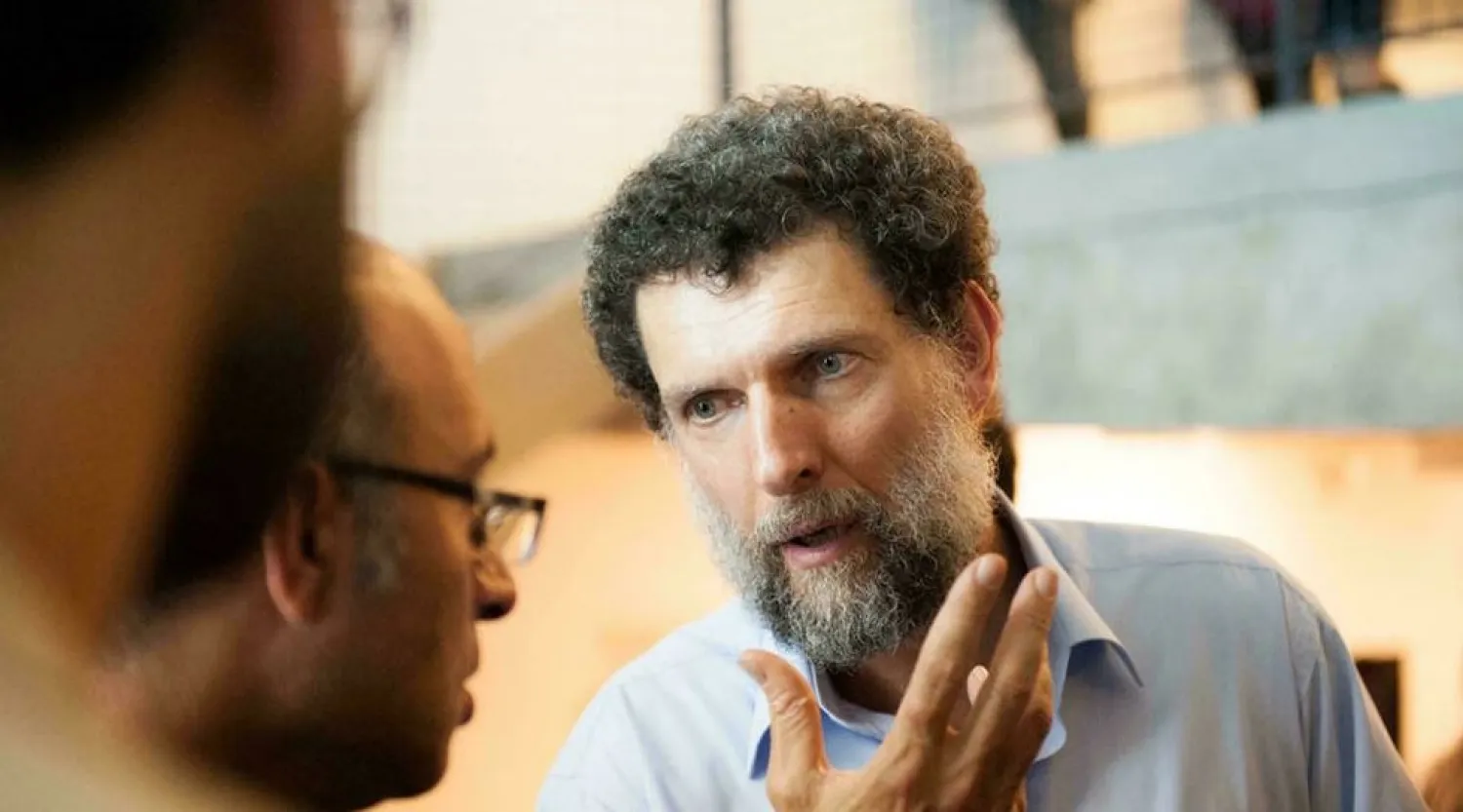

Council of Europe to Discipline Turkey Over Jailed Activist Osman Kavala

The jailing of Osman Kavala has become one of the most emblematic cases in Turkey under Erdogan Handout Anadolu Culture Center/AFP
TT

Council of Europe to Discipline Turkey Over Jailed Activist Osman Kavala

The jailing of Osman Kavala has become one of the most emblematic cases in Turkey under Erdogan Handout Anadolu Culture Center/AFP

The Council of Europe said Friday it will launch disciplinary action against Turkey for refusing to free prominent activist and philanthropist Osman Kavala, triggering a procedure used only once before in the organization's history.

The pan-European rights body's committee of ministers agreed the move over Turkey's repeated refusal to comply with a 2019 ruling by the European Court of Human Rights to release Kavala from prison, it said.

It comes as concern grows over rights abuses in Turkey under President Recep Tayyip Erdogan. The Turkish leader has repeatedly in speeches personally targeted Kavala, who has now been in jail for over four years without ever being convicted of a crime, AFP reported.

"By failing to ensure the applicant's immediate release, the committee considers that Turkey is refusing to abide by the court's final judgement in this case," the COE said.

The Turkish foreign ministry had urged the COE on Thursday not to begin the action "out of respect for the ongoing judicial process," warning that the procedure would be "interference" in its domestic affairs.

Amnesty International's Europe Director Nils Muiznieks welcomed the message to Turkey over the case as "crystal clear".

"Turkey's failure to ensure the immediate release of Osman Kavala and end his politically motivated prosecution is an unacceptable breach of the country's human rights obligations," he said.

January deadline

This is only the second time the COE has used its so-called infringement proceedings against one of its 47 member states, the first occasion being a 2017 action against Azerbaijan over its refusal to release dissident Ilgar Mammadov.

Mammadov was then released from jail in August 2018 and the proceedings ultimately were closed.

The procedure was created in 2010 to ensure full compliance with ECHR rulings, which are legally binding for member states and not advisory.

Turkey, a member of the COE since 1950, is like all member states obliged to abide by the European Convention on Human Rights, which the ECHR oversees.

The decision by the committee of ministers, which required a two-thirds majority, puts Turkey under formal notice that its failure to release Kavala will be referred back to the ECHR.

The ECHR will then decide whether Turkey's non-implementation of its ruling is a further violation of the rights convention.

Turkey has a deadline to respond by January 19, after which the committee would refer the case back to the ECHR at its next meeting on February 2. The next hearing in Kavala's case in Istanbul is scheduled for January 17.

The COE's statute allows for the suspension of a member state's voting rights at the committee of ministers, or even expulsion as an ultimate sanction. The process, however, is still far from reaching this stage and the mechanism exists to resolve such disputes.

'Attack on human dignity'

The jailing of Kavala has become one of the most emblematic cases in Turkey under Erdogan, who has dominated the country for the last two decades but is now battling a severe economic crisis.

The 64-year-old Paris-born businessman helped finance civil society projects and was also particularly engaged in seeking to reconcile Turkey and its neighbor Armenia with whom Ankara has no diplomatic relations.

Erdogan has repeatedly accused Kavala of being the agent in Turkey of billionaire financier and pro-democracy campaigner George Soros and being the key player in 2013 protests over the redevelopment of an Istanbul park which rattled the Turkish strongman.

But Kavala has rejected Erdogan's "defamatory" accusations as "an attack on human dignity."

Turkey's refusal to release Kavala has also fuelled tensions with the West.

In October, 10 embassies -- including France, Germany and the United States -- said in a highly unusual declaration that his continued detention "cast a shadow" over Turkey's democracy and judicial system.

Erdogan then threatened to expel the 10 Western ambassadors although he later stepped back from this.

Kavala is charged with financing 2013 anti-government protests and playing a role in a 2016 coup attempt against Erdogan. If convicted, he could face a life term without the possibility of parole.



Türkiye Says Greece-Chevron Activity off Crete Unlawful 

A Chevron gas station sign is pictured at one of their retain gas stations in Cardiff, California October 9, 2013. REUTERS/Mike Blake/File Photo
TT

Türkiye Says Greece-Chevron Activity off Crete Unlawful 

A Chevron gas station sign is pictured at one of their retain gas stations in Cardiff, California October 9, 2013. REUTERS/Mike Blake/File Photo

Türkiye said on Thursday it opposed Greece's "unilateral activities" in energy fields south of Crete with a consortium led by US major Chevron as a violation of international law and good neighbourly relations.

Athens responded that its policies abide international law.

The Chevron-led consortium signed exclusive lease agreements on Monday to look for natural gas off southern Greece, expanding US presence in the eastern Mediterranean.

"We oppose this unlawful activity, which is being attempted in violation of the 2019 Memorandum of Understanding on Maritime Jurisdiction between Libya and our country," the Turkish Defense Ministry said at a press briefing.

It said the activity, while not directly impacting Türkiye's continental shelf, also violated Libya's maritime jurisdiction that was declared to the United Nations in May last year.

"We continue to provide the necessary support to the Libyan authorities to take action against these unilateral and unlawful activities by Greece," the ministry said.

A 2019 agreement signed by Türkiye and Libya set out maritime boundaries in the Mediterranean Sea. It was rejected by Greece as it ignored the presence of the Greek island of Crete between the coasts of Türkiye and Libya. The Chevron deal doubles the amount of Greek maritime acreage available for exploration and is the second in months involving a US energy major, as the European Union seeks to phase out supplies from Russia and the US seeks to replace them.

Asked about the Turkish objections later on Thursday, Greek government spokesman Pavlos Marinakis told a press briefing that Athens followed an "active policy" and "exercises its rights in accordance with international law and respects international law steadfastly - and I think no one questions that, period."

There was no immediate comment from Chevron.

Neighbors and NATO members Türkiye and Greece have been at odds over a range of issues for decades, primarily maritime boundaries and rights in the Aegean, an area widely believed to hold energy resources and with key implications for airspace and military activity.

A 2023 declaration on friendly relations prompted a thaw between the sides and leaders have voiced a desire to address remaining issues.


Andrew Mountbatten-Windsor Arrested on Suspicion of Misconduct in Public Office

FILE - Britain’s Andrew Mountbatten-Windsor, formerly known as Prince Andrew, looks round as he leaves after attending the Easter Matins Service at St. George's Chapel, Windsor Castle, England, April 20, 2025. (AP Photo/Kirsty Wigglesworth, File)
TT

Andrew Mountbatten-Windsor Arrested on Suspicion of Misconduct in Public Office

FILE - Britain’s Andrew Mountbatten-Windsor, formerly known as Prince Andrew, looks round as he leaves after attending the Easter Matins Service at St. George's Chapel, Windsor Castle, England, April 20, 2025. (AP Photo/Kirsty Wigglesworth, File)

UK police arrested Andrew Mountbatten-Windsor on Thursday on suspicion of misconduct in public office.

The Thames Valley Police, an agency that covers areas west of London, including Mountbatten-Windsor’s former home, said it was “assessing” reports that the former Prince Andrew sent trade reports to convicted sex offender Jeffrey Epstein in 2010. The assessment followed the release of millions of pages of documents connected to a US investigation of Epstein.

The police force did not name Mountbatten-Windsor, as is normal under UK law. But when asked if he had been arrested, the force pointed to a statement saying that they had arrested a man in his 60s. Mountbatten-Windsor is 66.

“Following a thorough assessment, we have now opened an investigation into this allegation of misconduct in public office,’’ the statement said. “It is important that we protect the integrity and objectivity of our investigation as we work with our partners to investigate this alleged offence."

“We understand the significant public interest in this case, and we will provide updates at the appropriate time,” the statement added.

Pictures circulated online appearing to show unmarked police cars at Wood Farm on the Sandringham Estate in Norfolk, with plainclothes officers appearing to gather outside the home of Mountbatten-Windsor.


Georgia Arrests Two Foreigners Trying to Purchase Uranium

FILE PHOTO: A block with the symbol, atomic number and mass number of Uranium (U) element, in this illustration taken January 21, 2026. REUTERS/Dado Ruvic/Illustration/File Photo
TT

Georgia Arrests Two Foreigners Trying to Purchase Uranium

FILE PHOTO: A block with the symbol, atomic number and mass number of Uranium (U) element, in this illustration taken January 21, 2026. REUTERS/Dado Ruvic/Illustration/File Photo

Georgia has ‌detained two people who attempted to purchase $3 million worth of uranium and a cache of a radioactive isotope found in nuclear weapons testing programs, the national security service said on Thursday.

Two foreign nationals from unspecified countries were arrested in the city of Kutaisi, the State Security Service said in a statement.

"They were planning to ‌illegally purchase ‌nuclear material uranium and radioactive ‌substance ⁠Cesium 137 for $3 ⁠million and illegally transport it to the territory of another country," Reuters quoted it as saying.

It said other foreigners had been arriving in Georgia in recent weeks with the aim of purchasing and transporting the nuclear and ⁠radioactive materials, without elaborating further.

The ‌statement did ‌not specify the quantity of materials the individuals were ‌attempting to procure. There were ‌no details on the substances' origin or potential destination.

Cesium 137 is a radioactive isotope present primarily in the aftermath of nuclear weapons testing ‌and nuclear power plant accidents such as the Chernobyl disaster in ⁠then-Soviet ⁠Ukraine in 1986.

The security of nuclear materials was one of the biggest concerns after the 1991 fall of the Soviet Union, of which Georgia was part. There have been several serious incidents involving the illicit trade in nuclear materials in Georgia over recent decades.

Most recently, three Chinese citizens were arrested in the capital Tbilisi for attempting to purchase two kilograms of "nuclear material" uranium.