



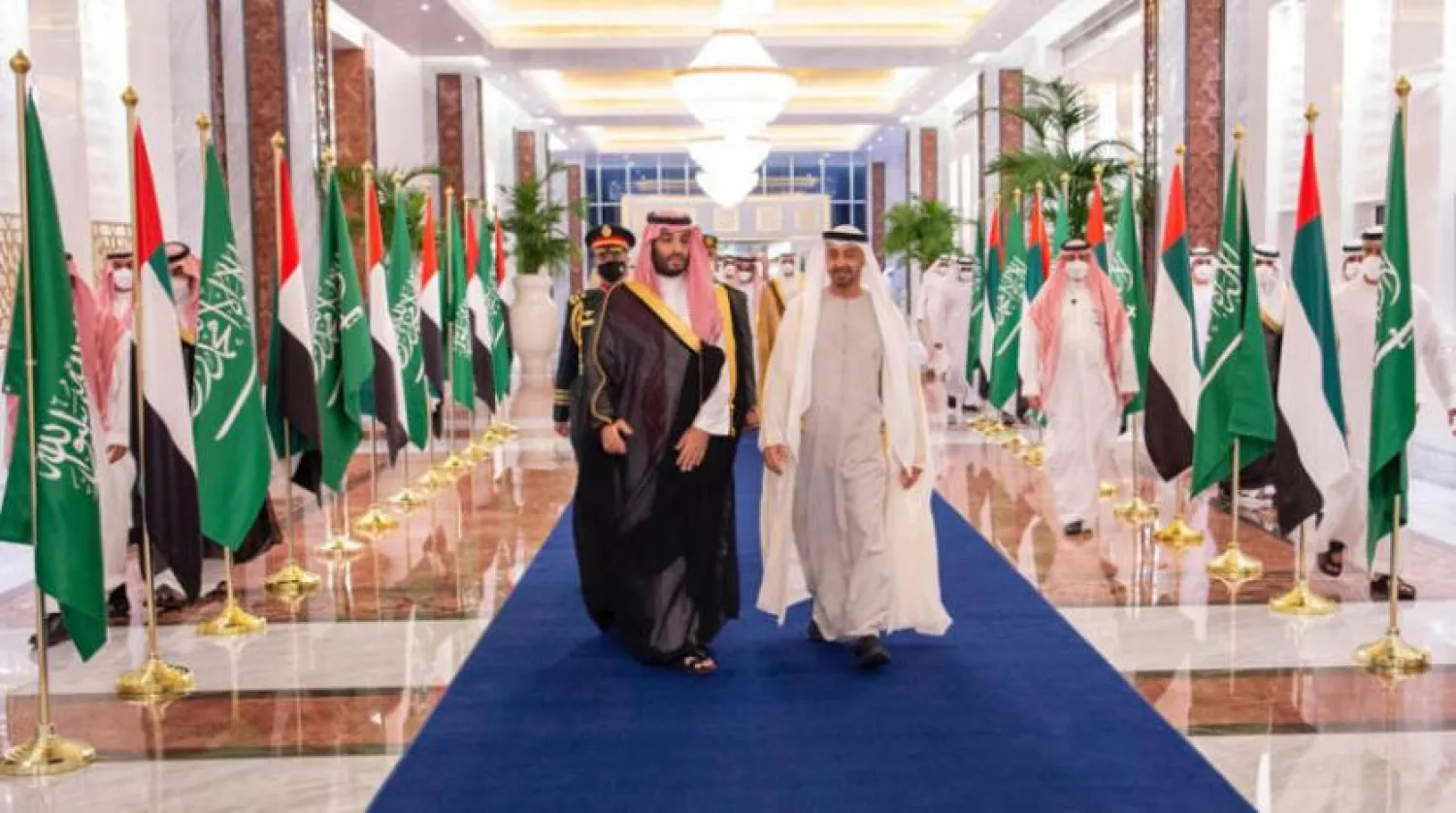

The UAE and Saudi Arabia issued a joint statement following the end of Saudi Crown Prince Mohammed bin Salman bin Abdul Aziz's visit to Abu Dahbi. The statement affirmed the distinguished ties and deep-rooted historic relations between the leaderships and peoples of both countries.
It also revealed that the Crown Prince's visit to the UAE comes in light of efforts exerted between both countries to boost and develop strategic cooperation, and economic and development integration to shape a better future, and ensure security and prosperity.
During the visit, Saudi Crown Prince Mohammed bin Salman congratulated the leadership, government and people of the UAE on the occasion of the country’s Golden Jubilee. He lauded the distinguished achievements of the UAE government in a variety of fields and wished the country further progress, wellbeing, prosperity, security and stability under the rule of its wise leadership.
During their meetings, the two leaders discussed the fraternal ties between the two countries, and ways of boosting bilateral ties.
The two sides lauded the distinguished level of cooperation between the two countries in political, security, military, economic and development areas, and the cooperation and integration under the framework of the Saudi-Emirati Coordination Council which was established upon the directives of the Custodian of the Two Holy Mosques, King Salman bin Abdulaziz Al Saud, and President of the UAE. The two sides stressed their determination to develop and strengthen the role of the council in all areas.
The two sides also highlighted the abundant economic potential and distinguished opportunities that could be generated through the strengthening of the strategic partnership between the two countries and increasing joint investments, stressing the importance of highlighting promising sectors to investors in both countries.
On energy, both sides lauded their close cooperation and the successful efforts of OPEC Plus to restore stability to the global oil market. They also affirmed the importance of continuing this cooperation, as well as the commitment of the member states of OPEC Plus to the agreement, stressing the importance of continuing their joint cooperation in the field of oil, gas and petrochemicals, as well as in the peaceful use of nuclear energy, oil products trade, capitalizing on the electricity connectivity and the electricity trade exchange, artificial intelligence, digital transformation, cybersecurity and advanced technologies.
Regarding climate change, the two sides said they are keen to strengthen their ongoing cooperation in implementing the circular economy approach launched by Saudi Arabia during its presidency of the G-20, and was approved by the group as a comprehensive framework aimed at addressing the challenges resulting from emissions that cause global warming.
The UAE also highlighted the local, regional and international achievements of the Green Middle East Initiative launched by Crown Prince Mohammed bin Salman to address climate change. Also, the Saudi side lauded the UAE’s pioneering role in addressing climate change, most notably its hosting of COP28 in 2023.
The two sides stressed they will continue enhancing their cooperation in various areas, including health, tourism, food security and social development.
Crown Prince Mohammed bin Salman congratulated the UAE for the successful organisation of Expo 2020 Dubai while Sheikh Mohamed bin Zayed highlighted the UAE’s support for Saudi Arabia’s bid to host Expo 2030.
- AlUla -
Saudi Arabia and the UAE emphasised the AlUla GCC Summit Declaration issued on 5th January, 2021, which stipulated the full and accurate implementation of the vision of the Custodian of the Two Holy Mosques, King Salman bin Abdulaziz, which was approved by the 36th Gulf Cooperation Council for Arab States (GCC) Leaders' Summit in December 2015 according to a specific timetable and careful follow-up.
This includes the completion of economic unity, the joint defense and security systems pillars, as well as coordinating positions in a way that enhances the solidarity and stability of the GCC countries and promotes their regional role through unifying political positions, developing political partnerships with the international community, regional and international organisations, strength and cohesion of the GCC states and unity among its member states.
- Palestine -
The two sides further reviewed the latest regional and global developments of mutual interest and emphasized coordination of their positions in a manner that serves their interests and supports and enhances security and stability in the region and the world.
In this regard, the two sides drew attention to their full support for all the legitimate rights of the Palestinian people, foremost of which is their right to establish an independent and sovereign Palestinian state on the borders of 4th June, 1967, with East Jerusalem as its capital, in accordance with the Arab Peace Initiative, the relevant United Nations Security Council (UNSC) resolutions, and the Madrid Conference references, and other agreed international references, to achieve the aspirations of the fraternal Palestinian people.
-Yemen -
The two sides emphasized the compatibility of their views regarding the continuation of their efforts to reach an overall political solution to the Yemeni crisis in accordance with the terms of reference represented by the Gulf initiative and its executive mechanism, the outcomes of the Comprehensive National Dialogue Conference, the UNSC Resolution 2216, and Saudi Arabia's initiative to end the Yemeni crisis and reach a comprehensive political resolution in a manner that preserves Yemen's unity and integrity, respects its sovereignty and independence and rejects any interference in its internal affairs.
They also stressed the need to complete the implementation of the Riyadh Agreement. The two sides also condemned the Houthi militia's continued targeting of airports, civilian and vital facilities in the Kingdom of Saudi Arabia.
- Lebanon, Iraq, and Sudan -
Regarding Lebanon, Saudi Arabia and the UAE underscored the importance of implementing comprehensive political and economic reforms to guarantees that Lebanon overcomes its crises and confines weapons in the hands of legitimate state institutions.
They also stressed that Lebanon will not be a starting point for any terrorist acts and an incubator for organizations and groups that target the security and stability of the region such as the terrorist "Hezbollah", and a source of the drug scourge that threatens the safety of societies, the region and the world.
They also welcomed the success of the electoral process in Iraq, and expressed their wishes for the formation of an Iraqi government that will continue to work towards enhancing Iraq's security, stability and development, and putting an end to terrorist activities and foreign interference in its internal affairs.
On Sudan, the sides welcomed the agreements reached by the parties to the transitional phase in the country, and affirmed their continued support for any steps that would help achieve security and stability in Sudan, expressing their wishes of stability and prosperity for Sudan and its people.
- Iran and Afghanistan -
The UAE and Saudi Arabia underscored the importance of dealing seriously and effectively with Iran's nuclear and missile dossier with all its components and repercussions to ensure achieving regional and international security and stability, respecting the principles of good neighborliness, the UN resolutions and international legitimacy, and sparing the region from all destabilizing activities and interventions.
In that context, they demanded that the concerned parties take into consideration the interests, security and stability of other countries in the region.
With regard to Afghanistan, they stressed the importance of supporting security and stability and disallowing the existence of safe havens for terrorists and extremists in it. Furthermore, they condemned any acts aimed at recruiting Afghan refugees in various conflict areas, and expressed the importance of supporting relief efforts and humanitarian work in Afghanistan. In this regard, the UAE valued Saudi Arabia's invitation to an extraordinary ministerial meeting of the Organization of Islamic Cooperation countries, to be held in Pakistan on 19th December, 2021, to discuss the situation in Afghanistan.
Also, Saudi Arabia commended the UAE's efforts in the evacuation operations in Afghanistan.
- Syria and Libya -
Saudi Arabia and the UAE affirmed that a political solution is the only way out of the Syrian crisis, and in that context, they announced their support for the efforts of the UN and its Special Envoy to implement the relevant international resolutions, foremost of which is UN Security Council Resolution No. 2254, and to stop regional interventions and projects that threaten Syria's unity, sovereignty and territorial integrity. They also highlighted their support of the Syrian people and the need to support the international humanitarian efforts in Syria.
As for Libya, the sides welcomed the Libyan and UN efforts to support the implementation of the agreed-upon political plan, and called for empowering the Libyan people to achieve their aspirations of unity, peace and stability. They also underlined the need to withdraw foreign mercenaries, fighters and forces from Libya.
At the end of the visit, Saudi Crown Prince Mohammed bin Salman expressed his thanks and appreciation to Sheikh Mohamed bin Zayed for the hospitality he showed to him and his accompanying delegation.
For his part, Sheikh Mohammed conveyed his best wishes to the Saudi Crown Prince and the Kingdom of Saudi Arabia, wishing them continued progress and prosperity under the country's wise leadership.


