

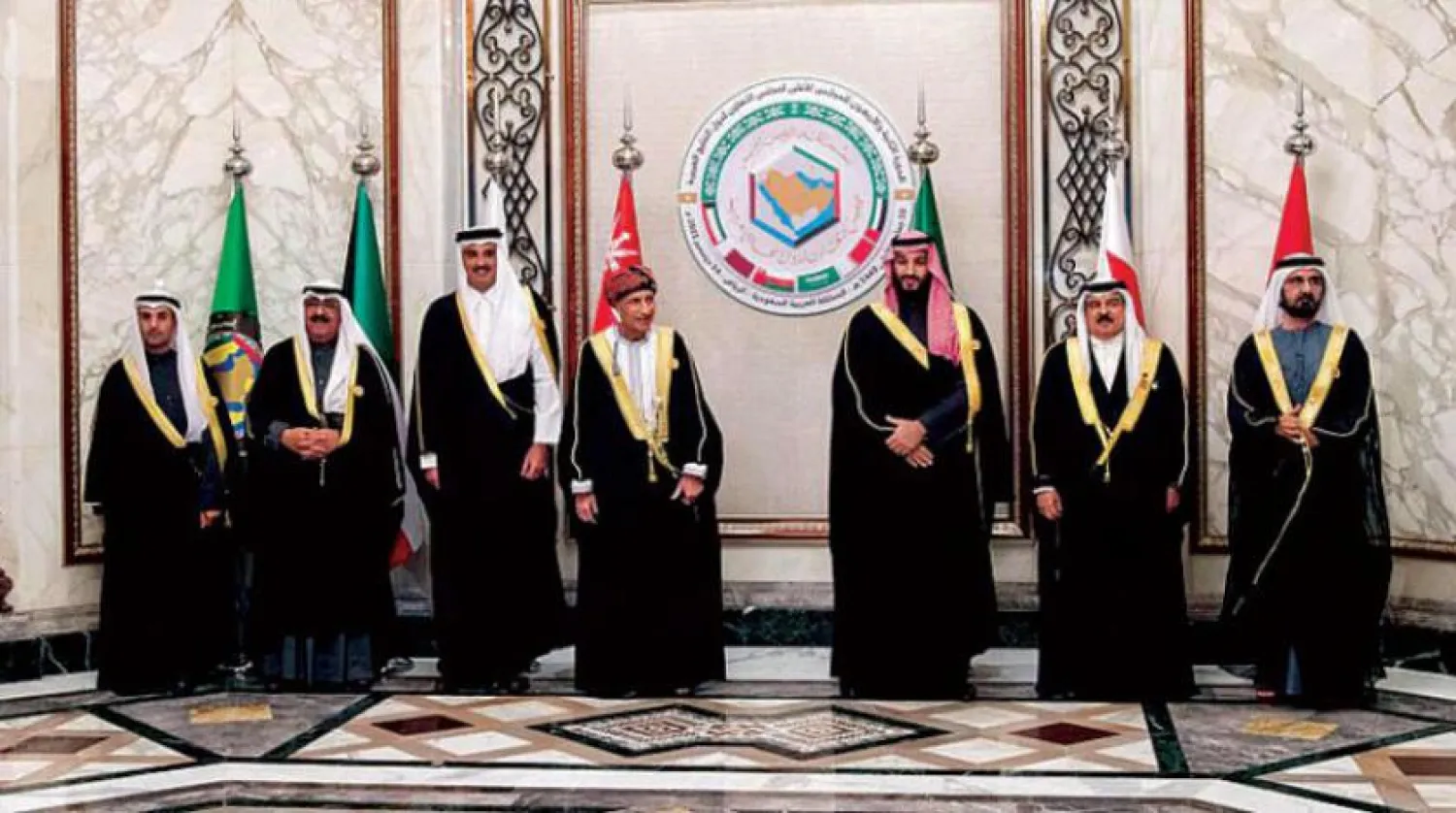

Gulf Summit: Solidarity, Stability, Economic Integration

A handout picture provided by the Saudi Royal Palace shows the GCC leaders. SPA
TT

Gulf Summit: Solidarity, Stability, Economic Integration

A handout picture provided by the Saudi Royal Palace shows the GCC leaders. SPA

At the end of the 42nd Gulf Cooperation Council (GCC) summit in Riyadh on Tuesday, Gulf leaders affirmed the significance of precise and comprehensive implementation of the vision of King Salman bin Abdulaziz. They also stressed the importance of pursuing economic, defense and security integration.

The leaders endorsed the coordination of positions to reinforce stability in GCC countries and ensure the best interest of the council's six members. This would help Gulf states avoid regional and international conflicts.

Besides achieving the people's aspirations in GCC countries, it would also reinforce the regional and international role of GCC states.

At Diriyah Palace in Riyadh, the summit focused on solidarity, stability, and economic integration. Its final communique stressed the importance of "unifying political positions and developing political partnerships at the regional and international levels."

In his speech to Gulf leaders, Saudi Crown Prince Mohammed bin Salman touched on several topics, including the Palestinian cause, the Yemeni crisis, and the situation in Afghanistan.

On behalf of King Salman bin Abdulaziz, the Crown Prince welcomed Gulf leaders in Saudi Arabia. He thanked Bahrain's King Hamad bin Isa Al Khalifa for his country's efforts during its chairing of the 41st GCC summit.

He stressed that Saudi Arabia recognizes the importance of dealing seriously and effectively with Iran's nuclear and missile program "in a way that contributes to achieving regional and international security and stability."

Additionally, the Crown Prince highlighted the importance of "Iraq forming a government that is capable of working towards establishing national security, stability, and development."

As for Yemen, he affirmed Saudi Arabia's continued support for the efforts of the UN special envoy to reach a political solution to the crisis according to the three references represented in the Gulf initiative.

The Saudi Crown Prince also said that the Kingdom is following the developments of the situation in Afghanistan, urging regional and international efforts to unite and provide humanitarian aid to the Afghan people.

He also emphasized that Afghanistan should not transform into a haven for terrorist organizations.

The summit's final communique, read by Nayef Al-Hajraf, the GCC general-secretary, said further teamwork would be necessary to meet future challenges and highlighted the importance of strengthening opportunities for women and young people and for digital transformation in the GCC countries.

"The leaders agreed on principles and policies to develop strategic cooperation and economic development integration among the GCC states and to achieve the aspirations of their citizens," Al-Hajraf said.

Gulf leaders also stressed the importance of strengthening work to implement the circular economy approach.


Custodian of the Two Holy Mosques Arrives in Jeddah

Custodian of the Two Holy Mosques King Salman bin Abdulaziz Al Saud. (SPA file)
TT

Custodian of the Two Holy Mosques Arrives in Jeddah

Custodian of the Two Holy Mosques King Salman bin Abdulaziz Al Saud. (SPA file)

Custodian of the Two Holy Mosques King Salman bin Abdulaziz Al Saud arrived in Jeddah on Tuesday coming from Riyadh.

At King Abdulaziz International Airport, he was received by Deputy Governor of Makkah Region Prince Saud bin Mishaal bin Abdulaziz.

King Salman was accompanied by several princes and senior officials.

At King Khalid International Airport in Riyadh, King Salman was seen off by Governor of Riyadh Region Prince Faisal bin Bandar bin Abdulaziz and Deputy Governor of Riyadh Region Prince Mohammed bin Abdulrahman bin Abdulaziz.


Saudi Arabia Declares Wednesday First Day of Ramadan

 Saudi Arabia declares Wednesday the first day of the holy fasting month of Ramadan. (Majmaah University)
Saudi Arabia declares Wednesday the first day of the holy fasting month of Ramadan. (Majmaah University)
TT

Saudi Arabia Declares Wednesday First Day of Ramadan

 Saudi Arabia declares Wednesday the first day of the holy fasting month of Ramadan. (Majmaah University)
Saudi Arabia declares Wednesday the first day of the holy fasting month of Ramadan. (Majmaah University)

Saudi Arabia declared on Tuesday that the holy fasting month of Ramadan will begin on Wednesday.

Qatar and the United Arab Emirates also declared that Ramadan will begin on Wednesday.

Saudi Arabia’s Supreme Court had on Sunday urged Muslims across the Kingdom to sight the crescent moon that signals the advent of Ramadan on Tuesday evening.


Saudi Arabia, Arab and Islamic Countries Condemn Israel’s 'State Land' Decision in West Bank 

The West Bank village of al-Ram is pictured behind Israel's controversial separation barrier from the outskirts of Jerusalem on February 16, 2026. (AFP)
TT

Saudi Arabia, Arab and Islamic Countries Condemn Israel’s 'State Land' Decision in West Bank 

The West Bank village of al-Ram is pictured behind Israel's controversial separation barrier from the outskirts of Jerusalem on February 16, 2026. (AFP)

The foreign ministers of Saudi Arabia, Jordan, the United Arab Emirates, Qatar, Indonesia, Pakistan, Egypt, and Türkiye strongly condemned on Tuesday Israel's decision to designate lands in the occupied West Bank as so-called "state land".

They also slammed it for approving procedures for the registration and settlement of land ownership across extensive areas of the occupied West Bank for the first time since 1967.

They condemned the moves as “a grave escalation aimed at accelerating illegal settlement activity, land confiscation, entrenching Israeli control, and applying unlawful Israeli sovereignty over the Occupied Palestinian Territory and undermining the legitimate rights of the Palestinian people.”

These measures are “a flagrant violation of international law and international humanitarian law, particularly the Fourth Geneva Convention, as well as a violation of relevant United Nations Security Council resolutions, foremost among them Resolution 2334,” the FMs said in a statement.

“The decision also contradicts the advisory opinion issued by the International Court of Justice concerning the legal consequences arising from Israeli policies and practices in the Occupied Palestinian Territory, which underscored the illegality of measures intended to alter the legal, historical, and demographic status of the Occupied Palestinian Territory, the obligation to end the occupation, and the prohibition of the acquisition of territory by force,” they added.

“This step reflects an attempt to impose a new legal and administrative reality designed to consolidate control over the occupied land, thereby undermining the two-state solution, eroding the prospects for the establishment of an independent and viable Palestinian State, and jeopardizing the attainment of a just and comprehensive peace in the region,” they warned.

The foreign ministers reiterated their “categorical rejection of all unilateral measures aimed at altering the legal, demographic, and historical status of the Occupied Palestinian Territory.”

They stressed that such policies are “a dangerous escalation that will further heighten tensions and instability in the Occupied Palestinian Territory and the region as a whole.”

They called on the international community “to assume its responsibilities and take clear and decisive steps to halt these violations, ensure respect for international law, and safeguard the inalienable rights of the Palestinian people, foremost among them their right to self-determination, ending the occupation, and establishing their independent and sovereign State based on 1967 borders with East Jerusalem as its capital.”
