


Hard-hit by COVID, Israel’s Ultra-orthodox Slow to Get Shots

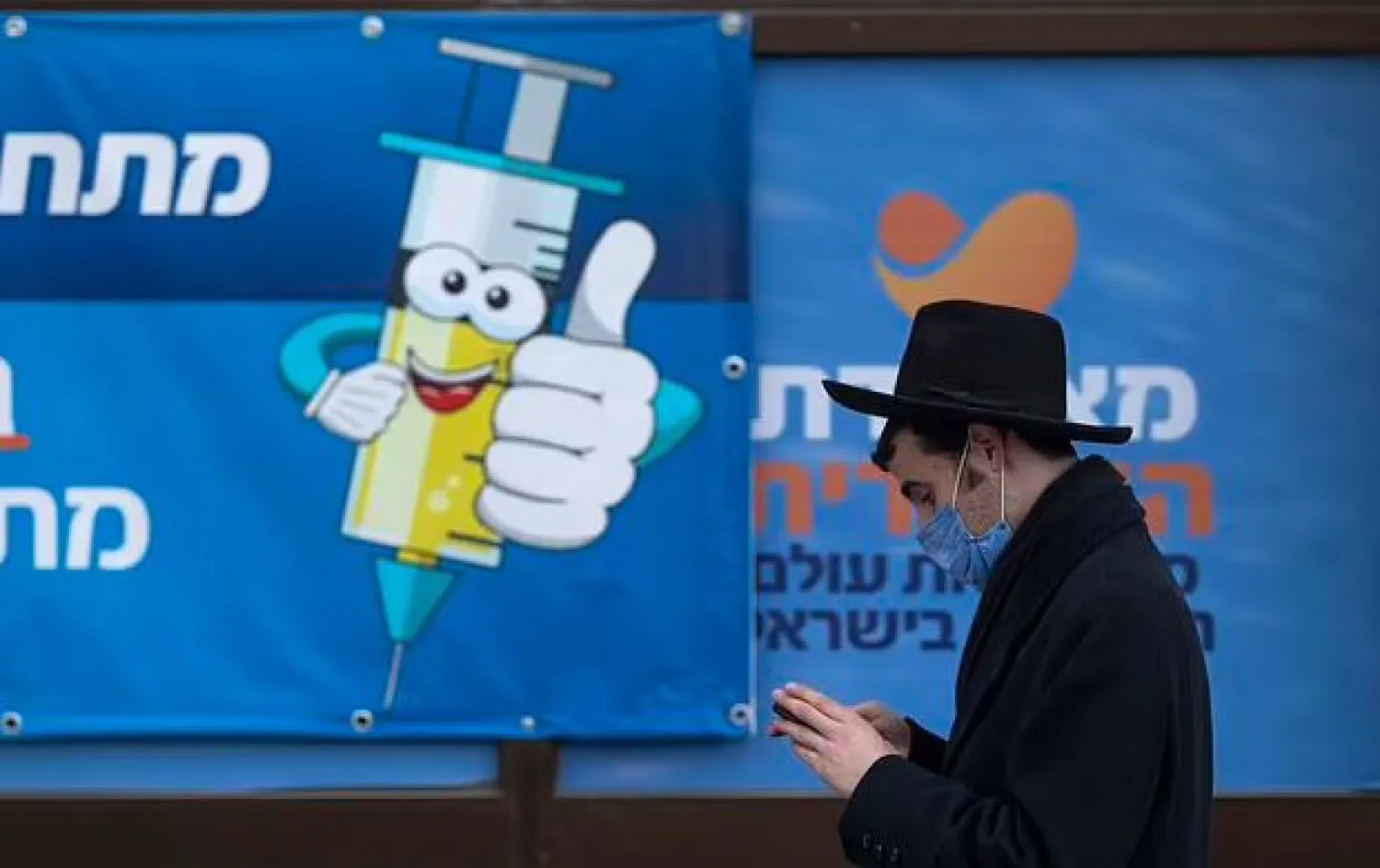
An Ultra-Orthodox Jewish man walks past a coronavirus vaccination center, in Jerusalem, Wednesday, Dec. 22, 2021. (AP Photo/Oded Balilty)
TT

Hard-hit by COVID, Israel’s Ultra-orthodox Slow to Get Shots

An Ultra-Orthodox Jewish man walks past a coronavirus vaccination center, in Jerusalem, Wednesday, Dec. 22, 2021. (AP Photo/Oded Balilty)

Yossi Levy has repeatedly booked and canceled his coronavirus vaccine appointment. The 45-year-old ultra-Orthodox Jew recovered from the virus earlier this year, as have his eight children and wife. But a combination of lethargy and procrastination has prevented him from following through and getting inoculated.

"It isn't something pressing. I'm not opposed to it. It's just laziness," he said.

Levy is among the hundreds of thousands of ultra-Orthodox Jews who have yet to receive their COVID-19 shots. The group has some of the lowest vaccination rates in the country despite being hit hard by the pandemic.

Facing the new coronavirus variant omicron, officials are now scrambling to ramp up vaccination rates in a population that has so far been slow to roll up their sleeves.

"We are going on the offensive with the issue of vaccinations," said Avraham Rubinstein, the mayor of Bnei Brak, the country´s largest ultra-Orthodox city.

It has been one year since COVID-19 vaccines became available, yet vaccine reluctance persists even as deaths mount and the highly contagious omicron variant spreads around the globe. An unconventional cadre of people has stepped up to promote vaccination with efforts that traditionally have been the realm of public health officials.

According to The Associated Press, Israeli officials have appealed to the community´s prominent rabbis, who serve as arbiters on all matters, to promote vaccination. They are deploying mobile clinics. And they are beating back a wave of lies about the vaccine that has washed over parts of the community.

The vaccination rate is low in part because half of the ultra-Orthodox population is under 16 and only recently made eligible for vaccination. Also, many ultra-Orthodox were already infected or believe they were and don´t think they need the vaccine.

The outreach effort has had mixed success. Officials hope to raise the vaccination rate with a new mobile-clinic campaign at religious schools and a media blitz stepping up pressure on parents to vaccinate children.

Israel was one of the first countries to vaccinate its population late last year and the first to give booster shots. But the campaign has lagged in recent weeks and hundreds of thousands of people remain unvaccinated or without a booster as the specter of an omicron surge looms.

While vaccination rates for the second dose among the general population hover around 63% and the booster at 45%, in the ultra-Orthodox community the number is around half of that. The community's immunity shoots up somewhat when the 300,000 or so of those who are known to have recovered are included, but Israel's Health Ministry recommends those who were infected to get at least one shot if six months have elapsed since the infection.

The low vaccination rate stands in stark contrast to the heavy price the community paid during the pandemic. The ultra-Orthodox were hit hard from the start, with the community's 1.2 million people often leading the country's morbidity rates and losing hundreds to the disease. The ultra-Orthodox make up 13% of Israel's 9.3 million population.

There are societal reasons for the quick community spread. The ultra-Orthodox tend to live in poor, crowded neighborhoods, with large families in small apartments, where sickness can quickly spread. Synagogues, the centerpiece of social life, bring men together to pray and socialize in small spaces.

The particular way of life of the ultra-Orthodox, also known as Haredim, has made driving up vaccination rates a unique challenge for health officials.

The cloistered community has long been separate from mainstream Israeli life, with children studying scripture but very little math and English. The community typically shuns the internet, doesn´t watch secular TV and tends to live separately from non-religious Israelis. It is suspicious of secular state authorities and many of the trappings of modernity.

"For Haredim, there is a double fear: fear of the state and fear of science. There is no basic trust in these entities," said Gilad Malach, who heads the ultra-Orthodox program at the Israel Democracy Institute, a Jerusalem think tank. He said that skepticism has allowed unfounded claims about the vaccines to spread in the community.

Avi Blumenthal, an adviser to the Health Ministry on the ultra-Orthodox, said vaccine information is disseminated to the ultra-Orthodox public through its local media as well as in biweekly messages posted on community notice boards, known as "pashkevils." He says these means reach the overwhelming majority of Haredim.

The ultra-Orthodox follow a strict interpretation of Judaism and rely on rabbis to guide them in many life decisions. While some rabbis have actively encouraged vaccination, others have taken a less aggressive approach and their followers have been less enthusiastic about getting inoculated.

Blumenthal, who himself is ultra-Orthodox, said the Health Ministry recently held a conference at the country´s largest hospital, inviting prominent rabbis to converse with doctors about the importance of the vaccine. The head of the government´s coronavirus advisory panel has repeatedly met with important religious figures, urging them to spread the word on vaccines.

"We go by the Jewish sages," said Dvora Ber, 27, a Bnei Brak resident and mother of four who is vaccinated. "What they tell us, we do."



Türkiye Says Greece-Chevron Activity off Crete Unlawful 

A Chevron gas station sign is pictured at one of their retain gas stations in Cardiff, California October 9, 2013. REUTERS/Mike Blake/File Photo
TT

Türkiye Says Greece-Chevron Activity off Crete Unlawful 

A Chevron gas station sign is pictured at one of their retain gas stations in Cardiff, California October 9, 2013. REUTERS/Mike Blake/File Photo

Türkiye said on Thursday it opposed Greece's "unilateral activities" in energy fields south of Crete with a consortium led by US major Chevron as a violation of international law and good neighbourly relations.

Athens responded that its policies abide international law.

The Chevron-led consortium signed exclusive lease agreements on Monday to look for natural gas off southern Greece, expanding US presence in the eastern Mediterranean.

"We oppose this unlawful activity, which is being attempted in violation of the 2019 Memorandum of Understanding on Maritime Jurisdiction between Libya and our country," the Turkish Defense Ministry said at a press briefing.

It said the activity, while not directly impacting Türkiye's continental shelf, also violated Libya's maritime jurisdiction that was declared to the United Nations in May last year.

"We continue to provide the necessary support to the Libyan authorities to take action against these unilateral and unlawful activities by Greece," the ministry said.

A 2019 agreement signed by Türkiye and Libya set out maritime boundaries in the Mediterranean Sea. It was rejected by Greece as it ignored the presence of the Greek island of Crete between the coasts of Türkiye and Libya. The Chevron deal doubles the amount of Greek maritime acreage available for exploration and is the second in months involving a US energy major, as the European Union seeks to phase out supplies from Russia and the US seeks to replace them.

Asked about the Turkish objections later on Thursday, Greek government spokesman Pavlos Marinakis told a press briefing that Athens followed an "active policy" and "exercises its rights in accordance with international law and respects international law steadfastly - and I think no one questions that, period."

There was no immediate comment from Chevron.

Neighbors and NATO members Türkiye and Greece have been at odds over a range of issues for decades, primarily maritime boundaries and rights in the Aegean, an area widely believed to hold energy resources and with key implications for airspace and military activity.

A 2023 declaration on friendly relations prompted a thaw between the sides and leaders have voiced a desire to address remaining issues.


Andrew Mountbatten-Windsor Arrested on Suspicion of Misconduct in Public Office

FILE - Britain’s Andrew Mountbatten-Windsor, formerly known as Prince Andrew, looks round as he leaves after attending the Easter Matins Service at St. George's Chapel, Windsor Castle, England, April 20, 2025. (AP Photo/Kirsty Wigglesworth, File)
TT

Andrew Mountbatten-Windsor Arrested on Suspicion of Misconduct in Public Office

FILE - Britain’s Andrew Mountbatten-Windsor, formerly known as Prince Andrew, looks round as he leaves after attending the Easter Matins Service at St. George's Chapel, Windsor Castle, England, April 20, 2025. (AP Photo/Kirsty Wigglesworth, File)

UK police arrested Andrew Mountbatten-Windsor on Thursday on suspicion of misconduct in public office.

The Thames Valley Police, an agency that covers areas west of London, including Mountbatten-Windsor’s former home, said it was “assessing” reports that the former Prince Andrew sent trade reports to convicted sex offender Jeffrey Epstein in 2010. The assessment followed the release of millions of pages of documents connected to a US investigation of Epstein.

The police force did not name Mountbatten-Windsor, as is normal under UK law. But when asked if he had been arrested, the force pointed to a statement saying that they had arrested a man in his 60s. Mountbatten-Windsor is 66.

“Following a thorough assessment, we have now opened an investigation into this allegation of misconduct in public office,’’ the statement said. “It is important that we protect the integrity and objectivity of our investigation as we work with our partners to investigate this alleged offence."

“We understand the significant public interest in this case, and we will provide updates at the appropriate time,” the statement added.

Pictures circulated online appearing to show unmarked police cars at Wood Farm on the Sandringham Estate in Norfolk, with plainclothes officers appearing to gather outside the home of Mountbatten-Windsor.


Georgia Arrests Two Foreigners Trying to Purchase Uranium

FILE PHOTO: A block with the symbol, atomic number and mass number of Uranium (U) element, in this illustration taken January 21, 2026. REUTERS/Dado Ruvic/Illustration/File Photo
TT

Georgia Arrests Two Foreigners Trying to Purchase Uranium

FILE PHOTO: A block with the symbol, atomic number and mass number of Uranium (U) element, in this illustration taken January 21, 2026. REUTERS/Dado Ruvic/Illustration/File Photo

Georgia has ‌detained two people who attempted to purchase $3 million worth of uranium and a cache of a radioactive isotope found in nuclear weapons testing programs, the national security service said on Thursday.

Two foreign nationals from unspecified countries were arrested in the city of Kutaisi, the State Security Service said in a statement.

"They were planning to ‌illegally purchase ‌nuclear material uranium and radioactive ‌substance ⁠Cesium 137 for $3 ⁠million and illegally transport it to the territory of another country," Reuters quoted it as saying.

It said other foreigners had been arriving in Georgia in recent weeks with the aim of purchasing and transporting the nuclear and ⁠radioactive materials, without elaborating further.

The ‌statement did ‌not specify the quantity of materials the individuals were ‌attempting to procure. There were ‌no details on the substances' origin or potential destination.

Cesium 137 is a radioactive isotope present primarily in the aftermath of nuclear weapons testing ‌and nuclear power plant accidents such as the Chernobyl disaster in ⁠then-Soviet ⁠Ukraine in 1986.

The security of nuclear materials was one of the biggest concerns after the 1991 fall of the Soviet Union, of which Georgia was part. There have been several serious incidents involving the illicit trade in nuclear materials in Georgia over recent decades.

Most recently, three Chinese citizens were arrested in the capital Tbilisi for attempting to purchase two kilograms of "nuclear material" uranium.