20-Member Family Killed in Iraq Massacre

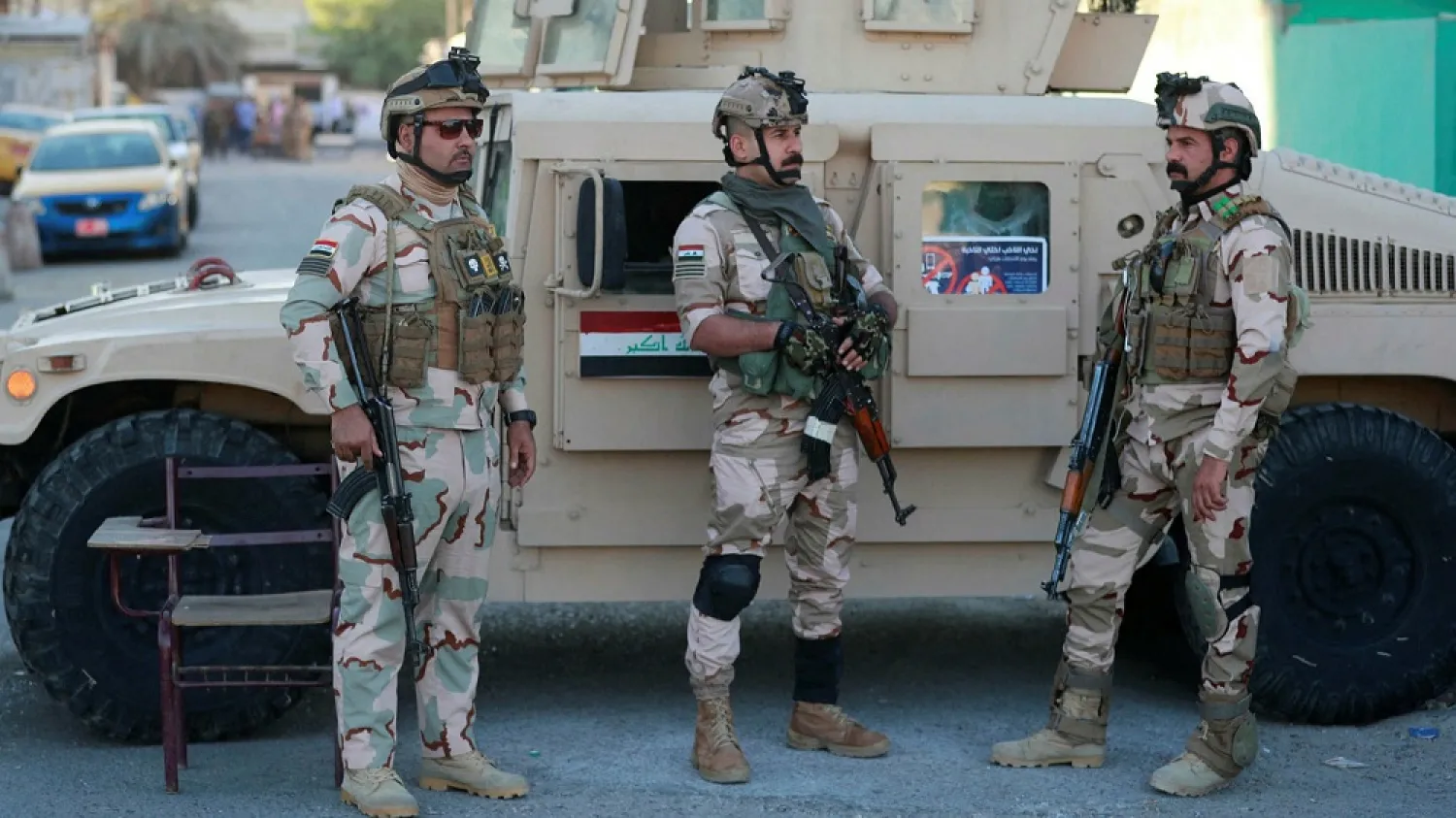
Iraqi security forces in Baghdad. (AFP file photo)
TT

20-Member Family Killed in Iraq Massacre

Iraqi security forces in Baghdad. (AFP file photo)

Twenty members of a single family were killed in Iraq's Babylon province on Thursday in a horrific massacre that has shocked a nation that is reeling from decades of violence.

Official and nonofficial accounts of what led to the massacre have exposed the limited means of the country's security and intelligence agencies.

Prime Minister Mustafa al-Kadhimi has ordered a fair probe into the massacre. Interior Minister Othman al-Ghanemi had visited the crime scene to oversee the investigations.

The official account of the crime said that authorities had received word that two wanted figures were seen at the residence of Raheem Kazem al-Ghariri. When the intelligence directorate sent agents to the house, Ghariri opened fire at them.

Witnesses offered a different account. It said the family was massacred by Ghariri's son-in-law, who works as an officer at a security agency, in wake of a family dispute.

Another account said that Ghariri himself had killed his own family after a three-hour faceoff with the security agencies. Once the fight was over, the security forces entered his house and discovered the crime.

Ghariri's sister gave a different account of events. In a video, she accused the son-in-law of committing the crime, adding that her brother would never have done such a thing.

The victims include Ghariri himself, his wife, six children, and six grandchildren.

Member of the Iraqi High Commission For Human Rights, Ali al-Bayati criticized how authorities have handled the crime.

In remarks to Asharq Al-Awsat, he pointed to the contradictory testimonies, saying they reflect a major weakness in intelligence information.

He accused the security forces of failing to protect civilians as they attempted to arrest a wanted suspect.

"Arresting a suspect does not mean risking the lives of other citizens," he stated.

He added that High Commission has repeatedly called for the formation of a committee that could train members of the security forces on how to properly deal with suspects and citizens alike.


Factions Tighten Grip on Iraq Gov’t Formation Talks

Mourners attend the funeral of members of the Iraqi armed group Kataib Hezbollah who were killed in an airstrike that targeted a PMF headquarters near the western al‑Qaim district on the Syrian border, amid the US-Israel conflict with Iran, in Baghdad, Iraq, March 2, 2026. REUTERS/Thaier Al-Suda
TT

Factions Tighten Grip on Iraq Gov’t Formation Talks

Mourners attend the funeral of members of the Iraqi armed group Kataib Hezbollah who were killed in an airstrike that targeted a PMF headquarters near the western al‑Qaim district on the Syrian border, amid the US-Israel conflict with Iran, in Baghdad, Iraq, March 2, 2026. REUTERS/Thaier Al-Suda

Despite the favorable conditions surrounding Prime Minister-designate Ali al-Zaidi’s efforts to form a new government, including backing from local and regional parties, observers say he still faces serious challenges, foremost among them US pressure to bar representatives of armed factions from joining the cabinet.

US President Donald Trump, voicing support last week for al-Zaidi’s nomination, said he wanted to see a new Iraqi government “free of terrorism.”

His remarks were widely interpreted as opposition to the inclusion of Iran-aligned armed factions that Washington has designated as terrorist groups.

Asaib Ahl al-Haq stands firm

Alongside US pressure, al-Zaidi faces competing domestic demands, particularly from groups seeking cabinet posts despite being under US sanctions. Chief among them is Asaib Ahl al-Haq, led by Qais al-Khazali, placing the premier-designate between two difficult constraints in his government formation efforts.

Hussein al-Shihani, a member of the political bureau of the Sadiqoun bloc, the political wing of Asaib Ahl al-Haq, said in media remarks that the group is seeking one of the deputy prime minister posts.

He said the bloc is targeting underperforming ministries “to prove its ability to reform them,” including the industry ministry to revive the “Made in Iraq” label, and the education ministry, where it claims to have a reform plan.

Asaib Ahl al-Haq held key cabinet portfolios in the previous two governments, including the culture and higher education ministries, and currently occupies the position of first deputy speaker of parliament.

Shihani said the post of first deputy speaker was valued at nine or 10 “points,” with each point equivalent to a parliamentary seat, adding that Sadiqoun aims to secure a deputy prime minister position based on its share.

It remains unclear how al-Zaidi will reconcile competing international and domestic pressures.

Some political and media circles warn that competition among factions, including Asaib Ahl al-Haq, over key posts around the prime minister-designate could shorten the lifespan of his prospective government.

Key hurdles

Political analyst Ihsan al-Shammari said al-Zaidi’s initial pledge to form an inclusive government could conflict with US conditions that it be free of militias designated as terrorist organizations.

He said this presents a major challenge, particularly as al-Zaidi is counting heavily on US support.

Shammari added that the issue could complicate negotiations with the political wings of armed factions, which now hold significant representation in parliament, making it difficult for al-Zaidi to bypass their influence.

He said al-Zaidi may resort to compromise, persuading factions to nominate figures who appear independent but remain loyal to them, potentially easing US pressure.

Failure to navigate these challenges could have major consequences, Shammari said, potentially leading to a repeat of the model seen under Prime Minister Mohammed Shia al-Sudani, where armed groups were represented in government, a scenario unlikely to be accepted by Washington.

If faction-linked figures are included in the cabinet, it could reinforce domestic perceptions of their return to executive power, potentially undermining the government’s chances of success, he added.

Shammari said al-Zaidi may ultimately seek a balance between factional pressures and US demands, possibly by convincing Washington that such groups will not be directly represented in government.

Navigating the faction dilemma

Firas Elias, a political science professor at the University of Mosul specializing in Iranian studies, said it would be difficult for al-Zaidi to form a government “free of terrorism” in the sense outlined by Trump.

“The proposal reflects a US political vision more than a reality that can be achieved within Iraq’s current structure,” he told Asharq Al-Awsat.

He said excluding these factions entirely from government is unrealistic, not only due to their influence on the ground but also because they are part of the political balance within the Coordination Framework, which is expected to serve as the main backer of al-Zaidi’s government.

Accordingly, he said, addressing the faction issue is unlikely to come through direct confrontation, but rather by recalibrating their role and limiting their influence in line with state requirements, without triggering open conflict.

The most likely scenario, Elias said, is not a government free of factions, but a more disciplined administration that contains these forces and redirects their role within the framework of the state.


Lebanon Tests ‘Arms Monopoly’ in Beirut Suburbs Crackdown

Damage to buildings in Beirut’s southern suburbs (Reuters)
TT

Lebanon Tests ‘Arms Monopoly’ in Beirut Suburbs Crackdown

Damage to buildings in Beirut’s southern suburbs (Reuters)

Lebanese security forces are intensifying a crackdown on gunfire during funerals held by Hezbollah for its members, in a move that signals an official push to curb lawlessness and halt scenes that are becoming increasingly frequent and alarming.

The Lebanese army said in a statement that military units raided the homes of suspects involved in shooting during funerals in Beirut’s southern suburbs and in Baalbek. Two people were arrested in the southern suburbs, along with another suspect wanted on multiple warrants.

The campaign extended beyond Beirut. The army said it also detained a man identified as H.N. in the al-Sharawneh neighborhood of Baalbek and another, S.A., in the town of Brital, over gunfire during funeral ceremonies.

It said weapons and ammunition were seized. The items were handed over and investigations have begun under judicial supervision, while efforts continue to arrest others involved.

Injuries in the southern suburbs

The crackdown comes as concern grows over the fallout from the practice, which has coincided with a rise in shooting incidents across several areas.

On Sunday, people were wounded in the Kafaat area of Beirut’s southern suburbs after gunfire and rocket-propelled grenades were fired into the air during a funeral, underscoring the immediate risks.

Ambulances rushed to evacuate the wounded, highlighting how funerals are turning from moments of mourning into scenes of danger.

The phenomenon is not confined to one region. In the Bekaa Valley, the army previously carried out wide raids in Brital, east of Baalbek, following gunfire and the use of B7 rockets during the funeral of two Hezbollah members.

The operation aimed to pursue those involved and curb the use of weapons at public events, in an effort to contain the situation before it escalated.

A gradual push to assert state authority

Hezbollah appears to be distancing itself from the gunfire.

Political analyst Ali al-Amine said “field indicators, including bullets landing in populated areas and near schools, confirm the seriousness of what is happening and show that this behavior cannot be justified under any pretext.”

He said the group is indirectly seeking to disassociate itself from such acts, and even condemn them, in a bid to contain the fallout. He added that the army is acting at a sensitive time, alongside negotiations and official meetings aimed at strengthening the state’s authority.

“There is a clear effort by the authorities to show they can take executive measures, even if gradually, toward imposing a monopoly on arms,” he said, adding the steps are not a direct confrontation with Hezbollah but an attempt to contain disorder.

“What is happening is a display or chaotic use of weapons.”

A costly confrontation

Al-Amine said Hezbollah understands that any confrontation with the state or the army would be costly and yield no gains, pushing it toward rhetoric rather than direct escalation.

“Whenever the state shows seriousness, reactions are less intense than initially portrayed,” he said, adding the real issue lies in the state’s decision, not the scale of risks, which he said are often exaggerated to obstruct reform.

“If the state fails to show it can act, it risks its role and existence,” he said.

He described the developments as the start of a new path toward consolidating state authority.

“The government is seeking to assert its sovereign role and show that the era of unchecked weapons is gradually giving way to the rule of law,” he said.


Germany’s Wadephul Says Aid to Gaza Must Be Improved

German Foreign Minister Johann Wadephul (R) and Israeli Foreign Minister Gideon Saar shake hands as they attend a news conference after their talks in Berlin, Germany, 05 May 2026. (EPA)
TT

Germany’s Wadephul Says Aid to Gaza Must Be Improved

German Foreign Minister Johann Wadephul (R) and Israeli Foreign Minister Gideon Saar shake hands as they attend a news conference after their talks in Berlin, Germany, 05 May 2026. (EPA)

German Foreign Minister Johann Wadephul said on Tuesday aid deliveries to Gaza had to be improved and he repeated Berlin's ‌position that ‌any de ‌facto annexation ⁠of parts of ⁠the occupied West Bank by Israel would not be acceptable to Germany.

"The ⁠plight of the ‌more ‌than two ‌million people whose situation ‌has not improved must not be overlooked amidst the conflict ‌in Iran. Humanitarian aid must ⁠be ⁠improved as a matter of urgency," Wadephul said at a joint news conference in Berlin with his visiting Israeli counterpart Gideon Saar.