


Scientist, Enforcer, High-flyer: 3 Women Put a Mark on Tech

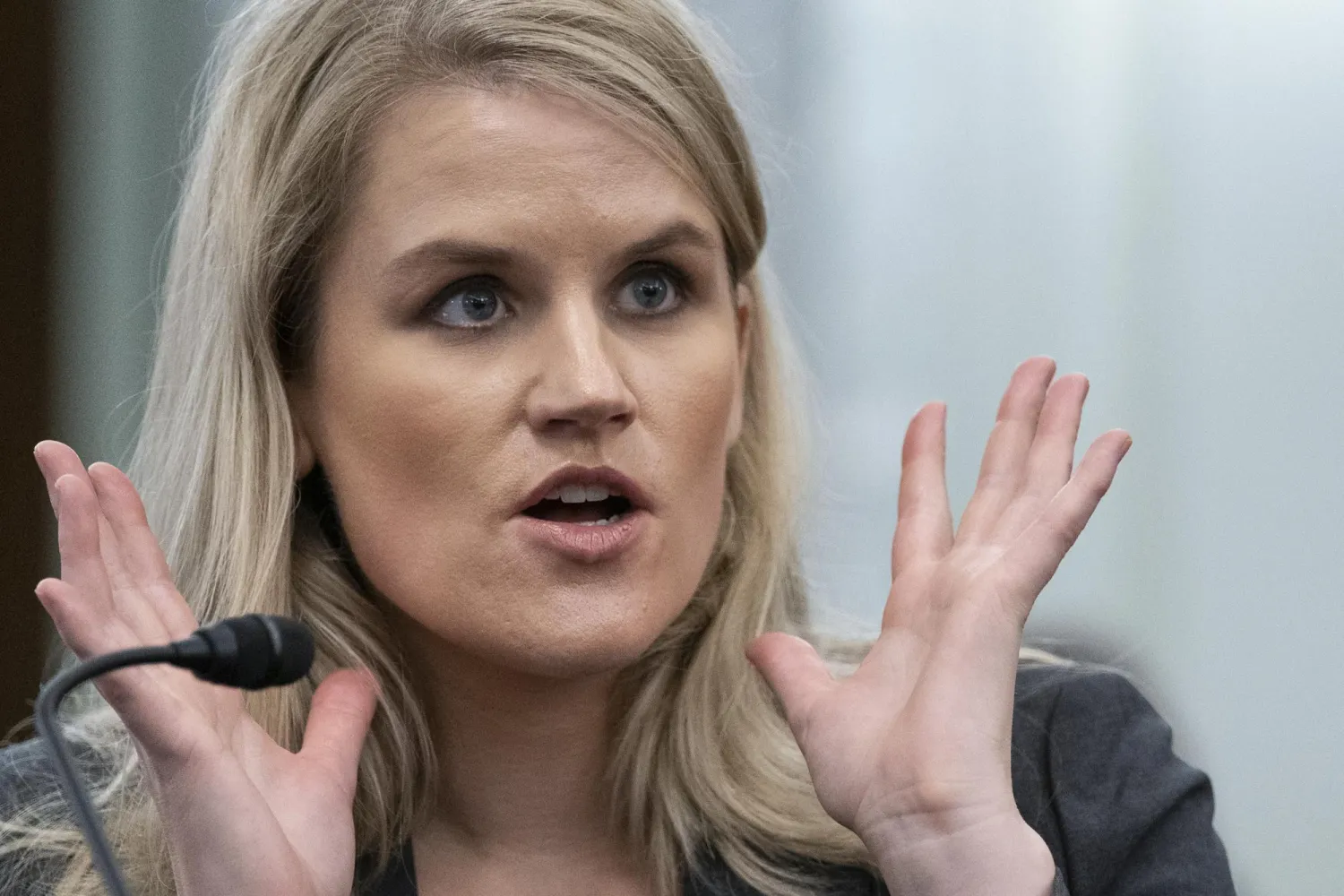
Frances Haugen. AP file photo
TT

Scientist, Enforcer, High-flyer: 3 Women Put a Mark on Tech

Frances Haugen. AP file photo

Three bright and driven women with ground-breaking ideas made significant — if very different — marks on the embattled tech industry in 2021, The Associated Press reported.

Frances Haugen, Lina Khan and Elizabeth Holmes — a data scientist turned whistleblower, a legal scholar turned antitrust enforcer and a former Silicon Valley high-flyer turned criminal defendant — all figured heavily in a technology world where men have long dominated the spotlight. Think Bill Gates, Steve Jobs, Mark Zuckerberg, Jeff Bezos, Elon Musk.

Haugen, a former product manager at Facebook, went public with internal documents to buttress accusations that the social network giant elevated profits over the safety of users. At 32, Khan is the youngest person ever to lead the Federal Trade Commission, an agency now poised to aggressively enforce antitrust law against the tech industry.

Holmes, once worth $4.5 billion on paper, is now awaiting a jury's verdict on fraud charges that she misled investors and patients about the accuracy of a blood-testing technology developed at her startup Theranos. Her story has become a Silicon Valley morality tale — a founder who flew too high, too fast — despite the fact that male tech executives have been accused of similar actions or worse without facing charges.
___
Haugen joined Facebook out of a desire to help it address misinformation and other threats to democracy. But her frustration grew as she learned of online misinformation that stoked violence and abuse — and which Facebook wasn't addressing effectively.

So in the fall of 2021 the 37-year-old Haugen went public with a trove of Facebook documents that catalogued how her former employer was failing to protect young users from body-image issues and amplifying online hate and extremism. Her work also laid bare the algorithms Big Tech uses to tailor content that will keep users hooked on its services.

“Frances Haugen has transformed the conversation about technology reform,” Roger McNamee, an early investor in Facebook who became one of its leading critics, wrote in Time magazine.

Facebook the company, which has since renamed itself Meta Platforms, has disputed Haugen’s assertions, although it hasn’t pointed to any factual errors in her public statements. The company instead emphasizes the vast sums it says it has invested in safety since 2016 and data showing the progress it's made against hate speech, incitement to political violence and other social ills.

Haugen was well positioned to unleash her bombshell. As a graduate business student at Harvard, she helped create an online dating platform that eventually turned into the dating app Hinge. At Google, she helped make thousands of books accessible on mobile phones and to create a fledgling social network. Haugen’s creative restlessness flipped her through several jobs over 15 years at Google, Yelp and Pinterest and of course Facebook, which recruited her in 2018.

Haugen’s revelations energized global lawmakers seeking to rein in Big Tech, although there's been little concrete action in the US. Facebook rushed to change the subject by rolling out its new corporate name and playing up its commitment to developing an immersive technology platform known as the “metaverse.”

Haugen moved this year to Puerto Rico, where she says she can enjoy anonymity that would elude her in northern California. “I don’t like being the center of attention,” she told a packed arena at a November conference in Europe.
___
A similar dynamic prevailed for Khan, an academic outsider with big new ideas and a far-reaching agenda that ruffled institutional and business feathers. President Joe Biden stunned official Washington in June when he installed Khan, an energetic critic of Big Tech then teaching law, as head of the Federal Trade Commission. That signaled a tough government stance toward giants Meta, Google, Amazon and Apple.

Khan is the youngest chair in the 106-year history of the FTC, which polices competition, consumer protection and digital privacy. She was an unorthodox choice, with no administrative experience or knowledge of the agency other than a brief 2018 stint as legal adviser to one of the five commissioners.

But she brought intellectual heft that packed a political punch. Khan shook up the antitrust world in 2017 with her scholarly work as a Yale law student, “Amazon’s Antitrust Paradox,” which helped shape a new way of looking at antitrust law.
For decades, antitrust work has defined anticompetitive action as market dominance that drives up prices, a concept that doesn't apply to many “free” technology services. Khan instead pushed to examine the broader effects of corporate concentration on industries, employees and communities. That school of thought — dubbed “hipster antitrust” by its detractors — appears to have had a significant influence on Biden.

Khan was born in London; her family moved to the New York City area when she was 11. After graduating from college, she spent three years as a policy analyst at the liberal-leaning think tank New America Foundation before leaving for Yale.
Under Khan’s six-month tenure, the FTC has sharpened its antitrust attack against Facebook in federal court and pursued a competition investigation into Amazon. The agency sued to block graphics chip maker Nvidia’s $40 billion purchase of chip designer Arm, saying a combined company could stifle the growth of new technologies.

In Khan's aggressive investigations and enforcement agenda, key priorities include racial bias in algorithms and market-power abuses by dominant tech companies. Internally, some employees have chafed at administrative changes that expanded Khan’s authority over policymaking, and one Republican commissioner has assailed Khan in public.

“She’s shaken things up,” said Robin Gaster, a visiting scholar at George Washington University who focuses on economics, politics and technology. “She is going to be a field test for whether an aggressive FTC can expand the envelope for antitrust enforcement.”

The US Chamber of Commerce, the leading business lobby, has publicly threatened court fights, asserting that Khan and the FTC are waging war on American businesses.
___
Holmes founded Theranos when she was 19, dropping out of Stanford to pursue a bold, humanitarian idea. Possessed of seemingly boundless networking chutzpah, Holmes touted Theranos blood-testing technology as a breakthrough that could scan for hundreds of medical conditions using just a few drops of blood.

By 2015, 11 years after leaving Stanford, Holmes had raised hundreds of millions of dollars for her company, pushing its market value to $9 billion. Half of that belonged to Holmes, earning her the moniker of the world’s youngest self-made female billionaire at 30.

Just three years later, though, Theranos collapsed in scandal. After a three-and-a-half-month federal trial, a jury now is weighing criminal fraud and conspiracy charges against Holmes for allegedly duping investors and patients by concealing the fact that the blood-testing technology was prone to wild errors. If convicted, Holmes, now 37, faces up to 20 years in prison.

When young, Holmes was a competitive prodigy who openly aspired to make a vast fortune. She started studying Mandarin Chinese with a tutor around age 9, and talked her way into summer classes in the language at Stanford after her sophomore year in high school.

In her sophomore college year, she took the remainder of her tuition money as a stake and dropped out to run her company.

As Theranos ascended, some saw Holmes as the next Steve Jobs. Theranos ultimately raised more than $900 million from investors including media baron Rupert Murdoch and Walmart’s Walton family.

The company’s fairy-tale success started to unravel in 2016, when a series of Wall Street Journal articles and a federal regulatory audit uncovered a pattern of grossly inaccurate blood results in tests run on Theranos devices.

The Holmes trial has exposed Silicon Valley’s “fake it ‘til you make it” culture in painful detail. Tech entrepreneurs often overpromise and exaggerate, so prosecutors faced the challenge of proving that Holmes’ boosterism crossed the line into fraud.



Saudi Arabia, Japan Explore AI and Digital Government Collaboration

The Saudi Minister of Communications and Information Technology met with Japan's Minister for Digital Transformation in Davos. SPA
TT

Saudi Arabia, Japan Explore AI and Digital Government Collaboration

The Saudi Minister of Communications and Information Technology met with Japan's Minister for Digital Transformation in Davos. SPA

Saudi Minister of Communications and Information Technology Abdullah Alswaha met with Japan's Minister for Digital Transformation Hisashi Matsumoto during the Kingdom's participation in the World Economic Forum (WEF) in Davos.

The meeting focused on expanding the partnership between the two countries in digital government, AI, digital capability development, and the empowerment of entrepreneurship.


Taiwan Says It Will Lead ‘Democratic’ High-Tech Supply Chain with US

Taiwan's Vice Premier Cheng Li-chiun speaks at a press conference about US-Taiwan trade deal in Taipei, Taiwan, January 20, 2026. (Reuters)
TT

Taiwan Says It Will Lead ‘Democratic’ High-Tech Supply Chain with US

Taiwan's Vice Premier Cheng Li-chiun speaks at a press conference about US-Taiwan trade deal in Taipei, Taiwan, January 20, 2026. (Reuters)

Taiwan aims to build a "democratic" high-tech supply chain ​with the United States and form a strategic AI partnership under the new tariffs deal it sealed with Washington last week, Taipei's top negotiator in the talks said on Tuesday.

US President Donald Trump has pushed the major producer of semiconductors, which runs a large trade surplus with the United States, to invest more in the US, specifically in chips that power AI.

Under the terms of the long-negotiated deal, chipmakers like TSMC that expand US production will incur a lower tariff on semiconductors or related manufacturing equipment and products they import into the US and will ‌be able ‌to import some items duty-free. Broad tariffs that apply to most ‌other Taiwanese ⁠exports ​to ‌the US will fall from 20% to 15%.

Taiwan companies will also invest $250 billion to boost production of semiconductors, energy and artificial intelligence in the US, while Taiwan will also guarantee an additional $250 billion in credit to facilitate further investment.

Speaking to reporters in Taipei, Vice Premier Cheng Li-chiun said the deal was not about hollowing out Taiwan's chip industry, which is so important for the economy it is widely referred to as the "sacred mountain protecting the country".

"This is not supply-chain relocation; rather, it is ⁠support for Taiwan's high-tech industries to extend their strength abroad - through addition, and even multiplication - to expand a strong international footprint in ‌the United States," she said.

CHIPMAKER INVESTMENTS

Under the agreement, chipmakers that ‍expand in the US will be able ‍to import up to 2.5 times their new capacity of semiconductors and wafers with no ‍extra tariffs during an approved construction period. Preferential treatment would apply to chips that exceed that quota.

Cheng said Taiwan has secured preferential treatment in advance under any future Section 232 measures on semiconductors, which is an ongoing US national security investigation into imports of key products like chips and pharmaceuticals.

"As for what the actual ​Section 232 semiconductor tariff will be in the future, (US Commerce) Secretary Lutnick recently mentioned a possible rate of 100%, but this remains undecided," Cheng said.

"Regardless, under any ⁠future tariff scenario, we have ensured that the US will grant Taiwan the most favorable treatment: zero tariffs within the quota and preferential tariffs even outside the quota."

In an interview with CNBC last week, US Commerce Secretary Howard Lutnick said that if companies do not build in the US, a tariff would likely be 100%.

"In the past we said, 'Taiwan can help'," Cheng added, referring to Taiwan's past efforts to help the international community during the COVID pandemic and other crises.

"We hope in the future it will be "Taiwan-US can lead,' with the two sides joining forces and, under the wave of AI, working together to build a high-tech supply chain for the democratic camp. This is our strategic objective."

The US is Taiwan's most important backer and arms supplier, despite the lack of formal diplomatic ‌ties. Beijing claims the democratically governed island as its own and has not ruled out the use of force to achieve its goals.


OpenAI Introducing Ads to ChatGPT

FILE PHOTO: OpenAI logo is seen in this illustration taken May 20, 2024. REUTERS/Dado Ruvic/Illustration/File Photo
TT

OpenAI Introducing Ads to ChatGPT

FILE PHOTO: OpenAI logo is seen in this illustration taken May 20, 2024. REUTERS/Dado Ruvic/Illustration/File Photo

OpenAI announced Thursday it will begin testing advertisements on ChatGPT in the coming weeks, as the wildly popular artificial intelligence chatbot seeks to increase revenue to cover its soaring costs.

The ads will initially appear in the United States for free and lower-tier subscribers, the company said in a blog post outlining its long-anticipated move into advertising.

The integration of advertising has been a key question for generative AI chatbots, with companies largely reluctant to interrupt the user experience with ads.

But the exorbitant costs of running AI services may have forced OpenAI's hand.
Only a small percentage of its nearly one billion users pay for subscription services, putting pressure on the company to find new revenue sources.

Since ChatGPT's launch in 2022, OpenAI's valuation has soared to $500 billion in funding rounds -- higher than any other private company. Some expect it could go public with a trillion-dollar valuation.

But the ChatGPT maker burns through cash at a furious rate, mostly on the powerful computing required to deliver its services.

With its move, OpenAI brings its business model closer to tech giants Google and Meta, which have built advertising empires on the back of their free-to-use services.

Unlike OpenAI, those companies have massive advertising revenue to fund AI innovation -- with Amazon also building a solid ad business on its shopping and video streaming platforms.

"Ads aren't a distraction from the gen AI race; they're how OpenAI stays in it," said Jeremy Goldman, an analyst at Emarketer.

"If ChatGPT turns on ads, OpenAI is admitting something simple and consequential: the race isn't just about model quality anymore; it's about monetizing attention without poisoning trust," he added.

OpenAI's pivot comes as Google gains ground in the generative AI race, infusing services including Gmail, Maps and YouTube with AI features that -- in addition to its Gemini chatbot -- compete directly with ChatGPT.

To address concerns about its pivot into advertising, OpenAI pledged that ads would never influence ChatGPT's answers and that user conversations would remain private from advertisers.

"Ads do not influence the answers ChatGPT gives you," the company stated, according to AFP. "Answers are optimized based on what's most helpful to you. Ads are always separate and clearly labeled."

In an apparent reference to Meta, TikTok and Google's YouTube -- platforms accused of maximizing user engagement to boost ad views -- OpenAI said it would "not optimize for time spent in ChatGPT."

"We prioritize user trust and user experience over revenue," it added.

The commitment to user well-being is a sensitive issue for OpenAI, which has faced accusations of allowing ChatGPT to prioritize emotional engagement over safety, allegedly contributing to mental distress among some users.