


Fresh Violence in Kazakhstan after Russia Sends Troops to Put Down Uprising

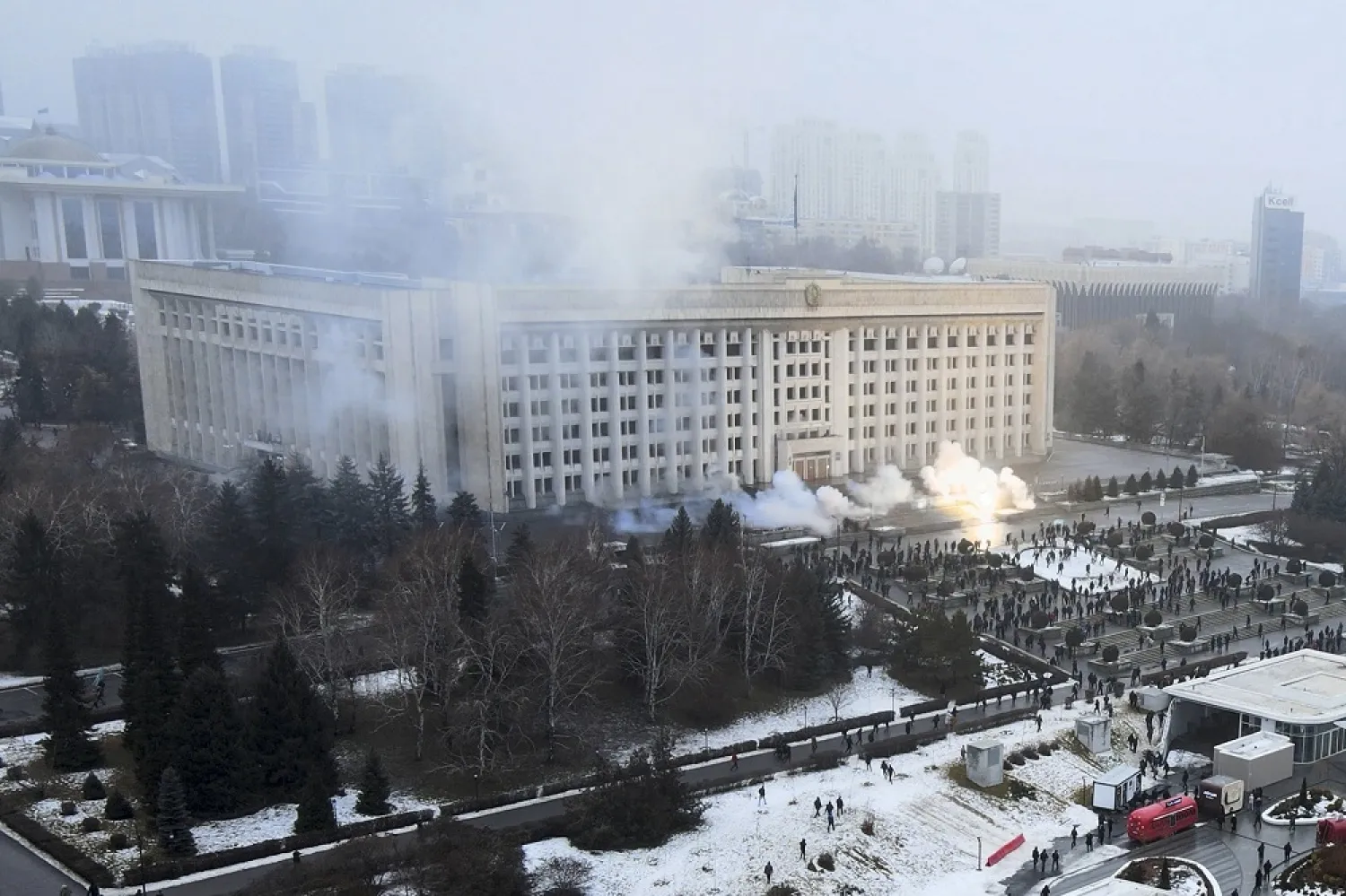
Smoke rises from the city hall building during a protest in Almaty, Kazakhstan, Jan. 5, 2022. (AP)
TT

Fresh Violence in Kazakhstan after Russia Sends Troops to Put Down Uprising

Smoke rises from the city hall building during a protest in Almaty, Kazakhstan, Jan. 5, 2022. (AP)

Fresh violence erupted in Kazakhstan's main city on Thursday after Russia rushed in paratroopers overnight to put down a countrywide uprising in one of Moscow's closest former Soviet allies.

Police in the main city Almaty said they had killed dozens of rioters overnight. The authorities said at least 18 members of the security forces had died, including two found decapitated. More than 2,000 people had been arrested.

After a night of running confrontations between protesters and troops on the streets, a presidential residence in the city and its mayor's office were both ablaze, and burnt out cars littered the city, Reuters journalists said.

Military personnel regained control of the main airport, seized earlier by protesters. Thursday evening saw renewed battles in Almaty's main square, occupied alternately by troops and hundreds of protesters throughout much of the day.

The Russian deployment was a gamble by the Kremlin that rapid military force could secure its interests in the oil and uranium-producing Central Asian nation, by swiftly putting down the worst violence in Kazakhstan's 30 years of independence.

Reuters reporters heard explosions and gunfire as military vehicles and scores of soldiers advanced, although the shooting stopped again after nightfall. TASS news agency quoted witnesses as saying people had been killed and wounded in the new gunfire.

Oil production at Kazakhstan's top field Tengiz was reduced on Thursday, its operator Chevron said, as some contractors disrupted train lines in support of the protests.

The internet was shut down across the country, making it impossible to gauge the extent of the unrest. But the violence was unprecedented in a state ruled firmly since Soviet times by leader Nursultan Nazarbayev, 81, who held on to the reins despite stepping down three years ago as president.

'Attack on our citizens'
Nazarbayev's hand-picked successor, President Kassym-Jomart Tokayev, called in the Russian forces overnight as part of a Moscow-led military alliance of ex-Soviet states. He blamed the unrest on foreign-trained terrorists who he said had seized buildings and weapons.

"It is an undermining of the integrity of the state and most importantly it is an attack on our citizens who are asking me... to help them urgently," he said.

Moscow said it would consult with Kazakhstan and allies on steps to support the Kazakh "counter-terrorist operation" and repeated Tokayev's assertion that the uprising was foreign-inspired. Neither Kazakhstan nor Russia provided evidence to support that.

Moscow did not disclose how many troops it was sending or what role they were playing, and it was not possible to determine the extent to which Russians may have been involved in Thursday's unrest.

The uprising, which began as protests against a New Year's Day fuel price hike, swelled on Wednesday, when protesters chanting slogans against Nazarbayev stormed and torched public buildings in Almaty and other cities.

Tokayev initially responded by dismissing his cabinet, reversing the fuel price rise and distancing himself from his predecessor, including by taking over a powerful security post Nazarbayev had retained. But those moves failed to mollify crowds who accuse Nazarbayev's family and allies of amassing vast wealth while the nation of 19 million remained poor.

Nazarbayev stepped aside from the presidency in 2019 as the last Soviet-era Communist Party boss still ruling a former Soviet state. But he and his family kept posts overseeing security forces and the political apparatus in Nur-Sultan, the purpose-built capital bearing his name. He has not been seen or heard from since the unrest began.

'Looters came in'
The swift arrival of Russian troops demonstrated the Kremlin's willingness to safeguard its influence in the ex-Soviet Union with force. Since late 2020, Moscow has shored up the leader of Belarus against a popular uprising, intervened to halt a war between Azerbaijan and Armenia, and, to the West's alarm, massed troops again near Ukraine, which Russia invaded eight years ago.

Deployment in Kazakhstan carries risk: by exposing the Kazakh authorities as dependent on Russian muscle, Moscow could further inflame the protesters.

"They are Kazakhs and Tokayev will try putting them down with Russian troops. That will not look great for Moscow," tweeted economist Tim Ash, who specializes in the region.

But it is difficult to say how broad support might be for protests in a country with little organized opposition, especially if demonstrators are blamed for violence.

"Thank God, the military has arrived, finally," Ali, a manager at Holiday Inn hotel near Almaty's main square, told Reuters by phone. "Looters came in last night, smashing car windows near us."

The West has so far mainly limited its response to calls for calm. US Secretary of State Antony Blinken spoke to his Kazakh counterpart "and advocated for a peaceful, rights-respecting resolution to the crisis", spokesperson Ned Price said.

EU top diplomat Josep Borrell said Russia's military intervention brought "memories of situations to be avoided".

Kazakhstan's long-dated dollar-denominated sovereign bonds have plunged, losing around 7 cents since the start of the week.

Kazakhstan is the top global producer of uranium, which jumped in price by 8% after the unrest.

The country is also the world's second-largest miner of bitcoin. Bitcoin's "hashrate" - the computing power of machines in its network - dropped by over 10% on Wednesday after Kazakhstan's internet was shut off, according to crypto mining firm BTC.com.



AI Cannot Be Left to 'Whims of a Few Billionaires', UN Chief Says

India's Prime Minister Narendra Modi speaks with United Nations Secretary-General Antonio Guterres during a welcoming ceremony at AI Impact Summit, in New Delhi, India, February 18, 2026. India's Press Information Bureau/Handout via REUTERS
TT

AI Cannot Be Left to 'Whims of a Few Billionaires', UN Chief Says

India's Prime Minister Narendra Modi speaks with United Nations Secretary-General Antonio Guterres during a welcoming ceremony at AI Impact Summit, in New Delhi, India, February 18, 2026. India's Press Information Bureau/Handout via REUTERS

UN chief Antonio Guterres warned technology leaders Thursday of the risks of artificial intelligence, saying its future cannot be left to "the whims of a few billionaires".

Speaking at a global AI summit in India, the UN chief called on tech tycoons to support a $3 billion global fund to ensure open access to the fast-advancing technology for all.

"AI must belong to everyone," he said.

"The future of AI cannot be decided by a handful of countries -- or left to the whims of a few billionaires," he added, warning the world risked deepening inequality unless urgent steps were taken.

"Done right, AI can... accelerate breakthroughs in medicine, expand learning opportunities, strengthen food security, bolster climate action and disaster preparedness and improve access to vital public services," he said.

"But it can also deepen inequality, amplify bias and fuel harm."

The UN has set up an AI scientific advisory body to help countries make decisions about the revolutionary technology.

Guterres warned that people must be protected from exploitation, and that "no child should be a test subject for unregulated AI".

He pressed for global guardrails to ensure oversight and accountability, and the creation of "Global Fund on AI" to build basic capacity.

"Our target is $3 billion," he told the conference, which includes national leaders as well as tech CEOs, including Sam Altman of OpenAI and Google's Sundar Pichai.

"That's less than one percent of the annual revenue of a single tech company. A small price for AI diffusion that benefits all, including the businesses building AI."

Without investment, "many countries will be logged out of the AI age", exacerbating global divides, he said.

He also cautioned that as AI's energy and water demands soar, data centers must switch to clean power, rather than "shift costs to vulnerable communities".


US Military Tells Trump It's ‘Ready’ to Strike Iran as Soon as Saturday

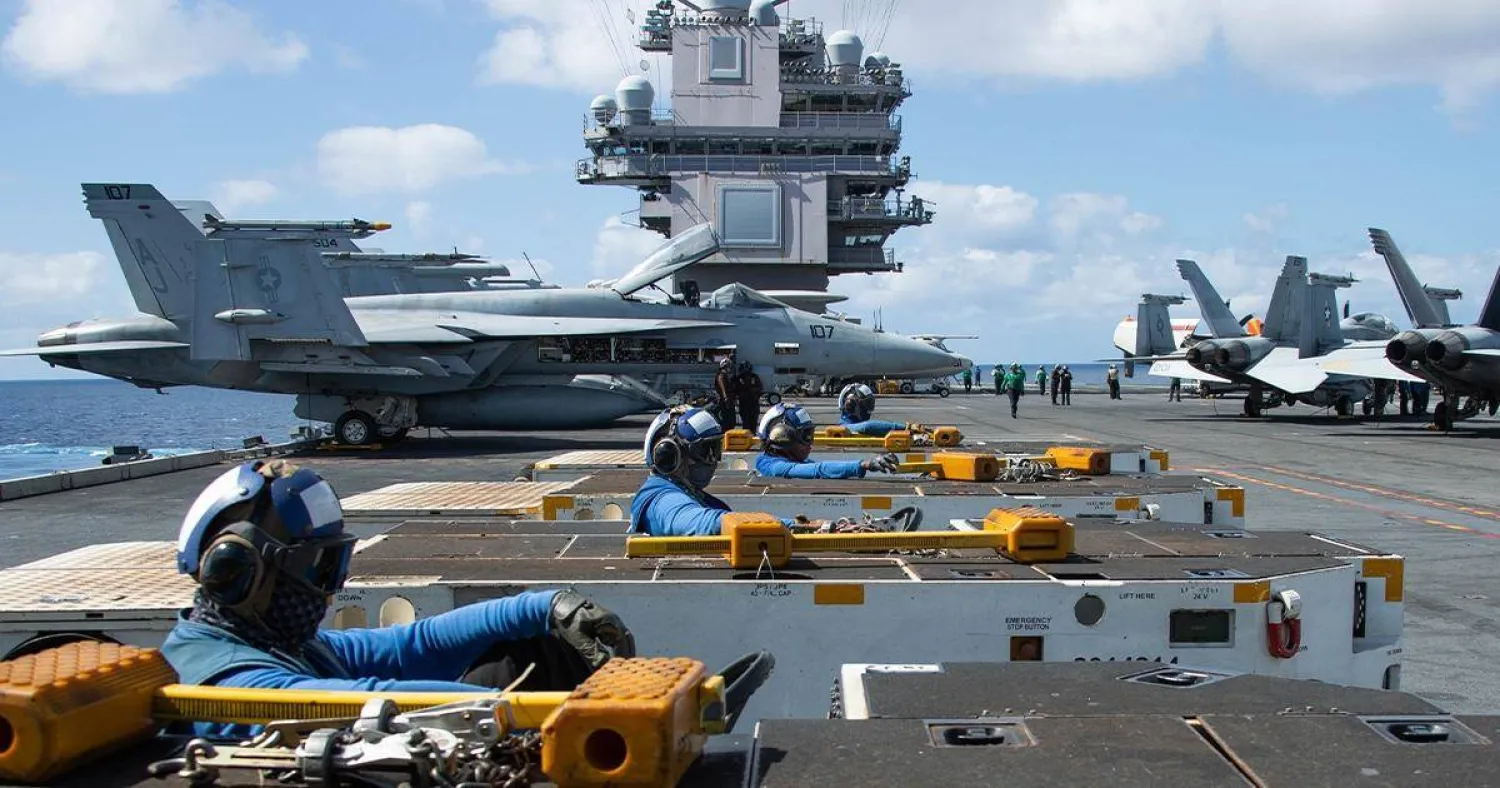
A shot showing personnel preparations aboard the US aircraft carrier "Gerald Ford" (US Navy)
TT

US Military Tells Trump It's ‘Ready’ to Strike Iran as Soon as Saturday

A shot showing personnel preparations aboard the US aircraft carrier "Gerald Ford" (US Navy)

Top national security officials have told US President Donald Trump the military is ready for potential strikes on Iran as soon as Saturday, but the timeline for any action is likely to extend beyond this weekend, sources familiar with the discussions told CBS News.

Trump has not yet made a final decision about whether to strike, said the officials, who spoke under condition of anonymity to discuss sensitive national matters.

The conversations have been described as fluid and ongoing, as the White House weighs the risks of escalation and the political and military consequences of restraint, added CBS.

Over the next three days, the Pentagon is moving some personnel temporarily out of the Middle East region — primarily to Europe or back to the United States — ahead of potential action or counterattacks by Iran if the US were to move ahead with its operation, according to multiple officials.

It's standard practice for the Pentagon to shift assets and personnel ahead of a potential US military activity and doesn't necessarily signal an attack on Iran is imminent, one of the sources told CBS.

Contacted by CBS News on Wednesday afternoon, a Pentagon spokesperson said they had no information to provide.

Iran was discussed in the White House Situation Room on Wednesday, a US official and a senior military official told CBS News. All military forces deployed to the region are expected to be in place by mid-March.

Axios had also said that a war between the United States and Iran is looming — and there are several factors suggesting President Trump might push the button soon.

On Wednesday, Iran's top diplomat Abbas Araghchi said that Tehran was "drafting" a framework for future talks with the United States, as the US energy secretary said Washington would stop Iran's nuclear ambitions "one way or another".


Satellite Images Show Iran Repairing and Fortifying Sites amid US Tensions

A satellite image shows tunnel entrances covered with soil at Isfahan nuclear complex, in Isfahan, Iran, February 10, 2026. Vantor/Handout via REUTERS
TT

Satellite Images Show Iran Repairing and Fortifying Sites amid US Tensions

A satellite image shows tunnel entrances covered with soil at Isfahan nuclear complex, in Isfahan, Iran, February 10, 2026. Vantor/Handout via REUTERS

Satellite images show that Iran has recently built a concrete shield over a new facility at a sensitive military site and covered it in soil, experts say, advancing work at a location reportedly bombed by Israel in 2024 amid tensions with the US.

Images also show that Iran has buried tunnel entrances at a nuclear site bombed by the US during Israel's 12-day war with Iran last year, fortified tunnel entrances near another, and has repaired missile bases struck in the conflict.

They offer a glimpse of Iranian activities at some of the sites at the center of tensions with Israel and the US, as Washington seeks to negotiate a deal with Tehran on its nuclear program while threatening military action if talks fail.

Some 30 km (20 miles) southeast of Tehran, the Parchin complex is one of Iran's most sensitive military sites. Western intelligence has suggested Tehran carried out tests relevant to nuclear bomb detonations there more than two decades ago.

Iran has always denied seeking atomic weapons. Israel reportedly struck Parchin in October 2024.

Satellite imagery taken before and after that attack shows extensive damage to a rectangular building at Parchin, and apparent reconstruction in images from November 6, 2024.

Imagery from October 12, 2025 shows development at the site, with the skeleton of a new structure visible and two smaller structures adjacent to it. Progress is apparent in imagery from November 14, with what appears to be a metallic roof covering the large structure.

But imagery from December 13 shows the facility partly covered. By February 16, it cannot be seen at all, hidden by what experts say is a concrete structure.

The Institute for Science and International Security (ISIS), in a January 22 analysis of satellite imagery, pointed to progress in the construction of a "concrete sarcophagus" around a newly built facility at the site, which it identified as Taleghan 2.

ISIS reported in November that imagery showed "ongoing construction and the presence of what appears to resemble a long, cylindrical chamber, maybe a high-explosives containment vessel, likely measuring approximately 36 meters long and 12 meters in diameter placed inside a building".

"High-explosive containment vessels are critical to the development of nuclear weapons," ISIS added, "but can also be used in many other conventional weapons development processes."

William Goodhind, a forensic imagery analyst with Contested Ground, said the roof had a similar hue to the surrounding area, adding: "It has most likely been covered with dirt to obscure the concrete color."

ISIS founder David Albright wrote on X: "Stalling the negotiations has its benefits: Over the last two to three weeks, Iran has been busy burying the new Taleghan 2 facility ... More soil is available and the facility may soon become a fully unrecognizable bunker, providing significant protection from aerial strikes."

TUNNEL ENTRANCES BURIED AT ISFAHAN NUCLEAR COMPLEX

The Isfahan complex is one of three Iranian uranium-enrichment plants bombed by the United States in June.

In addition to facilities that are part of the nuclear fuel cycle, Isfahan includes an underground area where diplomats say much of Iran's enriched uranium has been stored.

Satellite images taken in late January showed new efforts to bury two tunnel entrances at the complex, ISIS reported on January 29. In a February 9 update, ISIS said a third entrance had also been backfilled with soil, meaning all entrances to the tunnel complex were now "completely buried".

A February 10 image shows all three tunnels buried, Goodhind said.

ISIS reported on February 9 that "backfilling the tunnel entrances would help dampen any potential airstrike and also make ground access in a special forces raid to seize or destroy any highly enriched uranium that may be housed inside difficult".

TUNNEL ENTRANCES FORTIFIED AT COMPLEX NEAR NATANZ SITE

ISIS has reported that satellite images point to ongoing efforts since February 10 to "harden and defensively strengthen" two entrances to a tunnel complex under a mountain some 2 km (1.2 miles) from Natanz - the site that holds Iran's other two uranium enrichment plants.

Imagery shows "ongoing activity throughout the complex related to this effort, involving the movement of numerous vehicles, including dump trucks, cement mixers, and other heavy equipment", ISIS wrote.

Iran's plans for the facility, called Pickaxe Mountain, are unclear, ISIS said.

SHIRAZ SOUTH MISSILE BASE

About 10 km (6 miles) south of Shiraz in southern Iran, this is one of 25 primary bases capable of launching medium-range ballistic missiles, according to Alma Research and Education Center, an Israeli organization. Alma assessed the site had suffered light, above-ground damage in last year's war.

A comparison of images taken on July 3, 2025 and January 30 shows reconstruction and clearance efforts at the main logistics and likely command compound at the base, Goodhind said.

"The key takeaway is that the compound has yet to return to its full operational capacity from prior to the airstrikes."

QOM MISSILE BASE

Some 40 km north of the city of Qom, this base suffered moderate above-ground damage, according to Alma.

A comparison of images taken between July 16, 2025, and February 1 shows a new roof over a damaged building. The roof repairs appear to have begun on November 17 and were most likely complete 10 days later, Goodhind said.