

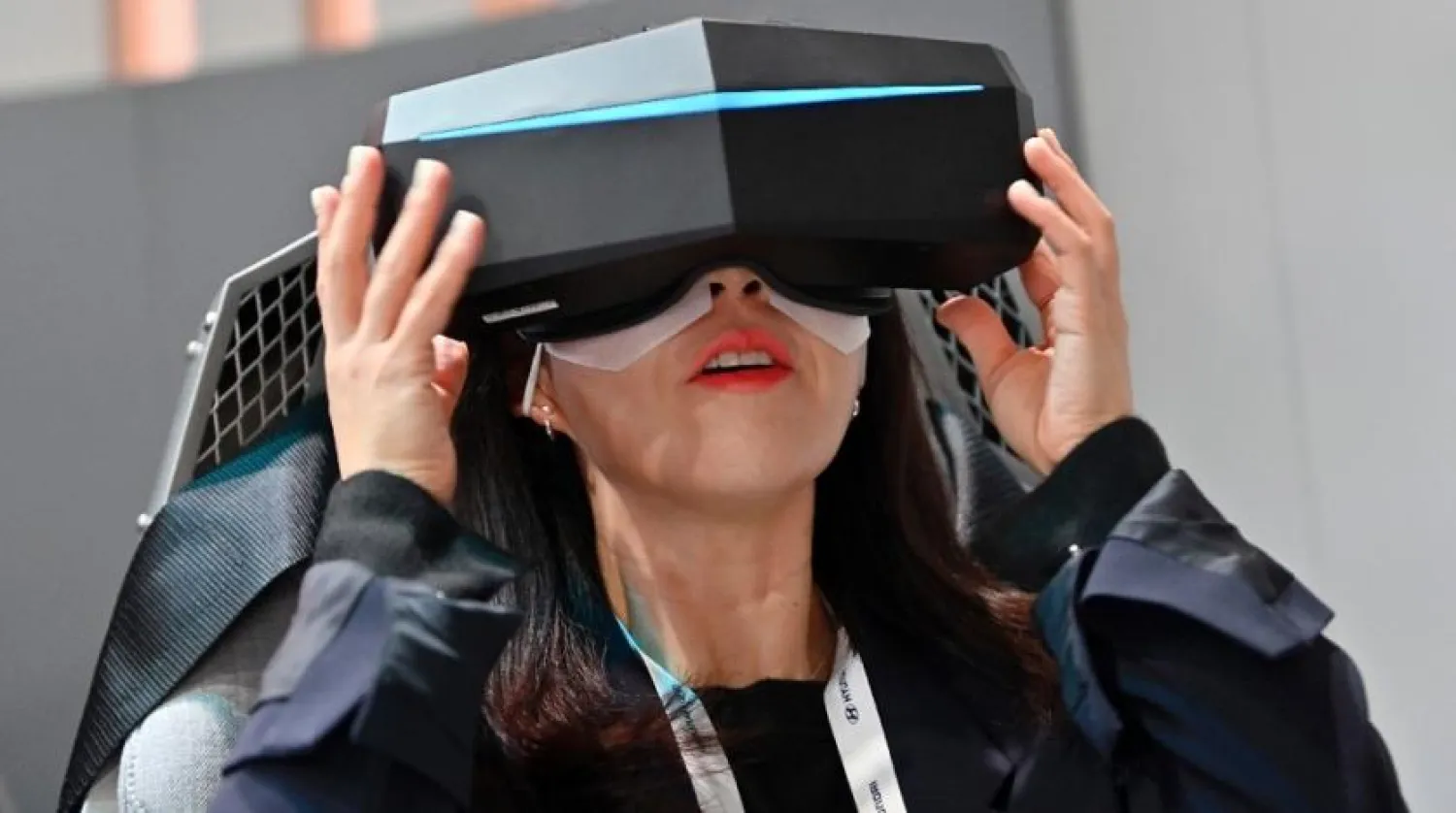

Metaverse Gets Touch of Reality at CES

Metaverse generally refers to shared virtual world environments which people can access via the internet. (AFP)
TT

Metaverse Gets Touch of Reality at CES

Metaverse generally refers to shared virtual world environments which people can access via the internet. (AFP)

A jacket equipped with sensors that let wearers feel hugs or even punches in virtual reality was among the innovations giving the metaverse a more realistic edge at the Consumer Electronics Show.

"What is the metaverse if you can't feel it?" asked Jose Fuertes, founder of the Spain-based startup Owo, which made the jacket. "It's just avatars."

The "metaverse" -- a parallel universe where human, augmented and virtual realities are supposed to merge -- was a hot theme at the annual gadget extravaganza in Las Vegas, with startups showing off computers, headsets and other gear promising to enhance time spent in virtual worlds.

Owo touts its jacket as able to immerse wearers, whether in video games or in the metaverse, letting them feel "a gunshot, the wind, someone grabbing your arm and even a hug from a loved one."

The tight-fitting jacket features bands that stick to the skin, with sensors that sync to a mobile application. Before donning a virtual reality (VR) headset, the wearer can choose the intensity of each sensation.

"Our mission is to turn the virtual into reality with a second skin; to add the sense of touch in the metaverse or video games," Fuertes said as AFP tried out the jacket.

The Owo garb -- to be priced less than $450 when it hits the market late this year -- brings to mind the sci-fi novel-turned-film "Ready Player One," in which people in a dystopian world live alternate lives in a virtual universe.

The science fiction future seems distant given a lack of full body suits and comfortable headsets for simulated experiences, or ubiquitous high-speed internet service to handle such rich data streams.

Nonetheless, the metaverse has become a popular topic since being endorsed by Facebook chief Mark Zuckerberg so enthusiastically that the technology company was renamed "Meta."

- Sound of inevitability? -
Virtual reality has mostly been used for video games, despite its potential for experiences such as letting people visit museums, landmarks or far-off cities while sitting at home, and even for providing seats literally in the middle of feature films.

While companies such as Meta and HTC have invested heavily in virtual reality headsets, the equipment is still not light and comfortable enough to wear for long periods of time.

"I'm the biggest sort of augmented and virtual reality nerd, but I don't think we are anywhere close to anything exciting happening in the metaverse," said Paddy Cosgrave, head of Web Summit in Europe.

He expects it to take more than a decade for the metaverse to become real.

"Nothing can stop it," Touchcast chief and founder Edo Segal said of the metaverse.

Touchcast showed off a platform for collaboration between companies in virtual reality, complete with ".metaverse" addresses akin to .com web addresses. But the domains will be registered on a blockchain database, instead of on servers.

"In 1999, it was hard to believe people would buy things online," Segal said.

"Look where we are today. Humanity is moving in this direction."

Industry trackers report that sales of virtual reality gear were boosted by the pandemic as people relied on the internet for games, work, learning and socializing.

- 'Like a cyborg' -
Since the pandemic began restricting people's movements, Takuma Iwasa has taken to spending weekends on a VR platform where people chat and party in a virtual world with avatars as their proxies.

As the year 2020 neared its end, the young Japanese entrepreneur focused on ways someone's leg or torso movements can be mirrored by avatars and other ways of making visits to virtual worlds more realistic.

His startup Shiftall, a subsidiary of Panasonic, unveiled lightweight, high-resolution VR glasses at CES.

"In the future, some of the special suits like in 'Ready Player One' will contain every system," Takuma said.

"Currently, metaverse users need to use different products, like a cyborg."

Israeli start-up Wearable Devices is working on a bracelet that detects the electrical signals sent by the brain to the hand. The wearer can control synced objects with a mere snap of their fingers -- a function that could prove useful if people use augmented reality glasses and need to select items displayed on the lenses.

But as the metaverse evolves, society will also need to be wary of dangers from online ills such as misinformation, harassment and losing touch with the real world, some experts warned.

"Counterfeit goods are going to exist in the metaverse, as well. Counterfeit identities are going to exist in the metaverse, as well," said Dan Guenther, an extended reality specialist at Accenture.

"And we've seen in many other evolutions of the internet that many times... (there) are the portions of the internet that we're uncomfortable with."



SVC Develops AI Intelligence Platform to Strengthen Private Capital Ecosystem

The platform offers customizable analytical dashboards that deliver frequent updates and predictive insights- SPA
TT

SVC Develops AI Intelligence Platform to Strengthen Private Capital Ecosystem

The platform offers customizable analytical dashboards that deliver frequent updates and predictive insights- SPA

Saudi Venture Capital Company (SVC) announced the launch of its proprietary intelligence platform, Aian, developed in-house using Saudi national expertise to enhance its institutional role in developing the Kingdom’s private capital ecosystem and supporting its mandate as a market maker guided by data-driven growth principles.

According to a press release issued by the SVC today, Aian is a custom-built AI-powered market intelligence capability that transforms SVC’s accumulated institutional expertise and detailed private market data into structured, actionable insights on market dynamics, sector evolution, and capital formation. The platform converts institutional memory into compounding intelligence, enabling decisions that integrate both current market signals and long-term historical trends, SPA reported.

Deputy CEO and Chief Investment Officer Nora Alsarhan stated that as Saudi Arabia’s private capital market expands, clarity, transparency, and data integrity become as critical as capital itself. She noted that Aian represents a new layer of national market infrastructure, strengthening institutional confidence, enabling evidence-based decision-making, and supporting sustainable growth.

By transforming data into actionable intelligence, she said, the platform reinforces the Kingdom’s position as a leading regional private capital hub under Vision 2030.

She added that market making extends beyond capital deployment to shaping the conditions under which capital flows efficiently, emphasizing that the next phase of market development will be driven by intelligence and analytical insight alongside investment.

Through Aian, SVC is building the knowledge backbone of Saudi Arabia’s private capital ecosystem, enabling clearer visibility, greater precision in decision-making, and capital formation guided by insight rather than assumption.

Chief Strategy Officer Athary Almubarak said that in private capital markets, access to reliable insight increasingly represents the primary constraint, particularly in emerging and fast-scaling markets where disclosures vary and institutional knowledge is fragmented.

She explained that for development-focused investment institutions, inconsistent data presents a structural challenge that directly impacts capital allocation efficiency and the ability to crowd in private investment at scale.

She noted that SVC was established to address such market frictions and that, as a government-backed investor with an explicit market-making mandate, its role extends beyond financing to building the enabling environment in which private capital can grow sustainably.

By integrating SVC’s proprietary portfolio data with selected external market sources, Aian enables continuous consolidation and validation of market activity, producing a dynamic representation of capital deployment over time rather than relying solely on static reporting.

The platform offers customizable analytical dashboards that deliver frequent updates and predictive insights, enabling SVC to identify priority market gaps, recalibrate capital allocation, design targeted ecosystem interventions, and anchor policy dialogue in evidence.

The release added that Aian also features predictive analytics capabilities that anticipate upcoming funding activity, including projected investment rounds and estimated ticket sizes. In addition, it incorporates institutional benchmarking tools that enable structured comparisons across peers, sectors, and interventions, supporting more precise, data-driven ecosystem development.


Job Threats, Rogue Bots: Five Hot Issues in AI

A Delhi police officer outside the venue of the 'India AI Impact Summit 2026'. Arun SANKAR / AFP
TT

Job Threats, Rogue Bots: Five Hot Issues in AI

A Delhi police officer outside the venue of the 'India AI Impact Summit 2026'. Arun SANKAR / AFP

As artificial intelligence evolves at a blistering pace, world leaders and thousands of other delegates will discuss how to handle the technology at the AI Impact Summit, which opens Monday in New Delhi.

Here are five big issues on the agenda:

Job loss fears

Generative AI threatens to disrupt myriad industries, from software development and factory work to music and the movies.

India -- with its large customer service and tech support sectors -- could be vulnerable, and shares in the country's outsourcing firms have plunged in recent days, partly due to advances in AI assistant tools.

"Automation, intelligent systems, and data-driven processes are increasingly taking over routine and repetitive tasks, reshaping traditional job structures," the summit's "human capital" working group says.

"While these developments can drive efficiency and innovation, they also risk displacing segments of the workforce," widening socio-economic divides, it warns.

Bad robots

The Delhi summit is the fourth in a series of international AI meetings. The first in 2023 was called the AI Safety Summit, and preventing real-world harm is still a key goal.

In the United States, families of people who have taken their own lives have sued OpenAI, accusing ChatGPT of having contributed to the suicides. The company says it has made efforts to strengthen its safeguards.

Elon Musk's Grok AI tool also recently sparked global outrage and bans in several countries over its ability to create sexualized deepfakes depicting real people, including children, in skimpy clothing.

Other concerns range from copyright violations to scammers using AI tools to produce perfectly spelled phishing emails.

Energy demands

Tech giants are spending hundreds of billions of dollars on AI infrastructure, building data centers packed with cutting-edge microchips, and also, in some cases, nuclear plants to power them.

The International Energy Agency projects that electricity consumption from data centers will double by 2030, fueled by the AI boom.

In 2024, data centers accounted for an estimated 1.5 percent of global electricity consumption, it says.

Alongside concerns over planet-warming carbon emissions are worries about water use to cool the data centers servers, which can lead to shortages on hot days.

Moves to regulate

In South Korea, a wide-ranging law regulating artificial intelligence took effect in January, requiring companies to tell users when products use generative AI.

Many countries are planning similar moves, despite a warning from US Vice President JD Vance last year against "excessive regulation" that could stifle innovation.

The European Union's Artificial Intelligence Act allows regulators to ban AI systems deemed to pose "unacceptable risks" to society.

That could include identifying people in real time in public spaces or evaluating criminal risk based on biometric data alone.

'Everyone dies'

More existential fears have also been expressed by AI insiders who believe the technology is marching towards so-called "Artificial General Intelligence", when machines' abilities match those of humans.

OpenAI and rival startup Anthropic have seen public resignations of staff members who have spoken out about the ethical implications of their technology.

Anthropic warned last week that its latest chatbot models could be nudged towards "knowingly supporting -- in small ways -- efforts toward chemical weapon development and other heinous crimes".

Researcher Eliezer Yudkowsky, author of the 2025 book "If Anyone Builds It, Everyone Dies: Why Superhuman AI Would Kill Us All" has also compared AI to the development of nuclear weapons.


OpenAI Hires Creator of 'OpenClaw' AI Agent Tool

FILE PHOTO: OpenAI logo is seen in this illustration taken May 20, 2024. REUTERS/Dado Ruvic/Illustration/File Photo
TT

OpenAI Hires Creator of 'OpenClaw' AI Agent Tool

FILE PHOTO: OpenAI logo is seen in this illustration taken May 20, 2024. REUTERS/Dado Ruvic/Illustration/File Photo

OpenAI has hired the Austrian creator of OpenClaw, an artificial intelligence tool able to execute real-world tasks, the US startup's head Sam Altman said on Sunday.

AI agent tool OpenClaw has fascinated -- and spooked -- the tech world since researcher Peter Steinberger built it in November to help organize his digital life.

A Reddit-like pseudo social network for OpenClaw agents called Moltbook, where chatbots converse, has also grabbed headlines and provoked soul-searching over AI.

Elon Musk called Moltbook "the very early stages of the singularity" -- a term for the moment when human intelligence is overwhelmed by AI forever, although some people have questioned to what extent humans are manipulating the bots' posts.

Steinberger "is joining OpenAI to drive the next generation of personal agents," Altman wrote in an X post.

"He is a genius with a lot of amazing ideas about the future of very smart agents interacting with each other to do very useful things for people," AFP quoted him as saying.

"We expect this will quickly become core to our product offerings," Altman wrote, saying that OpenClaw would remain an open-source project within a foundation supported by OpenAI.

"The future is going to be extremely multi-agent and it's important to us to support open source as part of that."

Users of OpenClaw download the tool, and connect it to generative AI models such as ChatGPT.

They then communicate with their AI agent through WhatsApp or Telegram, as they would with a friend or colleague.

Many users gush over the tool's futuristic abilities to send emails and buy things online, but others report an overall chaotic experience with added cybersecurity risks.

Only a small percentage of OpenAI's nearly one billion users pay for subscription services, putting pressure on the company to find new revenue sources.

It has begun testing advertisements and sponsored content in the massively popular ChatGPT, spawning privacy concerns as it looks for ways to start balancing its hundreds of billions in spending commitments.