

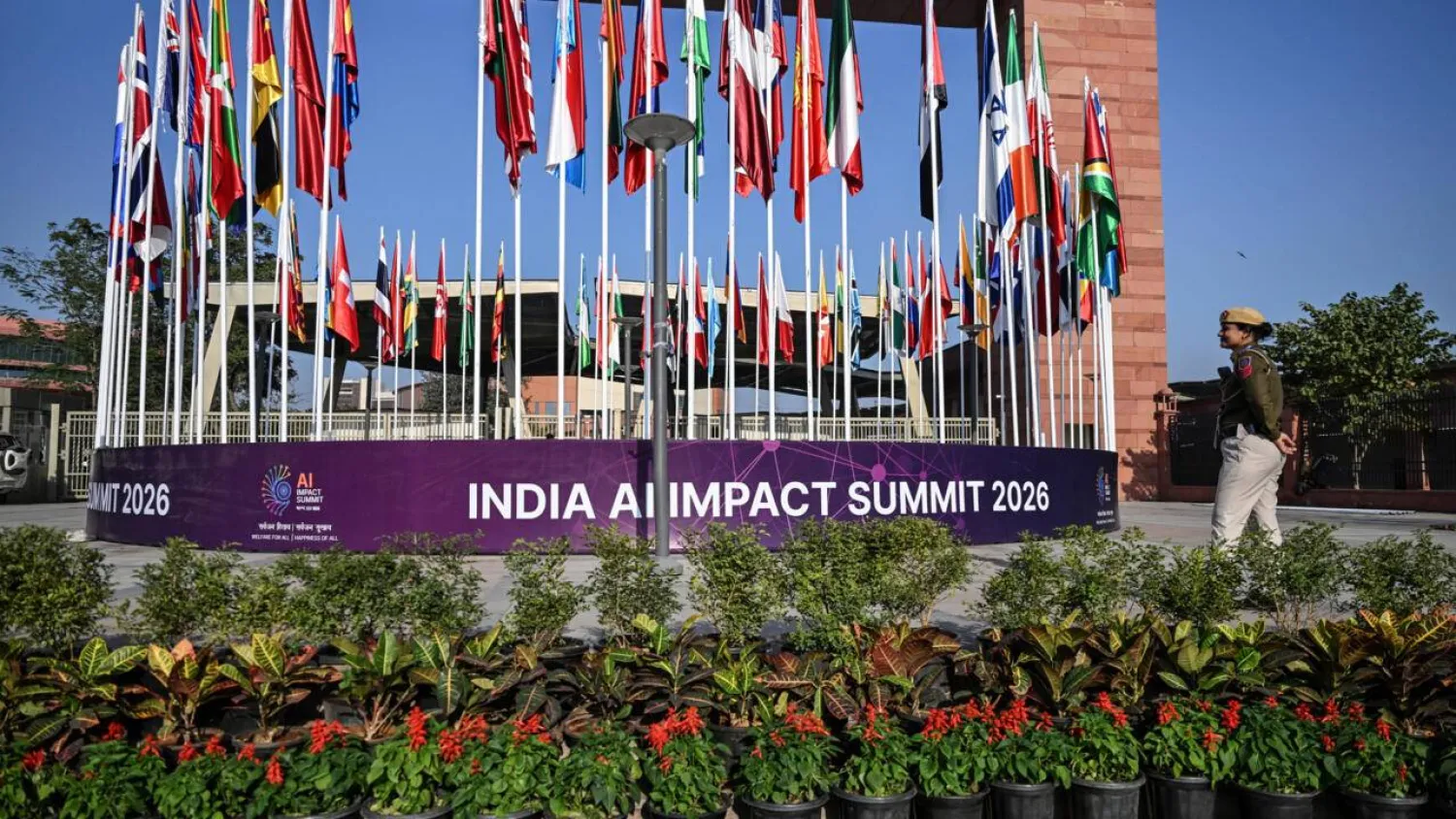

Job Threats, Rogue Bots: Five Hot Issues in AI

A Delhi police officer outside the venue of the 'India AI Impact Summit 2026'. Arun SANKAR / AFP
TT

Job Threats, Rogue Bots: Five Hot Issues in AI

A Delhi police officer outside the venue of the 'India AI Impact Summit 2026'. Arun SANKAR / AFP

As artificial intelligence evolves at a blistering pace, world leaders and thousands of other delegates will discuss how to handle the technology at the AI Impact Summit, which opens Monday in New Delhi.

Here are five big issues on the agenda:

Job loss fears

Generative AI threatens to disrupt myriad industries, from software development and factory work to music and the movies.

India -- with its large customer service and tech support sectors -- could be vulnerable, and shares in the country's outsourcing firms have plunged in recent days, partly due to advances in AI assistant tools.

"Automation, intelligent systems, and data-driven processes are increasingly taking over routine and repetitive tasks, reshaping traditional job structures," the summit's "human capital" working group says.

"While these developments can drive efficiency and innovation, they also risk displacing segments of the workforce," widening socio-economic divides, it warns.

Bad robots

The Delhi summit is the fourth in a series of international AI meetings. The first in 2023 was called the AI Safety Summit, and preventing real-world harm is still a key goal.

In the United States, families of people who have taken their own lives have sued OpenAI, accusing ChatGPT of having contributed to the suicides. The company says it has made efforts to strengthen its safeguards.

Elon Musk's Grok AI tool also recently sparked global outrage and bans in several countries over its ability to create sexualized deepfakes depicting real people, including children, in skimpy clothing.

Other concerns range from copyright violations to scammers using AI tools to produce perfectly spelled phishing emails.

Energy demands

Tech giants are spending hundreds of billions of dollars on AI infrastructure, building data centers packed with cutting-edge microchips, and also, in some cases, nuclear plants to power them.

The International Energy Agency projects that electricity consumption from data centers will double by 2030, fueled by the AI boom.

In 2024, data centers accounted for an estimated 1.5 percent of global electricity consumption, it says.

Alongside concerns over planet-warming carbon emissions are worries about water use to cool the data centers servers, which can lead to shortages on hot days.

Moves to regulate

In South Korea, a wide-ranging law regulating artificial intelligence took effect in January, requiring companies to tell users when products use generative AI.

Many countries are planning similar moves, despite a warning from US Vice President JD Vance last year against "excessive regulation" that could stifle innovation.

The European Union's Artificial Intelligence Act allows regulators to ban AI systems deemed to pose "unacceptable risks" to society.

That could include identifying people in real time in public spaces or evaluating criminal risk based on biometric data alone.

'Everyone dies'

More existential fears have also been expressed by AI insiders who believe the technology is marching towards so-called "Artificial General Intelligence", when machines' abilities match those of humans.

OpenAI and rival startup Anthropic have seen public resignations of staff members who have spoken out about the ethical implications of their technology.

Anthropic warned last week that its latest chatbot models could be nudged towards "knowingly supporting -- in small ways -- efforts toward chemical weapon development and other heinous crimes".

Researcher Eliezer Yudkowsky, author of the 2025 book "If Anyone Builds It, Everyone Dies: Why Superhuman AI Would Kill Us All" has also compared AI to the development of nuclear weapons.




Microsoft to Invest $10 bn for Japan AI Data Centers

Microsoft's Vice Chair and President Brad Smith (4th L) and (L-R) Sakura Internet Inc President and CEO Kunihiro Tanaka, SoftBank Corp. President and CEO Junichi Miyakawa, Microsoft Japan President Miki Tsusaka, hold a meeitng with Japan's Prime Minister Sanae Takaichi (2nd R) and Vice Minister of Economy, Trade and Industry Toshiro Ino (R) at the Prime Minister's Office in Tokyo on April 3, 2026. Kazuhiro NOGI / POOL/AFP
TT

Microsoft to Invest $10 bn for Japan AI Data Centers

Microsoft's Vice Chair and President Brad Smith (4th L) and (L-R) Sakura Internet Inc President and CEO Kunihiro Tanaka, SoftBank Corp. President and CEO Junichi Miyakawa, Microsoft Japan President Miki Tsusaka, hold a meeitng with Japan's Prime Minister Sanae Takaichi (2nd R) and Vice Minister of Economy, Trade and Industry Toshiro Ino (R) at the Prime Minister's Office in Tokyo on April 3, 2026. Kazuhiro NOGI / POOL/AFP

Microsoft said Friday it will invest $10 billion in Japan over the next four years to build artificial intelligence data centers and related infrastructure.

Power-hungry data centers -- warehouse-like facilities that power AI tools from chatbots to image generators -- are springing up worldwide, and the sector is growing particularly fast in Asia.

Microsoft President Brad Smith met Japanese Prime Minister Sanae Takaichi at her office on Friday to announce the investment, said AFP.

Smith said in a statement that it was a "response to Japan's growing need for cloud and AI services".

Businesses in Japan, the world's fourth-largest economy, are keen to get ahead in the fast-moving AI field.

But data centers expansion there is constrained by limited space and relatively expensive electricity.

The US tech giant will collaborate with Japan's SoftBank Group and Sakura Internet to expand domestic tech infrastructure, it said in a press release.

It follows a $2.9 billion two-year investment Microsoft announced in 2024 to bolster the country's push into AI and strengthen its cyber defenses.

The investment unveiled Friday also includes funds to enhance cybersecurity partnerships with Japanese government agencies, and to train one million engineers in cooperation with telecom and tech giants NTT and NEC.

A rush to build data centers in the Asia-Pacific region, especially in India and Southeast Asia, has sparked concerns over the facilities' environmental impact.

That includes increased demand on electricity grids that are often reliant on fossil fuels, and on local water supplies used to cool the hot servers inside.

Microsoft says it has pledged to become carbon negative, zero-waste and "water positive" by 2030.

On Tuesday, the company announced plans to invest more than $1 billion in cloud and AI data center infrastructure and operations in Thailand over the next two years.


Kia to Sell Lower-priced Electric Vehicle in US

A KIA logo on an electric vehicle is seen on display at the Canadian International AutoShow in Toronto, Ontario, Canada, February 13, 2025. REUTERS/Carlos Osorio
TT

Kia to Sell Lower-priced Electric Vehicle in US

A KIA logo on an electric vehicle is seen on display at the Canadian International AutoShow in Toronto, Ontario, Canada, February 13, 2025. REUTERS/Carlos Osorio

Kia said Wednesday it will begin selling a lower-priced electric vehicle in the United States later this year as automakers work to recharge EV sales.

The Korean automaker said at the New York Auto Show it will offer the EV3 in the US market starting later this year, Reuters reported.

Automakers are facing a tougher EV market in the United States after Congress repealed the $7,500 EV tax credit last year but higher gasoline prices in recent weeks has prompted new interest in the EVs.


Passengers Stranded in Moving Traffic after Robotaxi Outage in China

This file photo taken on August 1, 2024 shows a general view of a driverless robotaxi autonomous vehicle developed as part of tech giant Baidu's Apollo Go self-driving project, in Wuhan, in central China's Hubei province. (Photo by PEDRO PARDO / AFP)
TT

Passengers Stranded in Moving Traffic after Robotaxi Outage in China

This file photo taken on August 1, 2024 shows a general view of a driverless robotaxi autonomous vehicle developed as part of tech giant Baidu's Apollo Go self-driving project, in Wuhan, in central China's Hubei province. (Photo by PEDRO PARDO / AFP)

Some robotaxi passengers were left stranded in the middle of fast-moving traffic in a major Chinese city after their driverless vehicles stopped running, according to police and media reports on Wednesday.

A preliminary investigation indicates more than 100 robotaxis came to a halt because of a “system malfunction,” police in the city of Wuhan said in a statement, without elaborating. No injuries were reported.

One passenger told Chinese media that their robotaxi stopped after turning a corner. An instruction on a screen read: “Driving system malfunction. Staff are expected to arrive in 5 minutes.” After no one showed up, the passenger pushed an SOS button and was told that staff were on their way. The car door could be opened, so the passenger got out on their own.

It is the first time a mass shutdown of robotaxis has been reported in China, The Associated Press said. In December, many of Waymo’s self-driving cars came to a stop in San Francisco because of a power outage.

The taxis in Wuhan are operated by Baidu, a major Chinese internet and AI company that is expanding its Apollo Go robotaxi business to overseas locations in Europe and the Mideast.

Baidu did not have any immediate comment.

Police said reports that taxis were coming to a halt started coming in around 9 p.m., while media reports said multiple people were rescued.

While some passengers were able to exit their taxis on their own, others were afraid to get out because their vehicle had stopped in the middle lane of a ring road with other vehicles passing on both sides, the reports said. Ring roads are elevated roads without traffic lights designed to move traffic quickly in urban areas.

Baidu operates hundreds of robotaxis in Wuhan, which hosted an early pilot project for the company.