

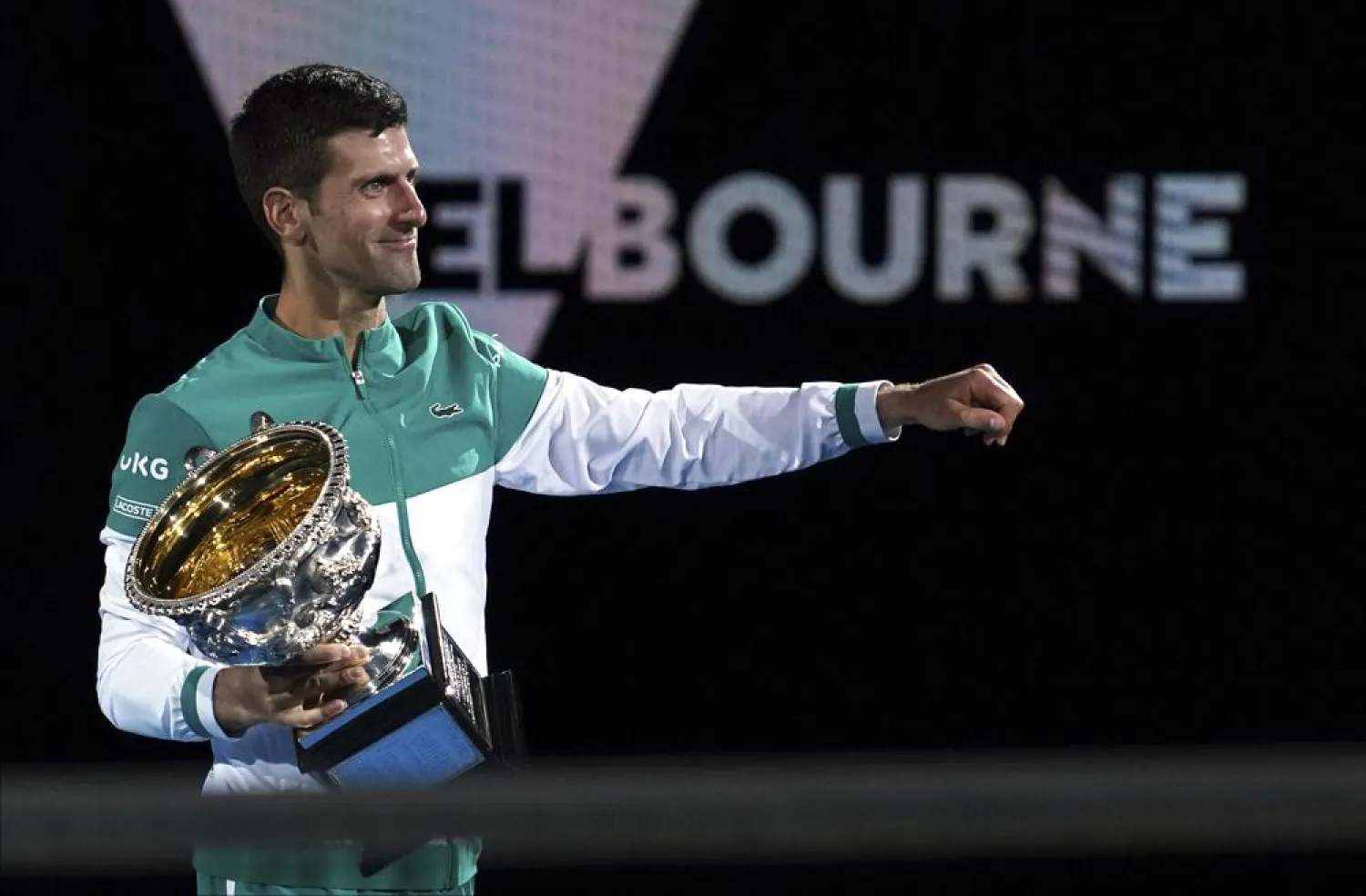

Djokovic Free but Australia Deportation Threat Still Looms

Serbia's Novak Djokovic holds the Norman Brookes Challenge Cup after defeating Russia's Daniil Medvedev in the men's singles final at the Australian Open tennis championship in Melbourne, Australia, Sunday, Feb. 21, 2021. (AP)
TT

Djokovic Free but Australia Deportation Threat Still Looms

Serbia's Novak Djokovic holds the Norman Brookes Challenge Cup after defeating Russia's Daniil Medvedev in the men's singles final at the Australian Open tennis championship in Melbourne, Australia, Sunday, Feb. 21, 2021. (AP)

Novak Djokovic woke up on Tuesday to his first morning outside immigration detention in Australia, almost a week after he flew into the country - and into an international furor over his COVID-19 vaccination status.

However, the world number one still faces the threat of being detained by the federal government for a second time and deported, despite Monday's court ruling quashing the government's earlier decision to cancel his visa.

Djokovic was back in training hours after winning that court challenge, thanking the judge who released him from immigration detention and saying he remained focused on trying to win a record 21st tennis major at next week's Australian Open.

"I am pleased and grateful that the judge overturned my visa cancellation," Djokovic wrote on Twitter, where he posted a photograph of himself on court at Melbourne Park after a chaotic few days. "Despite all that has happened I want to stay and try to compete at the Australian Open."

Djokovic's plight drew international attention, creating a political spat between Canberra and Belgrade and fueling heated debates over mandatory COVID-19 vaccination policies.

Australian Prime Minister Scott Morrison's office said he spoke with Serbian Prime Minister Ana Brnabic on Monday. Morrison's office said the Australian leader had "explained our non-discriminatory border policy," while Serbian media reports said Brnabic emphasized the importance of Djokovic being able to prepare for the tournament. Both said they agreed to stay in contact on the issue.

John Alexander, a member of Morrison's Liberal Party and a former professional tennis player, said it would be a mistake for Immigration Minister Alex Hawke to use his discretionary powers to deport the Serbian player.

To do so would "diminish" the status of the Australian Open, Alexander said.

"We had previously been the poor cousin of the four events," he said. "We've got a lot going for us, but we need to treat it carefully."

Hawke's office said late on Monday the minister was still considering whether he would use his discretion under the Migration Act to cancel Djokovic's visa for a second time. Spokespeople for the minister did not return calls seeking comment on Tuesday.

The ATP, the governing body of men's tennis applauded the court ruling, saying the dispute was "damaging on all fronts, including for Novak's well-being and preparation for the Australian Open."

The ATP said the situation highlighted the need for clearer understanding and communication of the rules. It said it strongly recommends all players get vaccinated and noted that 97% of the top 100 players are vaccinated.

Court ruling

Judge Anthony Kelly said he quashed the decision to block Djokovic's entry because the player had not been given enough time to respond to it.

Officials at Melbourne's airport, where Djokovic was detained when he landed late on Wednesday, had reneged on an agreement to give him until 8:30 a.m. to speak to Tennis Australia and lawyers, Kelly said.

Djokovic received the medical exemption because he contracted COVID-19 last month - the second time he had been infected. The player, who has long opposed mandatory vaccination, confirmed he was unvaccinated.

Kelly's ruling did not directly address the issue of whether that exemption was valid, a fact the government had disputed.

Australian Open

The Australian Open begins on Jan. 17. Djokovic has won the tournament, one of tennis' four Grand Slams, for the past three years and nine times in all.

Spain's Rafa Nadal, who is tied on 20 majors with Djokovic and Switzerland's Roger Federer, called the fraught build-up to the tournament a "circus" and said the "fairest decision" had been made.

Nick Kyrgios said while he supported vaccination he felt "embarrassed as an Australian athlete, seeing what this guy has done for us and the sport. I just don't think it's right how we are handling it."

However, former American player turned pundit Pam Shriver warned on Twitter the controversy may not be over: "If he plays the booing will be deafening."

Public opinion in Australia, which is battling an Omicron wave of infections and where more than 90% of the adult population is double vaccinated, has been largely against the player.

Resistance in Melbourne, home of the Open, has been particularly vocal after the city experienced the world's longest cumulative lockdown.

"We've had to go through vaccination protocols and lockdowns for such a long time and he swans in and pretty much does what he likes because he's the world best tennis player," Melbourne resident Keith Moore told Reuters.

Victoria state Premier Daniel Andrews, whose administration initially granted Djokovic an exemption, said the decision whether to again detain him rested with the federal government.

Andrews' left-leaning Victoria government and Prime Minister Scott Morrison's conservative administration have engaged in finger pointing over responsibility for the saga.

Under Australia's federal system, states and territories can issue exemptions from vaccination requirements to enter their jurisdictions. However, the federal government controls international borders and can challenge such exemptions.



Sinner Sees off Popyrin to Reach Doha Quarters

 Italy's Jannik Sinner greets the fans after defeating Australia's Alexei Popyrin in their men's singles match at the Qatar Open tennis tournament in Doha on February 18, 2026. (AFP)
Italy's Jannik Sinner greets the fans after defeating Australia's Alexei Popyrin in their men's singles match at the Qatar Open tennis tournament in Doha on February 18, 2026. (AFP)
TT

Sinner Sees off Popyrin to Reach Doha Quarters

 Italy's Jannik Sinner greets the fans after defeating Australia's Alexei Popyrin in their men's singles match at the Qatar Open tennis tournament in Doha on February 18, 2026. (AFP)
Italy's Jannik Sinner greets the fans after defeating Australia's Alexei Popyrin in their men's singles match at the Qatar Open tennis tournament in Doha on February 18, 2026. (AFP)

Jannik Sinner powered past Alexei Popyrin in straight sets on Wednesday to reach the last eight of the Qatar Open and edge closer to a possible final meeting with Carlos Alcaraz.

The Italian, playing his first tournament since losing to Novak Djokovic in the Australian Open semi-finals last month, eased to a 6-3, 7-5 second-round win in Doha.

Sinner will play Jakub Mensik in Thursday's quarter-finals.

Australian world number 53 Popyrin battled gamely but failed to create a break-point opportunity against his clinical opponent.

Sinner dropped just three points on serve in an excellent first set which he took courtesy of a break in the sixth game.

Popyrin fought hard in the second but could not force a tie-break as Sinner broke to grab a 6-5 lead before confidently serving it out.

World number one Alcaraz takes on Frenchman Valentin Royer in his second-round match later.


Ukraine's Officials to Boycott Paralympics over Russian Flag Decision

Milano Cortina 2026 Winter Olympics - Skeleton - Interview with Ukraine Youth and Sports minister Matvii Bidnyi - N H Hotel, Milan, Italy - February 12, 2026 Ukraine Youth and Sports Minister Matvii Bidnyi speaks after the disqualification of Ukrainian skeleton racer Vladyslav Heraskevych from the Winter Games. REUTERS/Kevin Coombs
TT

Ukraine's Officials to Boycott Paralympics over Russian Flag Decision

Milano Cortina 2026 Winter Olympics - Skeleton - Interview with Ukraine Youth and Sports minister Matvii Bidnyi - N H Hotel, Milan, Italy - February 12, 2026 Ukraine Youth and Sports Minister Matvii Bidnyi speaks after the disqualification of Ukrainian skeleton racer Vladyslav Heraskevych from the Winter Games. REUTERS/Kevin Coombs

Ukrainian officials will boycott the Paralympic Winter Games, Kyiv said Wednesday, after the International Paralympic Committee allowed Russian athletes to compete under their national flag.

Ukraine also urged other countries to shun next month's Opening Ceremony in Verona on March 6, in part of a growing standoff between Kyiv and international sporting federations four years after Russia invaded.

Six Russians and four Belarusians will be allowed to take part under their own flags at the Milan-Cortina Paralympics rather than as neutral athletes, the Games' governing body confirmed to AFP on Tuesday.

Russia has been mostly banned from international sport since Moscow invaded Ukraine. The IPC's decision triggered fury in Ukraine.

Ukraine's sports minister Matviy Bidny called the decision "outrageous", and accused Russia and Belarus of turning "sport into a tool of war, lies, and contempt."

"Ukrainian public officials will not attend the Paralympic Games. We will not be present at the opening ceremony," he said on social media.

"We will not take part in any other official Paralympic events," he added.

Ukrainian Foreign Minister Andriy Sybiga said he had instructed Kyiv's ambassadors to urge other countries to also shun the opening ceremony.

"Allowing the flags of aggressor states to be raised at the Paralympic Games while Russia's war against Ukraine rages on is wrong -- morally and politically," Sybiga said on social media.

The EU's sports commissioner Glenn Micallef said he would also skip the opening ceremony.

- Kyiv demands apology -

The IPC's decision comes amid already heightened tensions between Ukraine and the International Olympic Committee, overseeing the Winter Olympics currently underway.

The IOC banned Ukrainian skeleton racer Vladyslav Heraskevych for refusing to ditch a helmet depicting victims of the war with Russia.

Ukraine was further angered that the woman chosen to carry the "Ukraine" name card and lead its team out during the Opening Ceremony of the Games was revealed to be Russian.

Media reports called the woman an anti-Kremlin Russian woman living in Milan for years.

"Picking a Russian person to carry the nameplate is despicable," Kyiv's foreign ministry spokesman Georgiy Tykhy said at a briefing in response to a question by AFP.

He called it a "severe violation of the Olympic Charter" and demanded an apology.

And Kyiv also riled earlier this month at FIFA boss Gianni Infantino saying he believed it was time to reinstate Russia in international football.

- 'War, lies and contempt' -

Valeriy Sushkevych, president of the Ukrainian Paralympic Committee told AFP on Tuesday that Kyiv's athletes would not boycott the Paralympics.

Ukraine traditionally performs strongly at the Winter Paralympics, coming second in the medals table four years ago in Beijing.

"If we do not go, it would mean allowing Putin to claim a victory over Ukrainian Paralympians and over Ukraine by excluding us from the Games," said the 71-year-old in an interview.

"That will not happen!"

Russia was awarded two slots in alpine skiing, two in cross-country skiing and two in snowboarding. The four Belarusian slots are all in cross-country skiing.

The International Paralympic Committee (IPC) said earlier those athletes would be "treated like (those from) any other country".

The IPC unexpectedly lifted its suspension on Russian and Belarusian athletes at the organisation's general assembly in September.


'Not Here for Medals', Nakai Says after Leading Japanese Charge at Olympics

Ami Nakai of Japan competes during the women's short program figure skating at the 2026 Winter Olympics, in Milan, Italy, Tuesday, Feb. 17, 2026. (AP Photo/Ashley Landis)
TT

'Not Here for Medals', Nakai Says after Leading Japanese Charge at Olympics

Ami Nakai of Japan competes during the women's short program figure skating at the 2026 Winter Olympics, in Milan, Italy, Tuesday, Feb. 17, 2026. (AP Photo/Ashley Landis)

Ami Nakai entered her first Olympics insisting she was not here for medals — but after the short program at the Milano Cortina Games, the 17-year-old figure skater found herself at the top, ahead of national icon Kaori Sakamoto and rising star Mone Chiba.

Japan finished first, second, and fourth on Tuesday, cementing a formidable presence heading into the free skate on Thursday. American Alysa Liu finished third.

Nakai's clean, confident skate was anchored by a soaring triple Axel. She approached the moment with an ease unusual for an Olympic debut.

"I'm not here at this Olympics with the goal of achieving a high result, I'm really looking forward to enjoying this Olympics as much as I can, till the very last moment," she said.

"Since this is my first Olympics, I had nothing to lose, and that mindset definitely translated into my results," she said.

Her carefree confidence has unexpectedly put her in medal contention, though she cannot imagine herself surpassing Sakamoto, the three-time world champion who is skating the final chapter of her competitive career. Nakai scored 78.71 points in the short program, ahead of Sakamoto's 77.23.

"There's no way I stand a chance against Kaori right now," Nakai said. "I'm just enjoying these Olympics and trying my best."

Sakamoto, 25, who has said she will retire after these Games, is chasing the one accolade missing from her resume: Olympic gold.

Having already secured a bronze in Beijing in 2022 and team silvers in both Beijing and Milan, she now aims to cap her career with an individual title.

She delivered a polished short program to "Time to Say Goodbye," earning a standing ovation.

Sakamoto later said she managed her nerves well and felt satisfied, adding that having three Japanese skaters in the top four spots "really proves that Japan is getting stronger". She did not feel unnerved about finishing behind Nakai, who also bested her at the Grand Prix de France in October.

"I expected to be surpassed after she landed a triple Axel ... but the most important thing is how much I can concentrate on my own performance, do my best, stay focused for the free skate," she said.

Chiba placed fourth and said she felt energised heading into the free skate, especially after choosing to perform to music from the soundtrack of "Romeo and Juliet" in Italy.

"The rankings are really decided in the free program, so I'll just try to stay calm and focused in the free program and perform my own style without any mistakes," said the 20-year-old, widely regarded as the rising all-rounder whose steady ascent has made her one of Japan's most promising skaters.

All three skaters mentioned how seeing Japanese pair Riku Miura and Ryuichi Kihara deliver a stunning comeback, storming from fifth place after a shaky short program to capture Japan's first Olympic figure skating pairs gold medal, inspired them.

"I was really moved by Riku and Ryuichi last night," Chiba said. "The three of us girls talked about trying to live up to that standard."