

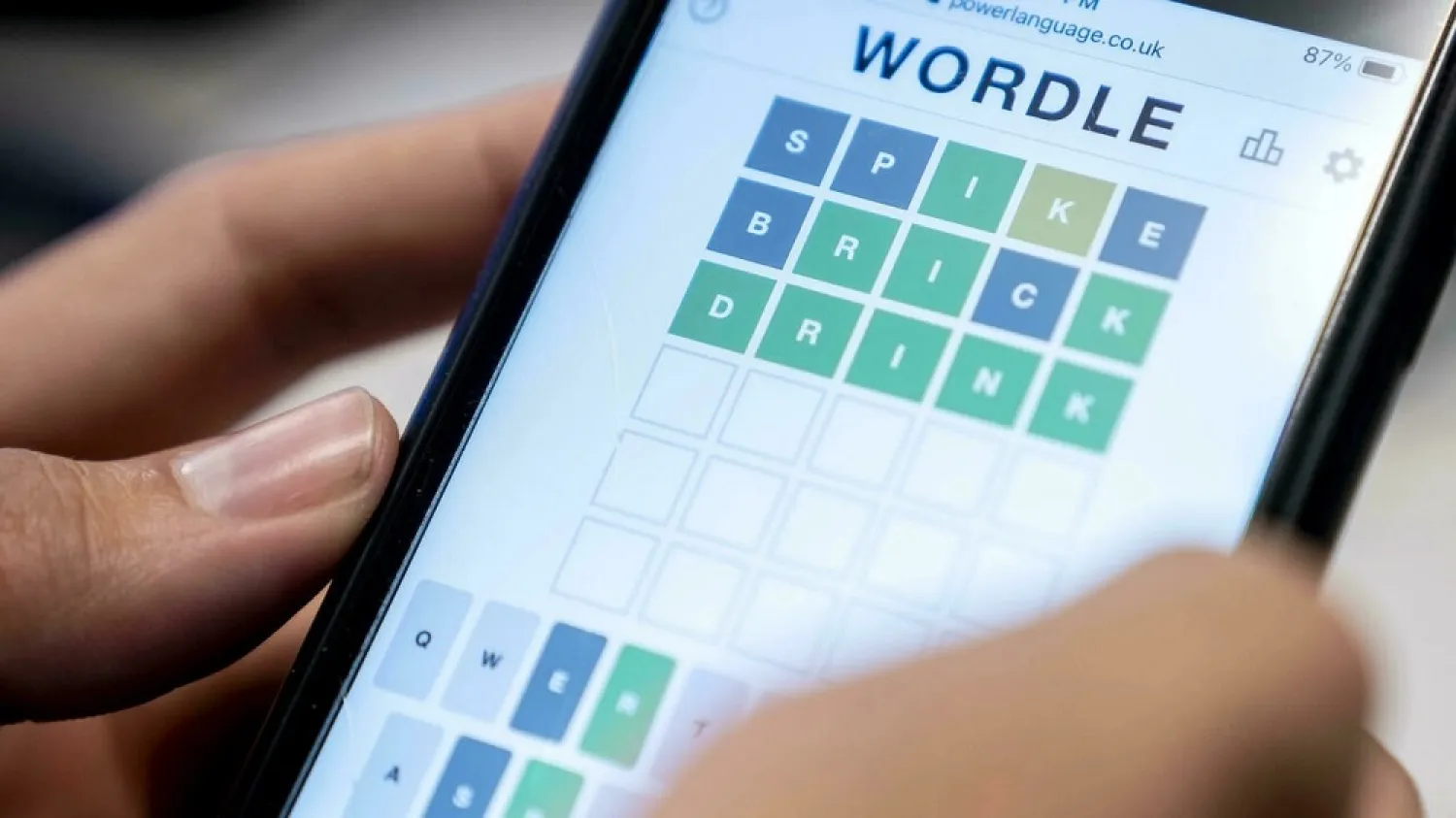

What in the Wordle? Five-Letter Puzzle Craze Goes Global

The online word game "Wordle" has gripped the attention of millions around the world. (AFP)
TT

What in the Wordle? Five-Letter Puzzle Craze Goes Global

The online word game "Wordle" has gripped the attention of millions around the world. (AFP)

Five letters, six attempts, and just one puzzle to solve per day: the "Wordle" formula couldn't be simpler, but in a matter of weeks the online brain teaser has got millions guessing around the world.

"It just grabs you," daily player Susan Drubin told AFP of the code-breaking word challenge -- perhaps best described as a cross between the retro board game "Mastermind" and a daily crossword.

"The great thing about it, is it only takes a few minutes, usually, and it's a very nice, tiny distraction," said the 65-year-old from the Washington suburbs.

The puzzle's rise has been meteoric: according to The New York Times, 90 people played on November 1. Two months later, on January 2, more than 300,000 tackled the challenge. The Guardian put the daily player count last weekend at two million, and rising...

Wordle's rules are disarmingly simple: find the word of the day in six tries or fewer. Each guess must be a valid five letter word: letters in the correct space turn green, while letters that are part of the answer but in the wrong spot turn yellow.

Only one word is offered up per day, and it is the same for everyone. Can't crack today's puzzle? You'll just have to wait until tomorrow for the next one.

Although the game itself is accessed on a website, rather than an app, players can generate a shareable widget, with six lines of colored squares indicating how many tries it took to solve the riddle -- without giving away the day's answer, of course.

After a couple of weeks, Drubin -- like legions of players -- took to sharing her results on social media under the hashtag #Wordle.

And thus, a viral phenomenon was born.

'Just fun'

Part of what makes Wordle special is that it costs nothing to play -- and is also, more unusually, ad-free.

Its designer Josh Wardle, a software engineer based in Brooklyn but originally from Wales, has decided not to monetize the game.

"I think people kind of appreciate that there's this thing online that's just fun," Wardle told The New York Times on Monday. "It's not trying to do anything shady with your data or your eyeballs."

While the game website -- "powerlanguage.co.uk/wordle" -- is free of ads or pop-ups, it did not take long for enterprising copy-cats to try to mimic the game concept, devising app store clones for purchase which have since been taken down.

The lone app left standing is an unrelated game called "Wordle!" with an exclamation mark, created by a teenager five years ago.

Its developer Steven Cravotta, now 24, says he initially "had no idea what was going on" when his app starting logging more than 40,000 daily downloads.

"I didn't know it was a craze," Cravotta told The Wall Street Journal.

Bragging rights

For Mikael Jakobsson, a research coordinator for the Massachusetts Institute of Technology Game Lab, Wordle falls into the "gap-filler" category, a game "that you can pull out when you're waiting for a friend or... for the bus."

He puts its success partly down to how easy it is to share results with friends, either by social media or word-of-mouth.

When you crack the puzzle, "you feel very proud of yourself... You have that share button right there. So then you can brag a little bit about it, which we tend to like doing."

Rachel Kowert, a psychologist specializing in video games, also points to the social comparison theory, which holds that everyone wants to evaluate themselves in relation to others.

The temptation is such that tongue-in-cheek debates have sprung up online about muting friends who tweet out their "humble-brag" scores.

Another key part of the game's allure, says Kowert, is that being "limited to one a day gives you a sense of psychological scarcity."

"You're not overdoing it in any one session, and it keeps you wanting to come back to continue to play day after day," she said.

Wordle is already being adapted into other languages, including French, having swiftly conquered the English-speaking world -- although, spoiler alert, the Wednesday word's American spelling triggered howls of online player protests from its creator's fellow Britons.



Italy Watchdog Orders Meta to Halt WhatsApp Terms Barring Rival AI Chatbots

The logo of Meta is seen at Porte de Versailles exhibition center in Paris, France, June 11, 2025. (Reuters)
TT

Italy Watchdog Orders Meta to Halt WhatsApp Terms Barring Rival AI Chatbots

The logo of Meta is seen at Porte de Versailles exhibition center in Paris, France, June 11, 2025. (Reuters)

Italy's antitrust authority (AGCM) on Wednesday ordered Meta Platforms to suspend contractual terms ​that could shut rival AI chatbots out of WhatsApp, as it investigates the US tech group for suspected abuse of a dominant position.

A spokesperson for Meta called the decision "fundamentally flawed," and said the emergence of AI chatbots "put a strain on our systems that ‌they were ‌not designed to support".

"We ‌will ⁠appeal," ​the ‌spokesperson added.

The move is the latest in a string by European regulators against Big Tech firms, as the EU seeks to balance support for the sector with efforts to curb its expanding influence.

Meta's conduct appeared capable of restricting "output, market ⁠access or technical development in the AI chatbot services market", ‌potentially harming consumers, AGCM ‍said.

In July, the ‍Italian regulator opened the investigation into Meta over ‍the suspected abuse of a dominant position related to WhatsApp. It widened the probe in November to cover updated terms for the messaging app's business ​platform.

"These contractual conditions completely exclude Meta AI's competitors in the AI chatbot services ⁠market from the WhatsApp platform," the watchdog said.

EU antitrust regulators launched a parallel investigation into Meta last month over the same allegations.

Europe's tough stance - a marked contrast to more lenient US regulation - has sparked industry pushback, particularly by US tech titans, and led to criticism from the administration of US President Donald Trump.

The Italian watchdog said it was coordinating with the European ‌Commission to ensure Meta's conduct was addressed "in the most effective manner".


Amazon Says Blocked 1,800 North Koreans from Applying for Jobs

Amazon logo (Reuters)
TT

Amazon Says Blocked 1,800 North Koreans from Applying for Jobs

Amazon logo (Reuters)

US tech giant Amazon said it has blocked over 1,800 North Koreans from joining the company, as Pyongyang sends large numbers of IT workers overseas to earn and launder funds.

In a post on LinkedIn, Amazon's Chief Security Officer Stephen Schmidt said last week that North Korean workers had been "attempting to secure remote IT jobs with companies worldwide, particularly in the US".

He said the firm had seen nearly a one-third rise in applications by North Koreans in the past year, reported AFP.

The North Koreans typically use "laptop farms" -- a computer in the United States operated remotely from outside the country, he said.

He warned the problem wasn't specific to Amazon and "is likely happening at scale across the industry".

Tell-tale signs of North Korean workers, Schmidt said, included wrongly formatted phone numbers and dodgy academic credentials.

In July, a woman in Arizona was sentenced to more than eight years in prison for running a laptop farm helping North Korean IT workers secure remote jobs at more than 300 US companies.

The scheme generated more than $17 million in revenue for her and North Korea, officials said.

Last year, Seoul's intelligence agency warned that North Korean operatives had used LinkedIn to pose as recruiters and approach South Koreans working at defense firms to obtain information on their technologies.

"North Korea is actively training cyber personnel and infiltrating key locations worldwide," Hong Min, an analyst at the Korea Institute for National Unification, told AFP.

"Given Amazon's business nature, the motive seems largely economic, with a high likelihood that the operation was planned to steal financial assets," he added.

North Korea's cyber-warfare program dates back to at least the mid-1990s.

It has since grown into a 6,000-strong cyber unit known as Bureau 121, which operates from several countries, according to a 2020 US military report.

In November, Washington announced sanctions on eight individuals accused of being "state-sponsored hackers", whose illicit operations were conducted "to fund the regime's nuclear weapons program" by stealing and laundering money.

The US Department of the Treasury has accused North Korea-affiliated cybercriminals of stealing over $3 billion over the past three years, primarily in cryptocurrency.


KAUST Scientists Develop AI-Generated Data to Improve Environmental Disaster Tracking

King Abdullah University of Science and Technology (KAUST) logo
TT

KAUST Scientists Develop AI-Generated Data to Improve Environmental Disaster Tracking

King Abdullah University of Science and Technology (KAUST) logo

King Abdullah University of Science and Technology (KAUST) and SARsatX, a Saudi company specializing in Earth observation technologies, have developed computer-generated data to train deep learning models to predict oil spills.

According to KAUST, validating the use of synthetic data is crucial for monitoring environmental disasters, as early detection and rapid response can significantly reduce the risks of environmental damage.

Dean of the Biological and Environmental Science and Engineering Division at KAUST Dr. Matthew McCabe noted that one of the biggest challenges in environmental applications of artificial intelligence is the shortage of high-quality training data.

He explained that this challenge can be addressed by using deep learning to generate synthetic data from a very small sample of real data and then training predictive AI models on it.

This approach can significantly enhance efforts to protect the marine environment by enabling faster and more reliable monitoring of oil spills while reducing the logistical and environmental challenges associated with data collection.