


North Korean Missile Tests Signal Return to Brinkmanship

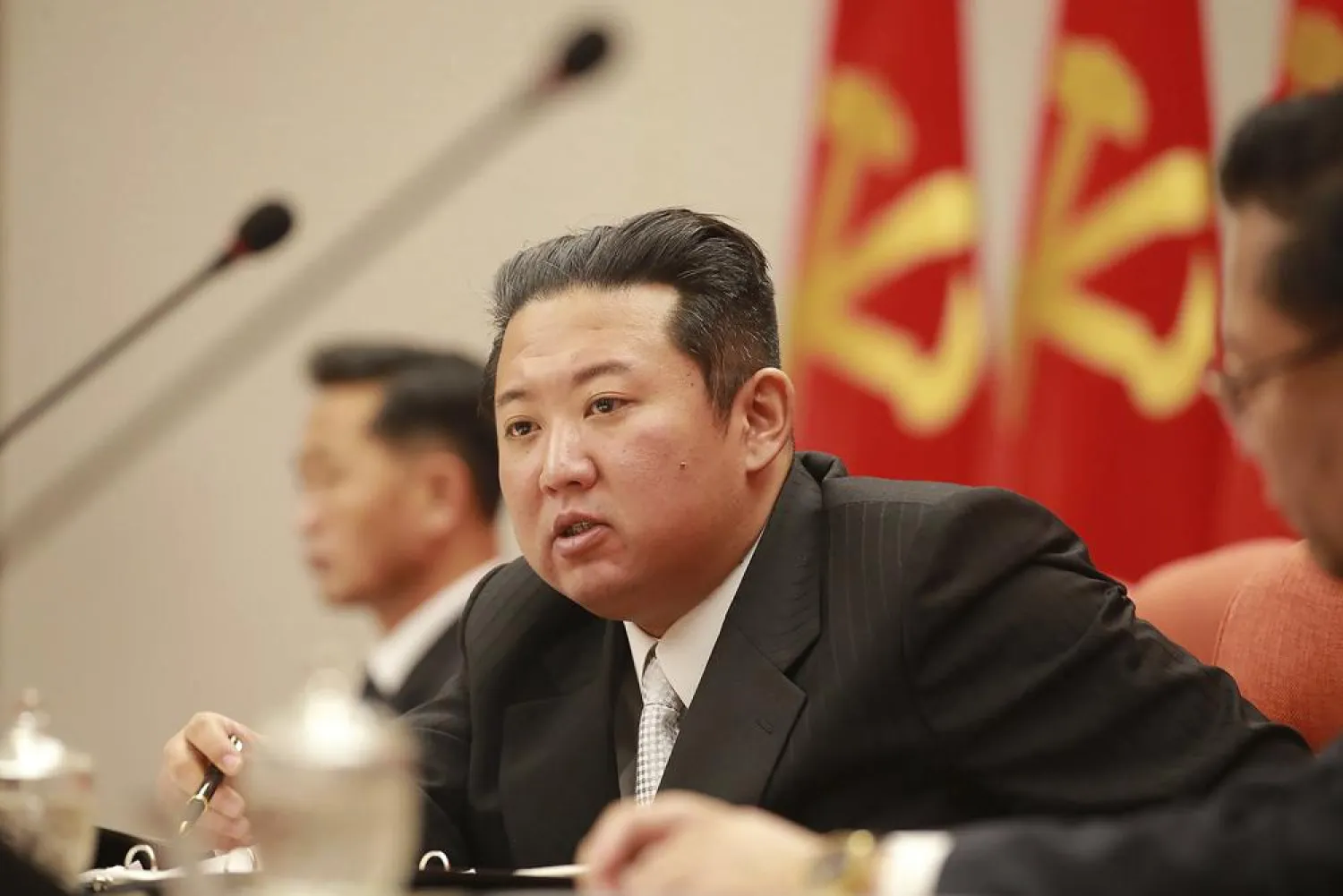
FILE - In this photo taken during Dec. 27 - Dec. 31, 2021 and provided by the North Korean government, North Korean leader Kim Jong Un, center, attends a meeting of the Central Committee of the ruling Workers' Party in Pyongyang, North Korea. Independent journalists were not given access to cover the event depicted in this image distributed by the North Korean government. The content of this image is as provided and cannot be independently verified. (Korean Central News Agency/Korea News Service via AP, File)
TT

North Korean Missile Tests Signal Return to Brinkmanship

FILE - In this photo taken during Dec. 27 - Dec. 31, 2021 and provided by the North Korean government, North Korean leader Kim Jong Un, center, attends a meeting of the Central Committee of the ruling Workers' Party in Pyongyang, North Korea. Independent journalists were not given access to cover the event depicted in this image distributed by the North Korean government. The content of this image is as provided and cannot be independently verified. (Korean Central News Agency/Korea News Service via AP, File)

Grappling with pandemic difficulties and US-led sanctions over his nuclear ambitions, North Korean leader Kim Jong Un could be reviving his 2017 playbook of nuclear and missile brinkmanship to wrest concessions from Washington and his neighbors.

North Korea’s short-range missile launches on Monday were its fourth round of missile tests this month and signaled a refusal to be ignored by the Biden administration, which has focused more on confronting bigger adversaries such as China and Russia.

The tests could also reflect a growing urgency in its need for outside relief after its economy decayed further under the severe sanctions and two years of pandemic border closures, experts say.

The two missiles launched Monday near the capital, Pyongyang, followed a resumption of railroad freight traffic with China that had been suspended over pandemic concerns, in what is likely an attempt to revive the desperate economy, according to The Associated Press.

Chinese Foreign Ministry spokesperson Zhao Lijian said Monday that trade between Dandong in China and Sinuiju in North Korea will be maintained while pandemic controls stay in place.

While North Korea is likely to continue showcasing its weapons in the coming weeks, it could keep things relatively quiet before the opening of the February Winter Olympics in China, its main ally and economic lifeline, launching known short-range missiles rather than more provocative systems.

But it could dramatically raise the ante once the Beijing Games end. Du Hyeogn Cha, an analyst at Seoul’s Asan Institute for Policy Studies, said Kim could resume testing nuclear explosives and intercontinental ballistic missiles.

Kim suspended nuclear and ICBM tests in 2018 while engaging in talks with former US President Donald Trump. But the diplomacy remains derailed since their second summit in 2019, when the Americans rejected North Korea’s demand for major sanctions relief in exchange for a partial surrender of its nuclear capabilities.

North Korea in recent months has ramped up tests of short-range missiles designed to defeat missile defenses in the region.

Its leaders may think it needs to stage more provocative tests to move the needle with the Biden administration, which has offered open-ended talks but has shown no willingness to ease sanctions unless Kim takes real steps to abandon his nuclear weapons program.

It’s unclear whether nuclear or ICBM tests would extract a compromise from Washington, which is more likely to respond with further sanctions and military pressure, possibly including a resumption of major military drills with South Korea, Cha said.

Nam Sung-wook, a North Korea expert at Seoul’s Korea University, said a nuclear test is more likely than an ICBM test because it would send a greater level of shock. The North may use that test to claim it has acquired an ability to produce a nuclear warhead small enough to fit on its purported hypersonic missile, which it first tested in September.

Nam said North Korea would time the test to maximize its political effect, with South Korean presidential elections scheduled in March and President Joe Biden facing crucial midterm elections in November. North Korea conducted its sixth and last test of a nuclear explosive device in September 2017.

“In Pyongyang’s mind, there is no other way to grab Washington’s attention than a major provocation,” Nam said.

North Korea strengthened efforts to expand its weapons capabilities following Kim’s 2021 announcement of a new five-year plan to develop his military forces, with an ambitious wish list that included hypersonic missiles, solid-fuel ICBMs, spy satellites and submarine-launched nuclear missiles.

However, the frequency of tests since then exceeds usual technological timelines and apparently reflects Kim’s desire to break out of the country’s current deepening economic problems and international isolation — what appears to be the toughest period of his decade-long rule.

“Externally, North Korea is trying to make a statement that it will continue to go its own way regardless of sanctions. Internally, the leadership is trying to tell its people that the supreme leader’s promises will be realized no matter what, whether they be weapons development or overcoming sanctions through a self-reliant economy,” Cha said.

“But they are proceeding with the tests at a very fast pace, and this reveals a sense of alarm within Pyongyang’s leadership, that they must get something done with the United States in 2022 or there could be trouble.”

According to South Korean estimates, North Korea’s trade with China shrank by about 80% in 2020 before plunging again by two-thirds in the first nine months of 2021. The contraction in 2020 was the biggest since 1997 as grain production dropped to the lowest level since Kim took power in 2011.

Describing its anti-coronavirus campaign as a matter of “national existence,” North Korea has severely restricted cross-border traffic and trade for the past two years and is even believed to have ordered troops to shoot on sight any trespassers who cross its borders.

Experts say a major COVID-19 outbreak would have devastating consequences because of North Korea’s poor health care system, and could even trigger instability.

Its resumption of the train route with China indicates how hard it has become for its leadership to withstand the economic strain caused by border closures, said Park Won Gon, a professor of North Korea studies at Seoul’s Ewha Womans University.

For decades, North Korea has mastered the art of brinkmanship, manufacturing diplomatic crises with weapons tests and threats before offering negotiations aimed at extracting concessions. Kim sped up the process in 2017 with a highly provocative run of nuclear and ICBM tests while exchanging threats of nuclear annihilation with Trump before beginning their diplomacy in 2018.

North Korea began 2022 with what it claimed were two successful tests of a hypersonic missile, which Kim said would significantly enhance his “war deterrent.” After the Biden administration imposed new sanctions over those launches, North Korea vowed stronger and more explicit action and fired two missiles from a train on Friday.

State media photos of Monday’s launch suggest the North tested a weapon that looks similar in appearance with the US MGM-140 Army Tactical Missile System. The missiles, which North Korea first tested in 2019, are part of the country’s expanding short-range weaponry designed to be maneuverable and fly at low altitudes, which potentially improves their chances of evading missile defense systems in South Korea and Japan.

Park said North Korea’s push to develop and mass-produce such missiles is a key part of its efforts to cement its status as a nuclear power. Its pressure campaign is not only aimed at winning economic benefits but also to negotiate with Washington from a position of power and convert the nuclear diplomacy into talks for mutual arms reduction, he said.



Independent UN Body Condemns ‘Vicious Attacks’ on UN Expert on Palestinian Rights

United Nations (UN) Special Rapporteur on the occupied Palestinian territories Francesca Albanese looks on at the end of a press conference on the human rights situation in Gaza in Geneva on September 15, 2025. (AFP)
TT

Independent UN Body Condemns ‘Vicious Attacks’ on UN Expert on Palestinian Rights

United Nations (UN) Special Rapporteur on the occupied Palestinian territories Francesca Albanese looks on at the end of a press conference on the human rights situation in Gaza in Geneva on September 15, 2025. (AFP)

An ‌independent United Nations body on Tuesday condemned what it described as vicious attacks based on disinformation by several European ministers against the organization's special rapporteur for Palestine, Francesca Albanese.

In the past week several European countries, including Germany, France and Italy, called for Albanese’s resignation over her alleged criticism of Israel. Albanese, an Italian lawyer, denies making the remarks.

On Friday, the Czech Republic's Foreign Minister Petr Macinka quoted Albanese on X as having called Israel a "common enemy of humanity", and he ‌also called for ‌her resignation.

A transcript of Albanese's remarks ‌made ⁠in Doha on ⁠February 7 seen by Reuters did not characterize Israel in this way, although she has consistently criticized the country in the past over the Gaza conflict.

The UN Coordination Committee - a body of six independent experts which coordinates and facilitates the work of Special Rapporteurs - accused European ministers of relying on "manufactured ⁠facts".

"Instead of demanding Ms. Albanese's resignation ‌for performing her mandate...these government representatives ‌should join forces to hold accountable, including before the International Criminal Court, ‌leaders and officials accused of committing war crimes and ‌crimes against humanity in Gaza," the Committee said.

It said the pressure exerted on Albanese was part of an increasing trend of politically motivated and malicious attacks against independent human rights experts, UN officials ‌and judges of international courts.

US President Donald Trump's administration imposed sanctions on Albanese after she wrote ⁠letters ⁠to US companies accusing them of contributing to gross human rights violations by Israel in Gaza and the West Bank.

UN experts are commissioned by the Geneva-based Human Rights Council to monitor and document specific human rights crises but are independent of the organization itself.

There is no precedent for removing a special rapporteur during their term, although diplomats said that states on the 47-member council could in theory propose a motion to do so.

However, they said strong support for Palestinian rights within the body means that such a motion was unlikely to pass.


US Plans to Deploy More Missile Launchers to the Philippines Despite China’s Alarm 

A US M142 High Mobility Artillery Rocket System (HIMARS) fires a missile during a Combined Joint Littoral Live Fire Exercise at the joint military exercise called "Balikatan", Tagalog for shoulder-to-shoulder in a Naval station in Zambales province, northern Philippines on Wednesday, April 26, 2023. (AP)
TT

US Plans to Deploy More Missile Launchers to the Philippines Despite China’s Alarm 

A US M142 High Mobility Artillery Rocket System (HIMARS) fires a missile during a Combined Joint Littoral Live Fire Exercise at the joint military exercise called "Balikatan", Tagalog for shoulder-to-shoulder in a Naval station in Zambales province, northern Philippines on Wednesday, April 26, 2023. (AP)

The United States plans to deploy more high-tech missile systems to the Philippines to help deter aggression in the South China Sea, where the treaty allies on Tuesday condemned what they called China’s "illegal, coercive, aggressive, and deceptive activities."

Beijing has repeatedly expressed alarm over the installation in the northern Philippines of a US mid-range missile system called the Typhon in 2024 and of an anti-ship missile launcher last year. It said the US weapons were aimed at containing China’s rise and warned that these were a threat to regional stability.

China has asked the Philippines to withdraw the missile launchers from its territory, but officials led by President Ferdinand Marcos Jr. have rejected the demand.

US and Philippine officials held annual talks Monday in Manila on broadening security, political and economic engagements and boosting collaboration with regional security allies.

The US and the Philippines outlined in a joint statement Tuesday specific defense and security plans for this year, including joint military exercises, Washington's support to help modernize the Philippine military and efforts "to increase deployments of US cutting-edge missile and unmanned systems to the Philippines."

The longtime allies "underscored their support for preserving freedom of navigation and overflight, unimpeded lawful commerce and other lawful uses of the sea for all nations," the statement said.

"Both sides condemned China’s illegal, coercive, aggressive and deceptive activities in the South China Sea, recognizing their adverse effects on regional peace and stability and the economies of the Indo-Pacific and beyond," it added.

Confrontations between Chinese and Philippine coast guard forces have spiked in the disputed waters in recent years. Vietnam, Malaysia, Brunei and Taiwan are also involved in the territorial standoffs.

Neither side elaborated on the planned missile deployments but Philippine ambassador to Washington, Jose Manuel Romualdez, who took part in Monday’s talks, said US and Filipino defense officials discussed the possible deployment this year of "upgraded" types of US missile launchers that the Philippines may eventually decide to purchase.

"It’s a kind of system that’s really very sophisticated and will be deployed here in the hope that, down the road, we will be able to get our own," Romualdez told The Associated Press.

The Typhon missile system that the US Army deployed to the main northern Philippine region of Luzon in April 2024 and an anti-missile launcher called the Navy Marine Expeditionary Ship Interdiction System that was deployed in April last year also to Luzon have remained in the Philippines, Romualdez said.

During joint drills, US forces have exhibited the missile systems to batches of Filipino forces to familiarize them with the weapons’ capabilities and usage, military officials said.

Romualdez said the US missile deployments to the Philippines did not aim to antagonize any country.

"It’s purely for deterrence," he said. "Every time the Chinese show any kind of aggression, it only strengthens our resolve to have these types."

The Typhon missile launchers, a land-based weapon, can fire the Standard Missile-6 and the Tomahawk Land Attack Missile. Tomahawk missiles can travel over 1,000 miles (1,600 kilometers), which places China within their target range, from the northern Philippine region of Luzon.

Last year, the US Marines deployed the anti-ship missile launcher, the Navy Marine Expeditionary Ship Interdiction System, to Batan island in the northernmost Philippine province of Batanes, which faces the Bashi Channel just south of Taiwan.

The sea passage is a critical trade and military route that the US and Chinese militaries have tried to gain strategic control of.


France's Macron Eyes Fighter Jet Deal in India

France's President Emmanuel Macron (C-R) and his wife Brigitte Macron (C) are welcomed by India's officials upon their arrival in Mumbai on February 17, 2026. (Photo by Ludovic MARIN / AFP)
TT

France's Macron Eyes Fighter Jet Deal in India

France's President Emmanuel Macron (C-R) and his wife Brigitte Macron (C) are welcomed by India's officials upon their arrival in Mumbai on February 17, 2026. (Photo by Ludovic MARIN / AFP)

French President Emmanuel Macron will meet Indian Prime Minister Narendra Modi in Mumbai on Tuesday, as he begins a three-day visit to India focused on artificial intelligence cooperation and a potential multibillion dollar fighter jet deal.

France is seeking to expand its military partnership with New Delhi, with discussions expected on a possible contract for 114 additional French Dassault Rafale fighter jets, said AFP.

Modi, in a statement on social media addressed to his "dear friend" Macron, after he began his trip with his wife Brigitte in India's financial capital, said he looked forward to "advancing our bilateral ties to new heights".

Modi, who will meet Macron later on Tuesday afternoon, said he was "confident that our discussions will further strengthen cooperation".

Macron, on his fourth visit to India since taking office in 2017, began on Tuesday with a program including honoring the victims of the 2008 Mumbai attacks, and meeting Bollywood film stars, including Shabana Azmi and Manoj Bajpayee.

He also called Modi his "dear friend", in post on X, saying they will "go even further" in cooperation.

The visit follows New Delhi's confirmation last week that it intends to place a major order for Rafale jets, as well as the signing of a landmark free trade agreement between India and the European Union in January.

Macron will travel to New Delhi for an artificial intelligence summit on Wednesday and Thursday.

- 'Contract of the century' -

New Delhi has sought over the past decade to reduce its dependence on Russia, its traditional main supplier of military equipment, turning to other countries while also pushing for more domestic production.

An Indian defense ministry statement last week said the proposed purchase of Rafale jets had been cleared -- with "the majority" of them to be manufactured in India.

Christophe Jaffrelot, an India specialist at Sciences Po Center for International Studies in Paris, described the potential EUR30 billion ($35 billion) deal for 114 Rafales as the "contract of the century".

If finalized, the jets would add to the 62 Rafales that India has already purchased.

The French presidency has voiced optimism that what it calls a "historic" agreement could be reached.

- 'Good chemistry' -

Modi and Macron will also inaugurate on Tuesday, via videoconference, India's first helicopter final assembly line, a joint venture between India's Tata Group and Airbus.

The facility in Vemagal, in the southern state of Karnataka near the tech hub of Bengaluru, will manufacture the Airbus H125, the company's best-selling single-engine helicopter.

France has emerged as one of India's most important defense and economic partners in the last decade.

"Through this visit, we seek to further strengthen cooperation" with India, and to "diversify" France's economic and trade partnerships, Macron's office said.

India, the world's most populous country with 1.4 billion people, is on track to become the fourth-largest economy globally.

This week's talks are also expected to address global economic uncertainty triggered by tariff policies under US President Donald Trump, as well as China's influence in the region.

Bilateral trade between France and India, driven largely by defense and aerospace -- India's commercial fleet includes a substantial number of Airbus aircraft -- stands at around EUR15 billion ($18 billion) annually.

French foreign direct investment in India totals nearly EUR13 billion ($15 billion).

The two leaders will also be keen to nurture close personal ties.

"There is apparently a good chemistry, a good personal rapport," Jaffrelot said.

One sensitive issue remains Ukraine: India has not condemned Russia's 2022 invasion and has continued buying oil from Moscow.

US President Donald Trump has said India had committed to halting the purchases, though that has not been formally confirmed by New Delhi.

"If the Indians stop buying Russian oil, they won't be blamed for abstaining at the UN," Jaffrelot added.