

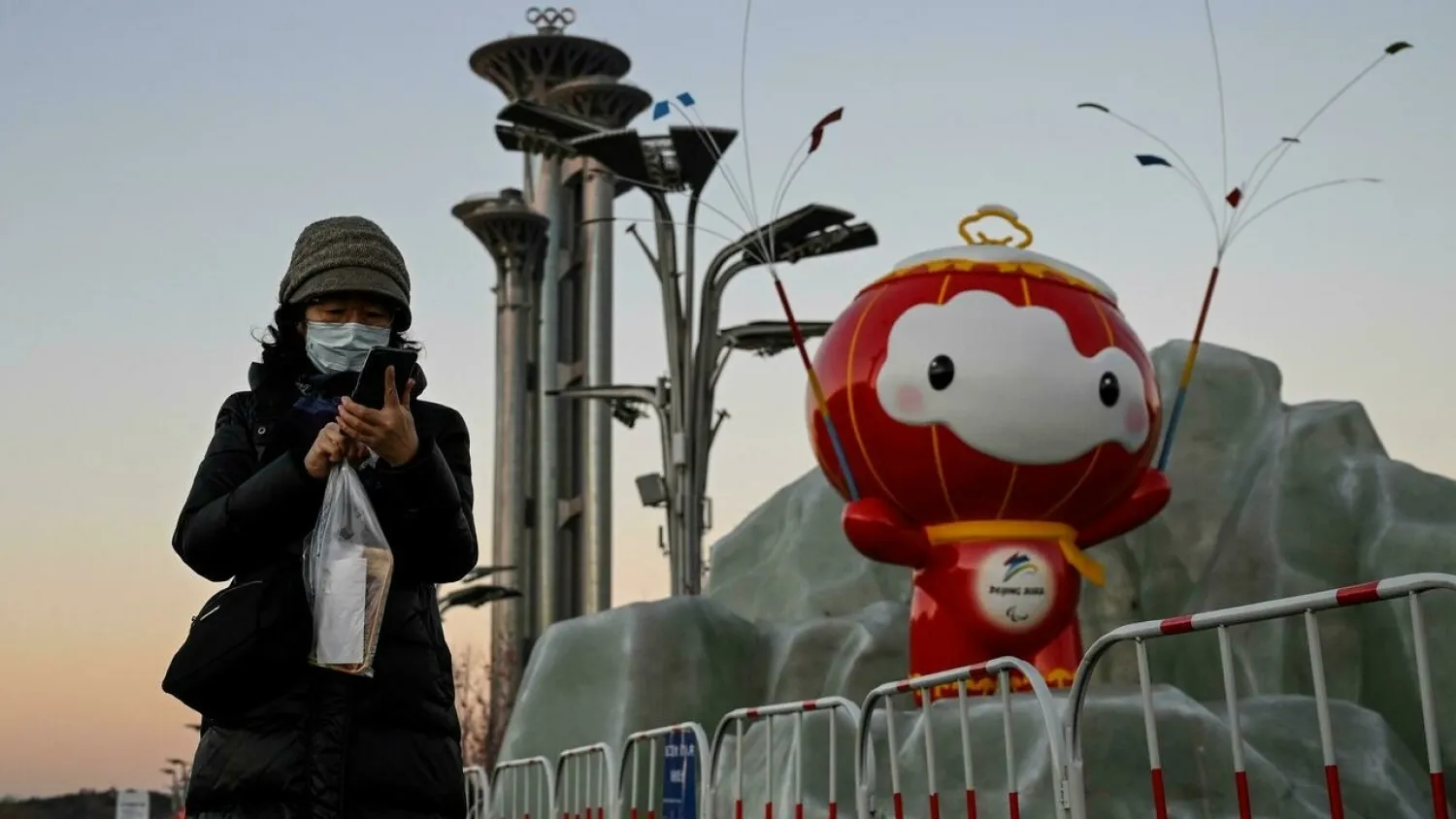

Athlete Surveillance Warnings Cloud China's Winter Olympics

Researchers have said a virus-monitoring app all Winter Olympics attendees must use has a 'simple but devastating' encryption flaw JADE GAO AFP
TT

Athlete Surveillance Warnings Cloud China's Winter Olympics

Researchers have said a virus-monitoring app all Winter Olympics attendees must use has a 'simple but devastating' encryption flaw JADE GAO AFP

A growing number of Western nations and cybersecurity groups have issued digital surveillance warnings for next month's Winter Olympics in Beijing, with some advising foreign athletes to leave personal phones and laptops at home.

China hopes to pull off a successful, coronavirus-free Games that will burnish its international reputation, AFP said.

But the run-up has been fraught with political controversies including diplomatic boycotts over Beijing's rights record and worries about the safety of tennis star Peng Shuai, who was not seen for weeks after accusing a former Communist Party leader of sexual assault.

Now concerns are focusing on whether the tens of thousands of foreign athletes, dignitaries and media workers will be safe from China's vast array of surveillance tools.

Everyone taking part in the Games will operate in a bubble that separates them from the rest of the population, to reduce the chances of the coronavirus spreading into China, which sticks to a strict zero-Covid policy.

Earlier this week, researchers at the University of Toronto's Citizen Lab said a virus-monitoring app all attendees must use was found to have a "simple but devastating" encryption flaw that could allow personal data including health information and voice messages to leak.

Citizen Lab said it notified Beijing organizers of the issues in early December, but received no reply.

"China has a history of undermining encryption technology to perform political censorship and surveillance," researcher Jeffrey Knockel wrote.

"As such, it is reasonable to ask whether the encryption in this app was intentionally sabotaged for surveillance purposes or whether the defect was born of developer negligence."

Canberra-based cybersecurity firm Internet 2.0 also warned in a recent report that official Games software -- including a VPN and an anti-virus product -- from two of the event's Chinese tech sponsors could potentially collect troves of user data without their knowledge.

- Burner phones -
The Beijing Winter Olympic Organizing Committee told AFP that cyber-threat allegations "have zero evidence and concerns are totally unnecessary", adding that "relevant information is only used for the Olympic and Winter Olympic Games".

The International Olympic Committee has also dismissed the Citizen Lab claims, citing assessments from two unnamed cybersecurity organizations which "confirmed that there are no critical vulnerabilities".

But such assurances have done little to mollify some Western teams.

National Olympic associations in the United States, Canada, the United Kingdom and Australia have advised athletes to leave their personal devices at home and use temporary burner phones if possible while in China for the Games.

"We've reminded all Team Canada members that the Olympic Games present a unique opportunity for cybercrime," the Canadian Olympic Committee said in a statement, adding it warned athletes to be "extra diligent".

Dutch and Belgian media reported last week that their athletes had been given similar advice. Australia will provide its own Wi-Fi for athletes in designated areas, Bloomberg reported.

Some of these countries have joined a growing diplomatic boycott of the Games that has incensed China. Other European nations are unruffled. The Spanish and Italian Olympic committees told AFP they had given no specific advice to athletes on cybersecurity.

- 'Uncensored does not mean unmonitored' -
China maintains the world's most sophisticated digital tools to monitor and censor the internet for its citizens, keeping the online world behind a "Great Firewall" and blocking major Western platforms such as Twitter, Facebook and YouTube.

It has previously provided uncensored internet access to guests at international events on Chinese soil.

The IOC has said China will give athletes and accredited foreign journalists uncensored internet access through Wi-Fi networks and official SIM cards.

State-owned China Unicom will provide 5G data SIM cards to incoming foreign journalists, according to an article on the news site of the Ministry of Industry and Information Technology.

But analysts fear such Wi-Fi networks could still pose potential cybersecurity threats to users, such as surveillance and personal data theft.

It is common practice for foreign diplomats to leave behind personal phones when visiting China on work trips for the same reasons.

"It would be a good assumption that connecting to public Wi-Fi in the bubble is not safe -- that the Ministry of Public Security and the Ministry of State Security could have access to the data," said Adam Segal, a cybersecurity expert at the Council on Foreign Relations in New York.

Robert Potter, co-founder of Internet 2.0, agreed that caution was reasonable, saying that "the surveillance state does not have an exception clause for athletes".

"Uncensored does not mean unmonitored," he told AFP. "I don't know of anyone who has entered China who has not been subject to some level of electronic surveillance."



Shakhtar Boss Pays Ukrainian Racer $200,000 After Games Disqualification

Ukrainian President Volodymyr Zelenskiy holds helmet as he meets with a Ukrainian skeleton racer Vladyslav Heraskevych , who was disqualified from the Olympic skeleton competition over his "helmet of remembrance" depicting athletes killed since Russia's invasion and his father and coach, Mykhailo Heraskevych, amid Russia's attack on Ukraine, in Munich, Germany February 13, 2026. (Ukrainian Presidential Press Service/Handout via Reuters)
TT

Shakhtar Boss Pays Ukrainian Racer $200,000 After Games Disqualification

Ukrainian President Volodymyr Zelenskiy holds helmet as he meets with a Ukrainian skeleton racer Vladyslav Heraskevych , who was disqualified from the Olympic skeleton competition over his "helmet of remembrance" depicting athletes killed since Russia's invasion and his father and coach, Mykhailo Heraskevych, amid Russia's attack on Ukraine, in Munich, Germany February 13, 2026. (Ukrainian Presidential Press Service/Handout via Reuters)

The owner of ‌Ukrainian football club Shakhtar Donetsk has donated more than $200,000 to skeleton racer Vladyslav Heraskevych after the athlete was disqualified from the Milano Cortina Winter Games before competing over the use of a helmet depicting Ukrainian athletes killed in the war with Russia, the club said on Tuesday.

The 27-year-old Heraskevych was disqualified last week when the International Bobsleigh and Skeleton Federation jury ruled that imagery on the helmet — depicting athletes killed since Russia invaded Ukraine in 2022 — breached rules on athletes' expression at ‌the Games.

He ‌then lost an appeal at the Court ‌of ⁠Arbitration for Sport hours ⁠before the final two runs of his competition, having missed the first two runs due to his disqualification.

Heraskevych had been allowed to train with the helmet that displayed the faces of 24 dead Ukrainian athletes for several days in Cortina d'Ampezzo where the sliding center is, but the International Olympic Committee then ⁠warned him a day before his competition ‌started that he could not wear ‌it there.

“Vlad Heraskevych was denied the opportunity to compete for victory ‌at the Olympic Games, yet he returns to Ukraine a ‌true winner," Shakhtar President Rinat Akhmetov said in a club statement.

"The respect and pride he has earned among Ukrainians through his actions are the highest reward. At the same time, I want him to ‌have enough energy and resources to continue his sporting career, as well as to fight ⁠for truth, freedom ⁠and the remembrance of those who gave their lives for Ukraine," he said.

The amount is equal to the prize money Ukraine pays athletes who win a gold medal at the Games.

The case dominated headlines early on at the Olympics, with IOC President Kirsty Coventry meeting Heraskevych on Thursday morning at the sliding venue in a failed last-minute attempt to broker a compromise.

The IOC suggested he wear a black armband and display the helmet before and after the race, but said using it in competition breached rules on keeping politics off fields of play. Heraskevych also earned praise from Ukraine President Volodymyr Zelenskiy.


Speed Skating-Italy Clinch Shock Men’s Team Pursuit Gold, Canada Successfully Defend Women’s Title

 Team Italy with Davide Ghiotto, Andrea Giovannini, Michele Malfatti, celebrate winning the gold medal on the podium of the men's team pursuit speed skating race at the 2026 Winter Olympics, in Milan, Italy, Tuesday, Feb. 17, 2026. (AP)
Team Italy with Davide Ghiotto, Andrea Giovannini, Michele Malfatti, celebrate winning the gold medal on the podium of the men's team pursuit speed skating race at the 2026 Winter Olympics, in Milan, Italy, Tuesday, Feb. 17, 2026. (AP)
TT

Speed Skating-Italy Clinch Shock Men’s Team Pursuit Gold, Canada Successfully Defend Women’s Title

 Team Italy with Davide Ghiotto, Andrea Giovannini, Michele Malfatti, celebrate winning the gold medal on the podium of the men's team pursuit speed skating race at the 2026 Winter Olympics, in Milan, Italy, Tuesday, Feb. 17, 2026. (AP)
Team Italy with Davide Ghiotto, Andrea Giovannini, Michele Malfatti, celebrate winning the gold medal on the podium of the men's team pursuit speed skating race at the 2026 Winter Olympics, in Milan, Italy, Tuesday, Feb. 17, 2026. (AP)

An inspired Italy delighted the home crowd with a stunning victory in the Olympic men's team pursuit final as

Canada's Ivanie Blondin, Valerie Maltais and Isabelle Weidemann delivered another seamless performance to beat the Netherlands in the women's event and retain their title ‌on Tuesday.

Italy's ‌men upset the US who ‌arrived ⁠at the Games ⁠as world champions and gold medal favorites.

Spurred on by double Olympic champion Francesca Lollobrigida, the Italian team of Davide Ghiotto, Andrea Giovannini and Michele Malfatti electrified a frenzied arena as they stormed ⁠to a time of three ‌minutes 39.20 seconds - ‌a commanding 4.51 seconds clear of the ‌Americans with China taking bronze.

The roar inside ‌the venue as Italy powered home was thunderous as the crowd rose to their feet, cheering the host nation to one ‌of their most special golds of a highly successful Games.

Canada's women ⁠crossed ⁠the line 0.96 seconds ahead of the Netherlands, stopping the clock at two minutes 55.81 seconds, and

Japan rounded out the women's podium by beating the US in the Final B.

It was only Canada's third gold medal of the Games, following Mikael Kingsbury's win in men's dual moguls and Megan Oldham's victory in women's freeski big air.


Lindsey Vonn Back in US Following Crash in Olympic Downhill 

Milano Cortina 2026 Olympics - Alpine Skiing - Women's Downhill 3rd Official Training - Tofane Alpine Skiing Centre, Belluno, Italy - February 07, 2026. Lindsey Vonn of United States in action during training. (Reuters)
TT

Lindsey Vonn Back in US Following Crash in Olympic Downhill 

Milano Cortina 2026 Olympics - Alpine Skiing - Women's Downhill 3rd Official Training - Tofane Alpine Skiing Centre, Belluno, Italy - February 07, 2026. Lindsey Vonn of United States in action during training. (Reuters)

Lindsey Vonn is back home in the US following a week of treatment at a hospital in Italy after breaking her left leg in the Olympic downhill at the Milan Cortina Games.

“Haven’t stood on my feet in over a week... been in a hospital bed immobile since my race. And although I’m not yet able to stand, being back on home soil feels amazing,” Vonn posted on X with an American flag emoji. “Huge thank you to everyone in Italy for taking good care of me.”

The 41-year-old Vonn suffered a complex tibia fracture that has already been operated on multiple times following her Feb. 8 crash. She has said she'll need more surgery in the US.

Nine days before her fall in Cortina d'Ampezzo, Italy, Vonn ruptured the ACL in her left knee in another crash in Switzerland.

Even before then, all eyes had been on her as the feel-good story heading into the Olympics for her comeback after nearly six years of retirement.