


Official Source: Lebanon Draft Budget Applies Range of FX Rates

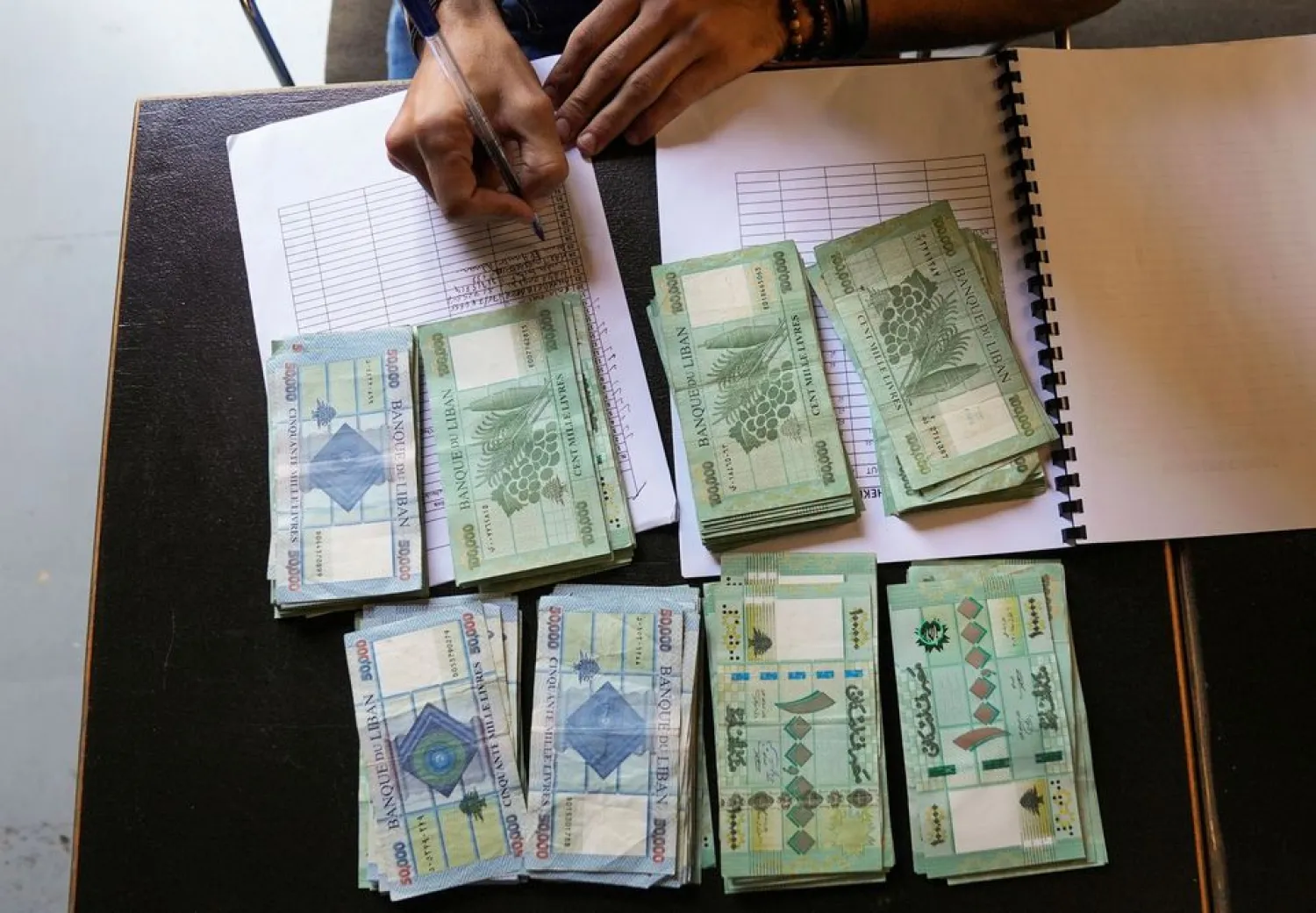
Lebanese pound banknotes are pictured on a desk in Beirut, Lebanon October 26, 2021. REUTERS/Issam Abdallah
TT

Official Source: Lebanon Draft Budget Applies Range of FX Rates

Lebanese pound banknotes are pictured on a desk in Beirut, Lebanon October 26, 2021. REUTERS/Issam Abdallah

Lebanon's draft budget for 2022 applies exchange rates ranging between 15,000 and 20,000 Lebanese pounds per dollar for operating expenses, an official source told Reuters on Friday, moving away from the previously used official rate of 1,500.

The pound has lost more than 90% of its value since Lebanon slumped into financial crisis in 2019. The official exchange rate is still 1,500 to the dollar, while the currency is changing hands on a parallel market at around 23,000.

The government is due to begin discussing the draft budget on Monday at its first meeting in more than three months.

The source, who is familiar with the draft budget, said a specific exchange rate was not mentioned in the draft budget because a range of rates were applied.

Last year's budget, drawn up by a caretaker government and not passed by parliament, applied the official exchange rate of 1,500 - a peg that was introduced in 1997.

Unifying the multiple exchanges currently used in Lebanon is a policy recommendation of the International Monetary Fund, with which Beirut has said it hopes to sign a preliminary agreement between January and February.

Lebanon relies heavily on imports, including fuel for the state-run electricity company.

A copy of the draft budget seen by Reuters projected revenues of 39.15 trillion pounds and spending of 49.42 trillion pounds - a deficit of 20.8%.

Lebanon is in the throes of what the World Bank has described as one of the world's sharpest ever economic depressions, and donors want to see its government enact long-delayed reforms before releasing any financial assistance.

"The budget lays the foundation for a sustainable plan for the coming three years that allows the state institutions to keep going," Prime Minister Najib Mikati told Reuters in a comment relayed via his office, asked about the significance of the budget.

Mike Azar, an expert on the Lebanese financial crisis and former lecturer in international economics at John Hopkins School of Advanced International Studies, said "the budget appears to be a standalone document when at this time the country needs a broader macroeconomic stabilization plan".

"Understanding the government's plans in terms of future monetary policy and restructuring the financial system and central bank are critical aspects for which we don't yet have any information," he said.

The budget included an advance for the state-owned power company, Électricité du Liban (EdL), of up to a maximum of 5.25 trillion pounds.




Europe Aims for Simpler Import Procedures

Amazon trailer trucks are seen at Cherbourg Harbor, France January 21, 2021. REUTERS/Gonzalo Fuentes
TT

Europe Aims for Simpler Import Procedures

Amazon trailer trucks are seen at Cherbourg Harbor, France January 21, 2021. REUTERS/Gonzalo Fuentes

Every day, more than 12 million packages enter the European Union – making it increasingly difficult for customs officers to check for illegal or undeclared goods or assess duties.

Many of those packages are small fry – in 2024, around 4.6 billion packages with a declared value of less than 22 Euro ($25.6) entered the EU. The Commission reported in August that only 0.0082% of all imported products were checked by customs authorities.

According to the EU court of auditors, customs checks in some member states are not rigorous enough and the uneven application of rules across the bloc makes fraud easy.

Customs Reform: What’s the plan?

Back in 2023, the European Commission presented proposals for a comprehensive reform with the aim to reduce bureaucracy and respond to challenges such as the steep rise in e-commerce.

A central point in the EU’s reform plans is how to manage this enormous flood of packages and parcels that enter the bloc from third countries, in particular China.

The EU also plans to abolish the current 150-Euro duty free limit on packages to ensure a level playing field for companies by 2028 – until then the temporary measures are to remain in force. In mid-December, the Member States also supported the introduction of a general 3-Euro-duty on low value parcels, effective from July 2026. This is also a temporary measure.

In a nutshell, the reform aims to modernize customs procedures, strengthen cooperation between member states’ customs authorities and improve checks on imports and exports. Furthermore, it promises improved collection of duties and taxes and better protection of the internal market.

To this end, there is to be a new EU Customs Data Hub which is to be overseen by the – still to be established – EU Customs Authority (EUCA).

The EUCA is intended to serve as a central hub to support national customs agencies. Once implemented, it will streamline customs procedures, improve the safety of online purchases for EU citizens, and provide national authorities with simpler, more uniform tools.

With this reform in place, a number of benefits should be realized – such as simplified reporting requirements via one single interface – which dovetails with Commission President Ursula von der Leyen’s promises to cut red tape. The EU also envisages savings of up to 2 billion Euro a year as the hub will replace customs IT infrastructure in member states.

EU Customs Authority

The EU Customs Authority is to be established from 2026, with the European Commission responsible for its launch: First access by companies to the Data Hub is scheduled by 2028, voluntary use of all businesses by 2032 and use becoming obligatory by 2038.

The first key decision will be its location. Nine member states have thrown their hats in the ring. The competitors are Belgium (Liège), Croatia (Zagreb), France (Lille), Italy (Rome), the Netherlands (The Hague), Poland (Warsaw), Portugal (Porto), Romania (Bucharest), and Spain (Málaga).

The EU executive will now assess the nine applications, seeking to ensure that the location will enable the authority to carry out its tasks and powers, recruit highly qualified and specialized staff, and offer training opportunities.

A decision is expected around February and will be made together with the member states and the EU Parliament.

The host country must offer immediately available buildings, advanced IT and security infrastructure, space for at least 250 employees, high-tech meeting rooms, and a “secure area” for the management of confidential information, among many other criteria.

Protecting EU markets

“Safer trade means a safer Europe,” said Polish Finance Minister Andrzej Domanski, explaining that a “strong and resilient” customs union guarantees the protection of the internal market, consumer safety and stable economic development.

But how to go about those joint trade and customs policies is still a bone of contention.

The customs reform is timely, as European capitals look to protect key strategic sectors against stiffening international trade headwinds.

Calls are growing in some parts for a “Made in Europe” scheme that would favor home-grown products. This position is being promoted especially by France.

The commission originally planned to publish a related EU initiative this month, but met with resistance from the Czechs, Slovaks, Irish, Swedes and Latvians and others.

The proposal has now been postponed until early next year, according to the Financial Times daily.


Saudi Smart Grid Conference 2025 Kicks Off in Riyadh on Monday

Saudi Smart Grid Conference 2025 Kicks Off in Riyadh on Monday
TT

Saudi Smart Grid Conference 2025 Kicks Off in Riyadh on Monday

Saudi Smart Grid Conference 2025 Kicks Off in Riyadh on Monday

The 13th Saudi Smart Grid Conference (SASG 2025) is set to kick off in Riyadh from December 15 to 17 under the theme "Innovation Today for a Sustainable Tomorrow."

Held under the patronage of the Ministry of Energy, the conference brings together experts from 25 countries and features 28 panel discussions and technical sessions presenting 225 scientific papers on global advancements in smart grid systems.

The ministry's patronage underscores its continued support for energy-sector development and knowledge exchange, as Saudi Arabia's electricity industry undergoes a major transformation under Saudi Vision 2030, driven by initiatives to diversify power generation sources, strengthen grid reliability and efficiency, and optimize the electricity generation mix, the Saudi Press Agency reported on Saturday.

The three-day conference provides a global platform for sharing expertise and forging partnerships in smart grids and the digital economy, it said.

The conference brings together international experts, decision-makers, and researchers to examine major transformations in the electricity sector, including the role of innovation in improving operational efficiency, advancing sustainability, and enabling digitalization across the power ecosystem.

Discussions will address key challenges and opportunities across the power sector, renewable energy, regulation, and the future of smart grids, with emphasis on technology localization, capacity building, and technical partnerships to strengthen smart infrastructure and support a sustainable, efficient, investment-friendly, and innovation-enabling energy ecosystem.

The conference will also explore the integration of renewable energy sources, the latest developments in electricity storage solutions and smart load-management systems, as well as the role of cybersecurity in protecting energy infrastructure and strengthening system reliability, SPA added.


Trump Reportedly Unsure Whether Impact of Economic Policies Will be Felt in Time for Midterms

US President Donald Trump makes a statement to reporters as he heads into the White House after landing on the South Lawn in Marine One in Washington, DC, USA, 13 December 2025. EPA/Samuel Corum / POOL
TT

Trump Reportedly Unsure Whether Impact of Economic Policies Will be Felt in Time for Midterms

US President Donald Trump makes a statement to reporters as he heads into the White House after landing on the South Lawn in Marine One in Washington, DC, USA, 13 December 2025. EPA/Samuel Corum / POOL

US Donald President Trump expressed uncertainty about whether Republicans would keep control of the House of Representatives in next year's midterm elections because some of his economic policies have yet to take full effect, the Wall Street Journal reported on Saturday.

Trump, in an interview conducted on Friday, told the Journal, "I can’t tell you. I don’t know when all of this money is going to kick in," when asked about the whether Republicans would lose the House in November.

The White House did not immediately respond to Reuters' request for comment.

The president has argued that his economic policies, including his imposition of widespread tariffs on imports, are creating jobs, boosting the stock market and attracting increased investment into the United States.

After campaigning last year on promises to tame inflation, Trump has in recent weeks alternated between dismissing affordability problems as a hoax, blaming President Joe Biden for them, and promising his economic policies will benefit Americans next year.

"I think by the time we have to talk about the election, which is in another few months, I think our prices are in good shape," Trump said in the interview.

Last month the president rolled back tariffs on more than 200 food products in the face of growing angst among American consumers about the high cost of groceries.

The president did not say whether he would lower tariffs on additional goods, the Journal reported.

Trump's overall approval rating edged up to 41% in a new Reuters/Ipsos poll but the approval rating on his performance on the cost of living was just 31%.

Democrats have won a string of victories in state and local elections in Virginia, New Jersey and New York City, where growing voter concerns about affordability, including high food prices, were a key topic.

Officials have said Trump will hit the road in the new year to campaign for Republican candidates and emphasize his economic policy successes. Trump has said his tax cuts and tariffs on foreign goods will put more money in the pockets of American families.