


Republicans Warn Biden against Providing Guarantees to Tehran

The US Capitol dome is seen in Washington, US, December 17, 2020. REUTERS/Erin Scott/File Photo
TT

Republicans Warn Biden against Providing Guarantees to Tehran

The US Capitol dome is seen in Washington, US, December 17, 2020. REUTERS/Erin Scott/File Photo

Republican lawmakers reiterated their total refusal of any nuclear deal with Iran without Congress’ approval, following Iran’s proposal that the United States makes a “political statement” of its commitment to a nuclear accord with Tehran.

About 200 Republican lawmakers wrote a letter to US President Joe Biden, warning that any agreement with Iran without congressional approval would face the same fate as the deal concluded by the administration of former President Barack Obama.

“We will view any agreement reached in Vienna which is not submitted to the US Senate for ratification as a treaty—including any and all secret agreements made with Iran directly or on the sidelines of official talks—as non-binding,” the lawmakers wrote in a letter dated Feb. 16, 2022.

They added: “As duly elected representatives of American citizens across the United States, sent to Washington to check and balance the executive branch as established by the separation of powers in our Constitution, we feel compelled to remind you that you do not have the power to provide any such ‘guarantee.’”

In an exclusive interview with the Financial Times, Iranian Foreign Minister Hossein Amir-Abdollahian said that Washington had failed to address Iran’s demand for guarantees that it would not abandon the deal, calling for a “political statement” that would stress its commitment in this regard.

The lawmakers warned Biden against ignoring the Congress and repeating the Obama administration’s mistakes in this file.

“Indeed, if you forge an agreement with the Supreme Leader of Iran without formal Congressional approval, it will be temporary and non-binding and will meet the same fate as the Joint Comprehensive Plan of Action (JCPOA),” they underlined.

The US lawmakers also pointed to the possibility of removing the Iranian Revolutionary Guard from the terrorist lists, and pledged to oppose any efforts in this direction.

“We will oppose any attempt to rescind the designation of the Iranian Revolutionary Guard Corps as a foreign terrorist organization and will work to expand US sanctions on all government entities, banks, companies and individuals connected to the IRGC,” they stressed.

The Republican lawmakers linked the file of negotiations with Iran and the Ukraine crisis, expressing concern that the United States’ dependence on Russia as a main mediator in the Vienna negotiations had weakened the US position with regards to Moscow’s plans to invade Ukraine.

“If your dependency on the Russians to revive the JCPOA [nuclear deal] is weakening our deterrent posture with the Russians in other areas of the world, the American people deserve to know,” they said, addressing Biden.

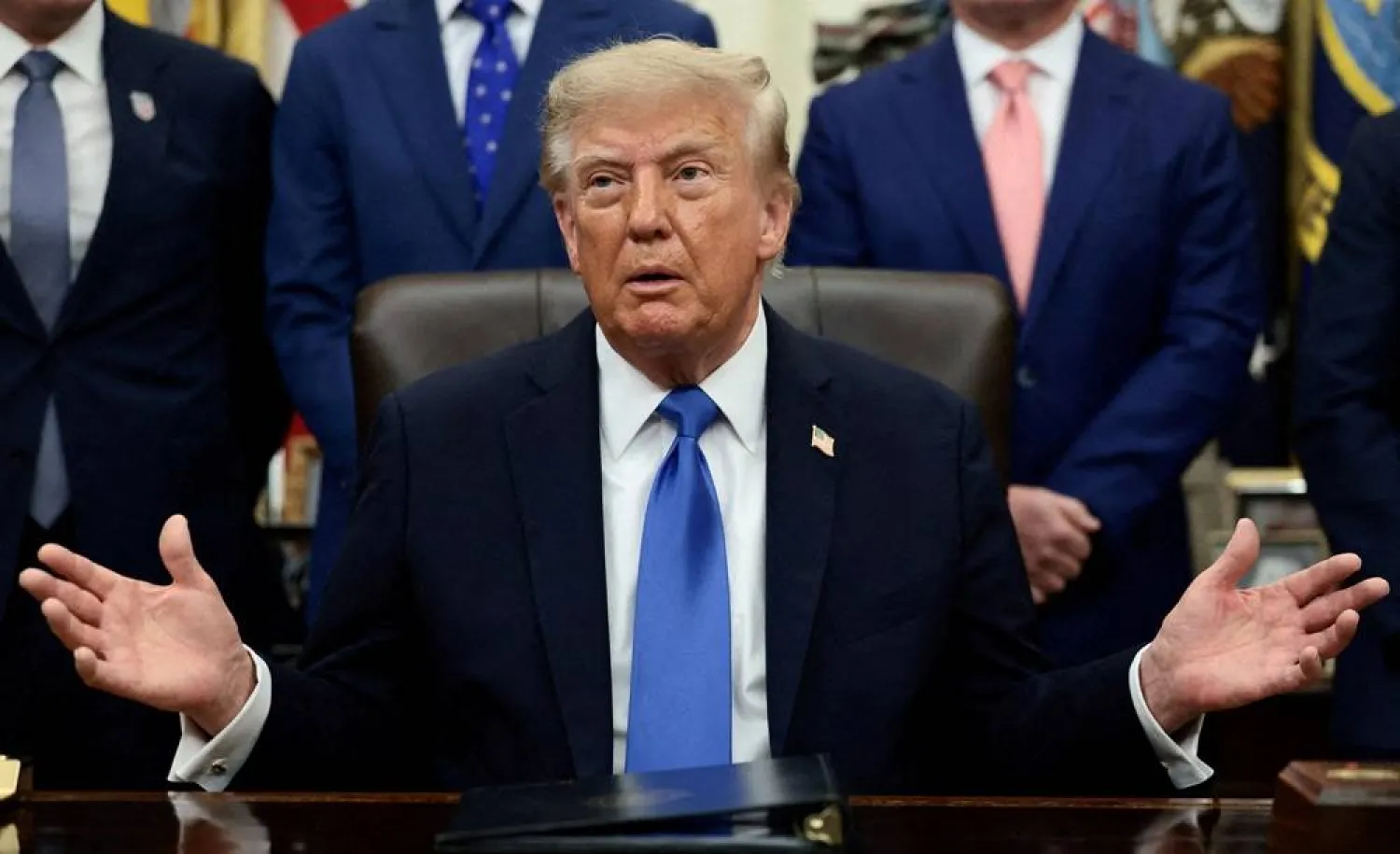


Trump Says US-Iran Talks Will Be Behind Closed Doors

US President Donald Trump, flanked by Secretary of Defense Pete Hegseth, speaks during a press conference in the James S. Brady Press Briefing Room at the White House in Washington, DC, US, April 6, 2026. (Reuters)
TT

Trump Says US-Iran Talks Will Be Behind Closed Doors

US President Donald Trump, flanked by Secretary of Defense Pete Hegseth, speaks during a press conference in the James S. Brady Press Briefing Room at the White House in Washington, DC, US, April 6, 2026. (Reuters)

US President Donald Trump on Wednesday said talks on the Iran crisis would be held behind closed doors, and that "only one group of meaningful 'POINTS'" were acceptable to the United States, ‌but gave ‌no other details about ‌the ⁠negotiations.

"These are the ⁠POINTS that are the basis on which we agreed to a CEASEFIRE. It is something that is reasonable, and can easily be dispensed with," he ⁠said in a social ‌media post.

Trump ‌separately told ABC News in ‌an interview that he expects talks ‌to begin on Friday and to move very quickly.

Pakistan's Prime Minister Shehbaz Sharif earlier on Wednesday said ‌US and Iranian delegations would be arriving in Pakistan ⁠on ⁠Friday after the two nations accepted a two-week ceasefire.

Trump in his online post also threatened a federal probe into unnamed individuals he accused--without providing evidence--of circulating various correspondence that he said were not the basis for the ceasefire agreement.


France Unveils Rearmament Boost to Face Russia Threat

 France's Defense Minister Catherine Vautrin speaks during the press conference following the weekly cabinet meeting at the Elysee Palace in Paris on April 8, 2026. (AFP)
France's Defense Minister Catherine Vautrin speaks during the press conference following the weekly cabinet meeting at the Elysee Palace in Paris on April 8, 2026. (AFP)
TT

France Unveils Rearmament Boost to Face Russia Threat

 France's Defense Minister Catherine Vautrin speaks during the press conference following the weekly cabinet meeting at the Elysee Palace in Paris on April 8, 2026. (AFP)
France's Defense Minister Catherine Vautrin speaks during the press conference following the weekly cabinet meeting at the Elysee Palace in Paris on April 8, 2026. (AFP)

France is to ramp up explosive drone stocks by up to 400 percent by 2030, draft legislation showed Wednesday, as the country seeks to accelerate rearmament to face an aggressive Russia.

The military spending bill was presented after France's top commanders said the country must be ready in the next few years for a clash with Russia and that NATO should adapt to produce more weapons and faster.

The government on Wednesday presented its updated military planning law, adding another 36 billion euros ($42 billion) to France's defense spending between 2024 and 2030, on top of the 413 billion euros ($483 billion) already allocated.

"Our armed forces must be capable of responding to a major engagement within a timeframe that none of us can predict," Defense Minister Catherine Vautrin said following a meeting of top defense and security officials.

According to the revised legislation, which is due to be presented to parliament, the annual budget would reach 76.3 billion euros in 2030, representing 2.5 percent of gross domestic product, compared with 57.1 billion euros for this year.

The legislation does not foresee an increase in the size of France's armed forces, which remains at 210,000 active-duty personnel, 225 combat aircraft and 15 first-rate frigates.

The conflicts in Ukraine and the Middle East have prompted a particular focus on stocks of missiles and shells. NATO commanders say the military bloc must respond to challenges such as Russia and Iran mass-producing drones.

According to the draft legislation, an additional 8.5 billion euros will be allocated to boost stockpiles of ammunition between now and 2030, bringing the total to 26 billion euros.

While stock levels are confidential, they are set to rise by 400 percent for all types of remotely operated munitions such as explosive drones, and by 85 percent for Scalp cruise missiles.

Stocks of torpedoes are to go up by 230 percent and those of surface-to-air missiles by 30 percent.

An additional two billion euros will be allocated to procurement of drones of all types, bringing the total investment to 8.4 billion euros.

The French Institute of International Relations (IFRI), a top think tank, warned in November that Europe could struggle to quickly produce enough weapons in case of a direct confrontation with Russia.


China Says Afghanistan and Pakistan Agree to Explore a ‘Comprehensive Solution’

A general view of Kabul, Afghanistan, 06 April 2026. (EPA)
TT

China Says Afghanistan and Pakistan Agree to Explore a ‘Comprehensive Solution’

A general view of Kabul, Afghanistan, 06 April 2026. (EPA)

China's government said that Afghanistan and Pakistan have agreed not to escalate their conflict and to "explore a comprehensive solution” after several weeks of cross-border fighting between the two countries that has left hundreds of people killed.

Foreign Ministry spokesperson Mao Ning said Wednesday that after seven days of peace talks in the western Chinese city of Urumqi under China mediation, all the parties also agreed to keep the dialogue.

“The three parties agreed to explore a comprehensive solution to the issues in the relations between Afghanistan and Pakistan, and clarified the core and priority issues that need to be addressed,” Mao said during the daily briefing in Beijing.

She said that they acknowledged that “terrorism is the core issue affecting the relationship.”

Afghanistan and Pakistan said that they won't “take actions that would escalate or complicate the situation.”

There was no comment from Islamabad about the weeklong talks.

But Afghanistan’s Foreign Ministry spokesman, Abdul Qahar Balkhi, said on Wednesday that the talks between the Afghan and Pakistani delegations, hosted and mediated by China in Urumqi, have concluded.

In a post on X, he said that the talks were held in a “constructive atmosphere,” with discussions focusing on bilateral relations, security issues and regional stability. Balkhi thanked Beijing for hosting the talks and expressed hope that the process would help strengthen trust, deepen relations and promote effective cooperation in the region.

The talks began last week in Urumqi at the invitation of China, in an effort to stop the conflict that began between the two countries in February.

Pakistan, which declared it was in “open war” with its neighbor, has also carried out airstrikes inside Afghanistan, including in the capital Kabul.

Afghanistan’s Foreign Ministry said Tuesday that the talks had been constructive.

The United Nations’ office for the coordination of humanitarian affairs in Afghanistan said on Tuesday that the conflict had displaced 94,000 people overall, while 100,000 people in two Afghan districts near the border have been completely cut off by the fighting since February.

Even during the talks, Afghanistan has accused Pakistan of carrying out shelling across its border on several occasions.

Pakistan accuses Afghanistan of providing a safe haven to militants who carry out deadly attacks inside Pakistan, especially the Pakistani Taliban, known as Tehrik-e-Taliban Pakistan or TTP. The group is separate from but allied with the Afghan Taliban, which took over Afghanistan in 2021 following the chaotic withdrawal of US-led troops. Kabul denies the charge.