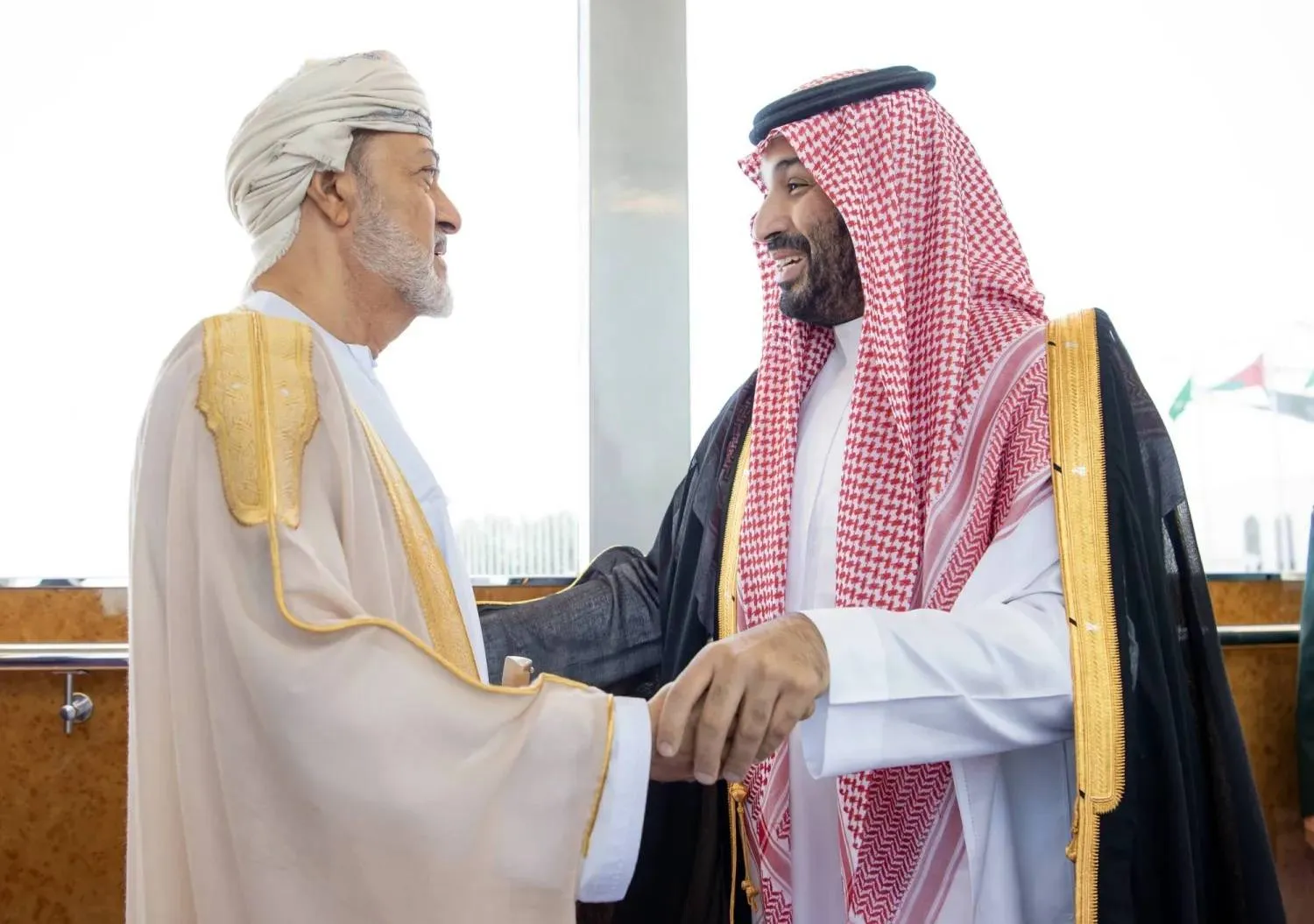
The visit by Oman’s Sultan Haitham bin Tariq to Saudi Arabia and his meeting with Saudi Crown Prince and Prime Minister Mohammed bin Salman come as the region grapples with significant developments, prompting its leaders to consult and coordinate to bolster regional and international security and stability.
Omani experts and writers say the timing gives the visit exceptional weight. An escalating US-Iranian confrontation and growing risks in the Strait of Hormuz have pushed Gulf security, energy market stability, and international shipping to the top of the global political and economic agenda.
Experts speaking to Asharq Al-Awsat said the talks could open the way for broader Saudi-Omani coordination to support settlement efforts.
Such coordination would draw on Muscat’s channels with the parties to the crisis and Riyadh’s regional and international clout, potentially leading to more durable arrangements for maritime security and the wider Gulf security architecture.
Al-Araimi: Critical timing
Omani political and strategic affairs writer and researcher Mohammed al-Araimi said the visit came “at a critical time, not only for Omani-Saudi relations but also because of the dangerous and rapidly unfolding political and security developments in the region.”
Relations between the two countries “have long rested on a solid foundation of mutual respect and shared interests,” he told Asharq Al-Awsat.
“There is also growing recognition of the importance of coordination between them amid the transformations taking place in the region and the world.”
Al-Araimi said the visit’s significance extended beyond bilateral ties to the wider Gulf and region.
“This is a critical stage in which the region needs more consultation and dialogue, not more tension and escalation,” he said.
Political, security and economic issues would feature prominently in the talks, he added, led by regional developments, the future of Gulf security and the security of shipping and energy flows through the Strait of Hormuz.
Al-Araimi said Oman’s mediation between the United States and Iran would be a particular focus.
The issue would be on the agenda because of Muscat’s contacts and efforts “to contain the dangerous escalation between the two sides, open paths for constructive dialogue and strengthen the foundations of trust between the warring parties,” he said.
Al-Araimi called navigation through the Strait of Hormuz “one of the most sensitive issues.”
“It will be resolved because it does not concern one country or the Gulf region alone. It concerns global economic security and international trade and energy flows,” he said.
“Protecting the strait and ensuring the smooth flow of shipping through it are therefore shared interests of every country in the region and the international community.”
Al-Araimi recalled Oman’s position that the strait and the region must not be allowed to become arenas for confrontation or tools of political conflict.
“Stability in Hormuz cannot be achieved through escalation,” he said. “It can only be achieved through understandings, guarantees and dialogue among the parties concerned.”
Al-Shaidi: Regional security
Asim al-Shaidi, editor-in-chief of Oman newspaper, said Sultan Haitham’s visit to Saudi Arabia came “at an extremely sensitive moment for the entire Gulf.”
“The war between the United States and Iran has made questions of regional security more urgent,” Al-Shaidi told Asharq Al-Awsat.
“It has shown that any major confrontation in the region quickly spreads beyond the immediate parties, affecting shipping, energy, Gulf economies and global supply chains.”
The visit’s importance, therefore, went beyond bilateral ties, he said.
“Oman and Saudi Arabia view the crisis from different but complementary positions,” Al-Shaidi said.
“Oman directly overlooks the Strait of Hormuz, maintains open political channels with Iran and the United States, and is playing a role in seeking a settlement. Saudi Arabia is the Gulf’s largest economic and political power and one of the world’s leading energy producers. Any prolonged disruption in Hormuz, therefore, directly affects its security and interests.”
Al-Shaidi said the meeting offered a chance to coordinate on moving the region from managing crises after they erupt to building security arrangements that prevent them from recurring.
“The past few months have shown that Gulf security cannot remain hostage to military deterrence alone,” he said.
“The region needs clearer rules for managing disputes, protecting maritime passages, and preventing them from becoming instruments of pressure during conflicts.”
The recent Saudi-Omani rapprochement gives the consultations added importance, Al-Shaidi said.
“There is now a greater scope for joint political, economic, and security action between Muscat and Riyadh,” he said.
“I believe the current circumstances are pushing both countries to use this relationship to formulate a broader Gulf approach to the future of regional security.”
Al-Shaidi said Iran and the future of navigation through the Strait of Hormuz would undoubtedly top the talks because they had effectively become a single issue.
A durable settlement to the war was impossible while Hormuz remained an arena of confrontation, he said. At the same time, normal shipping could not easily resume without a political settlement that eased the conflict between Washington and Tehran.
“What is important about Oman’s recent efforts is that they have moved beyond traditional political mediation toward building practical arrangements on the ground,” Al-Shaidi said.
“Recent Omani-Iranian consultations addressed a temporary shipping corridor, mine clearance, and future arrangements for managing maritime traffic and exchanging information and navigational and security services.”
That is where Saudi Arabia assumes particular importance, he said.
“Any long-term arrangement in Hormuz requires broad regional acceptance,” Al-Shaidi said. “It cannot be seen merely as a bilateral understanding between Oman and Iran.”
“Saudi Arabia, alongside the other Gulf states, is a central party to any future vision for the security of maritime passages and energy supplies.”
Al-Shaidi said Riyadh was likely to hear a detailed Omani assessment of Muscat’s contacts with Tehran and Washington during the visit.
The two sides were also likely to discuss guarantees to make any shipping agreement sustainable and prevent any party from using the strait as a tool of political or military pressure, he added.
The deeper question raised by the visit could be “the future of the Gulf security order after the war,” Al-Shaidi said.
“The crisis has shown that the Strait of Hormuz cannot be both an artery of the global economy and an open arena for settling political conflicts,” he said.
A durable settlement would have to combine three elements: respect for the sovereignty and rights of coastal states, guarantees of freedom of navigation under international law, and the involvement of regional countries in shaping arrangements that directly affect their security.
Al-Muharrami: Maritime security
Omani political writer Zakariya al-Muharrami pointed to the “serious security and economic challenges caused by the US-Iranian war” and “Iranian aggression against neighboring countries.”
The situation required “concerted efforts, coordinated positions and renewed strategic cooperation between the two largest countries in the Gulf Cooperation Council,” he told Asharq Al-Awsat.
Al-Muharrami said the conflict over the Strait of Hormuz required more than channels of communication with Tehran. It also required a regional power with considerable influence in Washington.
“With its political and economic weight, Saudi Arabia is best placed to perform this role alongside Oman and help bridge the differences between the two warring parties,” he said.
Saudi Arabia’s location and size also make it a strategic logistics corridor sought by Gulf countries, Iraq and the Levant as a route around the bottleneck of the Strait of Hormuz, Al-Muharrami said.
“Oman’s location on the Arabian Sea supports this anticipated Saudi role,” he added.
He also cited the “Makkah defense alliance” between Saudi Arabia, Türkiye and Pakistan, which Oman views as the nucleus of Islamic defense cooperation that could protect the region’s security.
Al-Muharrami said the meeting between the Omani sultan and the Saudi crown prince would address all these issues.
“Its results will have far-reaching consequences, not only for the current regional crisis but also for shaping a road map for the region’s security and logistics architecture,” he said.
Al-Azri: Joint efforts to halt escalation
Omani writer and former head of the Oman News Agency Ibrahim al-Azri said Sultan Haitham’s visit to Saudi Arabia was “extremely important, particularly because of its timing.”
“The region is witnessing major developments and repercussions because of tensions in the Strait of Hormuz and the war being waged by the United States against Iran,” he told Asharq Al-Awsat.
Al-Azri said an agreement between the two sides could spare Gulf countries and the wider region from consequences more severe than those already experienced.
“Continued attacks and exchanges of strikes would worsen security and economic conditions in the Gulf Cooperation Council states, the region and the entire world,” he said.
Oman and Saudi Arabia have extensive experience dealing with the crises that have swept the region over the past 30 years, Al-Azri said.
“They are pivotal countries with an active regional and international presence,” he said.
“The meeting between Sultan Haitham and the Saudi crown prince will undoubtedly produce results because both countries understand the gravity of what is happening.”
Al-Azri said Oman and Saudi Arabia had taken clear positions on the war. Both have called for de-escalation and a return to diplomatic dialogue and understanding between the United States and Iran, whether over Tehran’s nuclear program or the current situation in the Strait of Hormuz.
“Delaying solutions to the Strait of Hormuz crisis could have severe repercussions in the coming days,” he said.
Al-Azri said the current situation was delivering powerful shocks to Gulf Cooperation Council economies.
Saudi Arabia and Oman were also making major efforts to maintain supply chains and keep oil shipments flowing to countries importing crude from Oman, Saudi Arabia and the other Arab Gulf states, he added.