
Arab Refugees See Double Standards in Europe’s Embrace of Ukrainians

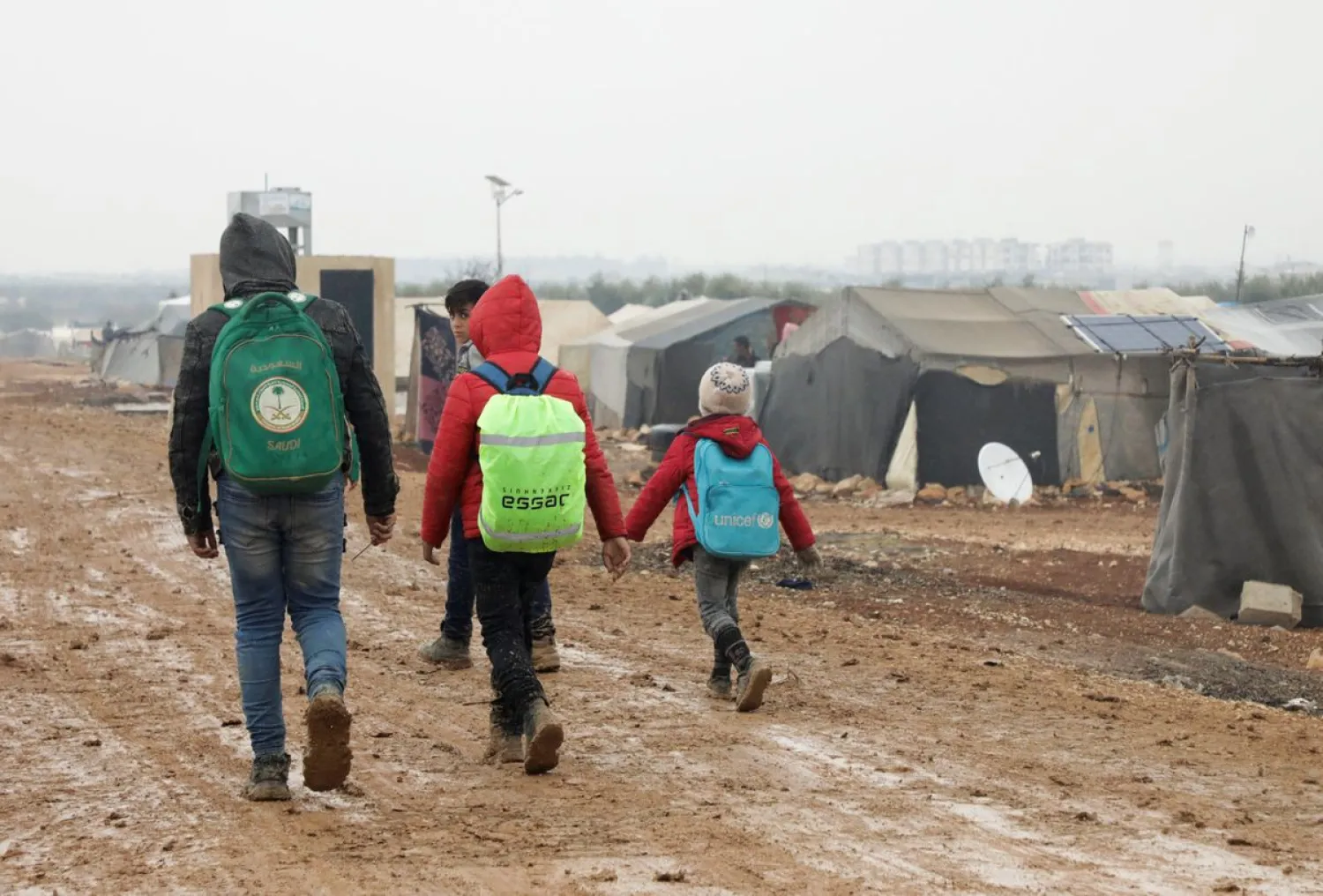
Internally displaced Syrians walk together near tents at a camp in Azaz, Syria March 1, 2022. Picture taken March 1, 2022. (Reuters)
TT

Arab Refugees See Double Standards in Europe’s Embrace of Ukrainians

Internally displaced Syrians walk together near tents at a camp in Azaz, Syria March 1, 2022. Picture taken March 1, 2022. (Reuters)

Syrian refugee Ahmad al-Hariri, who fled the war in his country for neighboring Lebanon 10 years ago, spent the last decade hoping in vain to escape to a new life in Europe.

Watching European nations open their arms to hundreds of thousands of Ukrainians in less than a week, the father of three can't help but compare their fates.

"We are wondering, why were Ukrainians welcome in all countries while we, Syrian refugees, are still in tents and remain under the snow, facing death, and no one is looking to us?" he told Reuters in a refugee center where 25 families are sheltered on the edge of the Mediterranean city of Sidon.

In the Arab world, where 12 million Syrians have been uprooted by war, critics ranging from Hariri to activists and cartoonists contrast the Western reaction to the refugee crisis triggered by Russia's invasion of Ukraine with the way Europe sought to hold back Syrian and other refugees in 2015.

Some recalled images of refugees walking for days in harsh weather, or losing lives in perilous sea crossings as they tried to breach Europe's borders.

On Monday, four days after Russia launched its attack, the European Union said at least 400,000 refugees had entered the bloc from Ukraine, which has land borders with four EU states.

Millions more are expected and the EU is preparing measures which would offer temporary residence permits as well as access to employment and social welfare - a swift opening of its doors at odds with its response to wars in Syria and elsewhere.

By early 2021, 10 years after Syria's conflict erupted, EU states had taken in 1 million Syrian refugees and asylum seekers, of which Germany alone took more than half. Most of them arrived before a 2016 deal in which the EU paid billions of euros for Turkey to continue hosting 3.7 million Syrians.

This time the welcome has been immediate.

"We have here not the refugee wave which we are accustomed to and we do not know what to do with - people with an unclear past," Bulgaria's Prime Minister Kiril Petkov said, describing Ukrainians as intelligent, educated and highly qualified.

"These are Europeans whose airport has been just bombed, who are under fire," he said. Bulgaria has said it will help everyone coming from Ukraine, where there are about 250,000 ethnic Bulgarians.

Last year 3,800 Syrians sought protection in Bulgaria and 1,850 were granted refugee or humanitarian status. Syrians say most refugees only pass through Bulgaria to wealthier EU states.

Poland's government, which came under heavy international criticism last year for pushing back against a wave of immigrants crossing over from Belarus, mostly from the Middle East and Africa, has welcomed those fleeing the Ukraine war.

In Hungary, which built a barrier along its southern border to prevent a repeat of the 2015 influx of people from the Middle East and Asia, the arrival of refugees from neighboring Ukraine has triggered an outpouring of support and offers of transport, short-term accommodation, clothes and food.

'Relatively civilized'

Hungary and Poland both say that refugees from the Middle East who arrive at their borders have already crossed other safe countries which have a duty to provide shelter.

Hungary's Foreign Minister Peter Szijjarto defended the different approaches. "I must reject drawing comparisons between those fleeing war and those trying to get into the country illegally," he told a United Nations meeting in Geneva.

The welcome has been eased by the fact that Ukraine is home to a large ethnic Hungarian community.

Ties like those have led some Western journalists to suggest that the humanitarian disaster in Ukraine is different to crises in Syria, Iraq or Afghanistan, because Europeans could relate more closely to the victims.

Their comments sparked a wave of condemnation on social media, accusing the West of bias. Clips of the reports were widely circulated and heavily criticized across the region.

For instance, a television reporter on US network CBS described Kyiv as a "relatively civilized, relatively European" city, in contrast to other war zones. Others said Ukraine was different because those fleeing were middle class or watched Netflix.

The CBS reporter Charlie D'Agata apologized, saying he had been trying to convey the scale of the conflict. CBS did not immediately respond to a request for further comment.

Nadim Houry, executive director of the Arab Reform Initiative, said parts of the media coverage were disturbing and revealed "ignorance about refugees from other parts of the world who also have the same aspirations as Ukrainians".

Fighters

Houry and other critics also say some governments are showing double standards on the issue of volunteers who want to fight in Ukraine against Russian forces.

Britain's foreign minister Liz Truss on Sunday backed President Volodymyr Zelenskiy's appeal for people to join an international force to fight Russian troops. "Absolutely. If people want to support that struggle, I would support them doing that," she told BBC television.

In contrast, British police warned Britons traveling to Syria to help the rebels fighting President Bashar al-Assad eight years ago that they could be arrested on their return, saying they may pose a security risk to the UK.

The foreign office did not immediately respond to a request for comment on Truss's remarks. Defense minister Ben Wallace said the situation was different to fighters who joined groups like ISIS in Syria, but that the government would discourage people from going to Ukraine.

While their sense of abandonment has been heightened by the Ukrainians' welcome in eastern Europe, several refugees in north Syria, Lebanon and in Jordan told Reuters responsibility for their plight lay with authorities closer to home.

Some say Arab countries should have done more to support the military struggle against Assad, which grew out of widespread popular protests against the president in 2011, and helped the refugees more. Apart from Syria's neighbors Jordan and Lebanon, Arab countries have taken in few of the war's displaced people.

"We do not blame European countries, we blame Arab countries," said Ali Khlaif, living in a tented camp near the northwestern Syrian town of Azaz. "European countries welcome those from their people. We blame our Arab brethren, not the rest."


How Trump’s Decisions Reshaped Syria

A photo of US President Donald Trump meeting Syrian President Ahmed al-Sharaa in Washington on Nov. 10 (AFP)
TT

How Trump’s Decisions Reshaped Syria

A photo of US President Donald Trump meeting Syrian President Ahmed al-Sharaa in Washington on Nov. 10 (AFP)

In a crowded regional and international landscape shaped by overlapping security, strategic, economic, and political pressures, the administration of US President Donald Trump has moved since its return to the White House in January 2025 to recalibrate its approach to Syria.

After years of US policy marked by hesitation and competing agendas, particularly under the administrations of Barack Obama and Joe Biden, Washington is now pursuing a more direct and openly pragmatic course, one focused on achieving tangible results on the ground and managing delicate balances, rather than ideological commitments or long-term strategic gambles.

The shift reflects profound changes inside Syria itself, led by the collapse of the former regime and the emergence of a new government seeking to consolidate domestic legitimacy and secure international recognition.

These developments coincide with the persistent threat posed by ISIS, a retreat in Iranian influence, and the expanding regional roles of Saudi Arabia, Türkiye, and Qatar.

Within this evolving landscape, Washington is repositioning its policy in line with what officials describe as Trump’s Middle East doctrine, centered on enforcing stability, limiting the costs of direct military involvement, and opening pathways for reconstruction, development, and investment.

Interests before ideology

Commenting on this shift, Firas Fahham, a researcher at the Abaad Studies Center, said President Trump’s policy toward Syria could be described as “decidedly pragmatic,” focusing primarily on international and economic interests while setting aside the ideological or intellectual background of Syria’s new government.

Fahham said the central pillar of the emerging convergence between Washington and Damascus was preventing the return of Iranian influence to Syria, a goal that sits at the top of the current US administration’s priorities.

He added that this approach could not be separated from the positions of Arab states allied with the United States, which have openly supported the new Syrian government, led by Saudi Arabia, followed by Türkiye and Qatar.

Fahham said the Trump administration had shown a willingness to respond to these positions, viewing them as a key foundation for rebuilding regional alliances.

Comparing the approach with previous administrations, Fahham said the policies of Obama and Biden had been closer to allowing Iran a free hand in the region and supporting minority influence, particularly through close cooperation with the Syrian Democratic Forces, known as the SDF.

He said this had complicated the landscape and weakened prospects for establishing a strong central state capable of maintaining security and preventing the return of extremist groups.

From Riyadh to Washington...turning points

Fahham traced key milestones in Trump’s new policy, saying the starting point came during meetings held in Riyadh in June, when the US president, at the request of Saudi Crown Prince Mohammed bin Salman, announced the lifting of sanctions on Syria.

He described the move as the first positive signal from Washington toward Damascus. This was followed by a trilateral meeting bringing together Trump, the Saudi Crown Prince, and Syrian President Ahmed al-Sharaa, during which the US president offered notable praise for his Syrian counterpart, reflecting Washington’s desire for political openness.

The most important moment, Fahham said, came at the Washington summit held in November, when Trump received President al-Sharaa at the White House in what he described as a pivotal turning point.

Following the meeting, the US administration began concrete efforts to pressure Congress to repeal the Caesar Act, while announcing Syria’s inclusion in the international coalition against ISIS.

This, Fahham said, shifted the relationship from limited coordination to something resembling an alliance.

The SDF and the future of eastern Syria

On the issue of the Syrian Democratic Forces, Fahham said the Trump administration was dealing with the matter from a strictly practical standpoint, balancing its interests with Syria’s new government, reflected in reduced support for the SDF compared with the Biden era, and its interests with its Turkish ally.

Washington, he said, now views Damascus as the most effective actor in the fight against ISIS.

This assessment, he said, was based on recommendations from US research centers. They concluded that previous reliance on the Kurdish component alone, and practices associated with it in eastern Syria, had created a sense of grievance that ISIS later exploited for recruitment.

As a result, the administration became convinced that cooperation with Damascus was more effective.

In a related context, Fahham said Washington viewed Israeli incursions in southern Syria with dissatisfaction, considering them destabilizing and contrary to Trump’s vision for regional development.

The United States, he added, fears that weakening the Syrian government could reopen the door to renewed Iranian influence and ISIS activity.

As for the southern province of Sweida, Fahham said the US administration supports integrating the province into the state, citing remarks by US envoy Tom Barrack, who stated that decentralization had failed in the Middle East, reflecting a preference for backing a unified Syria.

A parallel reading from the military establishment

From another angle, researcher on armed groups Raed al-Hamed offered a complementary reading of the US position.

He said that although Trump, during his first term, had moved toward withdrawing forces and ending the partnership with the SDF, warnings from senior military commanders about a possible ISIS resurgence after the battle of Baghouz in March 2019 prompted him to keep about 2,000 troops in Syria.

Al-Hamed noted that the partnership with the SDF dated back to the battle of Kobani in 2015, when Washington relied on the group as a ground force.

However, he said the new policy following the fall of Bashar al-Assad’s regime and Syria’s entry into the international coalition was now based on refusing to recognize any independent entity east of the Euphrates and rejecting federal formulas similar to Iraq’s Kurdistan region.

Al-Hamed said the new policy offered no real US guarantees to the SDF in the face of Türkiye and coincided with pressure to integrate the group into Syria’s military and security institutions, in line with the vision of the Syrian government, which rejects any armed presence outside the framework of the state.

This, he said, is still rejected by the SDF as the deadline approaches for implementing the March agreement with the government in Damascus, scheduled for the end of this year.

Overall, the Syrian scene appears to have entered a pivotal phase that goes beyond traditional conflict equations, laying the groundwork for a new reality governed by the language of interests and reciprocal security arrangements.

While Washington and its regional allies, particularly Riyadh and Ankara, are betting on the ability of the new leadership in Damascus to impose stability and end years of chaos, observers say the success of this path will depend on developments on the ground in the coming months.

The ability of the “new republic” to balance the demands of internal reconciliation with the conditions of external alliances will be the decisive test in determining whether this turn truly marks the opening chapter of an end to years of US hesitation in the region.


Thousands Flock to Bethlehem to Revive Christmas Spirit after 2 Years of War in Gaza

 Palestinian scout bands parade toward the Manger Square near the Church of the Nativity, traditionally believed to be the birthplace of Jesus, on Christmas Eve, in the West Bank city of Bethlehem, Wednesday, Dec. 24, 2025. (AP Photo/Mahmoud Illean)
Palestinian scout bands parade toward the Manger Square near the Church of the Nativity, traditionally believed to be the birthplace of Jesus, on Christmas Eve, in the West Bank city of Bethlehem, Wednesday, Dec. 24, 2025. (AP Photo/Mahmoud Illean)
TT

Thousands Flock to Bethlehem to Revive Christmas Spirit after 2 Years of War in Gaza

 Palestinian scout bands parade toward the Manger Square near the Church of the Nativity, traditionally believed to be the birthplace of Jesus, on Christmas Eve, in the West Bank city of Bethlehem, Wednesday, Dec. 24, 2025. (AP Photo/Mahmoud Illean)
Palestinian scout bands parade toward the Manger Square near the Church of the Nativity, traditionally believed to be the birthplace of Jesus, on Christmas Eve, in the West Bank city of Bethlehem, Wednesday, Dec. 24, 2025. (AP Photo/Mahmoud Illean)

Thousands of people flocked to Bethlehem's Manger Square on Christmas Eve as families heralded a much-needed boost of holiday spirit. The giant Christmas tree that was absent during the Israel-Hamas war returned on Wednesday, overlooking a parade of scouts playing songs on bagpipes.

The city where Christians believe Jesus was born cancelled Christmas celebrations for the past two years. Manger Square had instead featured a nativity scene of baby Jesus surrounded by rubble and barbed wire in homage to the situation in Gaza, The AP news reported.

Cardinal Pierbattista Pizzaballa, the top Catholic leader in the Holy Land, kicked off this year's celebrations during the traditional procession from Jerusalem to Bethlehem, calling for “a Christmas full of light.”

Arriving in Manger Square, Pizzaballa said he came bearing greetings from Gaza's tiny Christian community, where he held a pre-Christmas Mass on Sunday. Among the devastation, he saw a desire to rebuild.

“We, all together, we decide to be the light, and the light of Bethlehem is the light of the world,” he told thousands of people, Christian and Muslim.

Despite the holiday cheer, the impact of the war in the Israeli-occupied West Bank is acute, especially in Bethlehem, where around 80% of the Muslim-majority city’s residents depend upon tourism-related businesses, according to the local government.

The vast majority of people celebrating were residents, with a handful of foreigners in the crowd. But some residents said they are starting to see signs of change as tourism slowly returns.

Loss of tourism devastates Bethlehem “Today is a day of joy, a day of hope, the beginning of the return of normal life here,” said Bethlehem resident Georgette Jackaman, a tour guide who has not worked in more than two years.

She and her husband, Michael Jackaman, another guide, are from established Christian Bethlehem families that stretch back generations. This is the first real Christmas celebration for their two children, aged 2 1/2 and 10 months.

During the war, the Jackamans pivoted to create a website selling Palestinian handicrafts to try to support others who have lost their livelihoods.

During the Gaza war, the unemployment rate in the city jumped from 14% to 65%, Bethlehem Mayor Maher Nicola Canawati said earlier this month.

A visitor from France, Mona Riewer, said that “I came because I wanted to better understand what people in Palestine are going through, and you can sense people have been through a very hard time."

Although friends and family cautioned her against coming due to the volatile situation, Riewer said being in Bethlehem helped her appreciate the meaning of the holiday.

“Christmas is like hope in very dark situations, a very vulnerable child experiencing harshness,” she said.

Despite the Gaza ceasefire that began in October, tensions remain high across much of the West Bank.

Israel’s military continues to carry out frequent raids in what it says is a crackdown on militants. Attacks by Israeli settlers against Palestinians have reached their highest level since the United Nations humanitarian office started collecting data in 2006. Israel captured the West Bank in the 1967 Mideast war.

The internationally recognized Palestinian Authority has limited autonomy in parts of the territory, including Bethlehem. Palestinian President Mahmoud Abbas is expected to attend midnight Mass for the first time in two years, the mayor said.

As poverty and unemployment have soared, about 4,000 people have left Bethlehem in search of work, the mayor said. It’s part of a worrying trend for Christians, who are leaving the region in droves.

Christians account for less than 2% of the West Bank’s roughly 3 million residents. Across the Middle East, the Christian population has steadily declined as people have fled conflict and attacks.

The beginning of a return to normal life Fadi Zoughbi, who previously worked overseeing logistics for tour groups, said his children were ecstatic to see marching bands streaming through Bethlehem's streets.

The scouts represent cities and towns across the West Bank, with Palestinian flags and tartan draped on their bagpipes, drummers spinning mallets adorned with pompoms. For the past two years, the scouts marched silently as a protest against the war.

Irene Kirmiz, who grew up in Bethlehem and now lives in Ramallah, said the scout parade is among her favorite Christmas traditions. Her 15-year-old daughter plays the tenor drum with the Ramallah scouts.

But her family had to wake up at 5 a.m. to arrive in time for the parade and waited upwards of three hours at Israeli checkpoints. The drive previously took 40 minutes without the checkpoints that have increasingly made travel difficult for Palestinians, she said.

“It's very emotional seeing people trying to bounce back, trying to celebrate peace and love,” Kirmiz said.

The Israeli Ministry of Tourism estimates 130,000 tourists will visit Israel by the end of December, including 40,000 Christians. In 2019, a banner year for tourism before the pandemic, the tourism ministry said 150,000 Christian tourists visited during Christmas week alone.

During the previous two years, the heads of churches in Jerusalem urged congregations to forgo “any unnecessarily festive activities.” They encouraged priests and the faithful to focus on Christmas’ spiritual meaning and called for “fervent prayers for a just and lasting peace for our beloved Holy Land.”


Israel Planning to Exploit Druze File to Weaken Sharaa’s Rule in Syria

Head of the Military Council, Tareq al-Shoufi, is seen with his fighters.
TT

Israel Planning to Exploit Druze File to Weaken Sharaa’s Rule in Syria

Head of the Military Council, Tareq al-Shoufi, is seen with his fighters.

After the ouster of former president Bashar al-Assad, Israel supported Druze fighters in the south, in an effort to weaken Syria’s new government under the rule of President Ahmed Al-Sharaa and thus complicate his efforts to unify the country after its long civil war, according to a Washington Post report on Tuesday.

Current and former Israeli officials said this policy was not an immediate reaction to developments, but rather the result of a pre-planning that began months before the collapse of the Assad regime.

Since 2024, Druze leaders in Israel sought out a Syrian Druze counterpart who could help lead the 700,000 Druze in Syria in case the Assad regime collapsed, two former Israeli officials directly involved in the effort said.

Tareq al-Shoufi

Israeli officials told the Washington Post that Israel turned to Tareq al-Shoufi, a former colonel in Assad’s army.

A former Israeli official recalled tapping “20 men with military experience, dishing out ranks and tasks, and beginning to work on what was called the ‘Military Council’” in the Druze stronghold of Sweida province in southern Syria.

At the time, the Military Council, led by Shoufi, enjoyed the support of Sheikh Hikmat al-Hijri, a fiery, 60-year-old Venezuelan-born Druze cleric who has called for the establishment of a self-governing Druze state backed by Israel, a founding member of the council said.

One the former Israeli officials said that to help Shoufi renovate an old building as a command center and buy uniforms and basic equipment, Druze members of the Israeli security establishment funneled him $24,000 via the Syrian Democratic Forces (SDF).

The official added that the money was meant to tide over the Council until the Assad regime fell.

SDF role

The Post revealed that the SDF played a pivotal role in supporting Druze fighters.

The former Israeli official and two Druze commanders in Syria said up to half-million dollars were separately sent by the SDF to Hijri’s forces.

The SDF also trained Druze fighters, including women, in Kurdish-controlled areas in northern Syria, with that training reportedly continuing to this day, according to a senior Kurdish official.

Arms confiscated from Hezbollah, Hamas

The Washington Post report said when the Assad regime fell on December 8, 2024, Israel sprang directly into action.

Weapons supplied to the Druze by Israel included arms previously seized by fighters from Hezbollah and Hamas. A Druze commander told the Post that they also received sniper rifles, night vision equipment and machine gun ammunition.

Israelis are also providing monthly payments between $100 to $200 to about 3,000 Druze fighters from Hijri’s forces, two Druze officials said, further demonstrating that it continues to maintain a counterweight to the central Syrian government.

‘Fluid’ situation

The report also revealed that Israel provided Druze fighters with anti-tank missiles and satellite imagery that were used during battles against Syrian government forces, giving them a clear field advantage.

Today, Israeli officials and others briefed on their thinking say the situation in Syria — and Israel’s policy toward the Druze — remain fluid, according to the Washington Post report.

Backing an independent state would create a situation where “Israel needs to now defend a population that’s 100 kilometers away from the border,” an Israeli adviser said. “If we have an interest here, it’s not to create an independent Druzistan.”

Israeli officials have also grown wary of the internal power struggles that emerged among the Syrian Druze.

In August, Hijri sought to be recognized as the sole legitimate military authority among the Syrian Druze, and the “National Guard,” a new militia led by Hijri and his son Suleiman, replaced the Military Council as the recipient of weapons from Israel, according to a Syrian Druze commanders and the two former Israeli officials directly involved.

The move led to schisms among Druze commanders.

After US President Donald Trump first shook hands with Sharaa in May, Israel in August halted the flow of weapons to the Druze, Israeli and Druze officials revealed.

Therefore, Israel’s support for the Druze is carefully calibrated.

Israeli analysts warned that propping up an autonomous Druze state or proxy militia would represent a far different mandate than cooperating with them to secure Israel’s border.

One government adviser noted that Israel did not have a “good experience in south Lebanon,” where it supported a pro-Israel militia called the South Lebanon Army for two decades before the group crumbled in the face of Hezbollah advances in 2000.

Druze state stretching to Iraq

A Western official told the Post that Hijri prepared maps of a proposed future Druze state stretching all the way to Iraq and pitched it to at least one major Western government in early 2025.

The newspaper revealed that Israel is using the Druze paper in South Syria to undermine Sharaa’s ability to centralize power.

It said Israel is practicing a “shadow” policy in Syria: planned support for minorities, limited military intervention and tactical openness to negotiation, without a clear commitment to a final political path.

The report shows that the future of Israel’s policy towards Druze in south Syria remains dependent on the ability of Sharaa’s government to consolidate its power over the entire territory, and how willing Washington is to balance its bets on Sharaa to restore stability in Syria and respond to Israeli security concerns.