


Fleeing Sanctions, Oligarchs Seek Safe Ports for Superyachts

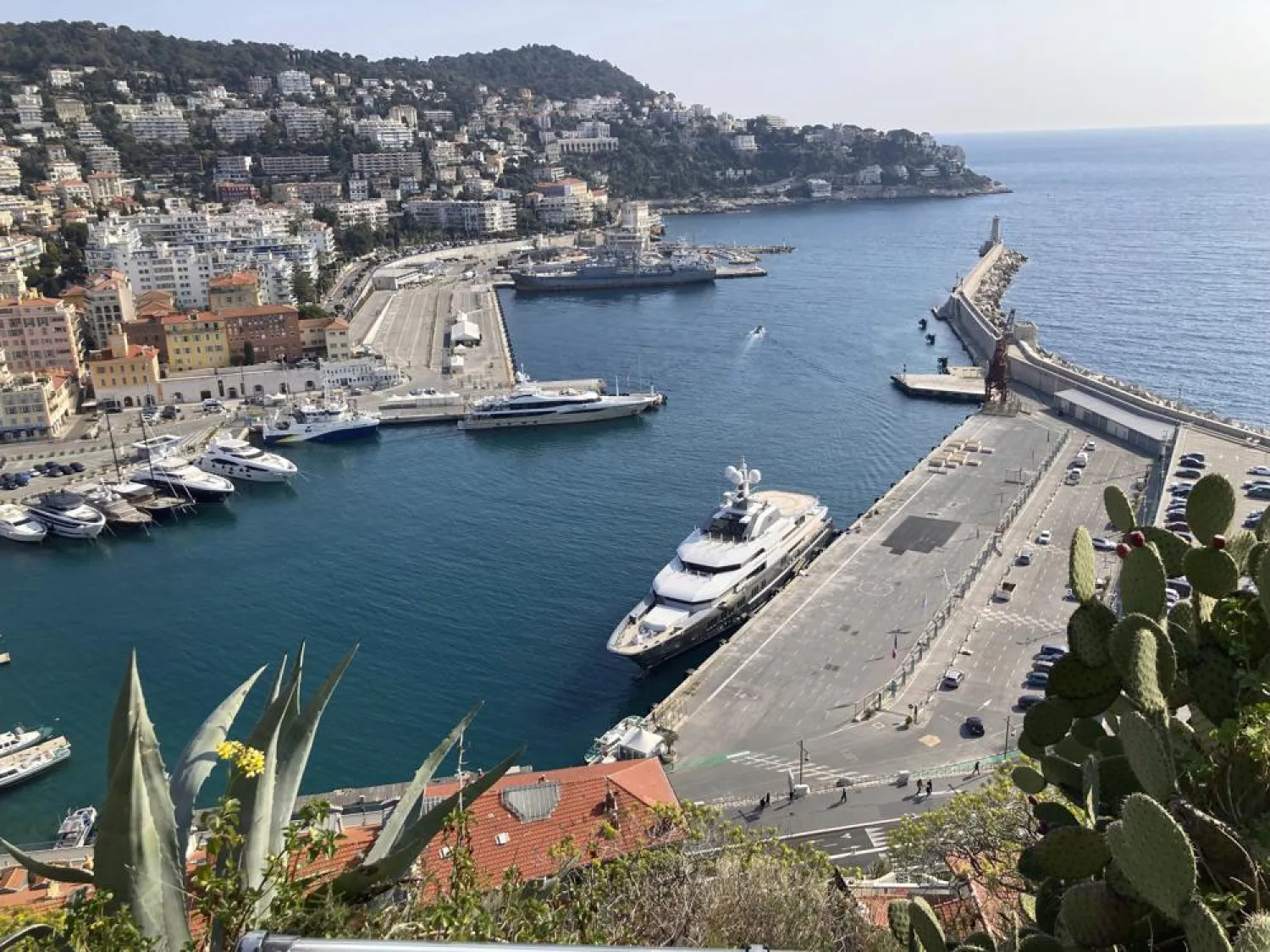
Stella Maris yacht belonging to Rashid Sardarov is docked in Nice, France, Tuesday, March 1, 2022. (AP)
TT

Fleeing Sanctions, Oligarchs Seek Safe Ports for Superyachts

Stella Maris yacht belonging to Rashid Sardarov is docked in Nice, France, Tuesday, March 1, 2022. (AP)

The superyacht Dilbar stretches one-and-a-half football fields in length. It has two helipads, berths for more than 130 people and a 25-meter swimming pool that itself can accommodate another superyacht.

Dilbar was launched in 2016 at a reported cost of more than $648 million. Five years later, its purported owner, the Kremlin-aligned Russian oligarch Alisher Usmanov, was already dissatisfied. He sent the vessel to a German shipyard last fall for a retrofit reportedly costing several hundred million dollars.

Dilbar was in drydock on Thursday when the United States and European Union announced economic sanctions against Usmanov — a metals magnate and early investor in Facebook — over his ties to Russian President Vladimir Putin and in retaliation for the Kremlin’s invasion of Ukraine.

“We are joining with our European allies to find and seize your yachts, your luxury apartments, your private jets,” President Joe Biden said during his State of the Union speech Tuesday night, addressing Russian oligarchs. “We are coming for your ill-begotten gains.”

Seizing the behemoth boats could prove challenging. Russian billionaires have had decades to shield their money and assets in the West from governments that might try to tax or seize them.

Several media outlets reported last week that German authorities had impounded the Dilbar. But a spokeswoman for Hamburg state’s economy ministry told The Associated Press no such action had yet been taken because it had been unable to establish ownership of the yacht.

Dilbar is flagged in the Cayman Islands and registered to a holding company in Malta, banking havens where the global ultra-rich often park their wealth.

Working with the UK-based yacht valuation firm VesselsValue, the AP compiled a list of 56 superyachts — generally defined as luxury vessels exceeding 24 meters (79 feet) in length — believed to be owned by a few dozen Kremlin-aligned oligarchs. The yachts have a combined market value estimated at more than $5.4 billion.

The AP then used two online services — VesselFinder and MarineTraffic — to plot the last known locations of the yachts as relayed by their onboard tracking beacons.

Many are anchored in the Mediterranean and Caribbean. But more than a dozen were underway or had already arrived in remote ports in small nations such as the Maldives and Montenegro, potentially beyond the reach of Western sanctions. Three had gone dark, their transponders last pinging just outside the Bosporus in Turkey — gateway to the Black Sea and the southern Russian ports of Sochi and Novorossiysk.

Graceful, a German-built Russian-flagged superyacht believed to belong to Putin, left a repair yard in Hamburg, Germany, on Feb. 7, two weeks before Russia invaded Ukraine. It is now moored in the Russian Baltic port of Kaliningrad, beyond the reach of Western sanctions imposed against him this past week.

French authorities seized the superyacht Amore Vero on Thursday in the Mediterranean resort town of La Ciotat. The boat is believed to belong to Igor Sechin, a Putin ally who runs Russian oil giant Rosneft, which has been on the US sanctions list since Russia annexed Crimea in 2014.

The French Finance Ministry said in a statement that customs authorities boarded the 289-foot Amore Vero and discovered its crew was preparing for an urgent departure, even though planned repair work wasn’t finished.

The 213-foot Lady M was seized by Italian authorities Friday while moored in the Riveria port town of Imperia. In a tweet announcing the seizure, a spokesman for Italian Prime Minister Mario Draghi said the yacht was the property of sanctioned steel baron Alexei Mordashov, listed as Russia’s wealthiest man with a fortune of about $30 billion.

But Mordashov’s the 464-foot Nord was safely at anchor on Friday in the Seychelles, a tropical island chain in the Indian Ocean not under the jurisdiction of US or EU sanctions. Among the world’s biggest superyachts, Nord has a market value of $500 million.

“No self-respecting Russian oligarch would be without a superyacht,” said William Browder, a US-born and now London-based financier who worked in Moscow for years before becoming one of the Putin regime’s most vocal foreign critics.

Russian metals and petroleum magnate Roman Abramovich is believed to have bought or built at least seven of the world’s largest yachts, some of which he has since sold off to other oligarchs.

Dennis Cauiser, a superyacht analyst with VesselsFinder, said the escalating US and EU sanctions on Putin-aligned oligarchs and Russian banks have sent a chill through the industry, with boatbuilders and staff worried they won’t be paid. It can cost upwards of $50 million a year to crew, fuel and maintain a superyacht.

Most of the Russians on the annual Forbes list of billionaires have not yet been sanctioned by the United States and its allies, and their superyachts are still crushing the world’s oceans. The 237-foot long Stella Maris, which was seen by an AP journalist docked this past week in Nice, France, is believed to be owned by Rashid Sardarov, a Russian billionaire oil and gas magnate.

The crash of the ruble and the tanking of Moscow stock market have depleted the fortunes of Russia’s elite. Cauiser said he expects some oligarch superyachts will soon quietly be listed by brokers at fire-sale prices.

On Thursday, the US Treasury Department issued a new round of sanctions that included news release citing Usmanov’s close ties to Putin and photos of Dilbar and the oligarch’s private jet, a custom-built 209-foot Airbus A340-300 passenger liner.

“I believe that such a decision is unfair and the reasons employed to justify the sanctions are a set of false and defamatory allegations damaging my honor, dignity and business reputation,” Usmanov said in a statement issued through the website of the International Fencing Federation, of which he has served as president since 2008.

Abramovich has not yet been sanctioned. Members of the British Parliament have criticized Prime Minister Boris Johnson for not going after Abramovich’s UK-based assets, which include the professional football club Chelsea. Under mounting pressure, the oligarch announced this past week he would sell the $2.5 billion team and give the net proceeds “for the benefit of all victims of the war in Ukraine.”

Meanwhile, location transponders showed the 533-foot Solaris — launched by Abramovich in 2010 with an undersea bay that reportedly holds a mini-sub — was moored in Barcelona, Spain, on Saturday. Abramovich’s $600 million Eclipse, eight stories tall and on the water since last year, set sail from St. Maarten late Thursday and is underway in the Caribbean Sea, destination undisclosed.



Coffee Regions Hit by Extra Days of Extreme Heat, Say Scientists 

17 April 2012, North Rhine-Westphalia, Vluyn: A general view of Arabica Coffee beans. (dpa)
TT

Coffee Regions Hit by Extra Days of Extreme Heat, Say Scientists 

17 April 2012, North Rhine-Westphalia, Vluyn: A general view of Arabica Coffee beans. (dpa)

The world's main coffee-growing regions are roasting under additional days of climate change-driven heat every year, threatening harvests and contributing to higher prices, researchers said Wednesday.

An analysis found that there were 47 extra days of harmful heat per year on average in 25 countries representing nearly all global coffee production between 2021 and 2025, according to independent research group Climate Central.

Brazil, Vietnam, Colombia, Ethiopia and Indonesia -- which supply 75 percent of the world's coffee -- experienced on average 57 additional days of temperatures exceeding the threshold of 30C.

"Climate change is coming for our coffee. Nearly every major coffee-producing country is now experiencing more days of extreme heat that can harm coffee plants, reduce yields, and affect quality," said Kristina Dahl, Climate Central's vice president for science.

"In time, these impacts may ripple outward from farms to consumers, right into the quality and cost of your daily brew," Dahl said in a statement.

US tariffs on imports from Brazil, which supplies a third of coffee consumed in the United States, contributed to higher prices this past year, Climate Central said.

But extreme weather in the world's coffee-growing regions is "at least partly to blame" for the recent surge in prices, it added.

Coffee cultivation needs optimal temperatures and rainfall to thrive.

Temperatures above 30C are "extremely harmful" to arabica coffee plants and "suboptimal" for the robusta variety, Climate Central said. Those two plant species produce the majority of the global coffee supply.

For its analysis, Climate Central estimated how many days each year would have stayed below 30C in a world without carbon pollution but instead exceeded that level in reality -- revealing the number of hot days added by climate change.

The last three years have been the hottest on record, according to climate monitors.


Dog Gives Olympics Organizers Paws for Thought

A dog wanders on the ski trail during the women's team cross country free sprint qualification event of the Milano Cortina 2026 Winter Olympic Games at Tesero Cross-Country Skiing Stadium in Lago di Tesero (Val di Fiemme), on February 18, 2026. (Photo by Anne-Christine POUJOULAT / AFP)
TT

Dog Gives Olympics Organizers Paws for Thought

A dog wanders on the ski trail during the women's team cross country free sprint qualification event of the Milano Cortina 2026 Winter Olympic Games at Tesero Cross-Country Skiing Stadium in Lago di Tesero (Val di Fiemme), on February 18, 2026. (Photo by Anne-Christine POUJOULAT / AFP)

A dog decided he would bid for an unlikely Olympic medal on Wednesday as he joined the women's cross country team free sprint in the Milan-Cortina Games.

The dog ran onto the piste in Tesero in northern Italy and gamely, even without skis, ran behind two of the competitors, Greece's Konstantina Charalampidou and Tena Hadzic of Croatia.

He crossed the finishing line, his moment of glory curtailed as he was collared by the organizers and led away -- his owner no doubt will have a bone to pick with him when they are reunited.


Olives, Opera and a Climate-Neutral Goal: How a Mural in Greece Won ‘Best in the World’ 

A building with the mural entitled “Kalamata” depicting opera legend Maria Callas by artist Kleomenis Kostopoulos is seen in Kalamata town, about 240 kilometers (150 miles) southwest of Athens, Monday, Feb. 9, 2026. (AP) 
TT

Olives, Opera and a Climate-Neutral Goal: How a Mural in Greece Won ‘Best in the World’ 

A building with the mural entitled “Kalamata” depicting opera legend Maria Callas by artist Kleomenis Kostopoulos is seen in Kalamata town, about 240 kilometers (150 miles) southwest of Athens, Monday, Feb. 9, 2026. (AP) 

Long known for its olives and seaside charm, the southern Greek city of Kalamata has found itself in the spotlight thanks to a towering mural that reimagines legendary soprano Maria Callas as an allegory for the city itself.

The massive artwork on the side of a prominent building in the city center has been named 2025’s “Best Mural of the World” by Street Art Cities, a global platform celebrating street art.

Residents of Kalamata, approximately 240 kilometers (150 miles) southwest of Athens, cultivate the world-renowned olives, figs and grapes that feature prominently on the mural.

That was precisely the point.

Vassilis Papaefstathiou, deputy mayor of strategic planning and climate neutrality, explained Kalamata is one of the few Greek cities with the ambitious goal of becoming climate-neutral by 2030. He and other city leaders wanted a way to make abstract concepts, including sustainable development, agri-food initiatives, and local economic growth, more tangible for the city’s nearly 73,000 residents.

That’s how the idea of a massive mural in a public space was born.

“We wanted it to reflect a very clear and distinct message of what sustainable development means for a regional city such as Kalamata,” Papaefstathiou said. “We wanted to create an image that combines the humble products of the land, such as olives and olive oil — which, let’s be honest, are famous all over the world and have put Kalamata on the map — with the high-level art.”

“By bringing together what is very elevated with ... the humbleness of the land, our aim was to empower the people and, in doing so, strengthen their identity. We want them to be proud to be Kalamatians.”

Southern Greece has faced heatwaves, droughts and wildfires in recent years, all of which affect the olive groves on which the region’s economy is hugely dependent.

The image chosen to represent the city was Maria Callas, widely hailed as one of the greatest opera singers of the 20th century and revered in Greece as a national cultural symbol. She may have been born in New York to Greek immigrant parents, but her father came from a village south of Kalamata. For locals, she is one of their own.

This connection is also reflected in practice: the alumni association at Kalamata’s music school is named for Callas, and the cultural center houses an exhibition dedicated to her, which includes letters from her personal archive.

Artist Kleomenis Kostopoulos, 52, said the mural “is not actually called ‘Maria Callas,’ but ‘Kalamata’ and my attempt was to paint Kalamata (the city) allegorically.”

Rather than portraying a stylized image of the diva, Kostopoulos said he aimed for a more grounded and human depiction. He incorporated elements that connect the people to their land: tree branches — which he considers the above-ground extension of roots — birds native to the area, and the well-known agricultural products.

“The dress I create on Maria Callas in ‘Kalamata’ is essentially all of this, all of this bloom, all of this fruition,” he said. “The blessed land that Kalamata itself has ... is where all of these elements of nature come from.”

Creating the mural was no small feat. Kostopoulos said it took around two weeks of actual work spread over a month due to bad weather. He primarily used brushes but also incorporated spray paint and a cherry-picker to reach all edges of the massive wall.

Papaefstathiou, the deputy mayor, said the mural has become a focal point.

“We believe this mural has helped us significantly in many ways, including in strengthening the city’s promotion as a tourist destination,” he said.

Beyond tourism, the mural has sparked conversations about art in public spaces. More building owners in Kalamata have already expressed interest in hosting murals.

“All of us — residents, and I personally — feel immense pride,” said tourism educator Dimitra Kourmouli.

Kostopoulos said he hopes the award will have a wider impact on the art community and make public art more visible in Greece.

“We see that such modern interventions in public space bring tremendous cultural, social, educational and economic benefits to a place,” he said. “These are good springboards to start nice conversations that I hope someday will happen in our country, as well.”