Rushing Clean Energy Could Stifle Everyone

Traffic at a gas station in central Paris (AFP)
TT

Rushing Clean Energy Could Stifle Everyone

Traffic at a gas station in central Paris (AFP)

In December 2021, the Saudi Energy Minister Prince Abdulaziz bin Salman al-Saud warned that the world is heading towards an energy crisis if investments in the oil sector continue to decrease.

Prince Abdulaziz touted investment as the only way to preserve energy supplies and meet market needs.

Last week, the price of an oil barrel shot up to $140 per barrel. The price hike can be traced back to an increase in demand and a drop in supplies as well as political events the world is experiencing today, the most important of which is the Russian-Ukrainian war and the Iranian nuclear talks.

Prince Abdulaziz’s warning came in response to an international drive towards reducing investment in fossil fuels, gas and oil, which led to a decrease in direct and indirect investments in the energy sector, estimated at hundreds of billions of dollars from 2014 until 2021.

Companies Roll back Investments

A report issued by CleanTechnica – a US-based website specializing in clean energy - indicated that multinational companies’ volume of investments taken out of fossil fuels in 2014 amounted to about $52 billion. In 2018, it amounted to more than $125 billion.

In 2019, 1110 institutions with assets of more than 11 trillion dollars committed to getting rid of fossil fuels. The once strong industry started witnessing a steady decline in its position. Because of the decrease in the number of institutional investors, lower profits, and weak expectations, companies such as BP, Equinor and Repsol wrote off a total of more than $11 billion in North American shale oil assets.

In 2020, 42 investment institutions from 14 countries announced the withdrawal of their investments from fossil fuels, and BlackRock, the world’s largest investment management company, announced that environmental sustainability would be a key and decisive factor in future investment decisions.

Moreover, the New York State Pension Fund decided to phase out oil and gas companies by 2024 and completely decarbonize its portfolio, estimated to be worth more than $500 billion, by 2040.

Increasing Taxes, Selling Assets

Mazen Al-Sudairy, head of research at Al-Rajhi Capital, said that the most important problems facing companies investing in fossil fuels include the increase in the cost of taxes in exchange for subsidizing renewable energy, and some countries, especially in Europe, adopting strict policies to get companies to invest in renewable energy.

Al-Sudairy noted that the decision by EU leaders to impose a “carbon tax” to reduce the use of fossil fuels had an evident impact on oil companies, especially considering current crises.

These policies prompted some companies to sell part of their assets, such as Shell and the Italian Eni, Al-Sudairy told Asharq Al-Awsat.

Moreover, BP is currently selling its stake in the Russian company, Rosneft, which constitutes 15% of the company’s production.

The London-based multinational oil and gas company has also exited fossil fuel investments in the US and is expected to pull the plug faster on its fossil fuel investments in the near future.

This puts pressure on the oil industry.

Al-Sudairy added that BP announced its intentions to sell its fossil fuel assets at a value of $25 billion by 2025, which is equivalent to about 13% of the company’s total fixed assets. The research expert said the move would “make matters worse,” especially with the increase in global demand for fossil fuels.

The structural lack of investments and insufficient capital spending will have major impacts on global production of fossil fuels, stressed Al-Sudairy.

He pointed out that in the event of continued reluctance to invest in the sector, the market would lose about 16 million oil barrels by 2030.

There is a need for investments in fossil fuels to exceed 450 billion dollars annually, emphasized Al-Sudairy.

The world’s largest international oil companies, or IOCs, sold over $198 billion of assets between 2015 and 2020, over four times the amount they invested into clean energy technologies, said a Bloomberg New Energy Finance report.

European IOCs notably diverged from their US peers. Equinor was the only IOC to see clean energy investment outstrip divestment proceeds.

Despite high levels of divestment from ExxonMobil, Chevron, and ConocoPhillips, they collectively invested just $757 million in clean energy, only 1% of the divestment proceeds.

Paris Agreement Battle

The Paris Climate Accords, signed in Paris in 2015, had entered into force in November 2016. The international climate treaty focuses on facing the problem of greenhouse gas emissions and finding solutions to adapt and mitigate their damage to the environment.

It also looks seriously at the obvious effects of climate change and seeks to launch initiatives that contribute to reducing emissions to get rid of dependence on fossil fuels.

One of the architects of this agreement is former US Secretary of State John Kerry, who is now the presidential envoy on climate affairs.

The Paris agreement was followed by calls from international institutions to get rid of investment in fossil fuels to access renewable energy, with the International Energy Agency leading a campaign of warnings against investors for not financing new oil, gas and coal projects.

Saudi Warnings

Prince Abdulaziz renewed his warning of challenges emerging to policymakers due to the rise in prices, describing the campaign against investments in the oil and gas sectors as “short-sighted and will have an impact on global welfare.”

The energy minister stressed that the Kingdom of Saudi Arabia would continue to invest in the oil and gas sectors as well as renewable energy.

He explained that the world is going through a stage of energy transition, “and it is wrong to focus on one aspect such as renewable energy because the world economy requires various sources of energy to develop.”

Prince Abdulaziz said that sustainability, which is the result of the circular economy of carbon, will be dependent on technology capable of ensuring a rise in the demand for fossil fuels while addressing emissions through technology.

It is noteworthy that G20 countries had agreed to adopt the circular economy approach to carbon, which was proposed by Saudi Arabia at the G20 Riyadh Summit in 2020.

For its part, the International Energy Agency said it expected a decline in demand to coincide with an increase in supplies during the coming period, expecting a decrease in oil demand by about 100,000 barrels per day in 2021 and 2022.

“Supplies may rise by 6.4 million barrels per day next year, compared to an increase of 1.5 million barrels in 2021,” said the agency in its December 2021 report.

“Continuing to retreat from the cuts may lead to a surplus of about two million barrels in the second quarter of 2022,” the report added.

On the other hand, a report issued by OPEC in 2020 predicted that global demand for crude oil will grow by 2025 to 103.7 million barrels per day, and by 2030 it will rise to 107.2 million barrels per day, then to 108.9 million barrels per day by 2035.

According to the report, global oil demands will grow to 109.3 million barrels per day by 2040.



Riyadh to Host Middle East’s Largest General Aviation Airshow in November 

The AERO Middle East x Sand & Fun 2026 will be held in Riyadh from November 24 to 28. (SPA)
TT

Riyadh to Host Middle East’s Largest General Aviation Airshow in November 

The AERO Middle East x Sand & Fun 2026 will be held in Riyadh from November 24 to 28. (SPA)

The Saudi Aviation Club announced that it will organize the AERO Middle East x Sand & Fun 2026 in Riyadh from November 24 to 28, reported the Saudi Press Agency on Tuesday.

The event is set to be the largest of its kind for general aviation in the Middle East, combining international business, investment, and innovation with live flying displays and interactive public experiences. It is being held in partnership with Messe Frankfurt Saudi Arabia.

Held at Thumamah Airport, the exhibition will bring together leading global companies operating in the general aviation industry, including aircraft and components manufacturers, avionics and navigation systems providers, as well as maintenance, repair, and overhaul (MRO) companies, offering an integrated platform that covers the full value chain of the sector.

The event will also spotlight startups in advanced air mobility (AAM) and innovators of electric vertical take-off and landing (eVTOL) aircraft, showcasing technologies and business models shaping the future of aviation.

General Supervisor of the Saudi Aviation Club Dr. Ahmed Alfahaid stated that AERO Middle East x Sand & Fun 2026 represents a qualitative leap for the Kingdom’s aviation sector and reinforces its positioning as a global hub for general aviation and advanced air mobility.

The partnership with Messe Frankfurt Saudi Arabia goes beyond presenting global innovations to providing a vital platform for international investment and strategic collaboration, he stressed.

Moreover, the event contributes to achieving Saudi Vision 2030 objectives, including the Kingdom’s ambition to rank among the world’s top 10 general aviation markets, he added.


Saudi Arabia, Kazakhstan Agree to Establish Coordination Council

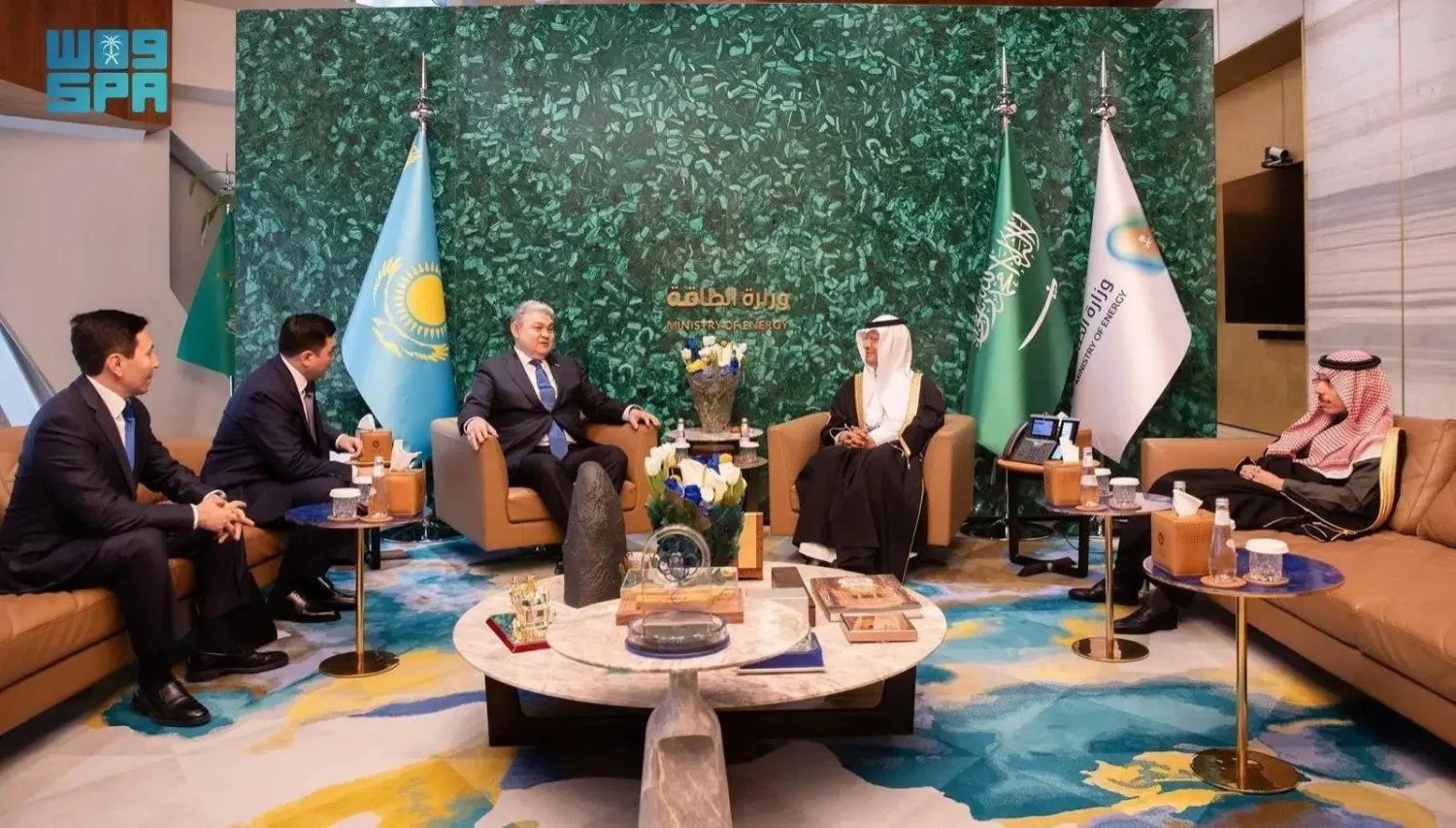
Saudi Minister of Energy Prince Abdulaziz bin Salman bin Abdulaziz receives Kazakhstan’s Foreign Minister Yermek Kosherbayev in Riyadh. (SPA)
TT

Saudi Arabia, Kazakhstan Agree to Establish Coordination Council

Saudi Minister of Energy Prince Abdulaziz bin Salman bin Abdulaziz receives Kazakhstan’s Foreign Minister Yermek Kosherbayev in Riyadh. (SPA)

Saudi Arabia and Kazakhstan agreed to establish a Saudi-Kazakh Coordination Council, reported the Saudi Press Agency on Tuesday.

Saudi Minister of Energy Prince Abdulaziz bin Salman bin Abdulaziz received in Riyadh Kazakhstan’s Foreign Minister Yermek Kosherbayev. Saudi FM Prince Faisal bin Farhan bin Abdullah and Minister of Energy of Kazakhstan Yerlan Akkenzhenov also attended the meeting.

The talks tackled the establishment of the coordination council, which will be chaired by the Saudi minister of energy and Kazakhstan’s foreign minister. The council reflects the two countries’ commitment to strengthening cooperation and expanding their bilateral partnership.

Prince Abdulaziz and Kosherbayev signed an agreement on the establishment of the council, which aims to boost coordination and consultation between the two countries and develop frameworks for cooperation across various sectors of mutual interest, elevating bilateral relations to broader levels.

Prince Abdulaziz and Kosherbayev discussed relations between their countries and ways to develop them further, especially in the energy field. They tackled opportunities for cooperation and investment in renewable energy and energy storage systems and discussed oil market developments.


Saudi-Qatari Partnership Paves Way for Logistics Corridors to Boost Regional Trade Efficiency 

The MoU was signed by Mawani President Eng. Suliman Almazroua and CEO of Qatar Ports Management Company Captain Abdullah Mohammed Al-Khanji. (QNA)
TT

Saudi-Qatari Partnership Paves Way for Logistics Corridors to Boost Regional Trade Efficiency 

The MoU was signed by Mawani President Eng. Suliman Almazroua and CEO of Qatar Ports Management Company Captain Abdullah Mohammed Al-Khanji. (QNA)

The Saudi Ports Authority (Mawani) and Qatar Ports Management Company signed on Tuesday a memorandum of understanding (MoU) aimed at boosting maritime and logistics cooperation between the two sides.

The agreement will contribute to the development of the ports sector, raising operational efficiency, and supporting regional and international trade flows.

The MoU was signed by Mawani President Eng. Suliman Almazroua and CEO of Qatar Ports Management Company Captain Abdullah Mohammed Al-Khanji. Qatari Ambassador to Saudi Arabia Bandar bin Mohammed Al Attiyah attended the signing ceremony.

The agreement reflects Saudi Arabia and Qatar’s commitment to building effective partnerships, exchanging expertise, establishing an organized framework for cooperation management, and developing joint investment opportunities in line with Saudi Vision 2030 and Qatar National Vision 2030.

The MoU outlines eight key areas of cooperation, including the exchange of best practices in port management and operations, and the study of opportunities for direct maritime and land connectivity between the ports of both countries to enhance trade flow efficiency.

It includes collaboration in logistics services, exploring the establishment of joint maritime corridors serving bilateral and regional trade, and assessing the feasibility of creating shared regional distribution centers.

In the fields of digital transformation and artificial intelligence, the two sides agreed to deepen cooperation on developing smart systems, data governance, and the unified maritime window, thereby boosting operational efficiency and keeping pace with technological advancements in the maritime sector.

The MoU places strong emphasis on maritime safety and environmental protection, including exchanging expertise in combating marine pollution and emergency response; developing joint maritime emergency plans; establishing an emergency communication line between the two countries; and cooperating to ensure compliance with international conventions, conduct joint exercises, and develop risk monitoring systems.

The cooperation also covers human capital development through joint training programs and field-exchange of expertise, as well as academic and research collaboration in maritime transport and logistics.

In terms of joint investment, both sides will study local and global investment opportunities in ports and related services and coordinate with the private sector to support these initiatives.

The MoU further includes cooperation in cruise tourism through enhanced maritime connectivity and joint promotion of Gulf cruise routes, as well as international and regional representation by coordinating positions in international maritime organizations and supporting joint initiatives, notably “Green Ports” and “Safe Sea Corridors.”

The agreement reflects the commitment of Mawani and Qatar Ports Management Company to advancing the ports sector and boosting its role as a key driver of trade and economic growth, contributing to Gulf integration and enhancing regional competitiveness in maritime and marine services.