


FIFA, Qatar Prepare for Unprecedented World Cup Finals Draw

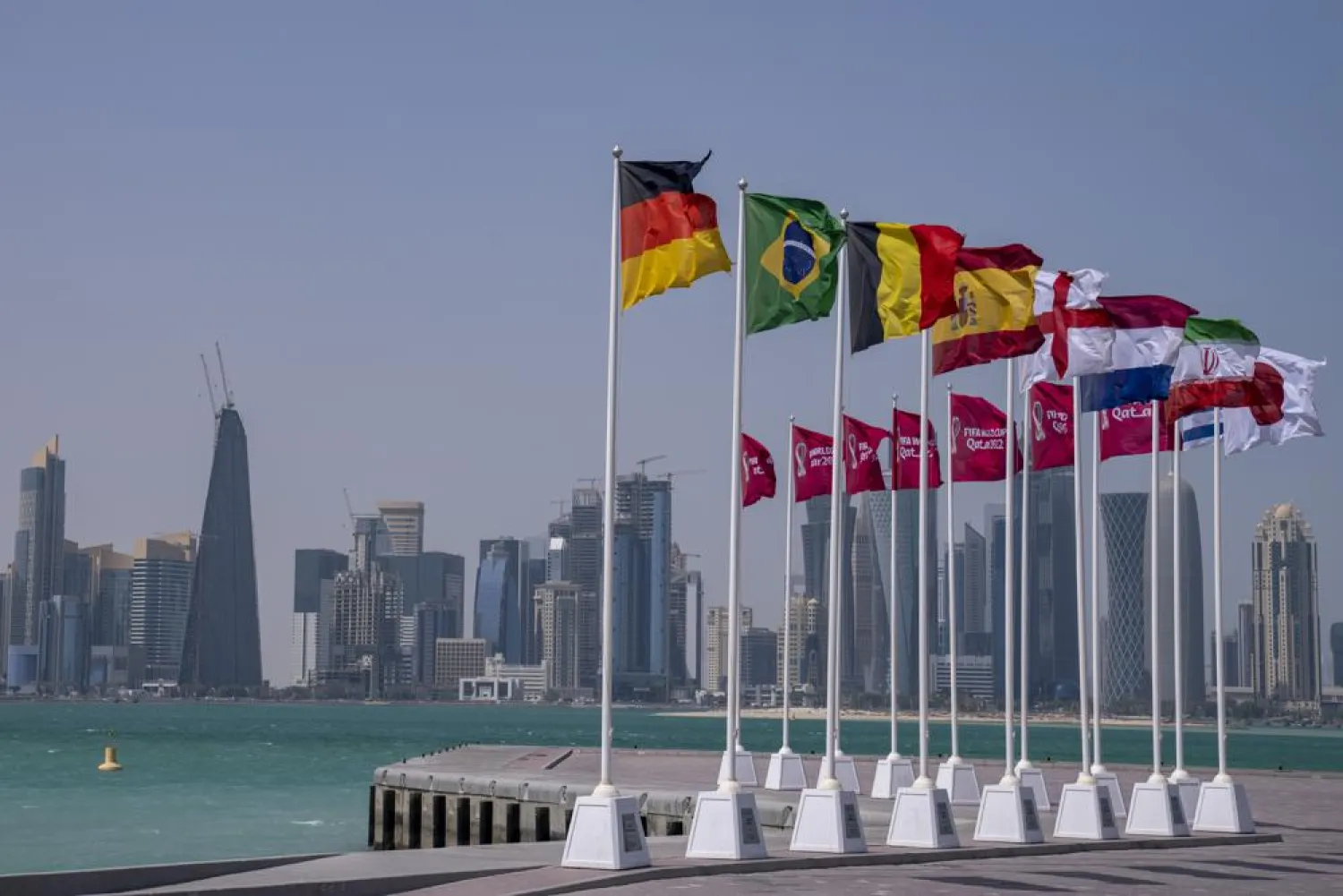
Flags of some of the qualified countries of the World Cup wave at the seafront in Doha, Qatar, Tuesday, March 29, 2022. (AP)
TT

FIFA, Qatar Prepare for Unprecedented World Cup Finals Draw

Flags of some of the qualified countries of the World Cup wave at the seafront in Doha, Qatar, Tuesday, March 29, 2022. (AP)

A World Cup like no other in its 92-year history will take shape this week at an unprecedented tournament draw.

When FIFA and host nation Qatar stage the draw ceremony show Friday, three of the 32 entries will be placeholders because the three-year qualifying program was delayed and still ongoing.

A once-in-a-century global health crisis and the war in Ukraine made sure of that.

It means 37 nations will be involved on Friday, including five which will ultimately not play in November when the first “winter” World Cup kicks off.

The full lineup will not be known until at least June 14, when the intercontinental playoff round ends in Qatar. That is 74 days after the draw and the same date the 2018 tournament started in Russia.

Maybe FIFA got lucky seven years ago by moving the 2022 tournament to November and December to avoid the searing desert heat of Qatar’s summer.

The later start created wriggle room to clear the match backlog after the COVID-19 pandemic wiped out almost every national-team game outside Europe in 2020.

It has also put uncertainty on stage at the Doha Exhibition & Convention Center, where the show Friday starts at 7 p.m. (1600 GMT) and lasts one hour.

One of the balls being drawn from pot 4 of low-ranked teams will represent “Peru or Australia or the United Arab Emirates.” Another is “Ukraine or Wales or Scotland.”

So it goes at this major World Cup milestone, in perhaps its most unlikely host nation, on April 1.

Here’s a look at this unusual World Cup draw.

First-timer Qatar
One sure thing is Qatar will be the top-seeded team in Group A, taking position A1 in the schedule of 64 matches in just 28 days.

The privilege is given to all host nations even when ranked No. 65 in the world, as Russia was. Qatar is currently No. 52.

Still, the 2019 Asian Cup winner is the exception among modern World Cup hosts, having never before qualified for the finals. Qatar's debut opens the tournament on Monday, Nov. 21 at Al Bayt Stadium.

It means in the group stage Qatar avoids the world’s top-ranked teams, from Nos. 1 to 7 — Brazil, Belgium, France, Argentina, England, Spain and Portugal.

Those countries will be the next seven drawn out of top-seeded pot 1 and allocated in turn to Groups B through H.

How the seeding works
Seeding pots are filled according to FIFA rankings which weigh results over several years and are officially updated Thursday.

The next eight highest-ranked qualifiers go into pot 2, which is the second to be drawn. It includes Germany and likely the United States and Mexico after Wednesday’s qualifying games.

Next is pot 3 with teams ranked in the 20s by FIFA and finally pot 4 including Canada, back in the World Cup after a 36-year gap. Canada is in pot 4 despite leading the North American qualifying group.

The simple format is now complicated by the three playoff entries delayed to June: The European bracket containing Ukraine, which cannot currently prepare a team, and the two intercontinental playoffs.

FIFA weighted those entries downward into pot 4 according to the lowest-ranked potential qualifiers, such as Scotland, New Zealand and the UAE.

Higher-ranked playoff teams Peru and Wales face being seeded below their true level.

Geography lesson
Geography also limits potential match-ups. Teams from the same continent generally can't go in the same group, except for some Europeans. Europe has 13 of the 31 qualifying slots and they cannot all avoid each other.

Five groups get two European teams, and the other three groups each get one. It means 2014 winner Germany from pot 2 can land with defending champion France.

Fixture schedule
Each four-team group is a round-robin of six games in total. The order each team plays the other is decided by another draw within the ceremony.

After each team is drawn, a subsequent ball — numbered 1, 2, 3 or 4 — is picked to place that country in the fixture grid.

This unpredictability means the two highest-ranked teams in a group could meet in any of the three rounds.

Knockout stage
The 32-team lineup is the perfect number for a knockout bracket. The top two teams in each group — where goal difference is the first tiebreaker — advance to the round of 16.

A team’s path through to the quarterfinals, semifinals and final is set in the bracket. If Qatar advances as the Group A winner, it must then play the Group B runner-up.

Teams which advance from the same group cannot meet again until the final.

Good draw, bad draw?
Is there a “good” or “bad” section of the draw to land in?

Maybe yes at this congested tournament, which will be four days shorter than the 2018 edition in Russia.

Landing in Group B means starting on Nov. 21 instead of Nov. 24 in Group G or H. That means three extra rest days.

The Group G winner would have to play seven games in just 25 days to win the title. That team also gets just two full days off before a round of 16 game on Dec. 5.

Why is the schedule so tight? This World Cup is jammed into an enforced break in domestic league seasons in Europe.

Reluctant to lose lucrative weekend broadcast slots, Europe’s top leagues ensured they will play through Nov. 13 — just eight days before kickoff in Qatar.



Shakhtar Boss Pays Ukrainian Racer $200,000 After Games Disqualification

Ukrainian President Volodymyr Zelenskiy holds helmet as he meets with a Ukrainian skeleton racer Vladyslav Heraskevych , who was disqualified from the Olympic skeleton competition over his "helmet of remembrance" depicting athletes killed since Russia's invasion and his father and coach, Mykhailo Heraskevych, amid Russia's attack on Ukraine, in Munich, Germany February 13, 2026. (Ukrainian Presidential Press Service/Handout via Reuters)
TT

Shakhtar Boss Pays Ukrainian Racer $200,000 After Games Disqualification

Ukrainian President Volodymyr Zelenskiy holds helmet as he meets with a Ukrainian skeleton racer Vladyslav Heraskevych , who was disqualified from the Olympic skeleton competition over his "helmet of remembrance" depicting athletes killed since Russia's invasion and his father and coach, Mykhailo Heraskevych, amid Russia's attack on Ukraine, in Munich, Germany February 13, 2026. (Ukrainian Presidential Press Service/Handout via Reuters)

The owner of ‌Ukrainian football club Shakhtar Donetsk has donated more than $200,000 to skeleton racer Vladyslav Heraskevych after the athlete was disqualified from the Milano Cortina Winter Games before competing over the use of a helmet depicting Ukrainian athletes killed in the war with Russia, the club said on Tuesday.

The 27-year-old Heraskevych was disqualified last week when the International Bobsleigh and Skeleton Federation jury ruled that imagery on the helmet — depicting athletes killed since Russia invaded Ukraine in 2022 — breached rules on athletes' expression at ‌the Games.

He ‌then lost an appeal at the Court ‌of ⁠Arbitration for Sport hours ⁠before the final two runs of his competition, having missed the first two runs due to his disqualification.

Heraskevych had been allowed to train with the helmet that displayed the faces of 24 dead Ukrainian athletes for several days in Cortina d'Ampezzo where the sliding center is, but the International Olympic Committee then ⁠warned him a day before his competition ‌started that he could not wear ‌it there.

“Vlad Heraskevych was denied the opportunity to compete for victory ‌at the Olympic Games, yet he returns to Ukraine a ‌true winner," Shakhtar President Rinat Akhmetov said in a club statement.

"The respect and pride he has earned among Ukrainians through his actions are the highest reward. At the same time, I want him to ‌have enough energy and resources to continue his sporting career, as well as to fight ⁠for truth, freedom ⁠and the remembrance of those who gave their lives for Ukraine," he said.

The amount is equal to the prize money Ukraine pays athletes who win a gold medal at the Games.

The case dominated headlines early on at the Olympics, with IOC President Kirsty Coventry meeting Heraskevych on Thursday morning at the sliding venue in a failed last-minute attempt to broker a compromise.

The IOC suggested he wear a black armband and display the helmet before and after the race, but said using it in competition breached rules on keeping politics off fields of play. Heraskevych also earned praise from Ukraine President Volodymyr Zelenskiy.


Speed Skating-Italy Clinch Shock Men’s Team Pursuit Gold, Canada Successfully Defend Women’s Title

 Team Italy with Davide Ghiotto, Andrea Giovannini, Michele Malfatti, celebrate winning the gold medal on the podium of the men's team pursuit speed skating race at the 2026 Winter Olympics, in Milan, Italy, Tuesday, Feb. 17, 2026. (AP)
Team Italy with Davide Ghiotto, Andrea Giovannini, Michele Malfatti, celebrate winning the gold medal on the podium of the men's team pursuit speed skating race at the 2026 Winter Olympics, in Milan, Italy, Tuesday, Feb. 17, 2026. (AP)
TT

Speed Skating-Italy Clinch Shock Men’s Team Pursuit Gold, Canada Successfully Defend Women’s Title

 Team Italy with Davide Ghiotto, Andrea Giovannini, Michele Malfatti, celebrate winning the gold medal on the podium of the men's team pursuit speed skating race at the 2026 Winter Olympics, in Milan, Italy, Tuesday, Feb. 17, 2026. (AP)
Team Italy with Davide Ghiotto, Andrea Giovannini, Michele Malfatti, celebrate winning the gold medal on the podium of the men's team pursuit speed skating race at the 2026 Winter Olympics, in Milan, Italy, Tuesday, Feb. 17, 2026. (AP)

An inspired Italy delighted the home crowd with a stunning victory in the Olympic men's team pursuit final as

Canada's Ivanie Blondin, Valerie Maltais and Isabelle Weidemann delivered another seamless performance to beat the Netherlands in the women's event and retain their title ‌on Tuesday.

Italy's ‌men upset the US who ‌arrived ⁠at the Games ⁠as world champions and gold medal favorites.

Spurred on by double Olympic champion Francesca Lollobrigida, the Italian team of Davide Ghiotto, Andrea Giovannini and Michele Malfatti electrified a frenzied arena as they stormed ⁠to a time of three ‌minutes 39.20 seconds - ‌a commanding 4.51 seconds clear of the ‌Americans with China taking bronze.

The roar inside ‌the venue as Italy powered home was thunderous as the crowd rose to their feet, cheering the host nation to one ‌of their most special golds of a highly successful Games.

Canada's women ⁠crossed ⁠the line 0.96 seconds ahead of the Netherlands, stopping the clock at two minutes 55.81 seconds, and

Japan rounded out the women's podium by beating the US in the Final B.

It was only Canada's third gold medal of the Games, following Mikael Kingsbury's win in men's dual moguls and Megan Oldham's victory in women's freeski big air.


Lindsey Vonn Back in US Following Crash in Olympic Downhill 

Milano Cortina 2026 Olympics - Alpine Skiing - Women's Downhill 3rd Official Training - Tofane Alpine Skiing Centre, Belluno, Italy - February 07, 2026. Lindsey Vonn of United States in action during training. (Reuters)
TT

Lindsey Vonn Back in US Following Crash in Olympic Downhill 

Milano Cortina 2026 Olympics - Alpine Skiing - Women's Downhill 3rd Official Training - Tofane Alpine Skiing Centre, Belluno, Italy - February 07, 2026. Lindsey Vonn of United States in action during training. (Reuters)

Lindsey Vonn is back home in the US following a week of treatment at a hospital in Italy after breaking her left leg in the Olympic downhill at the Milan Cortina Games.

“Haven’t stood on my feet in over a week... been in a hospital bed immobile since my race. And although I’m not yet able to stand, being back on home soil feels amazing,” Vonn posted on X with an American flag emoji. “Huge thank you to everyone in Italy for taking good care of me.”

The 41-year-old Vonn suffered a complex tibia fracture that has already been operated on multiple times following her Feb. 8 crash. She has said she'll need more surgery in the US.

Nine days before her fall in Cortina d'Ampezzo, Italy, Vonn ruptured the ACL in her left knee in another crash in Switzerland.

Even before then, all eyes had been on her as the feel-good story heading into the Olympics for her comeback after nearly six years of retirement.