


Saudi Arabia Boosts Entrepreneurship in Industry, Logistics

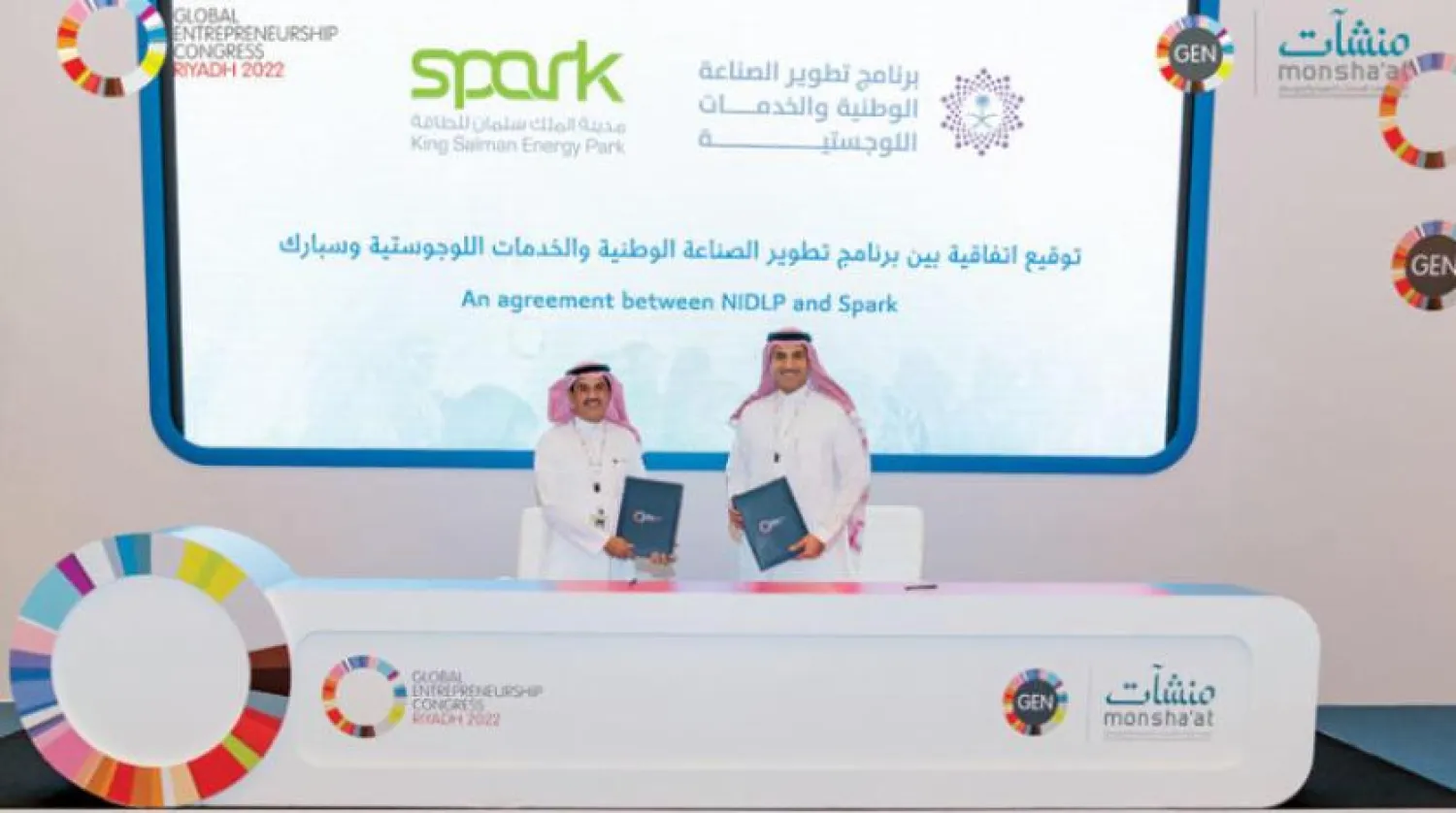
Signing ceremony at the Global Entrepreneurship Congress (GEC) in Riyadh (Asharq Al-Awsat)
TT

Saudi Arabia Boosts Entrepreneurship in Industry, Logistics

Signing ceremony at the Global Entrepreneurship Congress (GEC) in Riyadh (Asharq Al-Awsat)

The Saudi National Industrial Development and Logistics Program (NIDLP) launched the "Thousand Miles" initiative for small and medium enterprises (SMEs) in the industrial and logistics fields.

The initiative seeks to facilitate material support, feasibility studies, and asset investment.

The launch came during the Global Entrepreneurship Congress (GEC), organized by the Small and Medium Enterprises General Authority (Monsha'at) in cooperation with the Global Entrepreneurship Network.

The conference witnessed the signing and launching of many programs and initiatives with a total value exceeding $1.6 billion.

NIDLP's new program is an opportunity to qualify entrepreneurs in industry and logistics in cooperation with the relevant authorities. It will also enable the qualification of skills in theory and practice, prepare preliminary and detailed feasibility studies, and provide qualitative incentives.

Technical Spending

Governor of the Saudi Digital Government Authority (DGA) Ahmed al-Suwaiyan said that 73 percent of the venture capital funding is going to technology and digital entrepreneurs.

Suwaiyan indicated during one of the panels at GEC that the Kingdom is the highest in the world in technical government spending out of national technical spending, reaching 21.7 percent last year with a value of $24 billion until 2025.

Several panels and sessions were held at GEC addressing young people and their interests, with the participation of several public and private officials aiming to develop entrepreneurs in all fields and provide them with the support needed to increase the most prominent issues of the emerging generation.

Saudi opportunities

CEO of Mohammed bin Salman Foundation (Misk) Badr al-Badr reviewed the trends that dominate entrepreneurship in 2022 and the sectors in high demand in the future.

Badr confirmed that 50 percent of Saudi youth are thinking about starting their own business, indicating that Misk programs are available to all ambitious people who need support.

He added that the most difficult challenges facing entrepreneurs are regulations, local and global expansion, and lack of talent.

"Misk's focus on supporting the entrepreneurship sector is driven by creating real opportunities for the youth to become entrepreneurs, lead successful businesses, and enable employment opportunities for others," he said.

Business setup

Meanwhile, a session entitled "Nurturing Youth Entrepreneurship" hosted Vice President of Nesma Noura al-Turki, Independent Consultant Khaled al-Zamel, and CEO of the Entrepreneurial Learning Initiative Gary Schoeniger to discuss the need of current and future generations for a stimulating environment to develop new skills and ways of thinking.

The panel discussed how governments tap into this potential and empower young people to become future innovators, addressing the key sectors.

Turki stated that maintaining the entrepreneurial mindset within companies and within the youth who choose corporate careers, noting that it is vital to keep the spirit alive 40 years down the line in a company.

Zamil stated that entrepreneurship faces many difficulties and obstacles, noting that it is necessary to prepare for such possibilities always.

Entertainment

The speakers in the "Looking Ahead - Rise of The Film Industry" session discussed the challenges and opportunities of this sector. It was hosted by UTURN Chairman Kaswara al-Khatib and General Manager of MBC Studio Zainab Abu al-Samh.

Khatib stated they are enough stories to reflect the Saudi identity and be creative in highlighting its culture, adding that expectations are high and Saudi and Arab consumers have high energy and taste.

"Be authentic, focus on the storytelling itself. We have our own identity. We have a lot of stories to tell! Amazing stories!"

Samh indicated that the industry has all possibilities and opportunities, with creators capable of producing new materials. She explained that currently, there is a need to focus on young talents that will contribute to the continuation and development of the industry.

Speaking at the "Disrupting Entertainment: A future view" panel, Netflix co-founder Marc Randolph stressed that ideas must be revised to know that the product or service reaches the customer quickly and inexpensively, indicating that addressing the problem is better than creating ideas.

Programs and initiatives

On its third day, GEC witnessed the signing and launch of several programs and initiatives supporting the SME sector and entrepreneurship, with a total value exceeding $1.6 billion in support of the industry and providing financing solutions for SMEs.

The Small and Medium Enterprises Financing Guarantee Program (Kafalah) signed several agreements with the Ministries of Industry and Mineral Resources, Municipal and Rural Affairs and Housing, and Sports, as well as several funds, including the Cultural Development Fund, the Tourism Development Fund, the National Industries Development and Logistics Program (NIDLP).

Kafalah also signed an agreement with King Saud University, Jouf University, and Saudi Incubators and Accelerators.

Monsha'at signed several cooperation agreements with the Council of Health Insurance and the Saudi Commission for Health Specialties, the Saudi Food and Drug Authority to support and empower entrepreneurs and small and medium enterprises.

The Banque Saudi Fransi signed a cooperation agreement with Saudi Arabian Airlines (Saudia).

It also launched the fourth batch of influential mentoring for an ambitious program in cooperation with Endeavor Saudi Arabia to support fast-growing enterprises by facilitating access to the best mentors in local and global networks and linking with regional and international offices.

It aims to support more than 26 fast-growing firms represented by 35 Saudi entrepreneurs, with more than 400,000 direct and indirect jobs.

Over 20 fast-growing Saudi companies cooperated with the global Elite Network to launch the sixth batch of Elite's ambition, aiming to qualify four to six companies to be offered in Nomu, the parallel stock market.

Meanwhile, Chaizer Power signed a cooperation agreement with the European MegaTel Group to manufacture and supply electric vehicle chargers in Saudi Arabia and the Middle East.



Oil Prices Rise 1% as Supply Risks Remain in Focus

The Nave Photon, carrying crude oil from Venezuela, is docked at Port Freeport in Freeport, Texas, US, January 15, 2026. REUTERS/Antranik Tavitian
TT

Oil Prices Rise 1% as Supply Risks Remain in Focus

The Nave Photon, carrying crude oil from Venezuela, is docked at Port Freeport in Freeport, Texas, US, January 15, 2026. REUTERS/Antranik Tavitian

Oil prices rose over 1% on Friday as supply risks remained in focus despite the receding likelihood of a US military strike against Iran.

Brent crude was up 84 cents, or 1.3%, to $64.60 a barrel at 1413 GMT, on course for a fourth consecutive weekly gain. US West Texas Intermediate was up 80 cents, or 1.4%, to $59.99.

At those levels, Brent was on course for a 2% weekly gain and WTI for a 1.4% gain. Brent ⁠was up a little more than $1 at its intraday peak as investors continue to weigh the potential for supply outages should tensions in the Middle East escalate, Reuters reported.

"While geopolitical tensions in the Middle East have eased, they have not disappeared, and market participants remain concerned about potential supply disruptions," said UBS analyst Giovanni Staunovo.

Both benchmarks hit multi-month highs this week ⁠after protests flared up in Iran and US President Donald Trump signaled the potential for military strikes, but lost over 4% on Thursday as Trump said that Tehran's crackdown on the protesters was easing, allaying concerns of possible military action that could disrupt oil supplies.

"Above all, there are worries about a possible blockade of the Strait of Hormuz by Iran in the event of an escalation, through which around a quarter of seaborne oil supplies flow," Commerzbank analysts said in a note.

"Should there be signs of a sustained easing on ⁠this front, developments in Venezuela are likely to return to the spotlight, with oil that was recently sanctioned or blocked gradually flowing onto the world market."

Meanwhile, analysts expect higher supply this year, potentially creating a ceiling for the geopolitical risk premium on prices.

"Despite the steady drumbeat of geopolitical risks and macro speculation, the underlying balance still points to ample supply," said Phillip Nova analyst Priyanka Sachdeva.

"Unless we see a genuine revival in Chinese demand or a meaningful bottleneck in physical barrel flows, oil looks range-bound, with Brent broadly hovering between $57 and $67."


Gold Eases as Strong US Data, Easing Geopolitical Tensions Sap Momentum

FILE PHOTO: A saleswoman displays a gold necklace inside a jewellery showroom on the occasion of Akshaya Tritiya, a major gold buying festival, in Kolkata, India, May 7, 2019. REUTERS/Rupak De Chowdhuri/File Photo
TT

Gold Eases as Strong US Data, Easing Geopolitical Tensions Sap Momentum

FILE PHOTO: A saleswoman displays a gold necklace inside a jewellery showroom on the occasion of Akshaya Tritiya, a major gold buying festival, in Kolkata, India, May 7, 2019. REUTERS/Rupak De Chowdhuri/File Photo

Gold prices ticked lower on Friday, extending losses from the previous session, as stronger-than-expected US economic data and easing geopolitical tensions in Iran hampered bullion's bullish momentum.

Spot gold eased 0.3% to $4,603.02 per ounce by 0918 GMT. However, the metal is poised for a weekly gain of about 2% after scaling a record peak of $4,642.72 on Wednesday. US gold futures for February delivery edged 0.4% lower to $4,606.70.

"There was ‌a lot of ‌momentum in the (gold) market, which seems to ‌have ⁠faded slightly ‌at the moment....the economic news flow out of the US has been causing some headwinds rather than tailwinds as of late, which is reflected in a somewhat stronger US dollar," said Julius Baer analyst Carsten Menke.

The US dollar hovered near a six-week high on the back of positive economic data on Thursday showing initial jobless claims dropped 9,000 ⁠to a seasonally adjusted 198,000 last week, below economists' forecast of 215,000.

A firmer ‌dollar makes greenback-priced bullion more expensive for overseas ‍buyers. On the geopolitical front, people ‍inside Iran, reached by Reuters on Wednesday and Thursday, said ‍protests appeared to have abated since Monday.

Safe-haven gold tends to do well during times of geopolitical and economic uncertainty. Meanwhile, gold demand in India stayed muted this week as prices hit record highs again, taking the shine off retail buying, while bullion traded at a premium in China as demand remained steady ahead of the Lunar ⁠New Year.

Spot silver shed 1.1% to $91.33 per ounce, although it was headed for a weekly gain of over 14% after hitting an all-time high of $93.57 in the previous session. "The silver market seemed very determined to reach the $100 per ounce threshold before moving lower again....speculative traders are keeping an eye on that level even though it would not be sustainable in the medium to longer-term," Menke added.

Spot platinum dropped 2.7% to $2,345.78 per ounce, and was set to gain more than 3.1% for the week so far. Palladium lost 2.6% to $1,755.04 per ‌ounce, after hitting a more than one-week low earlier, and was headed for a weekly loss of 3.3%.


IMF's Growth Forecasts to Show Resilience to Global Trade Shocks, Georgieva Says

International Monetary Fund (IMF) Managing Director Kristalina Georgieva speaks during an interview with Reuters, amid Russia's attack on Ukraine, in Kyiv, Ukraine January 15, 2026. REUTERS/Valentyn Ogirenko
TT

IMF's Growth Forecasts to Show Resilience to Global Trade Shocks, Georgieva Says

International Monetary Fund (IMF) Managing Director Kristalina Georgieva speaks during an interview with Reuters, amid Russia's attack on Ukraine, in Kyiv, Ukraine January 15, 2026. REUTERS/Valentyn Ogirenko

The International Monetary Fund's latest economic forecasts due next week will show the global economy's continued resilience to trade shocks and "fairly strong" growth, IMF Managing Director Kristalina Georgieva told Reuters on Thursday.

In an interview during a visit to Kyiv to discuss the IMF's loan to Ukraine, Georgieva suggested the IMF could again revise its forecasts slightly upward as the World Bank did this week.

In October, the IMF edged its 2025 global GDP growth forecast higher to 3.2% from 3.0% in July as the drag from US tariffs was less than initially ‌feared. It kept ‌its 2026 global growth outlook unchanged at 3.1%.

Asked what ‌the ⁠January forecasts ‌would show after the upgrade in October, Georgieva said: "More of the same - that the world economy is remarkably resilient, that trade shock has not derailed global growth, that risks are more tilted to the downside, even if performance now is fairly strong."

The IMF is expected to release its World Economic Outlook update on January 19.

Georgieva said risks were focused on geopolitical tensions and rapid technological shifts. Things could turn out well, ⁠she said, but the global economy could also face significant financial distress if the huge resources flowing into ‌artificial intelligence did not result in promised productivity gains.

"We ‍are in a more unpredictable ‍world, and yet, quite a number of businesses and policymakers operate as if ‍the world hasn't changed."

Georgieva said she worried that many countries had failed to build up sufficient reserves to deal with any new shock that could occur. The IMF currently has 50 lending programs, a high number by historic standards, but was bracing for more countries to seek funds, she said.

The IMF chief said US economic performance had been "quite impressive" despite a raft of tariffs imposed by President Donald ⁠Trump last year on nearly every country in the world.

She said overall tariff levels were lower than initially threatened, and the US accounted for only about 13% to 14% of global trade. Most other countries had also refrained - at least so far - from imposing retaliatory measures, which had helped limit the impact of the wave of US tariffs.

She said inflation and macroeconomic conditions could still worsen, though, if the trade picture darkened.

Geopolitical factors were also clouding the outlook and now played a more significant role than in years past, said Georgieva, who took office in October 2019, just months before the COVID-19 pandemic hit in early 2020.

"Regrettably, since I took ‌this job (in 2019), there has been one shock after another after another," she said.