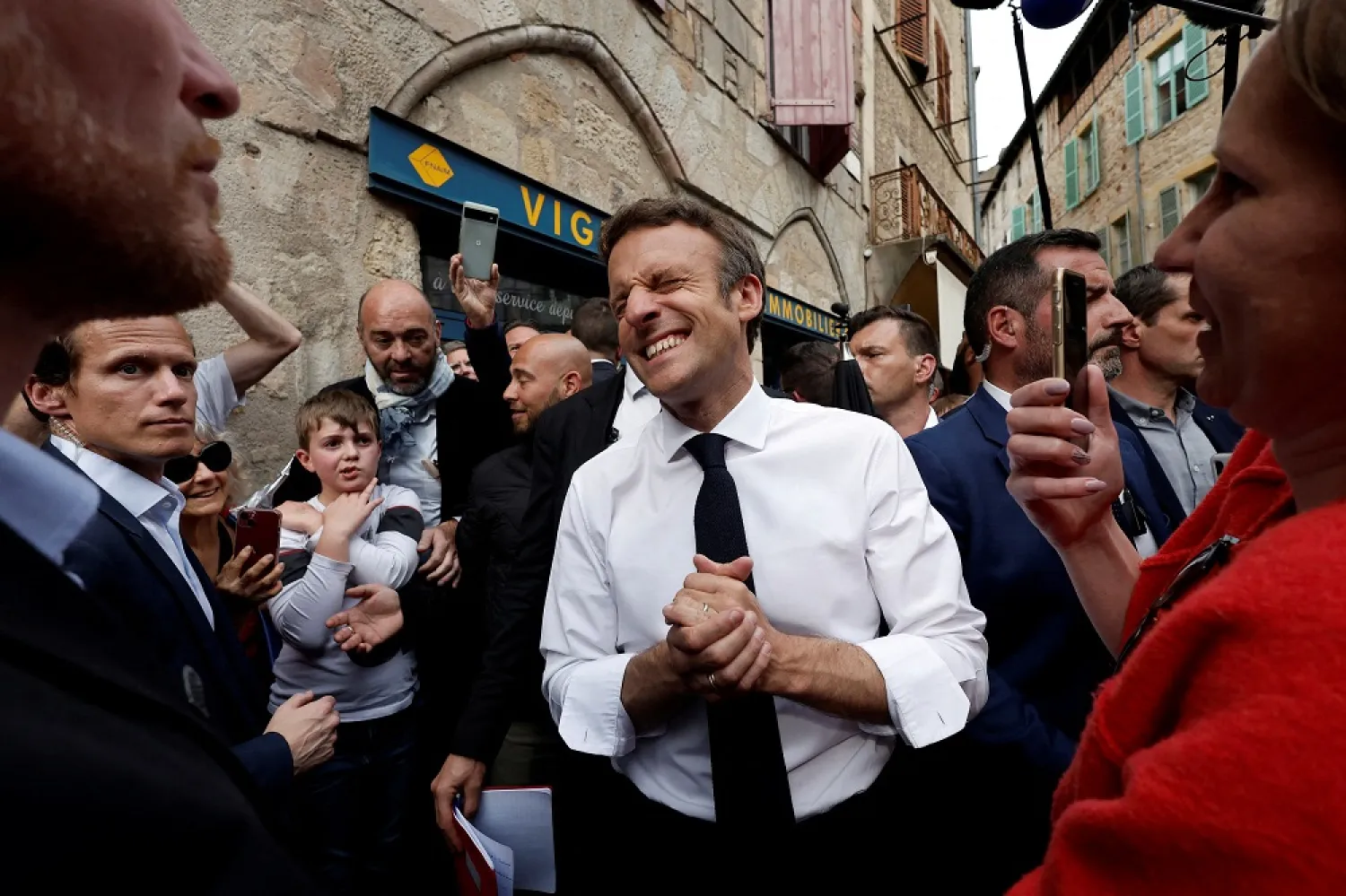
Macron Tells Voters: Now Choose the France You Want

French President Emmanuel Macron, candidate for his re-election in the 2022 French presidential election, reacts as he meets with supporters after a campaign rally in Figeac on the last day of campaigning, ahead of the second round of the presidential election, France, April 22, 2022. (Reuters)
TT

Macron Tells Voters: Now Choose the France You Want

French President Emmanuel Macron, candidate for his re-election in the 2022 French presidential election, reacts as he meets with supporters after a campaign rally in Figeac on the last day of campaigning, ahead of the second round of the presidential election, France, April 22, 2022. (Reuters)

French President Emmanuel Macron and far-right challenger Marine Le Pen made final appeals on Friday to undecided voters weighing fears of what a Le Pen presidency could bring against their anger at Macron's record.

According to the latest surveys for Sunday's run-off, fear may win the day over loathing: Macron the centrist, pro-European incumbent leads his anti-immigration, euroskeptic challenger by 10-14 points, well outside margins of error.

But the fact that nearly three in 10 voters say they will not vote or have not made up their minds means a surprise Le Pen win similar to events such as Brexit and the election of Donald Trump as US president cannot entirely be ruled out.

Wrapping up his campaign in the postcard-pretty medieval village of Figeac in southern France, Macron told voters that Sunday was no less than a plebiscite on the country's future.

"April 24 will be a referendum for or against Europe - we want Europe," he said. "April 24 will be a referendum for or against a secular, united, indivisible France ... we are for."

Surveys by France's leading pollsters published on Thursday and Friday showed Macron's score was either stable or slightly rising to reach between 55.5% and 57.5%.

But they also put turnout at between 72% and 74%, which would be the lowest for a presidential run-off since 1969.

"There is a risk that all of a sudden a section of the electorate wakes up which we haven't been able to measure," Jean-Daniel Levy of Harris Interactive polling told Reuters.

"But the risk seems limited because this is a two-round system," he said, contrasting that to the shocks of Brexit and Trump's victory produced by single-round votes.

In the central city of Auxerre - which over the years has been an accurate bellwether of presidential outcomes - some voters such as Marc Venner, a retired telecoms worker, were rallying to Macron, albeit without enthusiasm.

"Our democratic and institutional system is on its last legs. No candidate can tackle the real problems," Venner said. "We are a de-industrialized country, a country in decline."

Ghislaine Madalie, a hairdresser with family roots in Morocco, said she would switch to Macron on Sunday after voting for far-left Jean-Luc Melenchon in the first round. But she said some of her clients would vote Le Pen as an anti-Macron protest.

"I find that disastrous because she is racist," said Madalie, 36. "I am anxious, for me and for my children. I don’t understand this harassment (of Muslims), I don’t understand what she has against veiled women."

Bottom of the pile
Le Pen, whose policies include a ban on Muslim headscarves in public, giving French nationals priority on jobs and benefits, and limiting Europe's rules on cross-border travel, says Macron embodies an elitism that has failed ordinary people.

That resonates for many on the streets of the former industrial north of France, a region which includes many Le Pen strongholds and where she has chosen to conclude her campaign.

"The working class like us is always at the bottom of the pile," long-standing Le Pen voter Marcel Bail, 65, told Reuters at a motorway service station in the town of Roye, where Le Pen had lunch on Thursday with truck drivers.

It was the same message on Friday among supporters who turned out to see her in the coastal town of Etaples.

"I have 1,300 euros a month - after rent, heating and petrol that's 400 euros," said gardener Pascal Blondel, 52. "Since Macron got in, we don't eat lunch ... Everything costs more."

Despite one of the world's most generous welfare systems, massive support for French households during the pandemic and fuel bill caps to offset rising energy prices, the cost of living emerged as the top campaign issue of the election.

Even if data shows that all but the poorest 5% of households are better off than five years ago, analysts say the fact that purchasing power has stagnated over a decade may have left an entrenched feeling that people cannot get ahead.

This has combined with Macron's sometimes high-handed leadership style and a perception among many left-leaning voters that he quickly shifted to economically liberal policies soon after being elected, alienating a whole section of the public.

"He does not like the French," Le Pen told Europe 1 radio on Friday, accusing him of disdain towards her and voters in Wednesday's TV debate and saying he lacked the straightforward common sense she had as a mother of three.


Le Pen Says France Will No Longer Aid Ukraine ‘Financially’ if Elected

Marine Le Pen (C), the far-right National Rally (RN) party's candidate for the 2027 French presidential election, visits the "Made in France" fair at the Porte de Versailles exhibition center in Paris, France, 13 November 2026. (EPA)
TT

Le Pen Says France Will No Longer Aid Ukraine ‘Financially’ if Elected

Marine Le Pen (C), the far-right National Rally (RN) party's candidate for the 2027 French presidential election, visits the "Made in France" fair at the Porte de Versailles exhibition center in Paris, France, 13 November 2026. (EPA)

Marine Le Pen on Monday said that France would provide no further financial aid to Ukraine if she is elected president next year, after a meeting with Kyiv's ambassador in Paris.

"The state of France's public finances would no longer allow the country to provide financial assistance to Ukraine in the coming months," Le Pen said in a statement, while insisting France would honor existing commitments, including toward a 90-billion-euro ($100-billion) European Union loan.

Le Pen is currently ahead in polls in the race to succeed President Emmanuel Macron next year, as the war sparked by Russia's 2022 full-scale invasion of Ukraine grinds towards its fifth anniversary.

She has faced criticism over past links to Russia, which included a 2017 meeting in the Kremlin with President Vladimir Putin and her party taking a loan from a Russian bank that it paid off in full in 2023.

But she has opposed the invasion and, at her talks in Paris with Ukrainian ambassador Vadym Omelchenko, Le Pen made clear her "unwavering support for Ukraine since the beginning of the conflict".

The statement said the talks -- the first such between Le Pen and the Ukrainian ambassador -- were "cordial".

While financial aid would be cut, Le Pen told the ambassador that "France would continue to support Ukraine through donations of equipment, humanitarian aid and much more active diplomacy".

The statement said there was a "frank discussion" on the future of the conflict, with Le Pen stressing that "the pursuit of peace -- though a difficult goal to achieve -- must remain a priority for all".

She also asked the ambassador to tell President Volodymyr Zelensky she is ready to meet in "either Paris or Brussels". However, there was no mention of the candidate making the journey to Kyiv after Zelensky invited her to visit the Ukrainian capital.

Le Pen's opponents have expressed alarm that by emphasizing the importance of ending the war swiftly, she could force Ukraine to capitulate on unfavorable terms.

"If Russia imposes its will on a European nation through brutality, all of Europe is weakened," Macron wrote on Facebook at the weekend.

Taking aim at Le Pen, he said: "Let us be clear: those who seek to limit the resources available to Ukraine are, in effect, pushing for an unjust peace -- one that would leave Ukraine permanently vulnerable, and, by extension, leave Europe vulnerable as well."


Trump Says He Might Meet with North Korea’s Kim Jong Un in China

US President Donald Trump and North Korean leader Kim Jong Un shake hands before their one-on-one chat during the second US-North Korea summit at the Metropole Hotel in Hanoi, Vietnam February 27, 2019. (Reuters)
TT

Trump Says He Might Meet with North Korea’s Kim Jong Un in China

US President Donald Trump and North Korean leader Kim Jong Un shake hands before their one-on-one chat during the second US-North Korea summit at the Metropole Hotel in Hanoi, Vietnam February 27, 2019. (Reuters)

US President Donald Trump said on Monday he might meet with North Korean leader Kim Jong Un in China this week, an announcement that could dramatically reshape his upcoming trip through East Asia if it occurs.

The president, who met the North Korean leader several times during his 2017-2021 term, including once in the Korean Demilitarized Zone, has previously expressed ‌interest in ‌another meeting during his current term. Senior ‌US ⁠officials, however, have previously ⁠said he has no immediate plans to do so.

Moreover, Trump has repeatedly previewed meetings with Kim that never took place, including during a trip to Asia last year. North Korea, whose mission to the United Nations did not immediately respond to a ⁠request for comment, has publicly indicated it ‌has no intention of ‌meeting with the US president at this time.

Trump told reporters ‌while departing the White House en route to ‌the Philippines and China that any meeting would occur in China, and that the North Korean leader's presence was ultimately up to Chinese President Xi Jinping.

"(Xi) was here a ‌month ago, and we're also going to meet with (Russian) President Putin, and we ⁠may ⁠meet with Kim Jong Un also," Trump said.

"So that'll be good. We have a chance to accomplish a lot."

Trump has indicated he will meet with Putin and Xi during his trip, but US officials and analysts have played down the possibility of a meaningful agreement emerging from any trilateral sit-down.

Among the possible topics of conversation, Trump and others have said, are Russia's invasion of Ukraine, counterproliferation and the war in Iran.


Third US Aircraft Carrier Arrives in Middle East

This US Navy handout photograph released by US Naval Forces Central Command on November 4, 2026, shows the Nimitz-class aircraft carrier USS Theodore Roosevelt (CVN 71) sails alongside Royal Australian Navy Supply-class replenishment oiler HMAS Stalwart (A304). (AFP / NAVCENT Public Affairs / US Navy)
TT

Third US Aircraft Carrier Arrives in Middle East

This US Navy handout photograph released by US Naval Forces Central Command on November 4, 2026, shows the Nimitz-class aircraft carrier USS Theodore Roosevelt (CVN 71) sails alongside Royal Australian Navy Supply-class replenishment oiler HMAS Stalwart (A304). (AFP / NAVCENT Public Affairs / US Navy)

The USS Theodore Roosevelt aircraft carrier arrived in the Middle East on Sunday, media reports said, bringing the number of American carrier strike groups in the region to three.

The deployment, which was reported by the National News and Axios journalist Barak Ravid, comes as fighting reignites in the region, with Iran claiming a drone attack on Bahrain on Sunday, ending a lull in strikes in the war.

Iran also fired drones at Bahrain on Friday -- the first strikes since September against countries in the energy-rich Gulf, which has been targeted several times in the conflict that erupted in February.

US President Donald Trump plans to discuss the war at a trilateral meeting with his Chinese and Russian counterparts Xi Jinping and Vladimir Putin this week, an official said Friday.

Months of diplomacy have failed to resolve the war, which began with US-Israeli strikes that killed Iran's supreme leader Ali Khamenei.