Taliban Announce Women Must Cover Faces in Public, Say Burqa Is Best

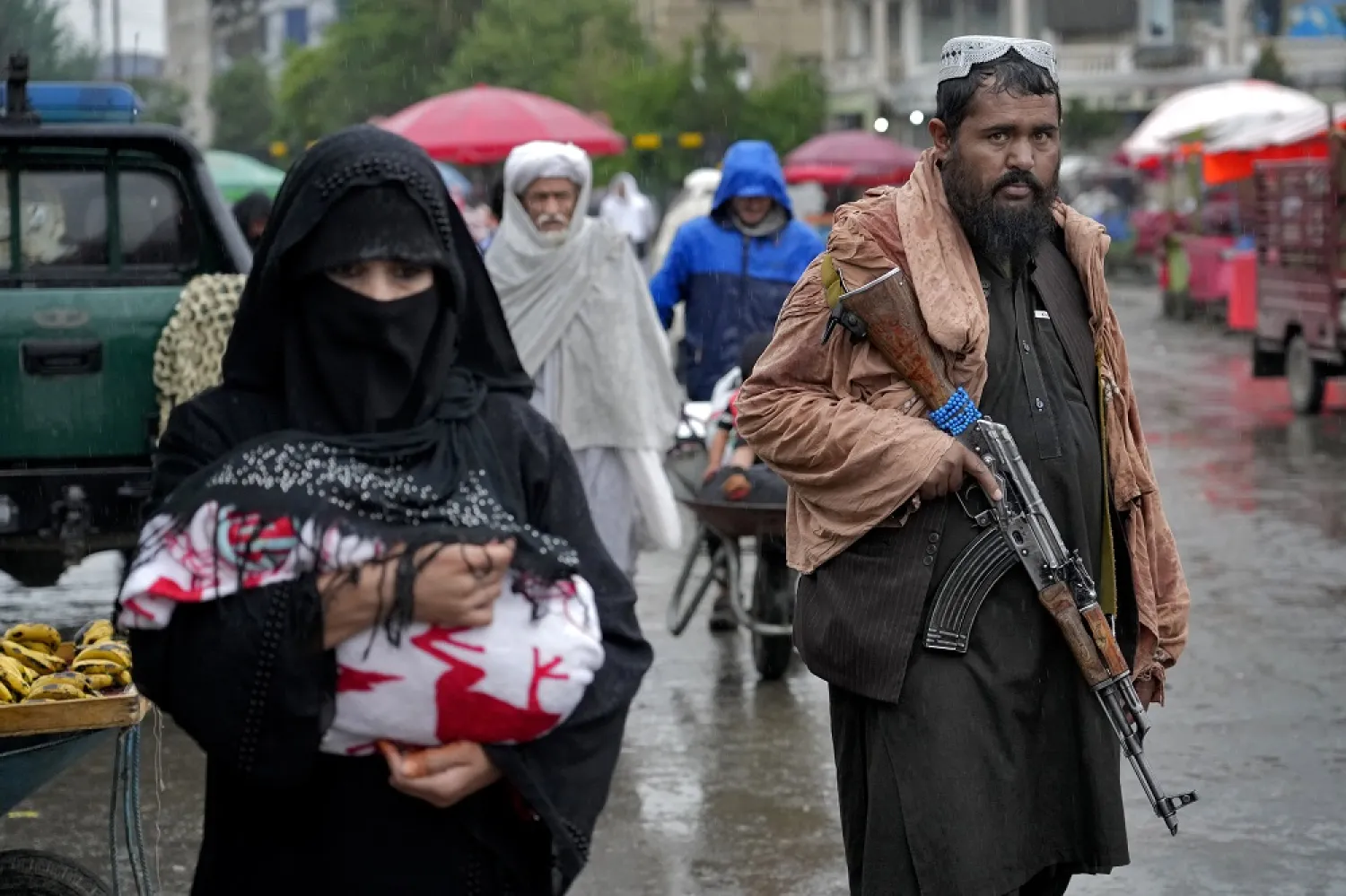
A Taliban fighter stands guard as people walk through the old market, in the city of Kabul, Afghanistan, Tuesday, May 3, 2022. (AP)
TT

Taliban Announce Women Must Cover Faces in Public, Say Burqa Is Best

A Taliban fighter stands guard as people walk through the old market, in the city of Kabul, Afghanistan, Tuesday, May 3, 2022. (AP)

The Taliban on Saturday ruled Afghan women must cover their faces, according to a decree from the group's supreme leader, an escalation of growing restrictions on women in public that is drawing a backlash from the international community and many Afghans.

A spokesman for the Ministry for the Propagation of Virtue and the Prevention of Vice read the decree from the group's supreme leader Hibatullah Akhundzada at a press conference in Kabul, saying that a woman's father or closest male relative would be visited and eventually imprisoned or fired from government jobs if she did not cover her face outside the home.

They added the ideal face covering was the all-encompassing blue burqa, which became a global symbol of the Taliban's previous hardline regime from 1996 until 2001.

Most women in Afghanistan wear a headscarf for religious reasons, but many in urban areas such as Kabul do not cover their faces.

The group has faced intense pushback, led by Western governments but joined by some religious scholars and Islamic countries for their growing limits on women's rights.

A surprise U-turn in March in which the group shuttered girls' high schools on the morning they were due to open drew the ire of the international community and prompted the United States to cancel planned meetings on easing country's financial crisis.

Washington and other nations have cut development aid and enforced strict sanctions on the banking system, since the Taliban took over in August, pushing the country towards economic ruin.

The Taliban has said it has changed since it last ruled when it banned girls' education or women leaving the house without a male relative and women were required to wear cover their faces.

However, in recent months the administration has increased its restrictions on women including rules limiting their travel without a male chaperone and banning men and women from visiting parks at the same time.


UN: Nearly 90 Mn Displaced Facing Severe Climate Risks

Scientists say human-caused climate change has made heavy rain and floods more frequent and severe. AFP
TT

UN: Nearly 90 Mn Displaced Facing Severe Climate Risks

Scientists say human-caused climate change has made heavy rain and floods more frequent and severe. AFP

Three-quarters of the world's displaced people live in countries facing severe exposure to climate-related hazards, the United Nations said Friday, calling for urgent action to protect them.

Days before the COP31 climate conference in Türkiye, a UN refugee agency report said nearly 90 million refugees and other forcibly displaced people faced severe risks linked to a warming planet.

"Refugees face a double injustice," Anton Leis Garcia, UNHCR's assistant high commissioner for operations, said in a statement.

"Forced to flee conflicts they did not cause, they are now on the frontlines of a climate crisis they have contributed least to."

People forced to flee conflict, violence and persecution find themselves in places grappling with severe droughts, deadly floods and extreme heat, the organization pointed out.

Climate change was also increasingly threatening the prospect of lasting solutions for displaced people, UNHCR said.

It said more than two-thirds of refugees who returned home during the first half of this year went back to countries highly vulnerable to climate hazards.

In Syria, where nearly four million displaced people have recently returned, declining groundwater and climate shocks were threatening recovery, the agency said.

It mentioned flooding along the Euphrates River last May that damaged homes and displaced thousands once again.

Extreme heat was also a growing threat, it said, cautioning that by 2050, one in three refugee settlements across sub-Saharan Africa could face 100 or more days of dangerous heat each year.

Weather-related disasters are meanwhile spurring even more displacement inside countries, causing more than 255 million internal displacements worldwide over the past decade, UNHCR said.

That amounts to 70,000 each day, it pointed out.

This year's exceptionally strong El Nino was expected to cause even more displacement.

In East Africa, forecasts indicate that severe flooding linked with the weather phenomenon could displace up to three million people across Somalia, Kenya, South Sudan and Uganda by the end of 2026.

"For millions, climate change is not a distant threat. It is destroying shelters, undermining livelihoods and putting their hopes of rebuilding their lives at risk," Garcia said.

UNHCR said only 10 percent of global climate finance goes to fragile and conflict-affected countries hosting large populations of climate-exposed displaced people.

The organization said that during COP31 it would call on governments and climate finance institutions to include refugees and other displaced populations in national climate plans and financing mechanisms.

"We cannot allow those who have already lost so much to be left behind in global climate action," Garcia said.


Trump Administration Held Talks with Iran on Deporting Iranians During War

Tehran's Azadi sports complex bombed at the start of the US-Israeli war with Iran (EPA)
TT

Trump Administration Held Talks with Iran on Deporting Iranians During War

Tehran's Azadi sports complex bombed at the start of the US-Israeli war with Iran (EPA)

US President Donald Trump’s administration held secret talks with Iran on deporting Iranians, court documents obtained by The Associated Press show.

The court documents unsealed Thursday show the Republican administration as recently as mid-October said it had plans to deport the Iranians through an unnamed third country, although they did not specify when that would be carried out.

The judge in the case ordered the government to give the court 24-hour notice of any finalized plans to deport Iranians to Iran or to any other country and five days’ written notice before any such deportation is carried out.

A legal group representing Iranians held by Immigration and Customs Enforcement said at least a dozen Iranian detainees had been notified over the past week that they were being deported to Iran, with some told it could be as soon as this coming Sunday.

The Iranian American Legal Defense Fund said Thursday the Iranian detainees were contacted by the Iranian Interest Section, an Iranian representative office in the Pakistani Embassy in Washington that handles consular affairs, in the past week and notified of an upcoming deportation flight to Iran through Pakistan. Some had also been notified by DHS officials of the upcoming deportation.

One of those detainees attempted suicide once he learned he might be returned to Iran, according to Yasmine Chubin, the executive director of the organization. He was one of two people who were subsequently moved across state lines to a detention center where detainees are often sent immediately before a removal.

None of the detainees who have been contacted have been provided any information in writing from immigration authorities, the legal group said.

“Some of those same asylum applicants, and others who could face the same death, are being sent back — all against a backdrop of further and intensifying US bombing of Iran,” Chubin said. “This flight must be stopped.”

Activists abroad have expressed concern about deportees returning to Iran, whose theocracy has been cracking down on intellectuals and where the government vociferously cracks down on any dissent.

The lawsuit on the Iranian asylum seekers alleges the Trump administration’s immigration agencies have been sharing confidential information about Iranian asylum seekers with the Iranian government, violating national immigration regulations and endangering countless Iranians, court filings state.

The lawsuit depicts a coordinated campaign between the US and Iranian governments to identify Iranians in ICE custody and pressure them to return to Iran — a marked departure from decades of diplomatic hostility between the two governments.

DHS has denied that it is sharing asylum application records with the Iranian government. The judge overseeing the case said it was possible the government shared the confidential information, but appeared skeptical of claims that have arisen in the lawsuit that DHS has a coordinated policy of sharing those records.

In addition, hundreds of emails exchanged between US immigration officials exposed how the two countries worked together to arrange for more than 100 Iranians to be flown back to Iran on three immigration flights in September and December 2025 and January 2026.


Trump Makes Oval Office a National Monument

US President Donald Trump delivers remarks during an executive order signing ceremony in the Oval Office of the White House in Washington, DC, US, 05 November 2026. (EPA)
TT

Trump Makes Oval Office a National Monument

US President Donald Trump delivers remarks during an executive order signing ceremony in the Oval Office of the White House in Washington, DC, US, 05 November 2026. (EPA)

US President Donald Trump signed an order Thursday designating the Oval Office as a national monument, redoubling his focus on beautifying the White House despite a brutal midterms defeat for his Republican Party.

Critics accused Trump of ignoring voter concerns over the Iran war and affordability ahead of Tuesday's midterm elections and obsessing instead on multiple construction and renovation projects in the capital.

The day after Democrats won the House of Representatives and Senate, Trump virtually ignored the result and showed off construction work on his new White House ballroom instead.

This time Trump’s focus was on the Oval Office, which he has bedecked with gold ornaments since returning to power last year, and the neighboring Cabinet Room.

He said the proclamation would “make it impossible for anybody ever to destroy this incredible space” and prevent future presidents from carrying out any building work on the two rooms.

“It won't be able to be taken down, destroyed, touched, or anything else. It's called actually a national monument,” Trump told reporters.

The move however fueled speculation that Trump could be preparing further work on the West Wing, after several hints that he could move reporters out of the famed briefing room located near the Oval.

Trump's signing of the order in the Oval Office was not broadcast on major US networks as he has banned CNN from the rotating “pool” of television outlets that cover White House events.

Trump did give one nod to the midterms, with a red baseball cap with the word “veto” on the Resolute Desk in front of him.

The 80-year-old Republican has threatened to use his presidential powers to block Democratic legislation, although saying he was also ready to work with the rival party.