

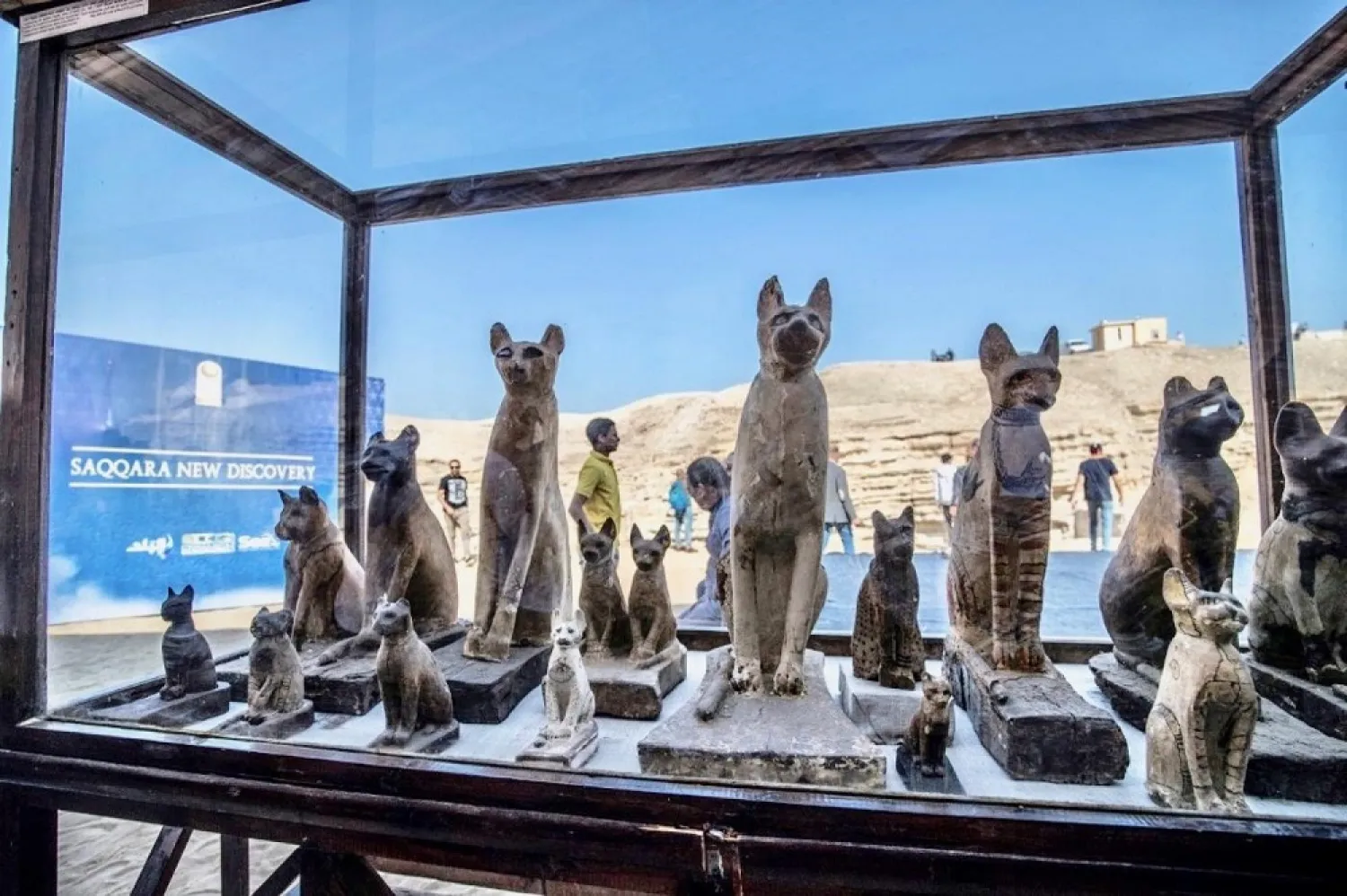

Luxor’s Mummification Museum Documents 25 Years of Pharaonic Secrets

Statues of cats discovered by Egyptian archaeological team in Giza's Saqqara necropolis, south of Cairo, are displayed. (AFP)
TT

Luxor’s Mummification Museum Documents 25 Years of Pharaonic Secrets

Statues of cats discovered by Egyptian archaeological team in Giza's Saqqara necropolis, south of Cairo, are displayed. (AFP)

On the eastern shore of the Nile River and the northern side of the Luxor Temple, stands the Mummification Museum, one of the largest specialized museums in Egypt that explores the land of the dead and the golden rays of the sun.

The museum exclusively documents the mysteries of embalming – one of most valuable secrets of ancient Egypt. It is celebrating its 25th anniversary by offering free workshops for visitors to allow them to learn about its history, archeological acquisitions, and boost their touristic and archeological knowledge. The workshops provide presentations that simulate the embalming process and tools in ancient Egypt, coffins, and deities from the other world.

Extending over 2,000 square meters, the Mummification Museum was inaugurated on May 7, 1997. It houses one gallery exhibiting around 73 antiquities providing an inclusive definition of the whole embalming process and explaining the religious value of embalming and the related rituals from the Old Kingdom until the Late Period. It also displays many mummification tools, Canopic jars collection, adorned coffins, amulets, deities’ statues, and funerary drawings.

The museum also exhibits many human mummies, as well as a collection of animal mummies including crocodiles, cats, and fish.

The Mummification Museum is the only museum specialized in documenting the mummification processes in ancient Egypt, said Mohammad Shehata, director general of the museum.

He told Asharq Al-Awsat that “the museum shed lights on the embalming process from death until the end of the burial ceremony, which spanned 70 days.”

“The priests who led the embalming processes were carefully selected based on specific qualifications, including good manners, and good medical and anatomical skills. They carried out embalming processes in the embalming house, or what the ancient Egyptians used to name ‘the beautiful house’, inside the Karnak Temple, where they used to undress the dead before purifying him with the water of the temple’s sacred lake, remove his insides, and cover his body with Natron salt,” explained Shehata.

The brain was extracted from the nasal cavities after breaking the ethmoid bone using a screwdriver-like tool and a spatula, while leaving the heart due to religious beliefs.

Shehata acknowledged the negative impact the coronavirus pandemic and global inflation had on tourism in Luxor. He added that the inauguration of the Avenues of the Sphinxes helped boost tourism for a few months before the eruption of the Russian war on Ukraine.

Among the prominent exhibited antiquities at the museum is the mummy of priest Masherti, son of King Pinedjem from the 21st Dynasty, who served as a senior Priest of Amun in Thebes and an army commander.

The museum also displays a column known as the "spine of God Osiris", mummy cases of High Priest of Amun from the 21st Dynasty, two wooden statues of deities Isis and Nephthys, and wooden boxes used inside tombs to preserve statues.



Orange Frog Size of Pencil Tip Discovered in Brazil Forests

Tiny toadlet measuring less than 14 mm in length (Luiz Fernando Ribeiro)
TT

Orange Frog Size of Pencil Tip Discovered in Brazil Forests

Tiny toadlet measuring less than 14 mm in length (Luiz Fernando Ribeiro)

Scientists have found a new orange toad species in Brazil that is so small it fits on the tip of a pencil, highlighting the need for more conservation efforts in the country’s mountainous forest areas.

The toad species, measuring less than 14mm, was found deep in the cloud forests of the Serra do Quiriri mountain range in the southern Brazilian Atlantic Forest, according to the Independent.

Researchers have named the new species Brachycephalus lulai in honor of Brazil’s president Luiz Inacio Lula da Silva.

Cloud forests typically are found at altitudes between 1,000 and 2,500m and a layer of clouds at the canopy level is common year-round.

Until now, around two million animal species have been discovered in the world, with estimates suggesting that the Earth is home to around eight million of them, meaning at least six million remain yet undiscovered.

For decades, researchers have been combing the southern Brazilian Atlantic Forest to find and catalogue new species.

The region is known to be home to micro-endemic frogs and toads that are only found in small, restricted areas of the forest and are vulnerable to extinction.

In the latest study, researchers document the discovery of tiny frogs with a striking orange body and distinctive green and brown freckles.

The males were found to measure between 9 and 11mm, and females between 11 and 14mm.

They are among the smallest four-legged animals on Earth, capable of fitting fully on the tip of a pencil, researchers say.

Scientists identified the new species by its unique mating call, consisting of two short bursts of sound, unlike those of other known Brachycephalus in the area.

Researchers also conducted CT X-ray scans to look at the skeletal structure and DNA analysis to confirm what they had was indeed a new species.

Comparing DNA samples of the toad with those of other species, they found that it is most closely related to two species that live in the Serra do Quiriri.

Following the discovery, scientists immediately called for conservation efforts to protect the toad species and its relatives.

“Through this tribute (the act of naming a new species), we seek to encourage the expansion of conservation initiatives focused on the Atlantic Forest as a whole, and on Brazil's highly endemic miniaturized frogs in particular,” researchers wrote in the study published in the journal PLOS One.

Caption: Tiny toadlet measuring less than 14 mm in length (Luiz Fernando Ribeiro)


'Extremely Exciting': The Ice Cores that Could Help Save Glaciers

A researcher cuts a slice from an ice core sample taken from a glacier in the Pamir mountain range in Tajikistan, at the Hokkaido University Institute of Low Temperature Science, in Sapporo, in northern Japan's Hokkaido prefecture on December 9, 2025. (Photo by GREG BAKER / AFP)
TT

'Extremely Exciting': The Ice Cores that Could Help Save Glaciers

A researcher cuts a slice from an ice core sample taken from a glacier in the Pamir mountain range in Tajikistan, at the Hokkaido University Institute of Low Temperature Science, in Sapporo, in northern Japan's Hokkaido prefecture on December 9, 2025. (Photo by GREG BAKER / AFP)

Dressed in an orange puffer jacket, Japanese scientist Yoshinori Iizuka stepped into a storage freezer to retrieve an ice core he hopes will help experts protect the world's disappearing glaciers.

The fist-sized sample drilled from a mountaintop is part of an ambitious international effort to understand why glaciers in Tajikistan have resisted the rapid melting seen almost everywhere else.

"If we could learn the mechanism behind the increased volume of ice there, then we may be able to apply that to all the other glaciers around the world," potentially even helping revive them, said Iizuka, a professor at Hokkaido University.

"That may be too ambitious a statement. But I hope our study will ultimately help people," he said.

Thousands of glaciers will vanish each year in the coming decades, leaving only a fraction standing by the end of the century unless global warming is curbed, a study published in the journal Nature Climate Change showed Monday.

Earlier this year, AFP exclusively accompanied Iizuka and other scientists through harsh conditions to a site at an altitude of 5,810 meters (about 19,000 feet) on the Kon-Chukurbashi ice cap in the Pamir Mountains.

The area is the only mountainous region on the planet where glaciers have not only resisted melting, but even slightly grown, a phenomenon called the "Pamir-Karakoram anomaly.”

The team drilled two ice columns approximately 105 meters (328 feet) long out of the glacier.

One is being stored in an underground sanctuary in Antarctica belonging to the Ice Memory Foundation, which supported the Tajikistan expedition along with the Swiss Polar Institute.

The other was shipped to Iizuka's facility, the Institute of Low Temperature Science at Hokkaido University in Sapporo, where the team is hunting clues on why precipitation in the region increased over the last century, and how the glacier has resisted melting.

Some link the anomaly to the area's cold climate or even increased use of agricultural water in Pakistan that creates more vapor.

But the ice cores are the first opportunity to examine the anomaly scientifically.
"Information from the past is crucial," said Iizuka.

"By understanding the causes behind the continuous build-up of snow from the past to the present, we can clarify what will happen going forward and why the ice has grown."

Since the samples arrived in November, his team has worked in freezing storage facilities to log the density, alignment of snow grains, and the structure of ice layers.

In December, when AFP visited, the scientists were kitted out like polar explorers to cut and shave ice samples in the comparatively balmy minus 20C of their lab.

The samples can tell stories about weather conditions going back decades, or even centuries.

A layer of clear ice indicates a warm period when the glacier melted and then refroze, while a low-density layer suggests packed snow, rather than ice, which can help estimate precipitation.

Brittle samples with cracks, meanwhile, indicate snowfall on half-melted layers that then refroze.

And other clues can reveal more information -- volcanic materials like sulfate ions can serve as time markers, while water isotopes can reveal temperatures.

The scientists hope that the samples contain material dating back 10,000 years or more, though much of the glacier melted during a warm spell around 6,000 years ago.

Ancient ice would help scientists answer questions such as "what kind of snow was falling in this region 10,000 years ago? What was in it?" Iizuka said.

"We can study how many and what kinds of fine particles were suspended in the atmosphere during that ice age," he added.

"I really hope there is ancient ice."

For now, the work proceeds slowly and carefully, with team members like graduate student Sora Yaginuma carefully slicing samples apart.

"An ice core is an extremely valuable sample and unique," said Yaginuma.

"From that single ice core, we perform a variety of analyses, both chemical and physical."

The team hopes to publish its first findings next year and will be doing "lots of trial-and-error" work to reconstruct past climate conditions, Iizuka said.

The analysis in Hokkaido will uncover only some of what the ice has to share, and with the other samples preserved in Antarctica, there will be opportunities for more research.

For example, he said, scientists could look for clues about how mining in the region historically affected the area's air quality, temperature and precipitation.

"We can learn how the Earth's environment has changed in response to human activities," Iizuka said.

With so many secrets yet to learn, the work is "extremely exciting," he added.


Jane Austen Fans Celebrate the Author’s 250th Birthday in Britain and Beyond

One of the new British 10 pound notes is posed for photographs outside the Bank of England in the City of London, Thursday, Sept. 14, 2017. (AP)
TT

Jane Austen Fans Celebrate the Author’s 250th Birthday in Britain and Beyond

One of the new British 10 pound notes is posed for photographs outside the Bank of England in the City of London, Thursday, Sept. 14, 2017. (AP)

Fans of Jane Austen celebrated the acclaimed author's 250th birthday on Tuesday with a church service in her home village, festive visits to her house — and a virtual party for those paying tribute from afar.

Thousands of enthusiasts around the world have already taken part in a yearlong celebration of one of English literature’s greats, who penned “Pride and Prejudice," “Sense and Sensibility” and other beloved novels.

On Tuesday — to mark 250 years since she was born on Dec. 16, 1775 — Jane Austen’s House, in the southern English village of Chawton, hosted talks, tours and performances for dozens of visitors, with celebrations concluding with an online party for fans from all over the world.

“Regency dress strongly encouraged,” organizers said, adding that more than 500 people had signed up for the Zoom party.

The cottage, now a museum with Austen artifacts, was where the author lived for the last years of her life and where she wrote all six of her novels.

A church service featuring music and readings is held in Steventon, the rural village where she was born.

Fans, who call themselves “Janeites," have marked the anniversary year with Regency balls and festivals staged in the UK, US and beyond.

At the weekend, the city of Bath, where Austen lived for five years, hosted the Yuletide Jane Austen Birthday Ball, the finale of many grand costumed events held there this year.