

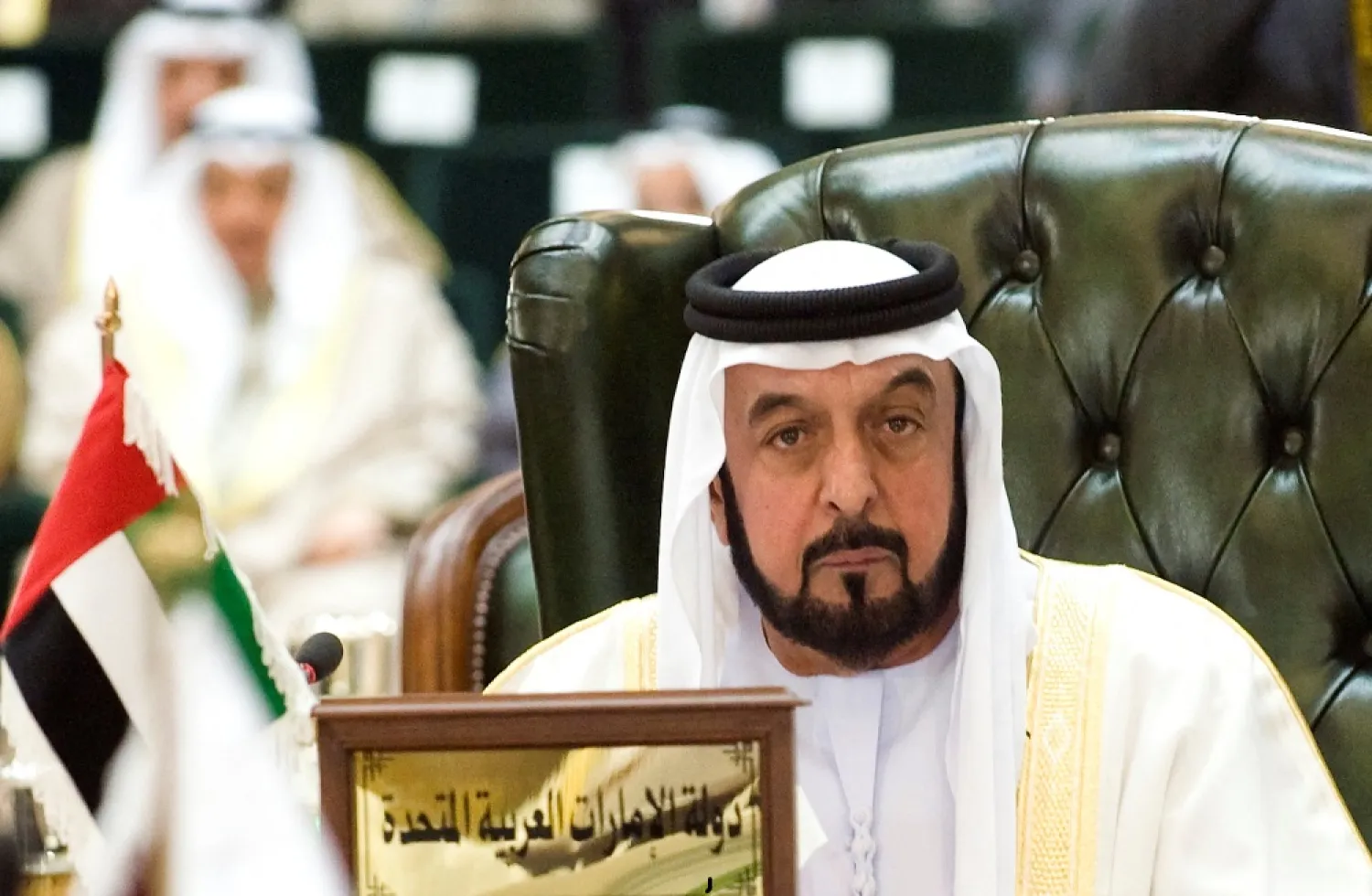

UAE Announces Death of President Sheikh Khalifa bin Zayed

United Arab Emirates President Sheikh Khalifa bin Zayed al-Nahyan listens to closing remarks during the closing ceremony of the Gulf Cooperation Council (GCC) summit in Kuwait's Bayan Palace December 15, 2009. (Reuters)
TT

UAE Announces Death of President Sheikh Khalifa bin Zayed

United Arab Emirates President Sheikh Khalifa bin Zayed al-Nahyan listens to closing remarks during the closing ceremony of the Gulf Cooperation Council (GCC) summit in Kuwait's Bayan Palace December 15, 2009. (Reuters)

United Arab Emirates President Sheikh Khalifa bin Zayed Al Nahyan has died, state news agency WAM reported on Friday. He was 73.

The UAE’s Ministry of Presidential Affairs announced a 40-day period of mourning and a three-day suspension of work in all ministries and the private sector beginning Friday, including flags to be flown at half-staff.

Sheikh Khalifa suffered a stroke and underwent emergency in 2014. He has largely been out of public sight ever since.

Sheikh Khalifa succeeded his father and the UAE's founder Sheikh Zayed in 2004.

He used Abu Dhabi’s oil wealth to attract cultural and academic centers, such as branches of the Louvre museum and satellite campuses of New York University and the Sorbonne. He also presided over efforts to move the OPEC country beyond its reliance on petrodollars with investments in renewable energy research, including plans for a futuristic low-carbon desert city known as Masdar.

In 2003, he called for the creation of a new airline, Etihad Airways. In 2007, he made a major gift to the Johns Hopkins Medicine complex in Baltimore.

Abu Dhabi’s big spending overseas during Sheikh Khalifa’s rule also helped push the emirate, which controls the bulk of the UAE’s oil reserves, out from Dubai’s shadow.

Sheikh Khalifa helped boost the UAE’s regional profile with relief missions to Pakistan after devastating floods.

His name is perhaps most familiar around the world for its connection to the world’s tallest building, a nearly half-mile (828-meter) glass-and-steel spire in Dubai.

Sheikh Khalifa took over as the UAE’s president and ruler of Abu Dhabi in November 2004 following the death his father, Sheikh Zayed bin Sultan Al Nahyan, who is widely revered by Emiratis as the country’s founding father.

Sheikh Khalifa was born in 1948 in the inland oasis of Al Ain, near the border with the sultanate of Oman, and named after his great grandfather, Sheikh Khalifa bin Shakhbout.

In 1969, while the area was still a British protectorate, Sheikh Khalifa was named as Abu Dhabi prime minister and chairman of the emirate’s Department of Defense, which later became the core of the UAE’s armed forces. After independence in 1971, he became defense minister along with other roles.

Like many in the Gulf, he was passionate about the traditional sport of falconry and was said to enjoy fishing. He was also passionate about poetry.



Saudi Arabia Urges Yemen’s STC to 'Urgently’ Withdraw from Hadhramaut and al-Mahra

Saudi Arabia Urges Yemen’s STC to 'Urgently’ Withdraw from Hadhramaut and al-Mahra
TT

Saudi Arabia Urges Yemen’s STC to 'Urgently’ Withdraw from Hadhramaut and al-Mahra

Saudi Arabia Urges Yemen’s STC to 'Urgently’ Withdraw from Hadhramaut and al-Mahra

The Saudi Ministry of Foreign Affairs issued a statement on Thursday expressing concern over the recent military movements witnessed in the governorates of Hadhramaut and al-Mahra.

It noted that “the actions carried out by the Southern Transitional Council were taken unilaterally, without the approval of the Presidential Leadership Council or coordination with the coalition leadership”.

The Kingdom described the moves as an “unjustified escalation” that has harmed the interests of the Yemeni people across all segments of society, undermined the Southern cause, and weakened the coalition’s efforts.

The Kingdom further emphasized that, in recent months, it has focused on maintaining unity and has undertaken intensive efforts to reach peaceful solutions to address the situation in the two governorates, as part of its ongoing endeavors to restore stability.

The statement added that these efforts were “coordinated with the brethren United Arab Emirates, the Chairman of the Presidential Leadership Council, and the Yemeni government to contain the situation”.

It said that a “joint Saudi–Emirati military team was dispatched to coordinate with the Southern Transitional Council in Aden, ensuring the withdrawal of its forces from the two governorates and the handover of camps to the National Shield Forces and local authorities under the coalition’s supervision”.

The Foreign Ministry stressed that efforts are still underway to restore the situation to its previous state, expressing the Kingdom’s hope that the public interest will prevail and that the Southern Transitional Council will take the initiative to de-escalate tensions and urgently and peacefully withdraw its forces from the two governorates.

Saudi Arabia also underscored the importance of cooperation among all Yemeni forces and components, exercising restraint, and avoiding actions that could undermine security and stability.

The Kingdom reiterated its position that the “Southern cause is a just issue with historical and social dimensions and can only be resolved through dialogue that brings all Yemeni parties together at one table, within a comprehensive political process that ensures a lasting solution in Yemen”.

The statement concluded by affirming the Kingdom’s “support for the Chairman and members of the Presidential Leadership Council and the Yemeni government, in a manner that achieves security, stability, development, and peace in the sisterly Republic of Yemen”.


MWL Condemns Attack Targeting Pakistani Police

The Muslim World League (MWL) logo
TT

MWL Condemns Attack Targeting Pakistani Police

The Muslim World League (MWL) logo

The Muslim World League (MWL) strongly condemned the attack targeting police personnel in Pakistan’s Khyber Pakhtunkhwa Province, the Saudi Press Agency reported on Thursday.

In a statement issued by its General Secretariat, MWL Secretary-General and Chairman of the Organization of Muslim Scholars, Sheikh Mohammed Al-Issa, affirmed the League’s solidarity with the Islamic Republic of Pakistan in the face of all threats to its security and stability. He reiterated the MWL’s firm rejection and condemnation of violence and terrorism in all their forms and under any pretext.

He also extended his sincere condolences and sympathies to the families of the victims and to the Pakistani people.


Sultan of Oman Awards Military Order to Royal Saudi Air Force Commander

Commander of the Royal Saudi Air Force (RSAF) Lieutenant General Prince Turki bin Bandar bin Abdulaziz receives the Military Order of Oman (Second Class). (SPA)
TT

Sultan of Oman Awards Military Order to Royal Saudi Air Force Commander

Commander of the Royal Saudi Air Force (RSAF) Lieutenant General Prince Turki bin Bandar bin Abdulaziz receives the Military Order of Oman (Second Class). (SPA)

Oman’s Sultan Haitham bin Tarik awarded on Wednesday the Military Order of Oman (Second Class) to Commander of the Royal Saudi Air Force (RSAF) Lieutenant General Prince Turki bin Bandar bin Abdulaziz in recognition of his efforts and contributions to strengthening military cooperation between the two countries.

The order was presented to the RSAF commander by Omani Deputy Prime Minister for Defense Affairs Shihab bin Tarik Al Said, in the presence of Commander of the Royal Air Force of Oman (RAFO) Air Vice Marshal Khamis Al Ghafri, Saudi Ambassador to Oman Ibrahim bin Saad bin Bishan, and the accompanying delegation.

During the visit, the RSAF commander also met with Minister of the Royal Office of Oman General Sultan bin Mohammed Al Nomani for talks on issues of mutual interest.

Prince Turki bin Bandar bin Abdulaziz arrived in Oman on Tuesday on an official visit during which he met with the commander of RAFO. The discussions addressed issues of common interest, particularly in the field of joint training and exercises.

The visit included a tour of the Air Center for Specialized Training, where the delegation reviewed the advanced capabilities on display, reflecting the level of development achieved by the Royal Air Force of Oman.