


Tunis, Cairo Seek Doubling Trade Exchange

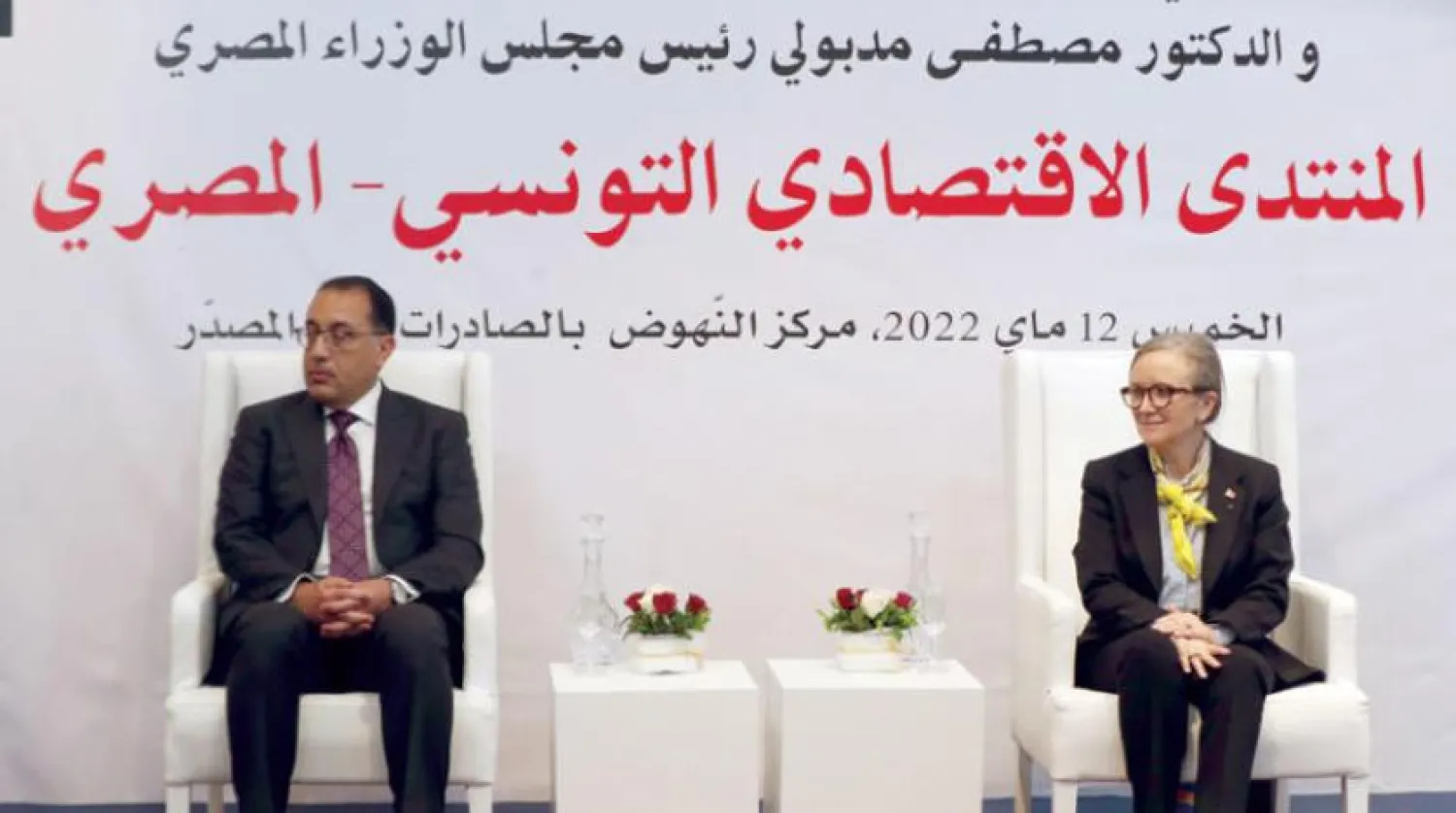
Tunisian Prime Minister Najla Bouden and her Egyptian counterpart Mostafa Madbouly during the activities of the Tunisian- Egyptian Economic Forum. (EPA)
TT

Tunis, Cairo Seek Doubling Trade Exchange

Tunisian Prime Minister Najla Bouden and her Egyptian counterpart Mostafa Madbouly during the activities of the Tunisian- Egyptian Economic Forum. (EPA)

The Tunisian-Egyptian Economic Forum kicked off on Thursday at the headquarters of the Export Promotion Center in the Tunisian capital.

Tunis and Cairo expressed common desire to value the major available capabilities and opportunities to increase the volume of trade exchange, diversify its base and develop the partnership to live up to the aspirations and goals of the two countries.

The event was held under the auspices of Tunisian Prime Minister Najla Bouden and her counterpart Mostafa Madbouly, who is currently on an official visit to Tunis.

Trade exchange between the two countries dropped to $330 million in 2021, data released in the forum showed.

The total investments were estimated at $570 million by the end of 2020, which were allocated to finance 42 economic projects.

These figures are below the expectations, given the huge investment opportunities available between the two countries.

Bouden called for unifying efforts and working together to further enhance the existing cooperation.

She underscored the importance of the legal framework that regulates the bilateral economic relations, noting that it is one of the best frameworks both countries have concluded with their economic partners.

The PM further underlined both governments’ key role to improve the business environment, facilitate the movement of economic actors, the flow of goods, and the rapid intervention to overcome all obstacles that might hinder the access of commodities and products to the Egyptian and Tunisian markets.

Madbouly, for his part, hailed the key role played by the forum and the Egyptian-Tunisian Higher Committee meetings to integrate public and private sector efforts and raise the level of bilateral ties in the fields of trade exchange, cooperation and investment partnership in all economic activities.

He called for establishing an immediate mechanism to issue visas for Tunisian businessmen, affirming that there are no restrictions on their movement between Tunisia and Egypt.

Tunisian businessmen are welcomed in Egypt, Madbouly stressed.

He pointed out that trade exchange indicators have dropped during the past two years due to the global health crisis, stressing the need to double the figures soon.



World Bank Sees Saudi Budget Deficit Halving, Current Account Surplus of 3.3% in 2026

 Riyadh, Saudi Arabia (Reuters)
Riyadh, Saudi Arabia (Reuters)
TT

World Bank Sees Saudi Budget Deficit Halving, Current Account Surplus of 3.3% in 2026

 Riyadh, Saudi Arabia (Reuters)
Riyadh, Saudi Arabia (Reuters)

As regional economies reel from a complex and uncertain geopolitical landscape, with shipping disruptions through the Strait of Hormuz adding pressure, the latest World Bank report points to standout resilience in Saudi Arabia’s economy.

The data show the kingdom on a fiscal consolidation path to strengthen its fiscal position, with the budget deficit set to halve and the current account shifting from deficit to surplus.

April data from the World Bank indicate Saudi Arabia has not only built solid “economic buffers,” but is also leveraging geopolitical pressures to advance structural reforms.

While much of the region faces sharp fiscal strain and negative growth, the kingdom is moving steadily ahead, recording the strongest growth among regional peers and reinforcing its role as a pillar of regional stability.

Despite broad downward revisions, Saudi Arabia remains the region’s top performer. Growth forecasts for the wider region have been cut to 1.8%, while the kingdom is expected to expand by 3.1%.

Current account shifts to a 3.3% surplus

World Bank data point to a shift in Saudi Arabia’s current account. After a projected deficit of 2.7% of GDP in 2025, forecasts for 2026 point to a surplus of 3.3%.

A current account surplus means exports of goods and services exceed imports, strengthening the balance of payments. It also reflects rising net foreign assets and stronger financing capacity, supported by solid export performance and moderate domestic demand.

The shift carries broader weight. Moving from deficit to surplus positions, Saudi Arabia becomes a net lender to the global economy, with oil export revenues, fast-growing non-oil sectors, and returns on foreign investments outpacing spending on imports and services.

Beyond the headline figures, the surplus acts as an external buffer, supporting currency stability and generating strong liquidity flows. This gives financial institutions and sovereign funds greater room to sustain investment in major development projects, while helping shield the economy from disruptions in global supply chains and shipping routes.

Deficit set to halve

Fiscal data show improved expenditure control and revenue growth. The World Bank expects the deficit to narrow from 6.4% of GDP in 2025 to 3.0% in 2026, below the Finance Ministry’s estimate of 3.3%.

The shift reflects tighter fiscal discipline. Despite the cost of regional tensions, the gap between revenue and spending is set to shrink by half in one year.

This reflects effective fiscal policy, including stronger tax collection and public financial management, rising non-oil revenues that reduce reliance on energy price swings, and more efficient public spending focused on high-impact development projects, limiting the need for external borrowing and supporting long-term fiscal balance.

Saudi Arabia leads per capita growth

The April 2026 report also shows a sharp divergence in per capita growth across the region. While countries such as Kuwait (-7.7%) and Qatar (-7.4%) face steep contractions, Saudi Arabia stands out with an expected per capita growth rate of 1.4%.

Inflation remains contained at 2.8%, helping preserve purchasing power despite global increases in energy and shipping costs driven by maritime disruptions. This stability protects the broader economy from imported inflation pressures.


European Development Bank Unveils 5 Bn Euros for War-hit Economies

A Lebanese man walks past destruction at the site of an Israeli airstrike the day before that targeted a building in Beirut on April 9, 2026. (Photo by Ibrahim AMRO / AFP)
TT

European Development Bank Unveils 5 Bn Euros for War-hit Economies

A Lebanese man walks past destruction at the site of an Israeli airstrike the day before that targeted a building in Beirut on April 9, 2026. (Photo by Ibrahim AMRO / AFP)

The European development bank said Thursday it was unlocking five billion euros ($5.9 bn) to help shore up economies hit by the Middle East war.

The European Bank for Reconstruction and Development (EBRD) said it will "deploy EUR5 billion in 2026 in economies impacted by Middle East conflict".

The funds would be focused on Iraq, Jordan, Lebanon, the West Bank and Gaza "and affected neighboring economies" including Egypt, Türkiye, Armenia and Azerbaijan, the bank said in a statement.

"The economic and social impact of the conflict is already being felt across many of the bank's economies in the form of disrupted trade routes, energy and commodity shocks, weakened investor confidence and broader costs to the population," it added.

Established in 1991 to help former Soviet bloc nations embrace free-market economies, the bank later extended its reach to the Middle East and Africa.

"In a time of rising uncertainty, we are stepping up where others may pull back," said EBRD president Odile Renaud Basso.

"We are here to support economies, clients and people in our countries of operation in tough times," she added.

The bank said "the volume of conflict response investment will be demand driven due to the fast-changing nature of the situation".

The funds will provide immediate relief "by supporting economic activity" and "fostering financial sector stabilization".

EBRD will aim to strengthen energy security and aid state-owned enterprises to "ensure the uninterrupted provision of essential goods and services".

On Thursday it had approved "a project to support Lebanon's retail chain," it said, adding it also aimed to safeguard access to jobs, finance and essential services.

Since starting operations in the southern and eastern Mediterranean in 2012, the EBRD has invested more than EUR26.5 billion in 489 projects in the region.

In Türkiye alone, the lender has committed more than 23 billion euros since 2009.


Saudia to Partially Resume Flights To, From Dubai, Abu Dhabi, and Amman on Saturday

One of Saudia’s aircraft (company website)
TT

Saudia to Partially Resume Flights To, From Dubai, Abu Dhabi, and Amman on Saturday

One of Saudia’s aircraft (company website)

Saudia announced on Thursday the partial resumption of its operations to and from Dubai, Abu Dhabi, and Amman starting Saturday, April 11.

In a post on its official account on the social media platform X, the airline said the resumption will be carried out through the operation of exceptional daily flights to and from those destinations.

Saudia advised passengers to check the status of their flights before heading to the airport, noting that further updates will be published through its official channels.