Bolsonaro to Meet Elon Musk in Brazil: Government Sourcehttps://english.aawsat.com/home/article/3655546/bolsonaro-meet-elon-musk-brazil-government-source
Bolsonaro to Meet Elon Musk in Brazil: Government Source
Bolsonaro to Meet Elon Musk in Brazil: Government Source
Brazilian President Jair Bolsonaro is set to meet with billionaire Elon Musk on Friday, according to a government source.
The meeting will be held in Sao Paulo, a source with the Brazilian president's office told AFP, without giving any details on what will be on the agenda.
Earlier, Bolsonaro said that he had planned a private meeting in Sao Paulo "with a very important person who is recognized throughout the world."
"He is coming to offer his help for our Amazon," the president said in his weekly social media broadcast, without naming Musk.
Currently the CEO of both SpaceX and Tesla, Musk is the richest person in the world, with a fortune estimated at $220 billion, according to Forbes magazine.
The entrepreneur attracted worldwide attention when he announced last month that he planned to buy Twitter in a deal worth $44 billion dollars.
The Brazilian government said in November that they were negotiating with SpaceX to secure satellite internet in the Amazon rainforest and to get help in detecting illegal deforestation.
In a bid to provide high-speed internet around the world, especially to underserved areas, SpaceX has launched thousands of its own Starlink satellites orbit, with many more launches already planned.
Security personnel guard trucks carrying aid as they arrive in Rafah, amid the ongoing conflict between Israel and the Palestinian Islamist group Hamas, in the southern Gaza Strip January 17, 2024. (Reuters)
Security personnel guard trucks carrying aid as they arrive in Rafah, amid the ongoing conflict between Israel and the Palestinian Islamist group Hamas, in the southern Gaza Strip January 17, 2024. (Reuters)
As Hamas moves to strike armed gangs operating in areas of the Gaza Strip under Israeli army control, the groups are responding with defiance, stepping up efforts to recruit young men and expand their ranks.
Videos posted on social media show training exercises and other activities, signaling that the gangs remain active despite pressure from Hamas security services.
Platforms affiliated with Hamas security say some members have recently turned themselves in following mediation by families, clans and community leaders. The gangs have not responded to those statements. Instead, they occasionally broadcast footage announcing new recruits.
Among the most prominent was Hamza Mahra, a Hamas activist who appeared weeks ago in a video released by the Shawqi Abu Nasira gang, which operates north of Khan Younis and east of Deir al-Balah.
Mahra’s appearance has raised questions about how these groups recruit members inside the enclave.
Field sources and others within the security apparatus of a Palestinian armed faction in Gaza told Asharq Al-Awsat that Mahra’s case may be an exception. They described him as a Hamas activist with no major role, despite his grandfather being among the founders of Hamas in Jabalia.
His decision to join the gang was driven by personal reasons linked to a family dispute, they said, not by organizational considerations.
The sources said the gangs exploit severe economic hardship, luring some young men with money, cigarettes and other incentives. Some recruits were heavily indebted and fled to gang-controlled areas to avoid repaying creditors.
Others joined in search of narcotic pills, the sources said, noting that some had previously been detained by Hamas-run security forces on similar charges. Economic hardship and the need for cigarettes and drugs were among the main drivers of recruitment, they added, saying the gangs, with Israeli backing, provide such supplies.
Resentment toward Hamas has also played a role, particularly among those previously arrested on criminal or security grounds and subjected to what the sources described as limited torture during interrogations under established procedures.
According to the sources, some founders or current leaders of the gangs previously served in the Palestinian Authority security services.
They cited Shawqi Abu Nasira, a senior police officer; Hussam al-Astal, an officer in the Preventive Security Service; and Rami Helles and Ashraf al-Mansi, both former officers in the Palestinian Presidential Guard.
These figures, the sources said, approach young men in need and at times succeed in recruiting them by promising help in settling debts and providing cigarettes. They also tell recruits that joining will secure them a future role in security forces that would later govern Gaza.
The sources described the case of a young man who surrendered to Gaza security services last week. He said he had been pressured after a phone call with a woman who threatened to publish the recording unless he joined one of the gangs.
He later received assurances from another contact that he would help repay some of his debts and ultimately agreed to enlist.
During questioning, he said the leader of the gang he joined east of Gaza City repeatedly assured recruits they would be “part of the structure of any Palestinian security force that will rule the sector.”
The young man told investigators he was unconvinced by those assurances, as were dozens of others in the same group.
Investigations of several individuals who surrendered, along with field data, indicate the gangs have carried out armed missions on behalf of the Israeli army, including locating tunnels. That has led to ambushes by Palestinian factions.
In the past week, clashes in the Zaytoun neighborhood south of Gaza City and near al-Masdar east of Deir al-Balah left gang members dead and wounded.
Some investigations also found that the gangs recruited young men previously involved in looting humanitarian aid.
Lockheed Martin: Saudi Arabia Is Strategic Choice for Global Defense Hubhttps://english.aawsat.com/business/5242319-lockheed-martin-saudi-arabia-strategic-choice-global-defense-hub
Lockheed Martin: Saudi Arabia Is Strategic Choice for Global Defense Hub
Lockheed Martin took part in the recent World Defense Show in Riyadh. (Asharq Al-Awsat)
Saudi Arabia’s push to localize half of its defense spending under Vision 2030 is drawing deeper commitments from US defense giant Lockheed Martin, which says it will expand local manufacturing, transfer advanced technologies, and further integrate the Kingdom into its global aerospace and defense supply chains.
Building Saudi partnerships
Steve Sheehy, vice president for international business development at Lockheed Martin’s aeronautics division, said the company is stepping up efforts to partner with both established and emerging Saudi aerospace firms.
Lockheed Martin is looking to build partnerships across maintenance, repair and overhaul, as well as component manufacturing and repair, particularly in advanced avionics, Sheehy told Asharq Al-Awsat.
Speaking after the company’s participation in the World Defense Show in Riyadh, he said Lockheed Martin is also targeting emerging fields such as additive manufacturing, from plastics to metals, and advanced composite materials.
The goal, he said, is twofold: plug gaps in the company’s global supply chain while transferring know-how and strengthening local capabilities in a mutually beneficial model.
Sheehy described the Saudi aerospace sector as established and growing. He also noted that it has a solid base in maintenance and manufacturing, as well as a clear shift toward advanced technologies, creating room for deeper collaboration between national firms and global industry leaders.
Alignment with Vision 2030
Retired Brigadier General Joseph Rank, chief executive of Lockheed Martin in Saudi Arabia and Africa, said the company’s strategy in the Kingdom is rooted in a long-term partnership aligned with Vision 2030, especially the target of localizing 50 percent of defense spending.
Lockheed Martin, he said, is focused on transferring knowledge and advanced technologies, developing local industrial capabilities and building an integrated defense ecosystem that positions Saudi Arabia firmly within global supply chains.
Rank said the company is working closely with government entities and national companies to strengthen local manufacturing, empower Saudi talent and establish a sustainable industrial base that supports innovation and creates high-quality jobs.
Lockheed Martin is advancing manufacturing and repair work on defense equipment, including components of the THAAD air defense system, missile launch platforms, and interceptor missile canisters, in cooperation with Saudi partners, Rank said.
The company has also opened a maintenance center in Riyadh for the Sniper Advanced Targeting Pod system, the first of its kind in the Middle East, to enhance maintenance and technical support capabilities.
Beyond hardware, Lockheed Martin is investing in transferring and localizing advanced technologies in air defense, command and control, and digital manufacturing. It is also supporting science, technology, engineering and mathematics programs and hands-on training in cooperation with national universities.
Broad local network
Rank said the company relies on a wide network of partners in the Kingdom. At the forefront are the General Authority for Military Industries, the main government partner in localization agreements, and Saudi Arabian Military Industries, a key manufacturing and technology transfer partner.
Other collaborators include the Advanced Electronics Company for advanced systems maintenance, the Middle East Propulsion Company and AIC Steel for producing THAAD components and platforms, and the National Company for Mechanical Systems for advanced manufacturing technologies.
Academic partnerships extend to King Abdullah University of Science and Technology, King Saud University, King Fahd University of Petroleum and Minerals, and Princess Nourah bint Abdulrahman University, supporting research and developing national talent.
Localizing aerospace manufacturing
Rank said localizing aerospace manufacturing is a strategic priority. Lockheed Martin has launched projects to produce interceptor missile launch platforms and canisters inside the Kingdom and awarded contracts for key components to Saudi companies, qualifying them to join its global supply network beyond the US.
The company is evaluating and qualifying hundreds of Saudi firms to produce defense equipment to international standards, focusing on technology transfer and building local expertise as a step toward manufacturing more integrated systems in the future.
Company officials said the approach goes beyond supplying systems. It centers on technology transfer, digital manufacturing, and command-and-control systems, laying the groundwork for the production of integrated systems in the Kingdom and strengthening Saudi Arabia’s position as a regional hub for aerospace and defense.
Obeidat to Asharq Al-Awsat: Gaddafi Tried to Assassinate King Hussein with Missile Given to Wadie Haddadhttps://english.aawsat.com/interviews/5242281-obeidat-asharq-al-awsat-gaddafi-tried-assassinate-king-hussein-missile-given
Obeidat to Asharq Al-Awsat: Gaddafi Tried to Assassinate King Hussein with Missile Given to Wadie Haddad
King Hussein and Moammar Gaddafi holding talks on the sidelines of an Arab summit in Cairo in 1970 (AFP).
In the second installment of his interview with Asharq Al-Awsat, former Jordanian prime minister and intelligence chief Ahmad Obeidat recounts details of a missile plot to assassinate King Hussein, which he says was backed by Muammar Gaddafi and carried out through operatives linked to Wadie Haddad, head of the external operations arm of the Popular Front for the Liberation of Palestine.
Obeidat, who also served as head of intelligence and as minister of interior and defense, revisits the confrontation between Israeli forces, the Jordanian army, and Palestinian guerrillas (fedayeen) in the border town of Karameh in March 1968, asserting that the Jordanian army “decided the battle,” but suffered a “moral defeat amid the fedayeen’s claims of victory.”
Obeidat died earlier this month. The interview was recorded before the “Al-Aqsa Flood,” whose aftermath delayed its publication. Below is the text of the second installment.
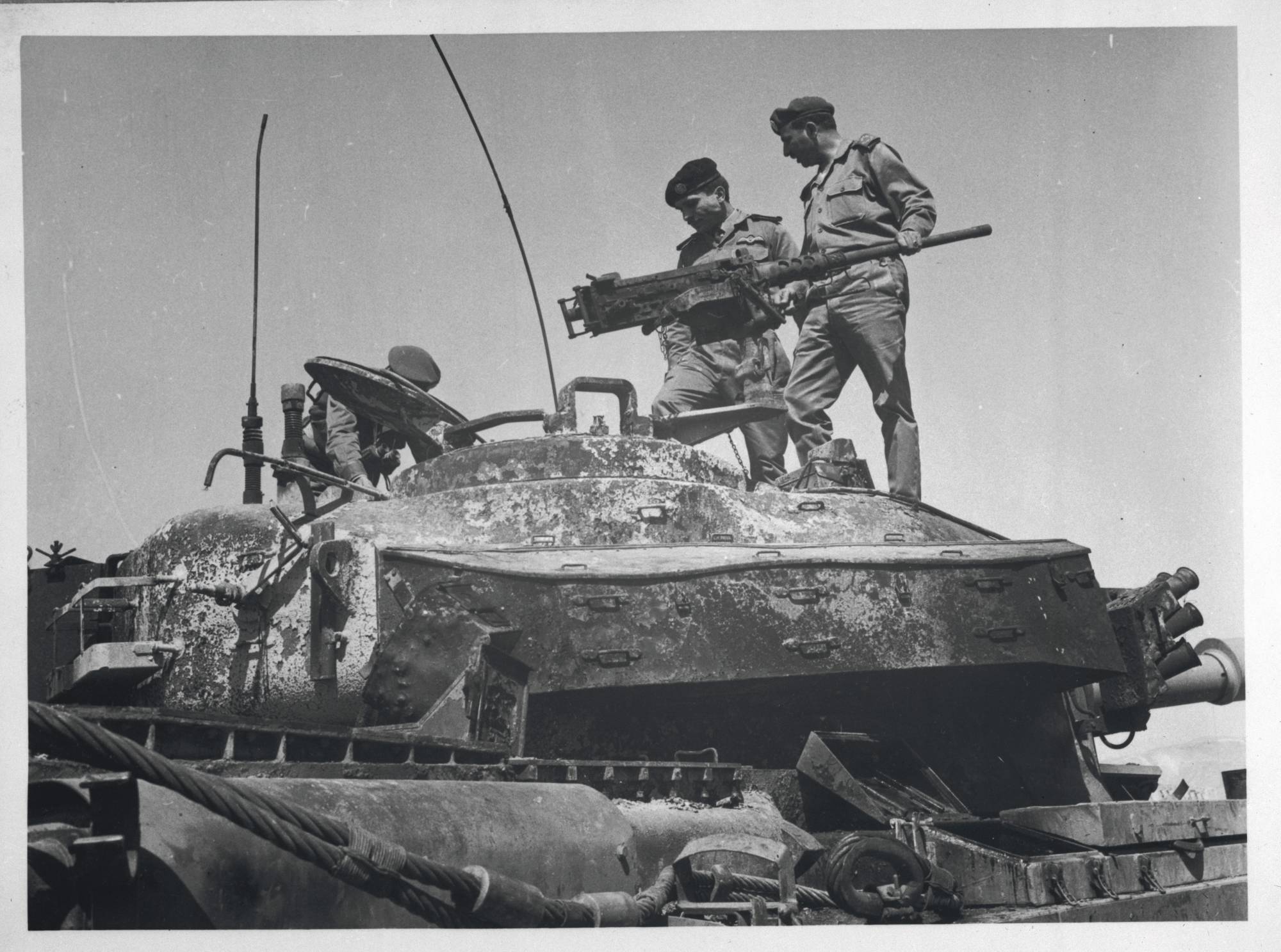
King Hussein inspects an Israeli tank left behind by occupying forces during the Battle of Karameh (Getty)
“Battle of Karameh”
Obeidat calls Karameh “a pivotal point of utmost importance,” especially for an army still reeling from the 1967 defeat and its withdrawal from the West Bank.
“The army lived the bitterness of that defeat,” he says. “It felt a moral, national, and pan-Arab responsibility.”
Karameh, he argues, offered a chance to restore the army’s fighting morale and reclaim some of its lost dignity.
“It was the army that settled the battle,” Obeidat says.
He credits Jordanian forces with thwarting Israeli attempts to build crossing bridges, destroying their vehicles on Jordanian soil and forcing, for the first time in Israel’s history, a request for a ceasefire. “The late King Hussein refused,” he adds.
Israel, he says, did not acknowledge a fifth of its casualties. Helicopters were evacuating the wounded who were “dripping with blood.”
He singles out artillery observation officers who advanced to the closest possible positions, relaying precise coordinates even as they effectively marked their own locations for shelling.
“The Jordanian soldier would identify his position near the Israeli army to be shelled,” he says, describing a willingness to die in order to restore dignity after the 1967 setback.
He says the declaration of “armed struggle” effectively erased the army’s role, presenting Palestinian fedayeen as the victors over Israel. “They monopolized the victory and ignored the army’s role entirely,” Obeidat says. “We emerged with a moral defeat in the face of their claims.”
He alleges that hundreds of millions of dollars in donations collected afterward, much of it going to Fatah, did not reach the Palestinian people but went to organizations and their leaders.
When the army entered Amman in September 1970, Obeidat says, it aimed to end what he describes as chaos: armed displays, roadblocks, arrests of soldiers on leave and interference in courts.
“The army swept areas without distinguishing between Jordanian and Palestinian,” he says. “It wanted to restore control over security, nothing more.”
He later describes what he calls a “state within a state,” extending from the Jordan Valley to Amman, after armed groups asserted authority over courts, roads, and civilian life.
On Syria’s intervention, Obeidat says Syrian forces entered northern Jordan flying Palestine Liberation Organization flags.
He later learned the decision was political, taken by the Baath Party, and that then-Defense Minister Hafez al-Assad complied reluctantly before Syrian tanks withdrew.
Iraq, he says, did not intervene. Obeidat affirms that he was told by Iraqi officials that neither the Iraqi state nor its forces intended to participate in any operation aimed at ending the Hashemite monarchy in Jordan.
According to one account, Iraqi leaders did not want to shoulder the political and diplomatic burden of the Palestinian issue or risk an uncalculated adventure.
He recounts another account, which he says he cannot adopt, according to which the operations command in the army was handled by a Pakistani figure. Under this account, Zia ul-Haq was receiving operational communications and sending messages that caused confusion among Iraqi and other forces, leading them to believe they would confront powerful strike units, prompting them to remain in a state of alert rather than engage.
He also recalls a meeting in which Palestinian figures, including Abu Iyad, reproached Iraqi President Ahmed Hassan al-Bakr. Al-Bakr replied: “We are a state with one life. If we make a fundamental mistake, we end. You are like cats with seven lives.”
As director of intelligence, Obeidat says he dealt directly with operations attributed to Haddad.
Between 1975 and 1977, he says, a missile was sent to Jordan with a group led by a Jordanian, Brik al-Hadid, affiliated with the PFLP. The target was King Hussein’s aircraft.
“The intention was to strike the plane, with Gaddafi’s knowledge and approval,” Obeidat says.
Jordanian intelligence monitored the group from the outset and later arrested its members. The king’s aircraft departed Marka military airport as scheduled but flew in the opposite direction to its planned route as a precaution, using jamming devices against any incoming missiles.
When confronted by Mudar Badran, then head of the Royal Court, Gaddafi denied knowledge. “I have no information,” Obeidat quotes him as saying.
Obeidat describes the aircraft hijackings orchestrated by Haddad as “the straw that broke the camel’s back,” contributing to the army’s intervention.
He says Jordanian intelligence had infiltrated Fatah and monitored its leaders, including Abu Iyad and Abu Yusuf al-Najjar.
In mid-1972, intelligence learned that Abu Dawood and a group were planning to enter Jordan from Baghdad to seize the Jordanian cabinet during a session and hold ministers hostage in exchange for the release of detained Fatah members.
The group crossed in three Mercedes cars, dressed in traditional Arab attire, with weapons concealed inside the seats and forged passports in hand. They were arrested at the border after a thorough search.
Obeidat rejects claims by Abu Iyad that Abu Dawood was tortured, insisting that “not a single hair on his head was touched,” and says Abu Dawood confessed only after realizing the operation had been fully uncovered.
Later, King Hussein met Abu Dawood’s parents, who pleaded for clemency. The king read the full confession and then met Abu Dawood himself. He ultimately ordered his release, honoring a promise he had made to Abu Dawood’s parents.
In Obeidat’s view, Abu Dawood was affected by the king’s treatment of his parents and “did not pose any future threat to Jordan.”
Obeidat describes a direct relationship between King Hussein and the General Intelligence Department.
The king met with officers regularly, not only to hear briefings but also to hear their personal views. Security presentations would include Crown Prince Hassan, senior advisers, army commanders, the public security chief, the Royal Court chief, and the prime minister.
“Sometimes,” Obeidat says, “it was necessary to elaborate orally before the king on certain matters so they would not circulate more widely.”
Obeidat says the late King Hussein maintained a direct relationship with the General Intelligence Department, meeting regularly with senior officers and listening not only to intelligence briefings but also to their personal assessments.
When security briefings were presented before the king, Crown Prince Hassan would attend, along with royal advisers, senior army commanders, the public security chief, the head of the Royal Court, and the prime minister.
Obeidat says he would submit reports to the prime minister and also meet with the king. When addressing the king, however, it was sometimes necessary to elaborate verbally on certain issues so that such information would not circulate among staff. He met with the king regularly.
When he was asked to present a security briefing before the king, the late King Hussein would summon Crown Prince Hassan. The king’s advisers would also attend, along with senior army commanders, the public security leadership, the head of the Royal Court, and the prime minister. The briefing of the security report would include an explanation of the security situation and any external or internal challenges.
لم تشترك بعد
انشئ حساباً خاصاً بك لتحصل على أخبار مخصصة لك ولتتمتع بخاصية حفظ المقالات وتتلقى نشراتنا البريدية المتنوعة