


Lebanon Recovery Plan Includes Central Bank Debt Write-Off, Haircuts to Depositors

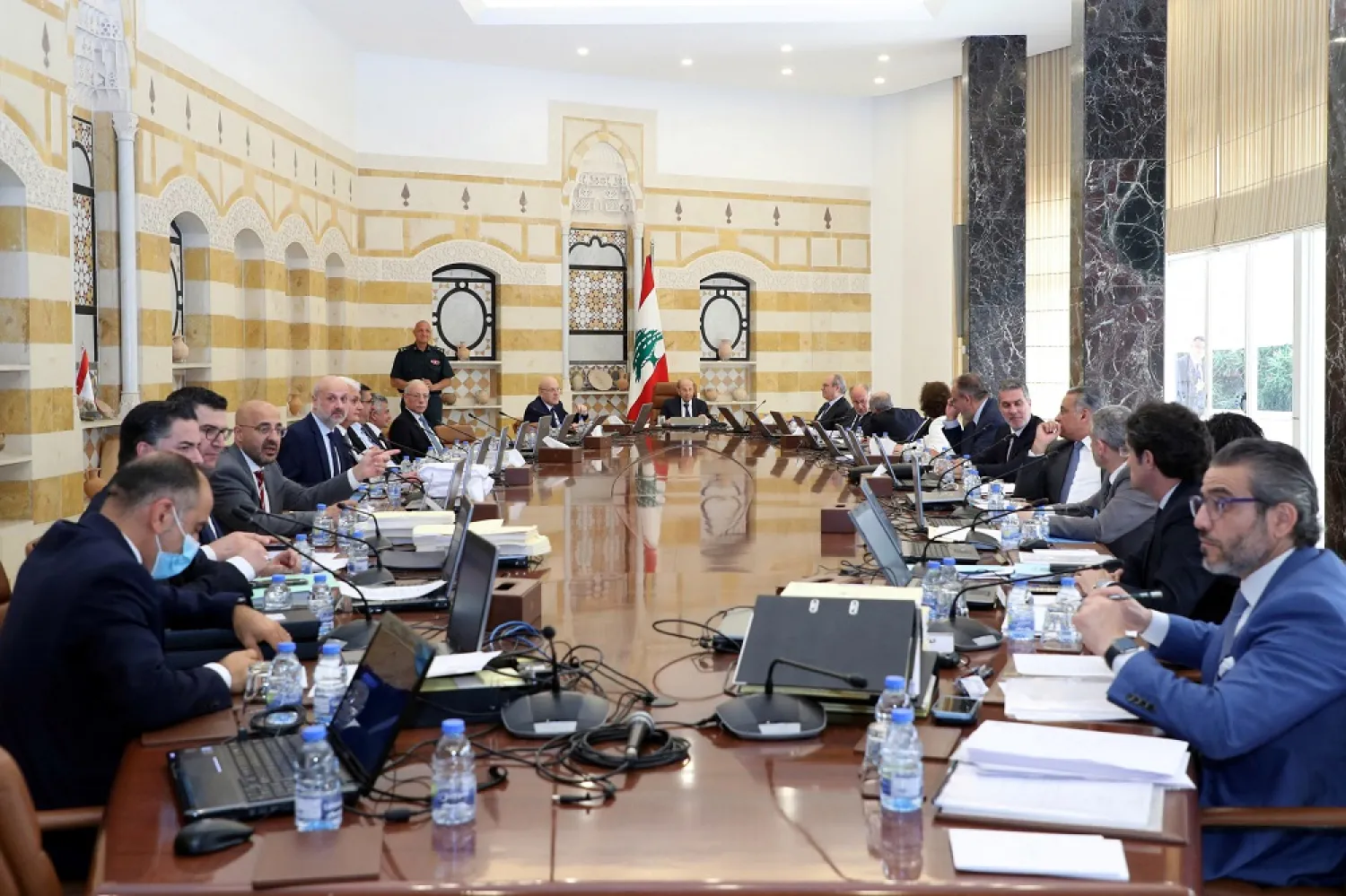
Lebanese President Michel Aoun heads a final cabinet meeting before the government enters a caretaker status at the presidential palace in Baabda, Lebanon May 20, 2022. (Dalati & Nohra)
TT

Lebanon Recovery Plan Includes Central Bank Debt Write-Off, Haircuts to Depositors

Lebanese President Michel Aoun heads a final cabinet meeting before the government enters a caretaker status at the presidential palace in Baabda, Lebanon May 20, 2022. (Dalati & Nohra)

Lebanon's government foresees cancelling "a large part" of the Central Bank's foreign currency obligations to commercial banks and dissolving non-viable banks by November, according to a financial recovery plan passed by the cabinet on Friday.

The document, seen by Reuters and verified as accurate by a minister, was passed by cabinet in its final session hours before losing decision-making powers, following the election of a new parliament on May 15.

It includes several measures that are prerequisites to unlock funds from a preliminary deal with the International Monetary Fund agreed in April that could help pull the country out of a three-year financial meltdown.

The plan foresees a full audit of the Central Bank's forex financial standing by July. Then, the government "will cancel, at the outset, a large part of the Central Bank's foreign currency obligations to banks in order to reduce the deficit in BDL's capital," the document said.

The largest 14 commercial banks, representing 83% of total assets, would also be audited. Viable banks would be recapitalized with "significant contributions" from bank shareholders and large depositors.

The plan said it would protect small depositors "to the maximum extent possible" in each viable bank, but did not lay out a minimum amount to be protected - unlike draft plans.

Non-viable banks, however, would be dissolved by the end of November, it added.

It also said the government would unify the official exchange rate, ending a system in which the government offered various exchange rates for different operations.

Lebanon's local currency has lost more than 90% of its value since its economic decline began in 2019.

In April 2020, Lebanon's cabinet endorsed a recovery plan that was then torpedoed by powerful political parties, the Central Bank, and commercial banks, who disputed the distribution of losses.

This April, the Association of the Banks in Lebanon (ABL) rejected a draft government recovery plan that it said would leave banks and depositors shouldering the "major portion" of a government-estimated $72 billion hole in the financial sector.

A spokesman for the association said it "did not meet yet to discuss the decision of the government, therefore ABL still endorses its last statement in this regards."

Lebanon's banks have been major lenders to the government for decades, helping to finance a wasteful and corrupt state that tipped into financial meltdown in 2019.


Israel Military Says Soldier Killed in Gaza 

A drone view shows the destruction in a residential neighborhood, after the withdrawal of the Israeli forces from the area, amid a ceasefire between Israel and Hamas in Gaza, in Gaza City, October 21, 2025. (Reuters)
TT

Israel Military Says Soldier Killed in Gaza 

A drone view shows the destruction in a residential neighborhood, after the withdrawal of the Israeli forces from the area, amid a ceasefire between Israel and Hamas in Gaza, in Gaza City, October 21, 2025. (Reuters)

The Israeli military announced that one of its soldiers had been killed in combat in southern Gaza on Wednesday, but a security source said the death appeared to have been caused by "friendly fire".

"Staff Sergeant Ofri Yafe, aged 21, from HaYogev, a soldier in the Paratroopers Reconnaissance Unit, fell during combat in the southern Gaza Strip," the military said in a statement.

A security source, however, told AFP that the soldier appeared to have been "killed by friendly fire", without providing further details.

"The incident is still under investigation," the source added.

The death brings to five the number of Israeli soldiers killed in Gaza since a ceasefire took effect on October 10.


Syria: SDF’s Mazloum Abdi Says Implementation of Integration Deal May Take Time

People sit outdoors surrounded by nature, with the Tigris river flowing in the background, following a long atmospheric depression, near the Syrian-Turkish border in Derik, Syria, February 16, 2026 REUTERS/Orhan Qereman
TT

Syria: SDF’s Mazloum Abdi Says Implementation of Integration Deal May Take Time

People sit outdoors surrounded by nature, with the Tigris river flowing in the background, following a long atmospheric depression, near the Syrian-Turkish border in Derik, Syria, February 16, 2026 REUTERS/Orhan Qereman

Mazloum Abdi, commander of the Syrian Democratic Forces, said the process of merging the SDF with Syrian government forces “may take some time,” despite expressing confidence in the eventual success of the agreement.

His remarks came after earlier comments in which he acknowledged differences with Damascus over the concept of “decentralization.”

Speaking at a tribal conference in the northeastern city of Hasakah on Tuesday, Abdi said the issue of integration would not be resolved quickly, but stressed that the agreement remains on track.

He said the deal reached last month stipulates that three Syrian army brigades will be created out of the SDF.

Abdi added that all SDF military units have withdrawn to their barracks in an effort to preserve stability and continue implementing the announced integration agreement with the Syrian state.

He also emphasized the need for armed forces to withdraw from the vicinity of the city of Ayn al-Arab (Kobani), to be replaced by security forces tasked with maintaining order.


Israeli Far-Right Minister to Push for ‘Migration’ of West Bank, Gaza Palestinians 

A Palestinian man checks leather belts as people prepare for Ramadan, in the old city of Hebron in the Israeli-occupied West Bank, February 17,2026. (Reuters)
TT

Israeli Far-Right Minister to Push for ‘Migration’ of West Bank, Gaza Palestinians 

A Palestinian man checks leather belts as people prepare for Ramadan, in the old city of Hebron in the Israeli-occupied West Bank, February 17,2026. (Reuters)

Israel's far-right Finance Minister Bezalel Smotrich said he would pursue a policy of "encouraging the migration" of Palestinians from the occupied West Bank and Gaza Strip, Israeli media reported Wednesday.

"We will eliminate the idea of an Arab terror state," said Smotrich, speaking at an event organized by his Religious Zionism Party late on Tuesday.

"We will finally, formally, and in practical terms nullify the cursed Oslo Accords and embark on a path toward sovereignty, while encouraging emigration from both Gaza and Judea and Samaria.

"There is no other long-term solution," added Smotrich, who himself lives in a settlement in the West Bank.

Since last week, Israel has approved a series of measures backed by far-right ministers to tighten control over the West Bank, including in areas administered by the Palestinian Authority under the Oslo Accords, in place since the 1990s.

The measures include a process to register land in the West Bank as "state property" and facilitate direct purchases of land by Jewish Israelis.

The measures have triggered widespread international outrage.

On Tuesday, the UN missions of 85 countries condemned the measures, which critics say amount to de facto annexation of the Palestinian territory.

"We strongly condemn unilateral Israeli decisions and measures aimed at expanding Israel's unlawful presence in the West Bank," they said in a statement.

"Such decisions are contrary to Israel's obligations under international law and must be immediately reversed.

"We underline in this regard our strong opposition to any form of annexation."

UN Secretary-General Antonio Guterres on Monday called on Israel to reverse its land registration policy, calling it "destabilizing" and "unlawful".

The West Bank would form the largest part of any future Palestinian state. Many on Israel's religious right view it as Israeli land.

Israeli NGOs have also raised the alarm over a settlement plan signed by the government which they say would mark the first expansion of Jerusalem's borders into the occupied West Bank since 1967.

The planned development, announced by Israel's Ministry of Construction and Housing, is formally a westward expansion of the Geva Binyamin, or Adam, settlement situated northeast of Jerusalem in the West Bank.

The current Israeli government has fast-tracked settlement expansion, approving a record 52 settlements in 2025.

Excluding Israeli-annexed east Jerusalem, more than 500,000 Israelis live in West Bank settlements and outposts, which are illegal under international law.
