


Russia Says Mariupol Battle at End as Ukrainian Defenders Surrender

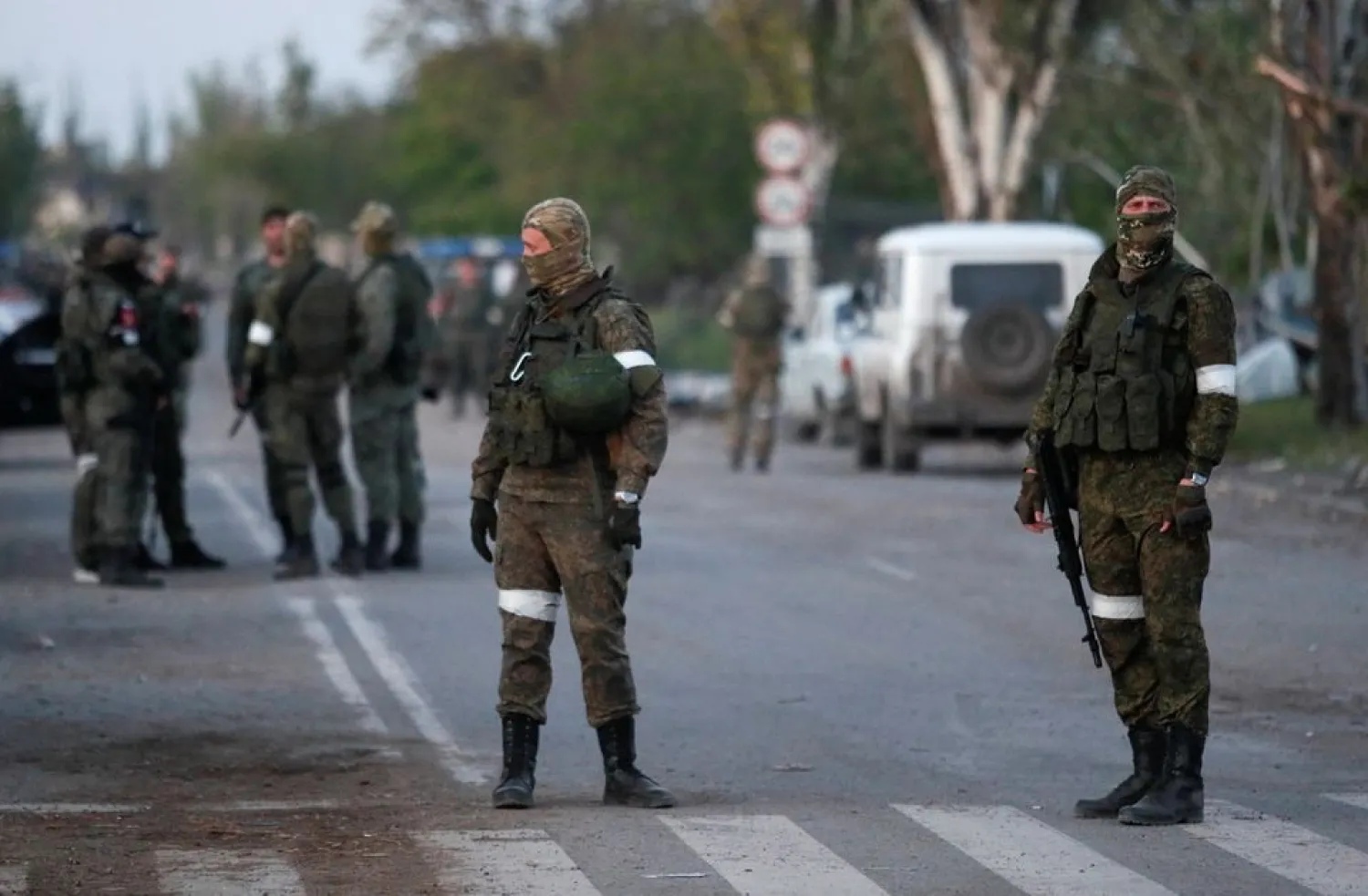
Service members of pro-Russian troops stand guard on a road before the expected evacuation of wounded Ukrainian soldiers from the besieged Azovstal steel mill in the course of Ukraine-Russia conflict in Mariupol, Ukraine May 16, 2022. REUTERS/Alexander Ermochenko
TT

Russia Says Mariupol Battle at End as Ukrainian Defenders Surrender

Service members of pro-Russian troops stand guard on a road before the expected evacuation of wounded Ukrainian soldiers from the besieged Azovstal steel mill in the course of Ukraine-Russia conflict in Mariupol, Ukraine May 16, 2022. REUTERS/Alexander Ermochenko

Russia has declared victory in its months-long operation to capture the strategic port of Mariupol after Ukraine ordered the last of its troops holed up in the city's Azovstal steelworks to lay down their arms.

Moscow's flattening of Mariupol has drawn multiple accusations of war crimes, including over a deadly attack on a maternity ward, and Ukraine has begun a legal reckoning for captured Russian troops, said AFP.

The first post-invasion trial of a Russian soldier for war crimes neared its climax in Kyiv on Friday, after 21-year-old sergeant Vadim Shishimarin admitted to killing an unarmed civilian early in the offensive. The verdict is due Monday.

Shishimarin told the court he was "truly sorry". But his lawyer said in closing arguments that the young soldier was "not guilty" of premeditated murder and war crimes.

Since Ukrainian forces fended off the Russian offensive around Kyiv both eastern Ukraine and Mariupol in the south have borne the brunt of a remorseless ground and artillery attack.

The fighting is fiercest in the eastern region of Donbas, a Russian-speaking area that has been partially controlled by pro-Kremlin separatists since 2014.

"Attempts to attack Donbas continue. They completely ruined Rubizhne, Vonokvakha, just as Mariupol," President Volodymyr Zelensky said in his nightly video address late Friday, adding the Russians were "trying to do the same with Severodonetsk and many other cities".

In the eastern city of Severodonetsk, 12 people were killed and another 40 wounded by Russian shelling, the regional governor said.

- 'End of the operation' -
Zelensky described the bombardment of Severodonetsk as "brutal and absolutely pointless", as residents cowering in basements described an unending ordeal of terror.

The city forms part of the last pocket of Ukrainian resistance in Lugansk, which along with the neighboring region of Donetsk comprises the Donbas war zone.

Moscow on Friday said the battle for the Azovstal steelworks -- a symbol of Ukraine's dogged resistance since Russian President Vladimir Putin launched the invasion on February 24 -- was now over.

Russian defense ministry spokesman Igor Konashenko said 2,439 Ukrainian personnel had surrendered at the steelworks since May 16, the final 500 on Friday.

Defence Minister Sergei Shoigu had informed Putin of "the end of the operation and the complete liberation of the (Azovstal) industrial complex and the city of Mariupol", Konashenko added.

Ukraine hopes to exchange the surrendering Azovstal soldiers for Russian prisoners. But in Donetsk, pro-Kremlin authorities are threatening to put some of them on trial.

In Washington, Pentagon spokesman John Kirby said all prisoners of war should "be treated in accordance with the Geneva Convention and the law of war".

President Joe Biden has cast the Ukraine war as part of a US-led struggle pitting democracy against authoritarianism.

The US Congress this week approved a $40-billion (38-billion-euro) aid package, including funds to enhance Ukraine's armored vehicle fleet and air defense system.

And meeting in Germany, G7 industrialized nations pledged $19.8 billion to shore up Ukraine's shattered public finances.

- Finland's price -
The war's economic repercussions were set to expand Saturday, with Russia expected to cut off its supply of natural gas to Finland.

Finnish state energy firm Gasum said the taps would be turned off when its contract with Russia's Gazprom ended at 7:00 am (0400 GMT).

The move, which Russia has blamed on the Nordic country's refusal to pay in rubles, comes days after Finland and Sweden submitted a joint application for NATO membership.

Moscow has repeatedly warned historically non-aligned Finland that applying for membership would be "a grave mistake with far-reaching consequences."

Both Finland and Sweden are seemingly on the fast track to joining the defense alliance, with Biden offering "full, total, complete backing" to their bids.

But all 30 existing NATO members must agree on any new entrants, and Turkey has condemned the Nordic neighbors' alleged toleration of Kurdish militants.

Shoigu has said the Kremlin would respond to any NATO expansion by creating more military bases in western Russia.

Saturday's expected halt to gas shipments follows Moscow cutting off Poland and Bulgaria last month in a move the EU described as "blackmail".

- Underground living -
While the invasion that sparked the potential NATO expansion has ebbed around the northeastern city of Kharkiv, it remains in Russian artillery range, and hundreds of people are refusing to leave the relative safety of its metro system.

"We're tired. You can see what home comforts that we have," said Kateryna Talpa, 35, pointing to mattresses and sheets on the ground, and some food in a cardboard box.

She and her husband Yuriy are doing their best to cope in the Soviet-era station called "Heroes of Labor", alongside their cats Marek and Sima.

"They got used to it," Talpa said.

In the town of Lozova, at least eight people, including a child, were wounded Friday when a powerful Russian missile strike gutted a newly repaired cultural center, the largest in the region.

Kharkiv regional governor Oleg Sinegubov said all eight had been struck by shrapnel after three Russian missiles had been fired towards the 1,000-capacity building.



War-Related Oil Squeeze a ‘Short-Term Pain,’ US Official Insists

 A customer fuels up with regular gasoline priced at $5.29 at a Chevron gas station in Bellevue, Wash., Friday, March 13, 2026. (AP)
A customer fuels up with regular gasoline priced at $5.29 at a Chevron gas station in Bellevue, Wash., Friday, March 13, 2026. (AP)
TT

War-Related Oil Squeeze a ‘Short-Term Pain,’ US Official Insists

 A customer fuels up with regular gasoline priced at $5.29 at a Chevron gas station in Bellevue, Wash., Friday, March 13, 2026. (AP)
A customer fuels up with regular gasoline priced at $5.29 at a Chevron gas station in Bellevue, Wash., Friday, March 13, 2026. (AP)

President Donald Trump's top energy official said Sunday that Americans will have to endure the "short-term pain" of higher prices at the pump as US forces conduct their war against Iran.

Now in the third week of a multi-dimensional Middle East conflict that has seen US and Israeli forces pound Iran's military targets, and Tehran responding with missile and drone attacks against several neighboring states, global energy prices have soared.

And concern has swelled that a lengthy blockage by Iran of the critical Strait of Hormuz could send crude prices through the roof.

"President Trump needed to act now... to stop the killing of American soldiers, to stop the destabilization of the region, and to end Iran's ability to threaten energy markets," US Energy Secretary Chris Wright told ABC News talk show "This Week."

He said economic conditions would grow dramatically worse without the ongoing military operation "to defang the Iranian regime" and ensure it can no longer threaten the world with nuclear weapons.

"This is short-term pain to get through to a much better place where the Middle East can no longer be held hostage by the one rogue nation in Iran," Wright added.

The energy secretary also said he predicted the war could end "in the next few weeks, and we'll see a rebound in (fuel) supplies and a pushing down of prices after that."

Since the war began, gas prices have soared in the United States, where Trump in 2024 campaigned relentlessly on a vow to lower fuel costs for Americans. The issue is a critical one for US voters, who head to the polls in November for the country's mid-term congressional elections.

Gas prices have jumped 25 percent in the past month, to $3.70 per gallon, according to the American Automobile Association.

The Trump administration has stressed other governments should help in a possible effort to unblock the Strait of Hormuz by escorting tankers through the narrow waterway along Iran's coast.

US Transportation Secretary Sean Duffy, speaking on Fox News "Sunday Morning Futures," said oil could soon flow through the strait if such escorts -- and shipping insurance -- are worked out.

"Could be a day, could be a week," Duffy said of possible escorts.


Israel Says ‘No Interceptor Shortage’ After Reports of Scarcity as Iranian Missiles Injure at Least 8

15 March 2027, Israel, Tel Aviv: People watch the site of a projectile impact following an Iranian strike on Tel Aviv. (dpa)
TT

Israel Says ‘No Interceptor Shortage’ After Reports of Scarcity as Iranian Missiles Injure at Least 8

15 March 2027, Israel, Tel Aviv: People watch the site of a projectile impact following an Iranian strike on Tel Aviv. (dpa)

An Israeli military source on Sunday denied media reports that Israel was running low on missile interceptors crucial to its air defenses, adding that the army was "continuously monitoring the situation". 

Citing US officials, news outlet Semafor had reported that Israel had informed the United States that it was "running critically low on ballistic missile interceptors", as the US-Israeli war against Iran entered its third week. 

"As of now, there is no interceptor shortage. The Israeli army is prepared for prolonged combat. We are continuously monitoring the situation," the military source said, in response to media queries. 

Israeli Foreign Minister Gideon Saar also dismissed the reports when questioned by journalists earlier on Sunday. 

At least eight people were injured in Israel Sunday following repeated missile launches from Iran, at least two of which contained cluster munitions according to Israeli authorities. 

Israeli police released footage from a CCTV camera in the Tel Aviv area showing an impact on a road, saying that it was from "cluster munitions" that caused "damage at several locations". 

Bomblets and shrapnel from the missile wounded four people in various parts of the Tel Aviv metropolitan area, according to the Magen David Adom (MDA) rescue service. 

A man in his 60s was hospitalized with moderate injuries to his head from broken glass, while three were treated due to the shock waves from the blast. 

In another barrage shortly before noon, two men aged 62 and 44 reported minor injuries "from pieces of asphalt that struck them as a result of the blast", according to MDA. 

During a salvo toward the Tel Aviv area at around 3:00 am (0100 GMT), a man and a woman in their 80s suffered light injuries, from glass shards and smoke inhalation respectively. 

Another Iranian missile directed at Israel's southernmost city of Eilat was intercepted before reaching the target, without causing injuries. The municipality of Eilat quoted security sources saying it was a cluster missile. 

By late midday on Sunday, seven missile salvos were launched from Iran toward the State of Israel, some of which were intercepted. 

Saar on Sunday accused Iran of targeting civilian areas, during a visit to the northern Arab Israeli town of Zarzir, hit two days prior by shrapnel from an Iranian missile that lightly wounded almost 60 residents. 

"While we are targeting military objectives... the Iranian regime is targeting civilians," Saar said. 

"All the casualties we faced during these two weeks of confrontation... are civilians from Iranian missiles. This is of course a war crime," he added. 

His words were echoed by police superintendent Shlomi Schlezinger while speaking near the site of one of the impacts on Sunday. 

Iran is "always targeting crowded places, with people, the big major cities," he said in central Tel Aviv. 

He attributed the relatively low number of Israeli casualties to civilians' adherence to safety instructions. 

"We have a lot of collateral damage to cars and buildings, as you can see," he said. 

"We're used to, in the last 16 days, to be in shelters and in safe rooms when we have the alarm." 

According to Haaretz, citing security officials, 250 ballistic missiles had been fired by Iran at Israel as of March 13. 

Twelve people have been killed in Israel by missiles or falling debris since the start of the war, according to an AFP tally of figures given by Israeli authorities and first responders. 


Iran FM Sees No Reason for Talks After Trump Says It Wants Deal

09 September 2025, Egypt, Cairo: Iranian Foreign Minister Abbas Araghchi attends a joint press conference in Cairo. (dpa)
TT

Iran FM Sees No Reason for Talks After Trump Says It Wants Deal

09 September 2025, Egypt, Cairo: Iranian Foreign Minister Abbas Araghchi attends a joint press conference in Cairo. (dpa)

Foreign Minister Abbas Araghchi said Iran was not interested in talks with the United States, pushing back on President Donald Trump's stance that Tehran wants a deal to end the war.

"We are stable and strong enough. We are only defending our people," Araghchi told CBS's "Face The Nation," in an interview aired Sunday.

"We don't see any reason why we should talk with Americans, because we were talking with them when they decided to attack us.

"There is no good experience talking with Americans."

Trump on Saturday said Iran wanted a deal, but that he was not prepared to make one on current terms, without giving further details.

"We never asked for a ceasefire, and we have never asked even for negotiation," Araghchi said.

He added that Iran was ready to talk to countries who want to negotiate for selected oil tankers to pass through the key Strait of Hormuz export route.

"I cannot mention any country in particular, but we have been approached by a number of countries who want to have a safe passage for their vessels," he said.