


Executive Plan for Saudi Green Initiative to Be Revealed in November

Minister of Environment, Water and Agriculture Abdulrahman al-Fadhli speaks at the inauguration of the International Exhibition and Forum on Afforestation Technologies in Riyadh. (Asharq Al-Awsat)
TT

Executive Plan for Saudi Green Initiative to Be Revealed in November

Minister of Environment, Water and Agriculture Abdulrahman al-Fadhli speaks at the inauguration of the International Exhibition and Forum on Afforestation Technologies in Riyadh. (Asharq Al-Awsat)

Saudi Arabia will announce in November the complete strategic and executive plan for the Saudi Green Initiative, based on an alliance of companies, scientific, and research bodies with over 60 experts in soil, water, climate change, and desertification.

Environmental experts recommended supporting green initiatives that adopt sustainable afforestation projects and plant cover development to meet the challenges of desertification.

Under the patronage of Crown Prince Mohammed bin Salman, Minister of Environment, Water and Agriculture, Abdulrahman al-Fadhli inaugurated the International Exhibition and Forum on Afforestation Technologies at the Riyadh International Convention and Exhibition Center on Sunday.

The event is organized by the National Center for Vegetation Development and Combating Desertification in coordination and cooperation with the Ministry of Environment.

More than 80 exhibitors and 90 speakers from 20 countries and organizations worldwide will engage in 20 dialogue sessions and workshops discussing more than 50 scientific papers.

Participants called for boosting the cooperation between regional countries to achieve the desired effect of these projects and determine their proper framework to avoid the many conflicts within different experiences.

Ambitious initiative

Fadhli said the Kingdom is moving towards achieving a qualitative and unprecedented leap in the Middle East in environmental protection and vegetation development with ambitious local and regional initiatives.

"The impact of the initiatives will be reflected globally in reducing desertification and boosting biodiversity, and pushes towards a cleaner and more sustainable future, thus improving human quality of life and well-being," the minister said.

Challenges

CEO of the National Center for Vegetation Cover and Combating Desertification Khaled al-Abdulqader warned that biodiversity loss is a great challenge, adding that planting 10 billion trees will have environmental, social, and economic benefits.

Undersecretary of the Ministry of Environment, Water, and Agriculture Osama Fakiha confirmed that Saudi Arabia had made significant efforts to implement the afforestation program throughout the Kingdom.

He reviewed the Green Riyadh Project, which started with planting 7.5 million trees and launching the King Salman Park and Saudi Green Cities, with the aim to plant more than 30 million trees in gardens and parks across the Kingdom.

Environmental movement

Leader of the Saudi Green Studies Project Alliance Khaled al-Othman said environmental interaction has no boundaries because addressing its challenges is inseparable from the mutual ecological influences within the same region.

Othman added that Saudi Arabia is within a wide regional area that requires the adoption of a broad environmental and integrated movement as part of the approaches of the Saudi Green Initiative to stimulate regional and joint cooperation.

Speaking to Asharq Al-Awsat, he pointed out that the Saudi Green Initiative is the cornerstone of the Middle East Green Initiative, placing the Kingdom in a pioneering position in specialized studies and a leader in afforestation.

Executive strategy

Othman stated that an alliance of companies and scientific and research bodies is devising a plan based on the scientific foundations, environmental reality, challenges, resources, and capabilities.

The plan will be part of a strategic implementation framework to understand the current situation, collect data, and conduct the necessary surveys.

He revealed that over 60 scientists and experts in soil, water, climate change, and levels of desertification are working in cooperation with the National Center for Vegetation Cover and Combating Desertification.

Othman noted that the efforts would result in developing a comprehensive strategic plan and an execution plan to implement this ambitious project by defining the required financing programs, the roles of governmental and non-profit agencies, and the areas of scientific research.

The project will also determine the new technologies employed with its necessary implementation tools.

He called for exerting efforts within the framework of the comprehensive plan, rather than conflicting attempts, in plant growth and comprehensive environmental rehabilitation.

He announced that the preliminary results of the study would be announced in November, and the implementation tools will be identified, which will answer all questions about water sources and the quality, timing, and locations of crops.

Reality of the region

Director of Seismic Studies Center Professor Abdullah al-Omari said the region suffers from drought, desertification, and various environmental problems, making afforestation initiatives vital to reducing carbon emissions and global warming.

He told Asharq Al-Awsat that Saudi Arabia and the rest of the regional countries, given their vast area and the lack of rain, will face various obstacles, namely the scarcity of water resources.

Saudi Arabia has sought, through its multiple initiatives, to meet its needs, face challenges, and create solutions.

Omari reiterated the importance of the participation of different countries at the International Exhibition and Forum on Afforestation Technologies to achieve these initiatives, exchange experiences, and boost cooperation.

Water supply

He pointed out that water availability is essential for the plan, and solving the issue of water shortage ensures its success.

He recalled Saudi efforts in this field, noting that the Kingdom is a pioneer in desalination, artificial lakes, and rain seeding.

Saudi Arabia also constructed over 230 dams around the Kingdom, despite high temperatures and increased evaporation levels.

Riyadh continues efforts to face water waste and maintain renewable water resources, securing them for future generations, meeting possible increases in population density, and prioritizing the public interests.

Agreements and contracts

The National Center for Vegetation Cover and Combating Desertification signed an agreement with the King Abdulaziz Royal Reserve to plant one million trees in the reserve.

The agreement aims to boost the cooperation and integration to develop the vegetation cover within the reserve, increase its area, and protest its diversity.

The areas of cooperation include defining afforestation sites within the reserve, including the northern and southern al-Khafs and Noura parks.

The Center signed on the sidelines of the Forum three memoranda of understanding with the Saudi Basic Industries Corporation (SABIC), the Saudi Arabian Mining Company (Maaden), and the Rural Development Program (Reef).

The agreements aim to combat desertification within the areas of cooperation, including protecting and developing the vegetation cover and its sustainability, raising environmental awareness, and launching afforestation initiatives and projects, such as the project to plant 20 million trees by 2040.

NEOM target

NEOM launched its Regreening Initiative in collaboration with the National Center for Vegetation Cover and Combating Desertification.

NEOM CEO Engineer Nadhmi al-Nasr announced the project seeks to plant 100 million trees as part of the Saudi Green Initiative, stressing that NEOM will be the first region to rely entirely on solar and wind energy.

Nasr stressed that the partnership with the Ministry of Environment, Water, and Agriculture had come a long way, highlighting NEOM's commitment to the future industry, development sustainability, and keeping pace with future aspirations.

NEOM will start planting 100 million trees soon.

Nasr pointed out that NEOM, which occupies an area the size of an entire country, such as Belgium, will be a 95 percent natural area, as a result of continuous work and coordination with the Ministry of Environment and in light of many initiatives and scientific research.

It will also rehabilitate 1.5 million hectares of land and natural reserves and restore wildlife habitats.
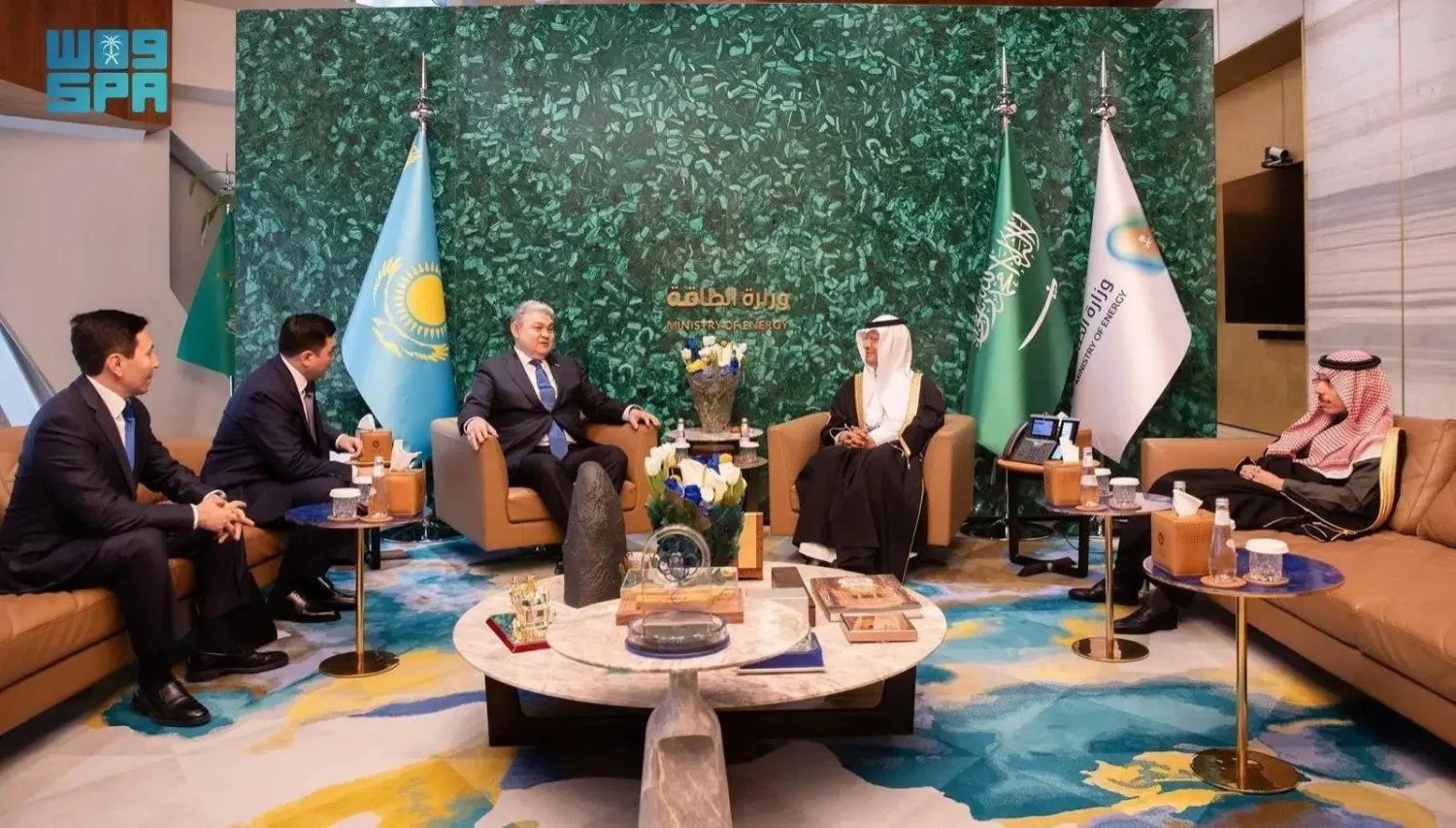



Saudi Arabia, Kazakhstan Agree to Establish Coordination Council

Saudi Minister of Energy Prince Abdulaziz bin Salman bin Abdulaziz receives Kazakhstan’s Foreign Minister Yermek Kosherbayev in Riyadh. (SPA)
TT

Saudi Arabia, Kazakhstan Agree to Establish Coordination Council

Saudi Minister of Energy Prince Abdulaziz bin Salman bin Abdulaziz receives Kazakhstan’s Foreign Minister Yermek Kosherbayev in Riyadh. (SPA)

Saudi Arabia and Kazakhstan agreed to establish a Saudi-Kazakh Coordination Council, reported the Saudi Press Agency on Tuesday.

Saudi Minister of Energy Prince Abdulaziz bin Salman bin Abdulaziz received in Riyadh Kazakhstan’s Foreign Minister Yermek Kosherbayev. Saudi FM Prince Faisal bin Farhan bin Abdullah and Minister of Energy of Kazakhstan Yerlan Akkenzhenov also attended the meeting.

The talks tackled the establishment of the coordination council, which will be chaired by the Saudi minister of energy and Kazakhstan’s foreign minister. The council reflects the two countries’ commitment to strengthening cooperation and expanding their bilateral partnership.

Prince Abdulaziz and Kosherbayev signed an agreement on the establishment of the council, which aims to boost coordination and consultation between the two countries and develop frameworks for cooperation across various sectors of mutual interest, elevating bilateral relations to broader levels.

Prince Abdulaziz and Kosherbayev discussed relations between their countries and ways to develop them further, especially in the energy field. They tackled opportunities for cooperation and investment in renewable energy and energy storage systems and discussed oil market developments.


Saudi-Qatari Partnership Paves Way for Logistics Corridors to Boost Regional Trade Efficiency 

The MoU was signed by Mawani President Eng. Suliman Almazroua and CEO of Qatar Ports Management Company Captain Abdullah Mohammed Al-Khanji. (QNA)
TT

Saudi-Qatari Partnership Paves Way for Logistics Corridors to Boost Regional Trade Efficiency 

The MoU was signed by Mawani President Eng. Suliman Almazroua and CEO of Qatar Ports Management Company Captain Abdullah Mohammed Al-Khanji. (QNA)

The Saudi Ports Authority (Mawani) and Qatar Ports Management Company signed on Tuesday a memorandum of understanding (MoU) aimed at boosting maritime and logistics cooperation between the two sides.

The agreement will contribute to the development of the ports sector, raising operational efficiency, and supporting regional and international trade flows.

The MoU was signed by Mawani President Eng. Suliman Almazroua and CEO of Qatar Ports Management Company Captain Abdullah Mohammed Al-Khanji. Qatari Ambassador to Saudi Arabia Bandar bin Mohammed Al Attiyah attended the signing ceremony.

The agreement reflects Saudi Arabia and Qatar’s commitment to building effective partnerships, exchanging expertise, establishing an organized framework for cooperation management, and developing joint investment opportunities in line with Saudi Vision 2030 and Qatar National Vision 2030.

The MoU outlines eight key areas of cooperation, including the exchange of best practices in port management and operations, and the study of opportunities for direct maritime and land connectivity between the ports of both countries to enhance trade flow efficiency.

It includes collaboration in logistics services, exploring the establishment of joint maritime corridors serving bilateral and regional trade, and assessing the feasibility of creating shared regional distribution centers.

In the fields of digital transformation and artificial intelligence, the two sides agreed to deepen cooperation on developing smart systems, data governance, and the unified maritime window, thereby boosting operational efficiency and keeping pace with technological advancements in the maritime sector.

The MoU places strong emphasis on maritime safety and environmental protection, including exchanging expertise in combating marine pollution and emergency response; developing joint maritime emergency plans; establishing an emergency communication line between the two countries; and cooperating to ensure compliance with international conventions, conduct joint exercises, and develop risk monitoring systems.

The cooperation also covers human capital development through joint training programs and field-exchange of expertise, as well as academic and research collaboration in maritime transport and logistics.

In terms of joint investment, both sides will study local and global investment opportunities in ports and related services and coordinate with the private sector to support these initiatives.

The MoU further includes cooperation in cruise tourism through enhanced maritime connectivity and joint promotion of Gulf cruise routes, as well as international and regional representation by coordinating positions in international maritime organizations and supporting joint initiatives, notably “Green Ports” and “Safe Sea Corridors.”

The agreement reflects the commitment of Mawani and Qatar Ports Management Company to advancing the ports sector and boosting its role as a key driver of trade and economic growth, contributing to Gulf integration and enhancing regional competitiveness in maritime and marine services.


Golden Halal Logo Launched at Makkah Halal Forum  

The Makkah Halal Forum 2026 was held from February 14 to 16. (SPA)
TT

Golden Halal Logo Launched at Makkah Halal Forum  

The Makkah Halal Forum 2026 was held from February 14 to 16. (SPA)

The Makkah Halal Forum 2026, which concluded on Monday, marked a pivotal milestone in the development of Saudi Arabia's halal industry, ushering in a new phase of structured institutional action.

This shift moves the sector beyond theoretical discourse toward a fully integrated implementation framework. It cements the Kingdom’s global leadership in halal and boosts the credibility of Saudi products in international markets.

The forum that began on February 14 witnessed the launch of a package of strategic enablers reflecting the maturity of the Saudi experience in the sector. Chief among them was the introduction of the Halal Academy as a specialized knowledge and training arm dedicated to building professional expertise and raising standards across the entire value chain.

The event also saw the unveiling of the Golden Halal logo, a high-level accreditation mark designed to provide global markets with a unified benchmark of trust, underscoring the Kingdom’s commitment to the highest standards of quality and compliance.

These initiatives signal a strategic shift that goes beyond the traditional concept of religious oversight. Instead, they frame halal as a comprehensive industrial and economic system that integrates Sharia compliance with high quality standards, advanced governance, and digital traceability. The approach is expected to boost the competitiveness of Saudi exports and facilitate their entry into global markets.

National success stories highlight the tangible impact of this transformation. CEO and founder of Roya Factory for Food Products Rasha Al Sanea noted that Saudi accreditation has evolved into a comprehensive quality certification that provides companies with a clear competitive edge abroad.

She noted that obtaining certification involves a rigorous process, including assessments of facility safety, manufacturing quality, and compliance with global standards ahead of final audits. These measures strengthen product reliability and boost readiness for international expansion.

The presence of international delegations and trade missions in Makkah on the sidelines of the forum helped accelerate expansion opportunities and open direct export channels to several markets, she added.

Pairing the Saudi Made logo with accredited halal marks, foremost among them the Golden Halal logo, enhances global consumer confidence and gives Saudi products a strong presence across diverse cultures and markets, she stressed.