


No Way Out as Iraq's Dangerous Post-election Impasse Deepens

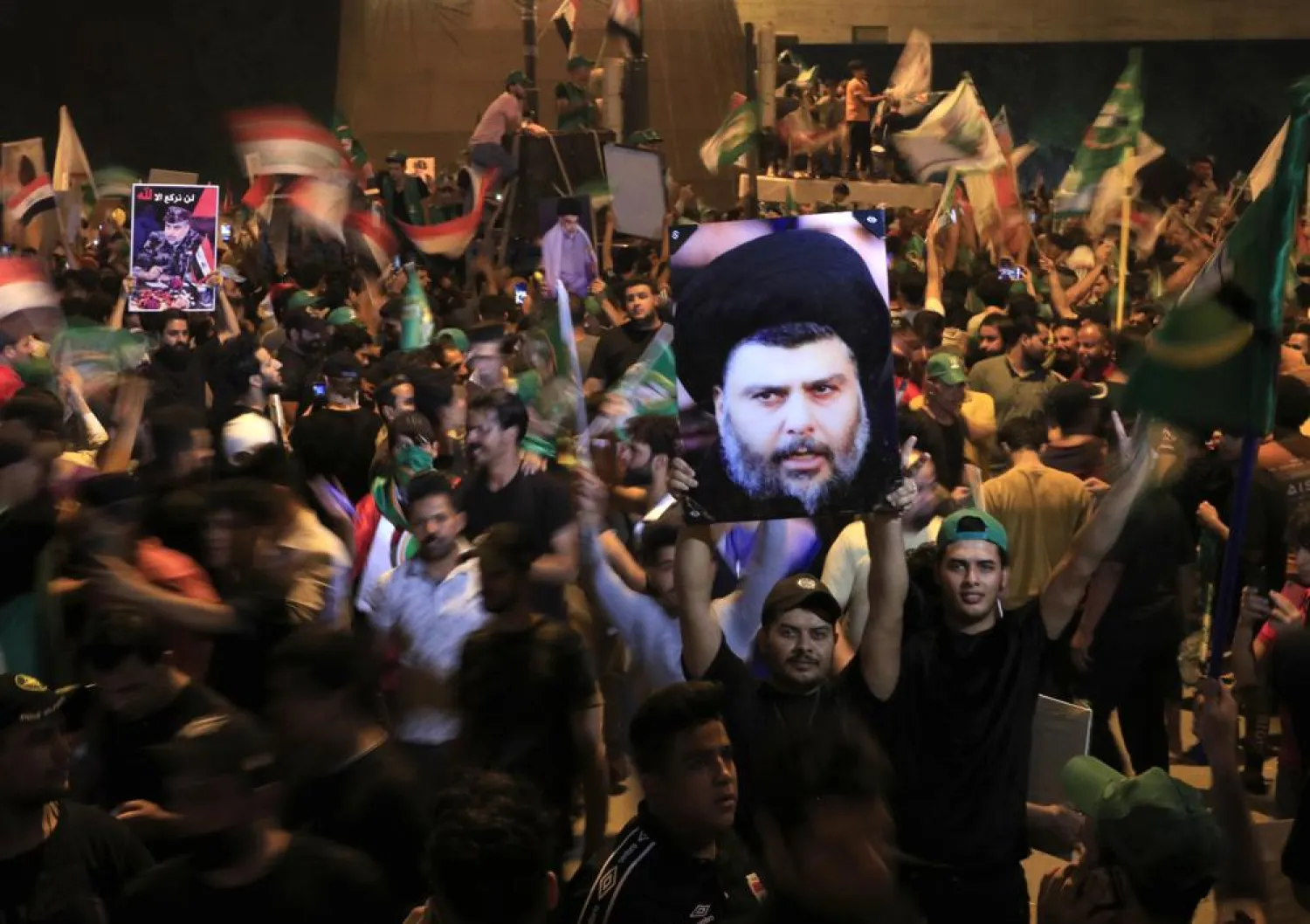
FILE - Followers of Shiite cleric Muqtada al-Sadr, on the poster, celebrate after the announcement of the results of the parliamentary elections in Tahrir Square, Baghdad, Iraq, Monday, Oct. 11, 2021. Eight months after national elections, Iraq still doesn't have a government. Driven by cutthroat competition for power and resources between elites, there is no clear way out of the unprecedented impasse. (AP Photo/Hadi Mizban, File)
TT

No Way Out as Iraq's Dangerous Post-election Impasse Deepens

FILE - Followers of Shiite cleric Muqtada al-Sadr, on the poster, celebrate after the announcement of the results of the parliamentary elections in Tahrir Square, Baghdad, Iraq, Monday, Oct. 11, 2021. Eight months after national elections, Iraq still doesn't have a government. Driven by cutthroat competition for power and resources between elites, there is no clear way out of the unprecedented impasse. (AP Photo/Hadi Mizban, File)

Eight months after national elections, Iraq still doesn’t have a government and there seems to be no clear way out of the dangerous deadlock.

Political elites are embroiled in cutthroat competition for power, even as the country faces growing challenges, including an impending food crisis resulting from severe drought and the war in Ukraine, The Associated Press said.

For ordinary Iraqis, everything is delayed. The caretaker government is unable to make crucial electricity payments or draft plans for badly needed investment ahead of the critical summer months. Investments to upgrade water infrastructure have been paused while unemployment, water shortages and concerns over food security are drawing public anger.

The election was held several months earlier than expected, in response to mass protests that broke out in late 2019 and saw tens of thousands rally against endemic corruption, poor services and unemployment.

The vote brought victory for powerful Shiite cleric Muqtada al-Sadr and was a blow for his Iran-backed Shiite rivals, who lost about two-thirds of their seats and have rejected the results.

Personal vendettas spanning decades underpin the Shiite rivalry, pitting al-Sadr and his Kurdish and Sunni allies on one side against the Coordination Framework, a coalition led by Iran-backed Shiite parties, and their allies on the other. In the middle are the independents, themselves divided amid attempts by rival factions to lure them to either side.

“It’s not about power; it’s about survival,” said Sajad Jiyad, an Iraq-based fellow with The Century Foundation.

Meanwhile, anger among the Iraqi public is growing as food prices soar and electricity cuts worsen.

Last month, caretaker Prime Minister Mustafa al-Kadhimi was forced to leave the Baghdad funeral of a celebrated poet after some mourners began chanting anti-government slogans and pelting the convoys of other government officials.

“Political obstruction impacts the work of the government and the state, and lowers the morale of citizens,” al-Kadhimi told reporters on Tuesday, blaming the impasse for obstructing his reform plans.

The UN envoy for Iraq, Jeanine Hennis-Plasschaert, warned Iraqi political leaders last month that “the streets are about to boil over” and said national interests were “taking a backseat to short-sighted considerations of control over resources.”

Al-Sadr, whose party garnered the most seats in the election, has not been able to corral enough lawmakers to parliament to get the two-thirds majority needed to elect Iraq's next president — a necessary step ahead of naming the next prime minister and selecting a Cabinet.

Al-Sadr's tripartite alliance includes Taqadum, a Sunni party led by Mohammed Halbousi who was elected parliament speaker in January, and the Kurdish Democratic Party lead by Masoud Barzani. The bloc is intent on forming a majority government, which would be a first since a consensus-based power-sharing system was introduced following the 2003 US invasion of Iraq to oust Saddam Hussein.

The government would exclude Iran-backed Shiite rivals of the Coordination Framework, which includes former Prime Minister Nouri al-Maliki’s State of Law and the Kurdish Patriotic Union of Kurdistan party.

Both al-Sadr and al-Maliki, longtime bitter political adversaries, have built up loyalists throughout ministries to advance their political agendas and fear that if in power, the other will use state resources — including the judiciary, anti-corruption committees — to purge institutions of rivals.

Also, al-Sadr and Qais al-Khazali, whose powerful Iranian-backed militia is part of the Framework alliance, are engaged in a deadly feud, with assassination campaigns targeting members of their militias across Iraq’s Shiite southern heartland.

Paradoxically, the current stalemate is in part a consequence of parties moving away from sectarian-oriented groups. In the past, Shiite alliances would form a united front to negotiate with Sunni and Kurdish blocs. But this time, alliances have crossed sectarian lines, inflaming tensions within each sect.

In the absence of an agreement, many fear violent protests by al-Sadr’s large grassroots following and potential clashes with Iran-backed militias.

In a May 16 speech, a visibly frustrated al-Sadr pledged never to strike a deal with his rivals. He also alluded to the capabilities of his own militia, Saraya Salam, which recently opened the doors for recruits in Babylon and Diyala provinces.

Al-Sadr was also angered by a recent Iraqi Supreme Court decision prohibiting the caretaker government from drafting and passing laws. This effectively struck down an emergency food bill needed for the caretaker government to use public funds to pay for food items and buy energy from Iran in the absence of a budget.

Al-Sadr, who had pushed the bill, saw the court's decision as a move leaning toward the Framework. However, in a small win for al-Sadr, Parliament convened late Wednesday and passed the food security bill.

Iraqi militia leaders speak privately of concerns that the stalemate could ignite street protests by supporters of al-Sadr and dissolve into violence between them and rival armed Shiite militias, The Associated Press said.

Iraq has in the past seen protracted political wrangling among rival groups on choosing a new president and prime minister, though the current stalemate in electing a president is the longest yet.

This time, Iran has not been able to mend rifts between Shiite rivals — a role that used to fall to the top Iranian general, Qassem Soleimani, who was killed in a US drone strike in January 2020. At least three trips to Iraq by Soleimani's successor to mediate among Shiites failed to produce a breakthrough.

Recently, Tehran cut 5 million cubic meters of gas exports to Baghdad, citing non-payment issues. Iraq's Electricity Minister Adel Karim told The Associated Press last month he had no idea how Iraq would pay the nearly $1.7 billion in arrears before the scorching summer months.

Meanwhile, the independents — parties drawn from the 2019 protest movement who ran under the so-called Imtidad list and won nine seats in the 329-seat legislature — seem to have lost their way. They had sworn to become a formidable opposition force to represent the protesters' demands in parliament.

The head of the movement, Alaa Rikabi, recently froze his position after members resigned over his vote in favor of electing Halbousi as parliament speaker. The protesters see Halbousi as complicit in the killings of activists during the protests.

A spokesman for Imtidad, Rasoul Al-Saray, said the two Shiite blocs want to use the independents “to cover their failure to form a government.”

Some independents have said they faced threats and fear for their lives; one said he was offered tens of thousands of dollars in way of bribes to side with the anti-Sadrist group. The independents spoke anonymously, fearing for their safety.

With prospects for a consensus government dwindling, some have floated the option of new elections.

But Jiyad, the Century fellow, disagrees.

“It’s starting from zero and a risk to everyone,” he said.


Israel to Terminate MSF Work in Gaza for Failing to Provide Palestinian Staff List

A young boy sits overlooking destroyed buildings at Nuseirat camp for Palestinian refugees in the central Gaza Strip on January 31, 2026. (AFP)
TT

Israel to Terminate MSF Work in Gaza for Failing to Provide Palestinian Staff List

A young boy sits overlooking destroyed buildings at Nuseirat camp for Palestinian refugees in the central Gaza Strip on January 31, 2026. (AFP)

Israel said Sunday it was terminating the humanitarian operations of the international charity Doctors Without Borders in Gaza after the organization failed to provide a list of its Palestinian staff.

"The Ministry of Diaspora Affairs and Combating Antisemitism is moving to terminate the activities of Medecins Sans Frontieres (MSF) in the Gaza Strip," the ministry said.

The decision follows "MSF's failure to submit lists of local employees, a requirement applicable to all humanitarian organizations operating in the region", it added, stating that the group will cease its work and leave Gaza by February 28.

In December, the ministry announced it would prevent 37 aid organizations, including MSF, from operating in Gaza from March 1 for failing to provide detailed information about their Palestinian staff.

It had alleged that two MSF employees had links with Palestinian armed groups Hamas and Islamic Jihad, which the medical charity vehemently denies.

On Sunday, the ministry said MSF had committed in early January that it would share the staff list as required by the Israeli authorities.

"Despite its public commitment, the organization refrained from transferring the lists," the ministry said.

"Subsequently, MSF announced it does not intend to proceed with the registration process at all, contradicting its previous statements and the binding protocol.

"In accordance with the regulations, MSF will cease its operations and depart the Gaza Strip by February 28, 2026," the ministry added.

In a statement posted on its website on Friday, MSF acknowledged that it had, as an "exceptional measure", agreed to share a list of names of its Palestinian and international staff with the Israeli authorities.

"However, despite repeated efforts, it became evident that we were unable to build engagement with Israeli authorities on the concrete assurances required," the charity said.

"These included that any staff information would be used only for its stated administrative purpose and would not be colleagues at risk."

MSF said it had not received assurances on these fronts, so "concluded that we will not share staff information in the current circumstances".


How the United Nations’ Relationship with the Houthis Reached a Dead End

The Houthis claim that humanitarian workers are spying on them. (Reuters file)
TT

How the United Nations’ Relationship with the Houthis Reached a Dead End

The Houthis claim that humanitarian workers are spying on them. (Reuters file)

After more than a year of suspending most of its humanitarian activities in areas controlled by the Houthi movement, amid the arrest of dozens of local staff and the seizure of assets and property, the United Nations has declared that its relationship with the group has reached a dead end. The development raises serious concerns about the humanitarian consequences for millions of Yemenis who rely on food assistance.

Reflecting the depth of the crisis, the World Food Program has decided to halt its operations entirely in Houthi-held Sanaa and dismiss all its staff, after exhausting efforts to end repeated violations against humanitarian workers and to secure minimum conditions for safe operations.

Sources working with the United Nations and the aid sector told Asharq Al-Awsat that the decision to end the program’s presence in Houthi-controlled areas was driven by systematic practices aimed at undermining the independence of humanitarian work. These included direct interference in operations, tight restrictions on staff movement, the seizure of offices and warehouses, and repeated attempts to impose beneficiaries based on political and security considerations.

The program had suspended its activities in those areas several times over recent years in protest against Houthi interference in food aid distribution and attempts to divert assistance away from its humanitarian purpose.

Despite this, it maintained limited operations through local partners to deliver emergency aid to the most vulnerable, particularly during natural disasters and floods that struck several governorates over the past two years. This continued until security and administrative conditions deteriorated to unprecedented levels.

Arrests and asset seizures

Despite the flexibility shown by the United Nations in dealing with restrictions and its efforts to overcome violations of the rules governing UN missions, the Houthis responded with escalating measures.

These included raids on the offices of several UN agencies, including the World Food Program, the arrest of dozens of local employees, accusations that they were spying for the United States and Israel, and the seizure of assets and property belonging to UN agencies and other organizations.

According to the sources, the program continued for more than a year to pay salaries to its staff, including those detained or barred from work after Houthi intelligence services took control of UN premises.

It also maintained paying rent on buildings, while engaging in difficult negotiations aimed at securing the release of detained staff, ending the takeover of offices, and recovering confiscated assets.

Aid organizations later concluded that they had delayed too long in deciding to end their presence, citing what they described as deliberate stalling during negotiations.

While one wing overseeing what is referred to as the Houthi foreign ministry showed some understanding of UN demands and proposed solutions, another wing led by intelligence agencies pushed for further escalation.

Escalation without end

During negotiations led by the UN coordinator for Yemen over the past year, the Houthis proposed presenting what they claimed were “evidence” to support espionage charges against local staff. They later suggested trying the detainees and issuing a general amnesty after convictions.

The United Nations rejected claims, insisting on the unconditional release of all detained staff — around 73 people — as well as others held from international and local organizations and diplomatic missions.

The talks coincided with further Houthi escalatory steps, including raids on additional humanitarian offices, new arrests of local staff, and the referral of dozens to a specialized court for terrorism and state security cases. This deepened mistrust and closed off any prospects for compromise.

With around 12 million people living in Houthi-controlled areas, the UN has warned that these measures, most recently the raid on the offices of six UN agencies in Sanaa and the seizure of their assets, will lead to an unprecedented deterioration of the humanitarian situation, in the absence of acceptable arrangements to ensure aid reaches those in need.

The UN Security Council adopted resolutions in 2025 and this year calling on the Houthis to provide a safe working environment and to immediately and unconditionally release all detained staff from the United Nations, non-governmental organizations, and diplomatic missions.

The militants have ignored the calls and demanded a review of the UN presence agreement in Yemen, which dates back to the 1960s.


Hezbollah Signals Refusal to Work with Lebanese Authorities to Disarm North of Litani

People inspect the site a day after a series of Israeli airstrikes struck a site with industrial machinery in the southern Lebanese village of Al-Marwanieh, Lebanon, on 31 January 2026. (EPA)
TT

Hezbollah Signals Refusal to Work with Lebanese Authorities to Disarm North of Litani

People inspect the site a day after a series of Israeli airstrikes struck a site with industrial machinery in the southern Lebanese village of Al-Marwanieh, Lebanon, on 31 January 2026. (EPA)

Hezbollah announced on Saturday that it will not cooperate with authorities in disarming its weapons north of the Litani River.

Hezbollah MP Hussein al-Hajj Hassan said: “Lebanon did everything asked of it. We have absolutely nothing else to offer or speak about north of the Litani.”

Army Commander Rodolphe Haykal is set to travel to the United States next week on an official visit where he will meet with military officials ahead of a Paris conference on March 5 to support the army. The donor conference aims to provide funds to the military and back its other duties, such as securing the border with Syria.

Hezbollah’s refusal to cooperate north of the Litani is a sign of the daunting task ahead of the army. The Iran-backed party had cooperated with it south of the Litani in line with the first phase to impose state monopoly over arms across Lebanon.

Significantly, Hezbollah’s ties with President Joseph Aoun have become strained in recent weeks amid the latter’s remarks that he is committed to the disarmament plan.

Lebanese sources following up on the government’s plan and contacts with Hezbollah said work north of the Litani demands political and security efforts to be successful.

The sources told Asharq Al-Awsat that the region north is much larger than the one south of it, which demands greater security and political cooperation with Hezbollah.

Hezbollah had reluctantly cooperated with the military south of the Litani.

The US is closely monitoring the situation in Lebanon, as well as the army’s disarmament plan.

Hajj Hassan criticized Lebanese officials, saying they were yielding to “American demands and pressure without having a clear strategic vision. They are just complying with the demands without confronting them with a comprehensive national strategy.”

“How do you intend to deal with the demands of the enemy [Israel] if you don't have any negotiating cards?” he asked.

“Concessions will only lead to endless concessions,” he warned, while urging the government against “ignoring Israel’s ongoing violations and crimes against Lebanon.”

He demanded that Israel withdraw from Lebanese regions it is occupying, end its daily violations and release prisoners. This will pave the way for reconstruction and a national security strategy.

“Only then can we talk about the weapons,” he stressed. “Other than that, we will not grant the enemy what it couldn’t achieve during the most challenging period of the wars that we waged against it with great perseverance.”

An Israeli strike on south Lebanon killed one person on Saturday, Lebanese authorities said, as the Israeli army said it targeted an operative from the party

Israel has kept up regular strikes in Lebanon despite a November 2024 truce that sought to end more than a year of hostilities including two months of all-out war with Hezbollah.

It usually says it is targeting members of the group or its infrastructure, and has kept troops in five south Lebanon border areas that it deems strategic.

Lebanon's health ministry said one person was killed in a strike on the village of Rub Thalatheen, close to the Israeli border.

The state-run National News Agency reported a man was killed in the strike while "carrying out repair work on the roof of a house".

The Israeli army said in a statement that it killed a Hezbollah operative "who took part in attempts to reestablish Hezbollah terror infrastructure in the Markaba area", adjacent to Rub Thalatheen.

It called the alleged activities "a violation of the ceasefire understandings between Israel and Lebanon".

This month, Lebanon's army said it had completed the first phase of its plan to disarm Hezbollah, covering the area south of the Litani river, around 30 kilometers (20 miles) from the Israeli border.

Israel, which accuses Hezbollah of rearming, has criticized the army's progress as insufficient, while Hezbollah has rejected calls to surrender its weapons.

More than 360 people have been killed by Israeli fire in Lebanon since the ceasefire, according to an AFP tally of health ministry reports.
