


China's Drone Carrier Hints at 'Swarm' Ambitions for Pacific

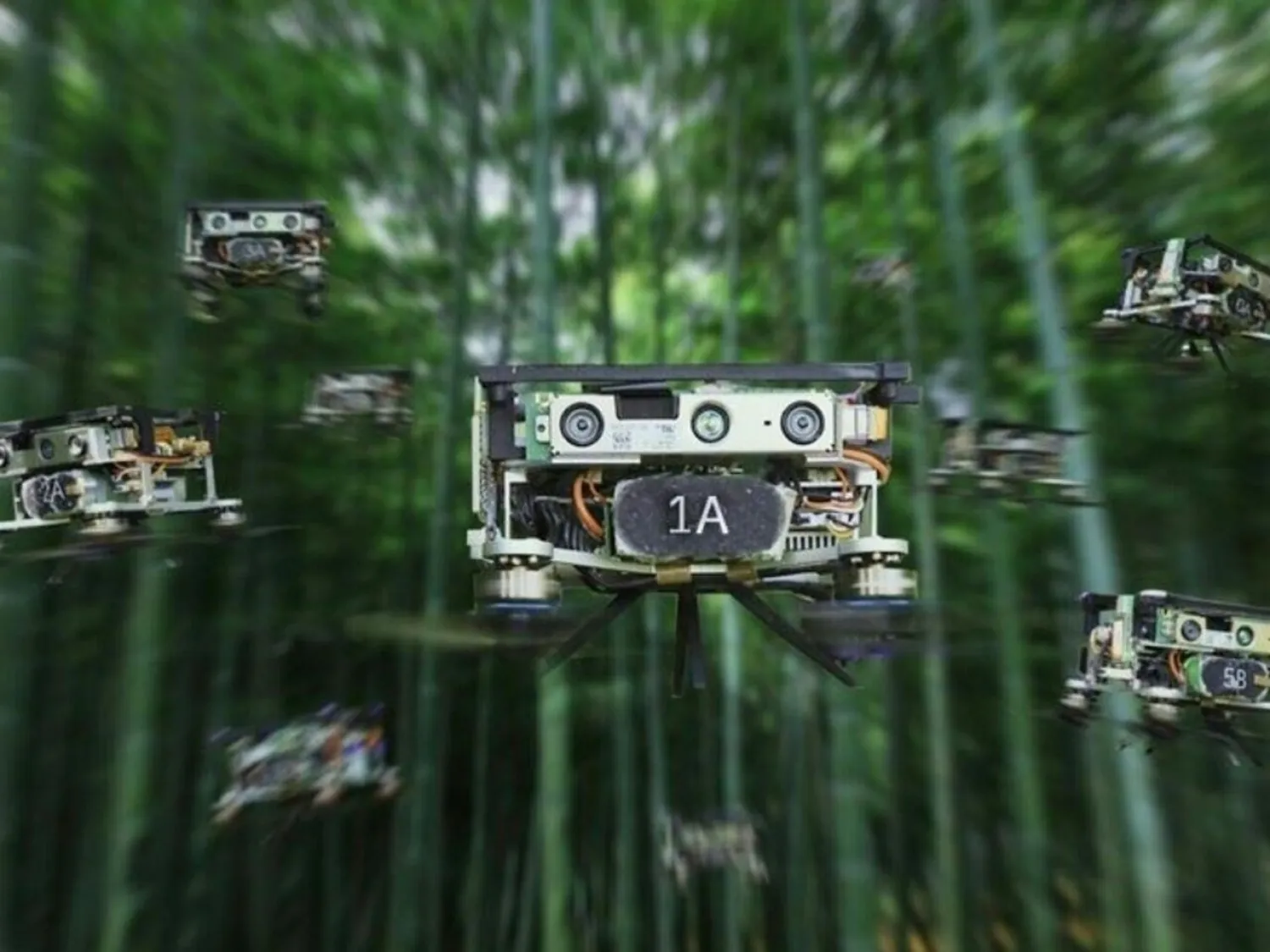
Last month, Chinese researchers published a drone swarm experiment allegedly showing devices autonomously navigating a dense patch of bamboo forest Handout Yuman Gao and Rui Jin/AFP
TT

China's Drone Carrier Hints at 'Swarm' Ambitions for Pacific

Last month, Chinese researchers published a drone swarm experiment allegedly showing devices autonomously navigating a dense patch of bamboo forest Handout Yuman Gao and Rui Jin/AFP

Officially it is just a research vessel, but China's newly unveiled drone carrier is a clear sign Beijing is rushing to deploy an autonomous swarm of unmanned devices in its push for military supremacy in the Pacific Ocean.

State media last month showed the launching of the Zhu Hai Yun -- "Zhu Hai Cloud" -- capable of transporting an unspecified number of flying drones as well as surface and submarine craft, and operating autonomously thanks to artificial intelligence, AFP said.

The 89-metre (292-foot) ship would be operational by year-end with a top speed of 18 knots, vastly increasing China's surveillance potential of the vast Pacific area it considers its zone of influence.

"The vessel is not only an unprecedented precision tool at the frontier of marine science, but also a platform for marine disaster prevention and mitigation, seabed precision mapping, marine environment monitoring, and maritime search and rescue," Chen Dake, lab director at the firm that built the carrier, told China Daily.

Armies worldwide see drone squadrons as key players in combat, able to overwhelm defense systems by sheer numbers and without putting soldiers' lives at risk, such as with more expensive jets or tanks.

"It's probably a first-of-its-kind development but other navies across the world, including the US Navy, are experimenting with remote warfare capabilities in the maritime domain," said US Army Lieutenant Colonel Paul Lushenko, who is also an international relations specialist at Cornell University in New York.

Even if the vessel's actual capabilities remain to be seen, Beijing is broadcasting its intent to cement territorial claims in the region, as seen with the security partnership agreed last month with the Solomon Islands northeast of Australia.

"It's definitely imposing, provocative, escalatory and aggressive," Lushenko told AFP.

Collective intelligence
Building fleets of autonomous and relatively inexpensive drones would greatly augment China's ability to enforce so-called anti-access and area denial (A2-AD) in the Pacific, with the aim of weakening decades of US influence.

Unlike traditional aircraft carriers or destroyers carrying hundreds of troops, the drone carrier could itself navigate for longer periods while sending out devices that create a surveillance "net," potentially able to fire missiles as well.

The Zhu Hai Yun could also improve China's mapping of the seafloor, providing a covert advantage for its submarines.

"These are capabilities that are likely to be critical in any future conflicts that China wages, including over the island of Taiwan," strategists Joseph Trevithick and Oliver Parken wrote on the influential War Zone site.

Beijing has made no secret of its desire to wrest control of Taiwan, and military experts say it is closely watching the West's response to the Russian invasion of Ukraine to gauge how and when it might make its move.

And last month, Chinese researchers published a drone swarm experiment allegedly showing 10 devices autonomously navigating a dense patch of bamboo forest, without crashing into the trees or each other.

"The ultimate goal is something that has a collective intelligence," said Jean-Marc Rickli, head of risks at the Geneva Centre for Security Policy.

"The analogy is a bit like a school of fish. They create forms in the water that are not the decision of any single fish, but the result of their collective intelligence," he told AFP.

Game-changer
It would be a big technological advance from current weapons, which can be programmed and semi-autonomous but must have human operators to react to unexpected challenges.

A fleet of self-navigating drones could in theory incapacitate defense systems or advancing forces by sheer numbers, saturating combat zones on land or at sea until an opponent's arsenal is depleted.

"A conventional attack becomes impossible when you're facing dozens, hundreds or thousands of devices that are much cheaper to develop and operate than heavy conventional weapons," Rickli said.

Noting this profound shift in modern warfare, a RAND Corporation study from 2020 found that while unmanned vehicles need significant improvements in onboard processing, "the overall computing capability required will be modest by modern standards -- certainly less than that of a contemporary smartphone."

"A squadron of approximately 900 personnel, properly equipped and trained, could launch and recover 300 L-CAATs every six hours, for a total of 1,200 sorties per day," it said, referring to low-cost attributable aircraft technology -- meaning devices so cheap an army can afford to lose them.

"We do have indications that China is making rapid capabilities development," Lushenko said of Beijing's new drone carrier.

"What we lack is empirical data to suggest that China's one-party state can actually employ the ship in an integrated fashion in conflict."



Samsung Electronics Says Customers Praised Competitiveness of HBM4 Chip

FILE PHOTO: A Samsung Electronics logo and a computer motherboard appear in this illustration taken August 25, 2025. REUTERS/Dado Ruvic/Illustration/File Photo
TT

Samsung Electronics Says Customers Praised Competitiveness of HBM4 Chip

FILE PHOTO: A Samsung Electronics logo and a computer motherboard appear in this illustration taken August 25, 2025. REUTERS/Dado Ruvic/Illustration/File Photo

Samsung Electronics customers have praised the differentiated competitiveness of its next-generation high-bandwidth memory (HBM) chips, or HBM4, saying "Samsung is back", co-CEO and chip chief Jun Young-hyun said in a New Year address.

In October, Samsung said it was in "close discussion" to supply its HBM4 to US artificial intelligence leader Nvidia , as the South Korean chipmaker scrambles to catch rivals including compatriot SK Hynix in AI chips.

"On HBM4 in particular, customers have even ‌stated that 'Samsung ‌is back'," Jun said in remarks reviewed ‌by ⁠Reuters, adding that ‌the company still had work to do to further improve competitiveness.

SK Hynix CEO Kwak Noh-Jung said in New Year remarks reviewed by Reuters that the company benefited from favorable external conditions as demand for artificial-intelligence chips materialized faster than expected.

He said competition was intensifying rapidly, noting that AI demand was now a given rather than an upside surprise, and that the business environment ⁠in 2026 would be tougher than last year, while stressing that the need for ‌continued bolder investment and effort to prepare for ‍the future.

SK Hynix was the ‍leading player in the HBM market in the third quarter of 2025 ‍with a 53% share, followed by Samsung at 35% and Micron at 11%, data from Counterpoint Research showed.

Shares of Samsung Electronics and SK Hynix ended up 7.2% and 4%, respectively, on the first trading day of the year, hitting record highs and outperforming the benchmark KOSPI’s 2.3% gain.

Turning to the foundry business, which manufactures chips designed by customers, Samsung's ⁠Jun said recent supply deals with major global customers had left the foundry business "primed for a great leap forward."

In July, Samsung Electronics signed a $16.5 billion deal with Tesla.

In a separate address, Samsung Electronics' co-CEO TM Roh, who also heads the company's device experience division overseeing its mobile phone, TV and home appliance businesses, said 2026 was likely to bring greater uncertainty and risks, citing rising component prices and global tariff barriers.

"To position ourselves to maintain a competitive advantage in any situation, we will reinforce our core competitiveness through proactive supply chain diversification and optimization of global operations to ‌address issues like component sourcing and pricing, and global tariff risks," Roh said.


Foundation Stone Laid for World’s Largest Government Data Center in Riyadh

Officials are seen at Thursday's ceremony. (SPA)
TT

Foundation Stone Laid for World’s Largest Government Data Center in Riyadh

Officials are seen at Thursday's ceremony. (SPA)

The foundation stone was laid in Riyadh Thursday for the Saudi Data and Artificial Intelligence Authority (SDAIA) “Hexagon” Data Center, the world’s largest government data center by megawatt capacity.

Classified as Tier IV and holding the highest data center rating by the global Uptime Institute, the facility will have a total capacity of 480 megawatts and will be built on an area exceeding 30 million square feet in the Saudi capital.

Designed to the highest international standards, the center will provide maximum availability, security, and operational readiness for government data centers. It will meet the growing needs of government entities and support the increasing reliance on electronic services.

The project will contribute to strengthening the national economy and reinforce the Kingdom’s position as a key player in the future of the global digital economy.

A ceremony was held on the occasion, attended by senior officials from various government entities. They were received at the venue by President of SDAIA Dr. Abdullah bin Sharaf Alghamdi and SDAIA officials.

Director of the National Information Center at SDAIA Dr. Issam bin Abdullah Alwagait outlined the project’s details, technical and engineering specifications, and the operational architecture ensuring the highest levels of readiness and availability.

He also reviewed the international accreditations obtained for the center’s solutions and engineering design in line with recognized global standards.

In a press statement, SDAIA President Dr. Abdullah bin Sharaf Alghamdi said the landmark national project comes as part of the continued support of Prince Mohammed bin Salman bin Abdulaziz Al Saud, Crown Prince, Prime Minister and Chairman of SDAIA’s Board of Directors.

This support enables the authority, as the Kingdom’s competent body for data, including big data, and artificial intelligence and the national reference for their regulation, development, and use, to contribute to advancing the Kingdom toward leadership among data- and AI-driven economies, he noted.

The Kingdom will continue to strengthen its presence in advanced technologies with the ongoing support of the Crown Prince, he stressed.

SDAIA will pursue pioneering projects that reflect its ambitious path toward building an integrated digital ecosystem, strengthening national enablers in data and artificial intelligence, and developing world-class technical infrastructure that boosts the competitiveness of the national economy and attracts investment. This aligns with Saudi Vision 2030’s objectives of building a sustainable knowledge-based economy and achieving global leadership in advanced technologies.


Neuralink Plans ‘High-Volume’ Brain Implant Production by 2026, Musk Says

Elon Musk steps off Air Force One upon arrival at Morristown Municipal Airport in Morristown, New Jersey, US, March 22, 2025. (AFP)
TT

Neuralink Plans ‘High-Volume’ Brain Implant Production by 2026, Musk Says

Elon Musk steps off Air Force One upon arrival at Morristown Municipal Airport in Morristown, New Jersey, US, March 22, 2025. (AFP)

Elon Musk's brain implant company Neuralink will start "high-volume production" of brain-computer interface devices and move to an entirely automated surgical procedure in 2026, Musk said in a post on the social media platform X on ‌Wednesday.

Neuralink did ‌not immediately respond ‌to ⁠a Reuters ‌request for comment.

The implant is designed to help people with conditions such as a spinal cord injury. The first patient has used it to play video ⁠games, browse the internet, post on ‌social media, and ‍move a cursor ‍on a laptop.

The company began ‍human trials of its brain implant in 2024 after addressing safety concerns raised by the US Food and Drug Administration, which had initially rejected its application in ⁠2022.

Neuralink said in September that 12 people worldwide with severe paralysis have received its brain implants and were using them to control digital and physical tools through thought. It also secured $650 million in a June funding round.