Saudi Develops Capital Projects’ Portfolios in 20 Entitieshttps://english.aawsat.com/home/article/3700486/saudi-develops-capital-projects%E2%80%99-portfolios-20-entities
Saudi Develops Capital Projects’ Portfolios in 20 Entities
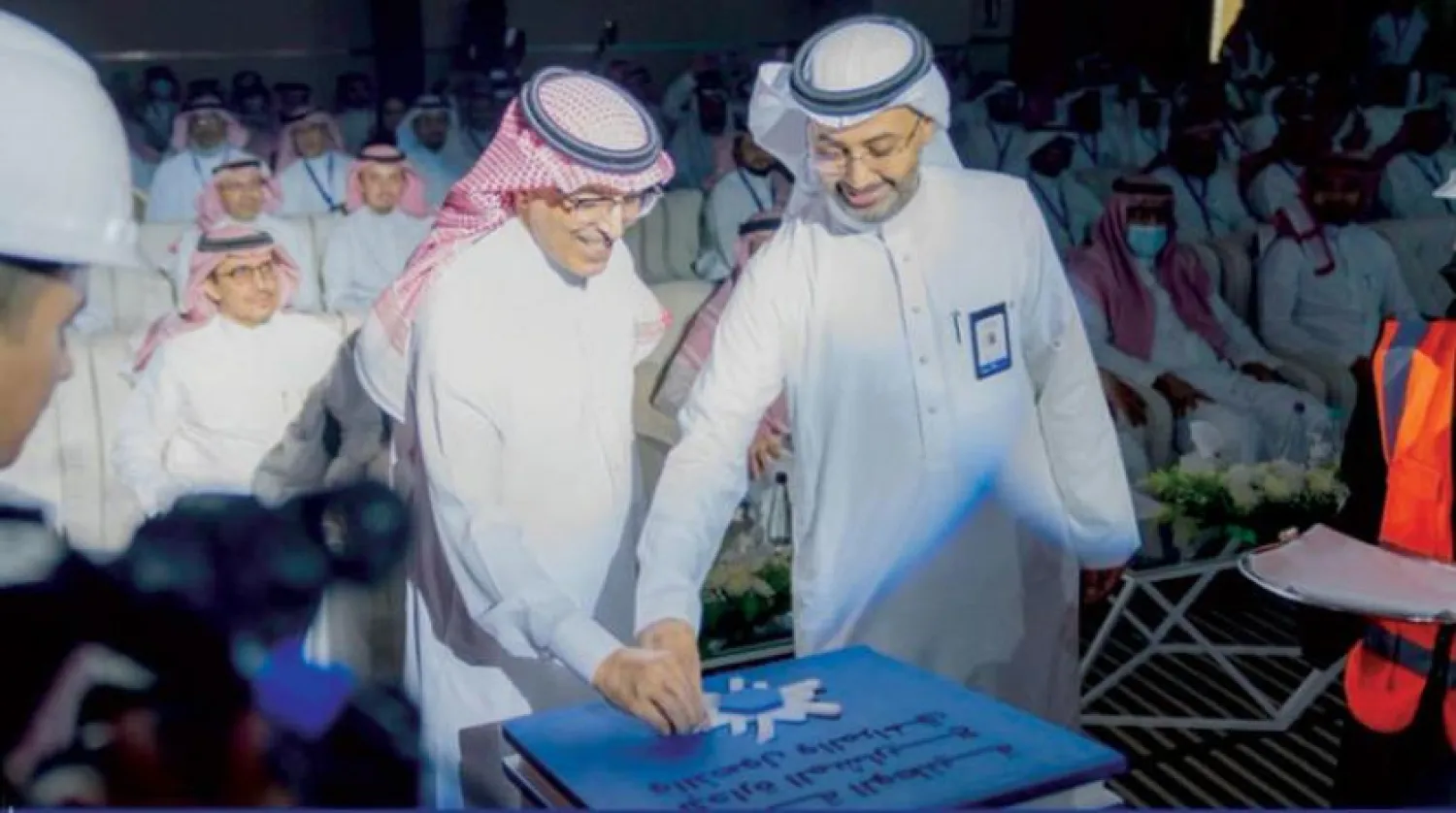
Saudi Minister of Finance Mohammed Al-Jadaan during the inauguration of the National Guide to Project Management and the National Guide to Asset and Facilities Management (Asharq Al-Awsat)
Saudi Develops Capital Projects’ Portfolios in 20 Entities
Saudi Minister of Finance Mohammed Al-Jadaan during the inauguration of the National Guide to Project Management and the National Guide to Asset and Facilities Management (Asharq Al-Awsat)
Saudi authorities have recently accomplished many achievements in the field of financial sustainability, redirecting SAR540 billion to high-priority spending to serve locals and residents, Minister of Finance Mohammed Al-Jadaan said.
Al-Jadaan, who is also the Chairman of Expenditure & Projects Efficiency Authority (EXPRO), inaugurated the National Guide to Project Management and the National Guide to Asset and Facilities Management, during a ceremony in the presence of a number of government agency officials and specialists.
EXPRO has developed an action plan with 20 highest-spending government agencies to arrange their priorities and align them with the goals of Vision 2030, said Al-Jadaan.
The minister further explained that the efforts of a number of government agencies resulted in the launch of the National Guide to Project Management, and the National Guide to Asset and Facilities Management, which will contribute to achieving institutional excellence and raising the quality of projects, assets, facilities and infrastructure planning.
Al-Jadaan indicated that the recent measures in the field of achieving quality and sustainability of project management and public utilities are part of a larger and broader process.
For his part, the CEO of EXPRO, Abdul Razzaq bin Subhi Al-Aujan, said the two guides have been prepared in accordance with the best local and international standards and practices.
“They were under the supervision and follow-up of distinguished national competencies and expertise, which contributes to improving and raising spending efficiency in operating expenses and consolidating the quality of the services provided,” said Al-Aujan.
“Work has been done to build the scientific content of the two guides based on rich national and global experiences for managing infrastructure projects in all its stages, covering the entire life cycle of the project starting from the planning and construction stage, through the stages of contracting and purchasing, and from operating and maintaining with initiatives to raise spending efficiency in partnership with government agencies,” he added.
BlackRock: Saudi Arabia Accounts for More Than 60% of Capital-Raising in the Regionhttps://english.aawsat.com/business/5321137-blackrock-saudi-arabia-accounts-more-60-capital-raising-region
BlackRock: Saudi Arabia Accounts for More Than 60% of Capital-Raising in the Region
The King Abdullah Financial District (KAFD) in Riyadh
Saudi Arabia is leading fundraising in the region, accounting for over 60% of all Middle East-based funds closed since 2015, a sign of the Kingdom's growing role as a destination for private investment, alongside a broader regional shift from being merely a source of capital to becoming a market that attracts investment and redeploys it domestically.
BlackRock's Aladdin released on Tuesday “Market Evolution: The Middle East,” a new report examining the region's shift from a source of global private markets capital to a destination for private capital deployment.
The report says Saudi Arabia’s economic transformation programs, growing infrastructure investments, and advancing institutional capabilities are driving the expansion of the Kingdom’s private capital market. At the same time, investor appetite for technology, infrastructure, and other sectors continues to grow.
Saudi Arabia’s leadership in capital fundraising has been accompanied by an accelerating pace of domestic capital deployment.
According to the report, “Saudi Arabia's Public Investment Fund has accelerated domestic deployment, overtaking rest-of-world direct deal activity in the Middle East deals in 2023 and has extended that lead since.”
This shift reflects a broader trend toward building a local market capable of absorbing a larger share of investment capital. In 2024, Larry Fink, Chairman and CEO of BlackRock, stated that BlackRock Riyadh Investment Management Platform, launched in partnership with PIF, aims to elevate Saudi Arabia’s capital markets and attract greater foreign institutional investment.
He noted that the ambition extends beyond connecting global investors to Saudi Arabia; it also includes “bringing capital back to Saudi Arabia.”
Larry Fink, Chairman and CEO of BlackRock, speaking at a session of the Future Investment Initiative conference (Asharq Al-Awsat file photo)
Fink later highlighted the development of local capital markets as a central theme in his discussions with regional leaders. He emphasized that BlackRock’s partnership with PIF was designed to encourage investment and strengthen the Kingdom’s capital markets.
These developments coincide with growing interest among major investors in the region in private assets. “Middle East sovereign wealth funds tracked by Preqin allocate 43% of their exposure to private capital, compared with 35% for their rest-of-world peers, and appetite continues to build,” said the report.
“The share of Middle East LP investors positive on or considering private equity mandates has climbed from 70% in 2019 to 83% in 2026. Among LP investors elsewhere in the world, that figure has moved only marginally over the same period, from 60% to 61%, showing regional conviction is growing well ahead of the global baseline,” it added.
Managing Director and Head of Aladdin Business Development for the Middle East, Central Asia, Africa and India Ayman Daif said: "The direction of travel in the region points to a structural shift: capital is increasingly being deployed at home, and the institutions and ecosystems are being built around it.”
"The next phase of growth will be shaped by continued collaboration between sovereign wealth funds, family offices and global investment managers, alongside broader adoption of technology and data-driven investment approaches,” he stated.
"This comes as BlackRock Investment Institute research suggests GCC countries will invest about $2.1 trillion by 2030, with spending focused on making economies more resilient to disruptions in trade, shipping and energy markets,” Daif added.
FILE PHOTO: The company logo and trading information for BlackRock is displayed on a screen on the floor of the New York Stock Exchange (NYSE) in New York, US, March 30, 2017. REUTERS/Brendan McDermid/File Photo
The report identifies Saudi Arabia and the UAE as the region's leading private capital markets, supported by economic transformation programs, expanding infrastructure investment and growing institutional sophistication, with centers such as Kuwait also increasing activity.
The report’s findings also highlight the growing importance of infrastructure and digital infrastructure investment. Regional investors cite opportunities across energy, utilities, transport, data centers and artificial intelligence-related infrastructure as key drivers of future growth.
Family offices are also playing an increasingly important role in the region's investment ecosystem. The report finds family offices now account for nearly half of active private capital investors in the Middle East, with private equity representing their largest area of investment interest.
GCC family offices tilt toward private equity at 27% of future search mandates, ahead of real estate at 19%, private credit at 16%, infrastructure at 14%, hedge funds at 13%, and natural resources at 11%.
As an indication of the resilience of the region’s venture capital market amid a more challenging global funding environment, aggregate Middle East VC deal value averaged $2.4 billion per year between 2021 and 2025, holding steady throughout the period.
Add-ons have also risen from 20% of total buyout deal activity in 2020 to 46% in 2025, reflecting the growing use of this strategy to expand companies and existing investment platforms.
“Market Evolution: The Middle East” draws on Preqin Pro data as of June 2026, covering funds closed in the Middle East since 2015 and private capital deal activity since 2020.
The report also draws on preliminary results from Preqin's upcoming Middle East Investor Survey, which had captured responses from 26 regional investors and remained open at the time of publication, alongside interviews with BlackRock leaders across the region.
Oil Prices Climb after Declining for 4 Consecutive Sessionshttps://english.aawsat.com/business/5321102-oil-prices-climb-after-declining-4-consecutive-sessions
FILE PHOTO: Flames and smoke rise from the Greek-flagged oil tanker Sounion, which has been on fire since August 23, after an attack by Houthi militants, on the Red Sea, September 12, 2024 in this handout image. EUNAVFOR ASPIDES/Handout via REUTERS
Oil Prices Climb after Declining for 4 Consecutive Sessions
FILE PHOTO: Flames and smoke rise from the Greek-flagged oil tanker Sounion, which has been on fire since August 23, after an attack by Houthi militants, on the Red Sea, September 12, 2024 in this handout image. EUNAVFOR ASPIDES/Handout via REUTERS
Oil prices gained on Tuesday after declining for four consecutive sessions as investors awaited developments on potential US-Iran talks at the United Nations General Assembly this week after more supplies emerged through the Strait of Hormuz over the weekend.
The Brent crude futures November contract rose $1.29, or 1.29%, to $101.63 a barrel at 0758 GMT. The WTI October contract, which expires on Tuesday, climbed 92 cents, or 0.96%, to $96.70 a barrel, Reuters reported.
The more actively traded November contract was up 80 cents, or 0.87%, at $93.17 a barrel.
Tehran and Washington exchanged threats on Sunday, though US President Donald Trump said he would be open to meeting Iranian President Masoud Pezeshkian, who is expected to be in New York this week for the UN meeting.
The rebound in crude suggests traders need fresh developments on supply risks or diplomatic efforts before pushing prices materially lower, said Ole Hansen, head of commodity strategy at Saxo Bank.
Over the weekend, Iran also reportedly conveyed its conditions to mediators for re-engaging in negotiations.
"Oil exports from the Middle East have recovered but remain well below pre-conflict averages," said UBS analyst Giovanni Staunovo.
Hansen said he does not see much further downside in oil prices until there is increased supply through the Strait of Hormuz, particularly refined products, where the real crunch remains.
Separately, an armed group closed valve seven on Libya's Sharara crude pipeline to Zawiya port on Monday, resulting in a significant decline in production at the Sharara oilfield, Libya's National Oil Corporation said in a statement.
Production at the field has fallen by around 200,000 barrels per day and is currently between 100,000 and 105,000 bpd, two engineers at the field told Reuters.
Binance Reportedly Under US Scrutiny Over Possible Iran Sanctions Violationshttps://english.aawsat.com/business/5321066-binance-reportedly-under-us-scrutiny-over-possible-iran-sanctions-violations
FILE PHOTO: Smartphone with displayed Binance logo and representation of cryptocurrencies are placed on a keyboard in this illustration taken, June 8, 2023. REUTERS/Dado Ruvic/Illustration/File Photo
Binance Reportedly Under US Scrutiny Over Possible Iran Sanctions Violations
FILE PHOTO: Smartphone with displayed Binance logo and representation of cryptocurrencies are placed on a keyboard in this illustration taken, June 8, 2023. REUTERS/Dado Ruvic/Illustration/File Photo
US federal prosecutors are investigating whether Binance violated sanctions on Iran by failing to prevent certain trading activity on its platform, Bloomberg News reported on Monday, citing people familiar with the matter.
Here are a few details:
The probe is being led by the Manhattan US attorney's office, with the Justice Department's criminal division in Washington also involved, Bloomberg News reported, adding that authorities are examining whether Binance knowingly allowed the trading.
Binance said in a statement that it has a zero-tolerance approach to sanctions violations. "We fully cooperate with law enforcement, and we remain committed to rooting out and shutting down bad actors."
The DOJ declined to comment to Reuters, while the Manhattan US attorney's office could not immediately be reached for a comment outside regular business hours.
Binance has faced US scrutiny in the past. In 2023, Binance's then-chief Changpeng Zhao stepped down and pleaded guilty to breaking US anti-money laundering laws as part of a $4.3 billion settlement resolving a years-long probe into the world's largest crypto exchange.
The US government earlier this month imposed sanctions on firms and individuals it says are helping Hezbollah and other Iranian proxies in the Middle East, intensifying its campaign to isolate Iran economically.
لم تشترك بعد
انشئ حساباً خاصاً بك لتحصل على أخبار مخصصة لك ولتتمتع بخاصية حفظ المقالات وتتلقى نشراتنا البريدية المتنوعة