
Iraqi Leaders Vow to Move Ahead after Sadr MPs Quit Parliament

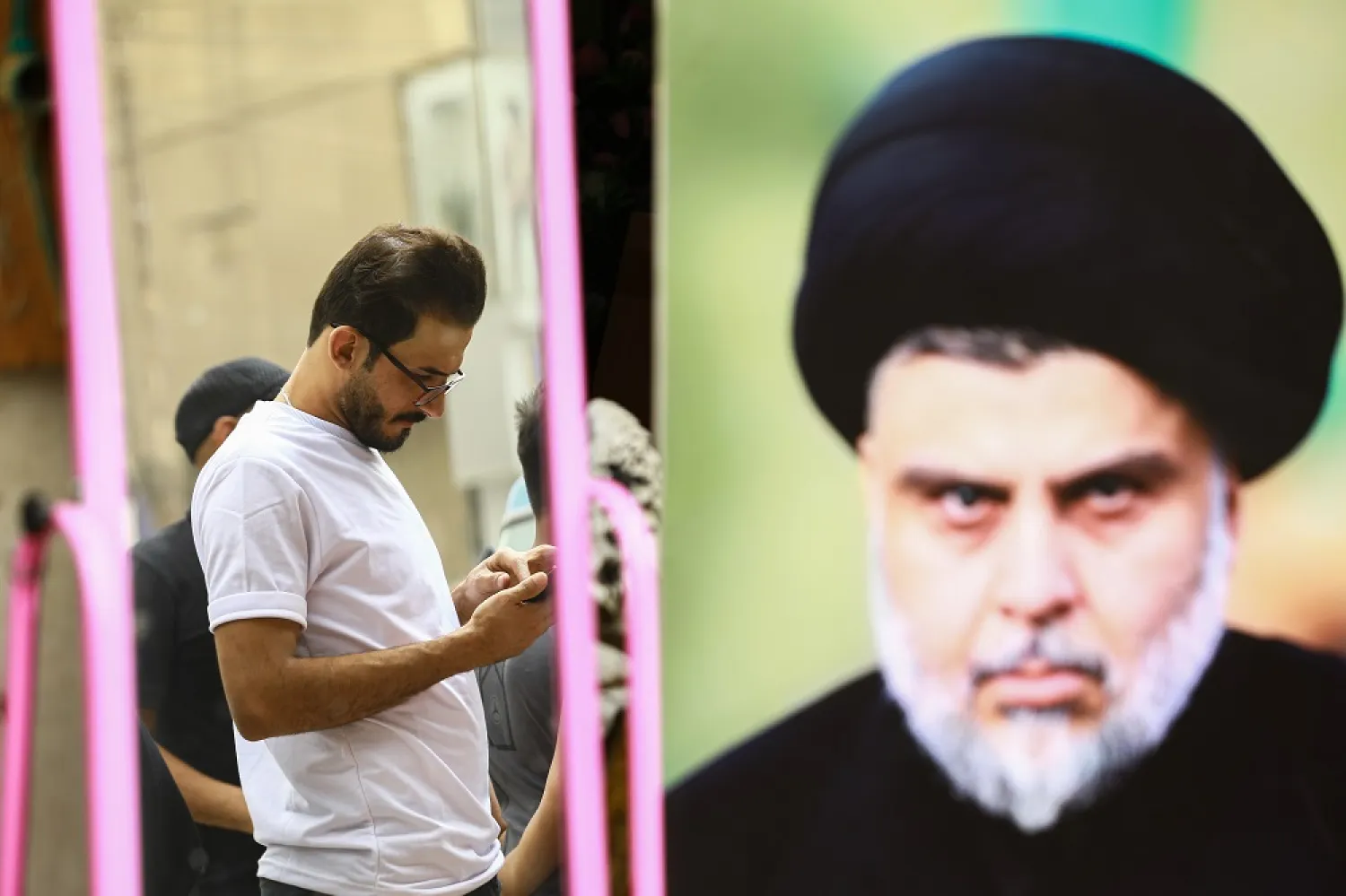
13 June 2022, Iraq, Sadr City: A man stands on the street near a poster bearing the picture of Iraqi Shiite cleric Moqtada al-Sadr. (dpa)
TT

Iraqi Leaders Vow to Move Ahead after Sadr MPs Quit Parliament

13 June 2022, Iraq, Sadr City: A man stands on the street near a poster bearing the picture of Iraqi Shiite cleric Moqtada al-Sadr. (dpa)

Iraqi leaders vowed Monday to move forward with efforts to form a government following the shocking resignation of 73 lawmakers from parliament during a prolonged political impasse.

But the unprecedented mass withdrawal by members of Shiite cleric Moqtada al-Sadr’s bloc dramatically alters the political landscape, throwing government formation talks into further doubt.

It is a huge gamble by Sadr, one of the most influential politicians in Iraq with a large street following, leaving his political movement out of parliament for the first time since 2005.

The surprise move is an attempt to break a persistent political impasse eight months after general elections were held.

Sadr emerged as the winner of the October vote, giving him 73 out of Parliament’s 329 seats. It was also a blow for his Iran-backed Shiite rivals who lost about two-thirds of their seats and have rejected the results.

Since then, the two sides have been locked in a cutthroat competition for power, even as the country faces growing challenges including an impending food crisis resulting from severe drought and the war in Ukraine.

Sadr had been intent on forming, along with his allies, a majority government that excludes the Iran-backed factions. But he has not been able to corral enough lawmakers to get the two-thirds majority needed to elect Iraq’s next president - a necessary step ahead of naming the next prime minister and selecting a Cabinet.

On Sunday, he ordered his lawmakers to resign calling it a "sacrifice" he was making for the good of the country. His cousin and nominee for prime minister, Jaafar al-Sadr, withdrew his candidacy Monday.

"Moqtada’s withdrawal bolsters his political position, and will help him win the sympathy of the disenchanted Iraqi street fed up with politicians and the political process," said political analyst Ihsan al-Shammari, according to The Associated Press.

"He knows there’s going to be protests in the street, and this will open communication channels with the protesters, making him the only survivor," he added.

The question now is whether the political parties will be able to form a government with Sadr in the opposition.

With the resignation of Sadrist lawmakers, Iranian-backed groups are now expected to hold the majority in parliament.

According to Iraqi law, if a seat in parliament becomes vacant, the candidate who obtained the second highest number of votes in the district takes the seat. In this case, it would be Sadr’s opponents from the so-called Coordination Framework, a coalition led by Iran-backed Shiite parties and their allies.

"Any government in which Moqtada does not participate will be stillborn," Shammari said. He also questioned whether the Iran-backed parties would be able and willing to negotiate with Kurdish Democratic Party leader Masoud Barzani, with whom there is mutual and deep-seated distrust.

The election was held several months earlier than expected, in response to mass protests that broke out in late 2019 that saw tens of thousands rally against endemic corruption, poor services and unemployment.

Parliament Speaker Mohammed al-Halbousi said Monday that government formation efforts will continue based on certain "other political understandings," without elaborating.

A Shiite politician said he expected the political process to go ahead with the Coordination Framework, which will have more than 100 seats after Sadr’s withdrawal, seeking to form the next government.

"Negotiations will proceed with the other Sunni and Kurdish blocs," he said, speaking on condition of anonymity because he was not authorized to give official statements.

He said the next government may face protests or disturbances in the street, especially from followers of Sadr, and its success would depend on the government’s ability to manage it.

A member of parliament from the Coordination Framework who refused to be named admitted they were baffled by Sadr’s withdrawal.

"We do not know yet the motives behind Moqtada’s withdrawal. ... This was a surprise for all of us," he said. The lawmaker pointed out that the resignations took place while parliament was in recess and that there could still be new developments.

"We have a month for parliament to return and everything is possible in this month," he said.


Meta's Zuckerberg Faces Questioning at Youth Addiction Trial

REUTERS/Francis Mascarenhas Purchase Licensing Rights
TT

Meta's Zuckerberg Faces Questioning at Youth Addiction Trial

REUTERS/Francis Mascarenhas Purchase Licensing Rights

Meta Platforms CEO and billionaire Facebook founder Mark Zuckerberg is set to be questioned for the first time in a US court on Wednesday about Instagram's effect on the mental health of young users, as a landmark trial over youth social media addiction continues. While Zuckerberg has previously testified on the subject before Congress, the stakes are higher at the jury trial in Los Angeles, California. Meta may have to pay damages if it loses the case, and the verdict could erode Big Tech's longstanding legal defense against claims of user harm, Reuters reported.

The lawsuit and others like it are part of a global backlash against social media platforms over children's mental health. Australia has prohibited access to social media platforms for users under age 16, and other countries including Spain are considering similar curbs. In the US, Florida has prohibited companies from allowing users under age 14. Tech industry trade groups are challenging the law in court. The case involves a California woman who started using Meta's Instagram and Google's YouTube as a child. She alleges the companies sought to profit by hooking kids on their services despite knowing social media could harm their mental health. She alleges the apps fueled her depression and suicidal thoughts and is seeking to hold the companies liable.

Meta and Google have denied the allegations, and pointed to their work to add features that keep users safe. Meta has often pointed to a National Academies of Sciences finding that research does not show social media changes kids' mental health.

The lawsuit serves as a test case for similar claims in a larger group of cases against Meta, Alphabet's Google, Snap and TikTok. Families, school districts and states have filed thousands of lawsuits in the US accusing the companies of fueling a youth mental health crisis.

Zuckerberg is expected to be questioned on Meta's internal studies and discussions of how Instagram use affects younger users.

Over the years, investigative reporting has unearthed internal Meta documents showing the company was aware of potential harm. Meta researchers found that teens who report that Instagram regularly made them feel bad about their bodies saw significantly more “eating disorder adjacent content” than those who did not,

Reuters reported

in October. Adam Mosseri, head of Instagram, testified last week that he was unaware of a recent Meta study showing no link between parental supervision and teens' attentiveness to their own social media use. Teens with difficult life circumstances more often said they used Instagram habitually or unintentionally, according to the document shown at trial.

Meta's lawyer told jurors at the trial that the woman's health records show her issues stem from a troubled childhood, and that social media was a creative outlet for her.


Israel Permits 10,000 West Bank Palestinians for Friday Prayers at Al Aqsa

Palestinians attend Friday prayers in a mosque following an attack that local Palestinians said was carried out by Israeli settlers, in the village of Deir Istiya near Salfit in the Israeli-occupied West Bank November 14, 2025. REUTERS/Sinan Abu Mayzer
TT

Israel Permits 10,000 West Bank Palestinians for Friday Prayers at Al Aqsa

Palestinians attend Friday prayers in a mosque following an attack that local Palestinians said was carried out by Israeli settlers, in the village of Deir Istiya near Salfit in the Israeli-occupied West Bank November 14, 2025. REUTERS/Sinan Abu Mayzer

Israel announced that it will cap the number of Palestinian worshippers from the occupied West Bank attending weekly Friday prayers at the Al-Aqsa Mosque in east Jerusalem at 10,000 during the holy month of Ramadan, which began Wednesday.

Israeli authorities also imposed age restrictions on West Bank Palestinians, permitting entry only to men aged 55 and older, women aged 50 and older, and children up to age 12.

"Ten thousand Palestinian worshippers will be permitted to enter the Temple Mount for Friday prayers throughout the month of Ramadan, subject to obtaining a dedicated daily permit in advance," COGAT, the Israeli defense ministry agency in charge of civilian matters in the Palestinian territories, said in a statement, AFP reported.

"Entry for men will be permitted from age 55, for women from age 50, and for children up to age 12 when accompanied by a first-degree relative."

COGAT told AFP that the restrictions apply only to Palestinians travelling from the West Bank, which Israel has occupied since the 1967 Arab-Israeli war.

"It is emphasised that all permits are conditional upon prior security approval by the relevant security authorities," COGAT said.

"In addition, residents travelling to prayers at the Temple Mount will be required to undergo digital documentation at the crossings upon their return to the areas of Judea and Samaria at the conclusion of the prayer day," it said, using the Biblical term for the West Bank.

During Ramadan, hundreds of thousands of Palestinians traditionally attend prayers at Al-Aqsa, Islam's third holiest site, located in east Jerusalem, which Israel captured in 1967 and later annexed in a move that is not internationally recognized.

Since the war in Gaza broke out in October 2023, the attendance of worshippers has declined due to security concerns and Israeli restrictions.

The Palestinian Jerusalem Governorate said this week that Israeli authorities had prevented the Islamic Waqf -- the Jordanian-run body that administers the site -- from carrying out routine preparations ahead of Ramadan, including installing shade structures and setting up temporary medical clinics.

A senior imam of the Al-Aqsa Mosque, Sheikh Muhammad al-Abbasi, told AFP that he, too, had been barred from entering the compound.

"I have been barred from the mosque for a week, and the order can be renewed," he said.

Abbasi said he was not informed of the reason for the ban, which came into effect on Monday.

Under longstanding arrangements, Jews may visit the Al-Aqsa compound -- which they revere as the site of the first and second Jewish temples -- but they are not permitted to pray there.

Israel says it is committed to upholding this status quo, though Palestinians fear it is being eroded.

In recent years, a growing number of Jewish ultranationalists have challenged the prayer ban, including far-right politician Itamar Ben Gvir, who prayed at the site while serving as national security minister in 2024 and 2025.


EU Exploring Support for New Gaza Administration Committee, Document Says

Palestinians push a cart past the rubble of residential buildings destroyed during the two-year Israeli offensives, in Gaza City, February 17, 2026. REUTERS/Mahmoud Issa
TT

EU Exploring Support for New Gaza Administration Committee, Document Says

Palestinians push a cart past the rubble of residential buildings destroyed during the two-year Israeli offensives, in Gaza City, February 17, 2026. REUTERS/Mahmoud Issa

The European Union is exploring possible support for a new committee established to take over the civil administration of Gaza, according to a document produced by the bloc's diplomatic arm and seen by Reuters.

"The EU is engaging with the newly established transitional governance structures for Gaza," the European External Action Service wrote in a document circulated to member states on Tuesday.

"The EU is also exploring possible support to the National Committee for the Administration of Gaza," it added.

European foreign ministers will discuss the situation in Gaza during a meeting in Brussels on February 23.