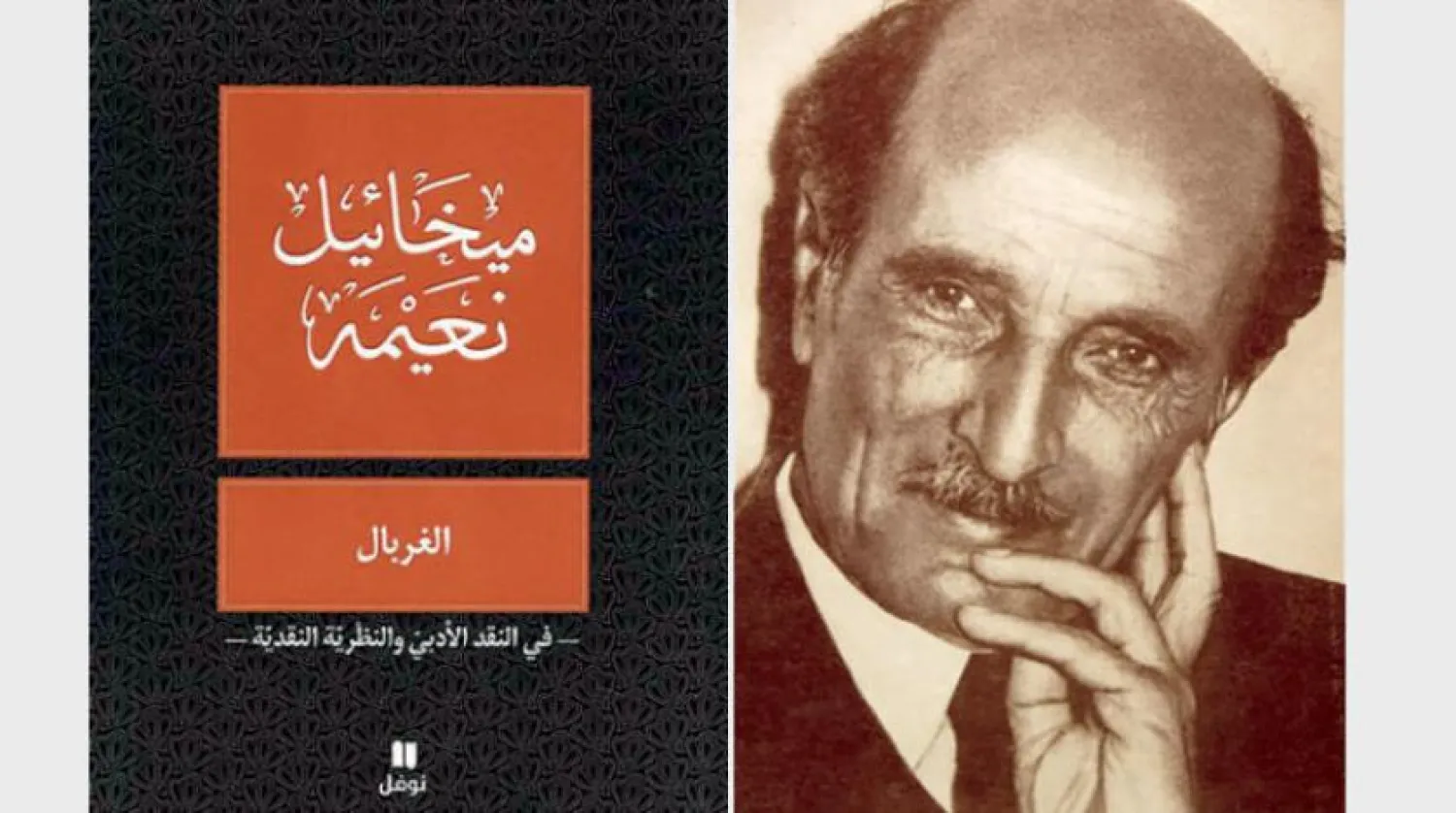

Mikhail Naimy's 'Al-Ghirbal': 'Arabic Literature Could Die If We Listen to the Croaking of Frogs'

Mikhail Naimy's 'Al-Ghirbal': 'Arabic Literature Could Die If We Listen to the Croaking of Frogs'
TT

Mikhail Naimy's 'Al-Ghirbal': 'Arabic Literature Could Die If We Listen to the Croaking of Frogs'

Mikhail Naimy's 'Al-Ghirbal': 'Arabic Literature Could Die If We Listen to the Croaking of Frogs'

Did the "Al-Ghirbal" book age? Did it lose its impact? Did it become obsolete? Yes, maybe in some of its aspects, but not in its essence.

The spirit of the book is still alive and reviving. It is still relevant to our current reality. In a nutshell, when we read the book, we feel that Mikhail Naimy is still living with us, and this is the loudest proof on his value and prominence as an Arabic, progressive, pioneering intellectual.

The book includes a large chapter, the "The Croaking of Frogs: Position of Language in Literature" that is enough to immortalize the book itself and Naimy.

But what does it mean?

It means the frogs of literature paralyze us with their croaks, swamps, and slackness. They paralyze the development of the Arabic language and Arabic life itself. They keep correcting your language: "say this and don’t say that", "this is acceptable and this is forbidden", "this is correct according to Al-Tha'alibi and Al-Asmai, and that is not, be careful", and "don’t you dare to violate the liturgies of inherited language, the Arabic language should remain s it is, as it has been for centuries."

Why don't you write in the correct dictionary language? Otherwise, you would violate literary standards. Let us take Gibran Khalil Gibran's famed "Al-Mawakeb" poem, which was sung by by Fairuz, in which he wrote:

"Have you bathed in its fragrance and dried yourself in its light."

This great poem reminds us of Lebanon’s mountains, creeks, and valleys where you can feel the scent of existence. But the problem in this etherical poem is that it contains a linguistic mistake! The literary frogs or the Arabic language frogs describe it as linguistic mistake, frown upon it, and blame the writer for it.

For them, Gibran committed an unforgivable crime against the Arabic language. But what’s this crime? Where is it? I can’t see it. Why did the poet use the word "Yatahamam" (Arabic for bathe) instead of its legitimate, classic Arabic alternative "istaham"? Can a genius, creative writer commit to the literary language of Al-Tha'alibi and Al-Asmai? Wouldn’t this commitment affect his genius and creativity?

The poet has the right to invent new words, to ignite the language, to practice his freedom.

Without this freedom, there would be no linguistic development, and Arabic literature would die if we listened to the croaking frogs. Instead, we should listen carefully to Naimy, who said: "If the Arabic language frogs saw the history of their language, they would find the greatest proof on this saying. Didn’t they see that the language we use today to write in our magazines and newspapers and to speak on stages is different from the language of Mudar, Tamim, Humair, and Quraysh? Didn’t they notice that if their ancestors managed to control us 2,000 years ago, we wouldn’t have the language we use today?"

Here lies the importance of this great book. It really cares about the Arabic language and seeks to develop and save it, but how? By allowing it to inspire its terms from our life. However, the close-minded linguists want to control and suffocate the language. For example, the French people envy us because they don’t have a feminine form for the word "doctor" and have to use "female doctor"; they don’t have a feminine form for the word "writer" as well, but we do. In fact, they have recently invented a feminine form of the world writer, but it’s ugly. And yet, some Arab writers still find new ways to bring more complexity to our language.

But why all this burden? Let the Arabic language breathe, let it loosen, let it become closer to our daily life language.
Saudi Arabia: Ship of Tolerance Initiative Promotes Cultural Dialogue in Jeddah

The Royal Institute of Traditional Arts (Wrth) will offer traditional craft workshops throughout Ramadan. SPA
TT

Saudi Arabia: Ship of Tolerance Initiative Promotes Cultural Dialogue in Jeddah

The Royal Institute of Traditional Arts (Wrth) will offer traditional craft workshops throughout Ramadan. SPA

The Saudi Ministry of Culture, in collaboration with the "Lenobadir" volunteer and community partnership program and the Athr Foundation, has launched the Ship of Tolerance initiative in Historic Jeddah during Ramadan.

The initiative aims to enhance shared human values through arts, and promote tolerance and coexistence among children and families. It provides an educational and cultural experience aligned with the area’s unique character as a UNESCO World Heritage site.

As part of this global art project, children will create artworks that represent acceptance and dialogue.

The Royal Institute of Traditional Arts (Wrth) will offer traditional craft workshops throughout Ramadan, linking the initiative's values with local heritage and enriching visitors' connection to the region's identity.

This effort supports cultural programs with educational and social dimensions in Historic Jeddah, activating local sites for experiences that combine art, crafts, and community participation. It aligns with the National Strategy for Culture under Saudi Vision 2030, focusing on heritage preservation and expanding culture's impact on daily life.


Oscar Contender ‘Hamnet’ Boosts Tourism at Shakespeare Heritage Sites 

A view of Shakespeare’s Birthplace, William Shakespeare's childhood home, in Stratford-upon-Avon, Britain, February 9, 2026. (Reuters)
TT

Oscar Contender ‘Hamnet’ Boosts Tourism at Shakespeare Heritage Sites 

A view of Shakespeare’s Birthplace, William Shakespeare's childhood home, in Stratford-upon-Avon, Britain, February 9, 2026. (Reuters)

On a cloudy winter's day, visitors stream into what was once William Shakespeare's childhood home in Stratford-upon-Avon and the nearby Anne Hathaway's cottage, family residence of the bard's wife.

Hathaway's cottage is one of the settings for the BAFTA and Oscar best film contender "Hamnet", and the movie's success is drawing a new wave of tourists to Shakespeare sites in the town in central England.

Shakespeare's Birthplace is the house the young William once lived in and where his father worked as a glove maker, while Hathaway's cottage is where he would have visited his future wife early in their relationship.

Typically, around 250,000 visitors, from the UK, Europe, the United States, China and elsewhere, walk through the locations each year, according to the Shakespeare Birthplace Trust. ‌The charity looks after ‌Shakespeare heritage sites, which also include Shakespeare's New Place, the site of ‌the ⁠Stratford home where the ⁠bard died in 1616.

Visitors are flocking in this year thanks to "Hamnet", the film based on Maggie O'Farrell's 2020 novel, which gives a fictional account of the relationship between Shakespeare and Hathaway, also known as Agnes, and the death of their 11-year-old son Hamnet in 1596.

"Visitor numbers have increased by about 15 to 20% across all sites since the film was released back in January. I think that will only continue as we go throughout the year," Richard Patterson, chief operating officer for the Shakespeare Birthplace Trust, said.

"They particularly want ⁠to look (at) Anne Hathaway's cottage and the specifics around how the family ‌engaged in the spaces and the landscape in and around ‌the cottage... you can see why he would have been inspired."

NEW ACCESS TO SHAKESPEARE

"Hamnet" has 11 nominations at ‌Sunday's British BAFTA awards, including best film and leading actress for Jessie Buckley, who plays Agnes. It ‌also has eight Oscar nominations, with Buckley seen as the frontrunner to win best actress.

"Hamnet" is set in Stratford-upon-Avon and London although it was not filmed in Stratford.

It sees Paul Mescal's young Shakespeare fall for Agnes while teaching Latin to pay off his father's debts. The drama, seen mainly through Agnes' eyes, focuses on their ‌life together and grief over Hamnet's death, leading Shakespeare to write "Hamlet".

"Shakespeare... is notoriously enigmatic. He writes about humanity, about feeling, about emotion, about conflict, ⁠but where do we understand ⁠who he is in that story?" said Charlotte Scott, a professor of Shakespeare studies and interim director of collections, learning and research at the Shakespeare Birthplace Trust.

"And that's driven people creative and otherwise for hundreds and hundreds of years. Where is Shakespeare's heart? And this is what the film I think has so beautifully opened up."

Little is known about how the couple met. Shakespeare was 18 and Hathaway 26 when they married in 1582. Daughter Susanna arrived in 1583 and twins Judith and Hamnet in 1585.

The film acknowledges the names Hamnet and Hamlet were interchangeable back then. While grief is a dominant theme, audiences also see Shakespeare in love and as a father.

"A lot of people will see this film not necessarily having... had any kind of relationship with Shakespeare," Scott said.

"So people will come to this film, I hope, and find a new way of accessing Shakespeare that is about creativity, that is about understanding storytelling as a constant process of regeneration, but also crucially, looking at it from that kind of emotive angle."


Culture Ministry Continues Preparations in Historic Jeddah to Welcome Visitors during Ramadan 

Historic Jeddah has emerged as a leading cultural tourism destination during Ramadan. (SPA)
TT

Culture Ministry Continues Preparations in Historic Jeddah to Welcome Visitors during Ramadan 

Historic Jeddah has emerged as a leading cultural tourism destination during Ramadan. (SPA)

The Saudi Ministry of Culture is continuing its efforts to revitalize Historic Jeddah in preparation for welcoming visitors during the holy month of Ramadan, offering cultural programs, events, and heritage experiences that reflect the authenticity of the past.

The district has emerged as a leading cultural tourism destination at this time of year as part of the “The Heart of Ramadan” campaign launched by the Saudi Tourism Authority.

Visitors are provided the opportunity to explore the district’s attractions, including archaeological sites located within the geographical boundaries of the UNESCO World Heritage-listed area, which represent a central component of the Kingdom’s urban and cultural heritage.

The area also features museums that serve as gateways to understanding the city’s rich heritage and cultural development, in addition to traditional markets that narrate historical stories through locally made products and Ramadan specialties that reflect authentic traditions.

These initiatives are part of the ministry’s ongoing efforts to revitalize Historic Jeddah in line with the objectives of Saudi Vision 2030 and aiming to transform it into a vibrant hub for arts, culture, and the creative economy, while preserving its tangible and intangible heritage.