


Yemen Insists on Ending Taiz Blockade, Achieving Peace According to the References

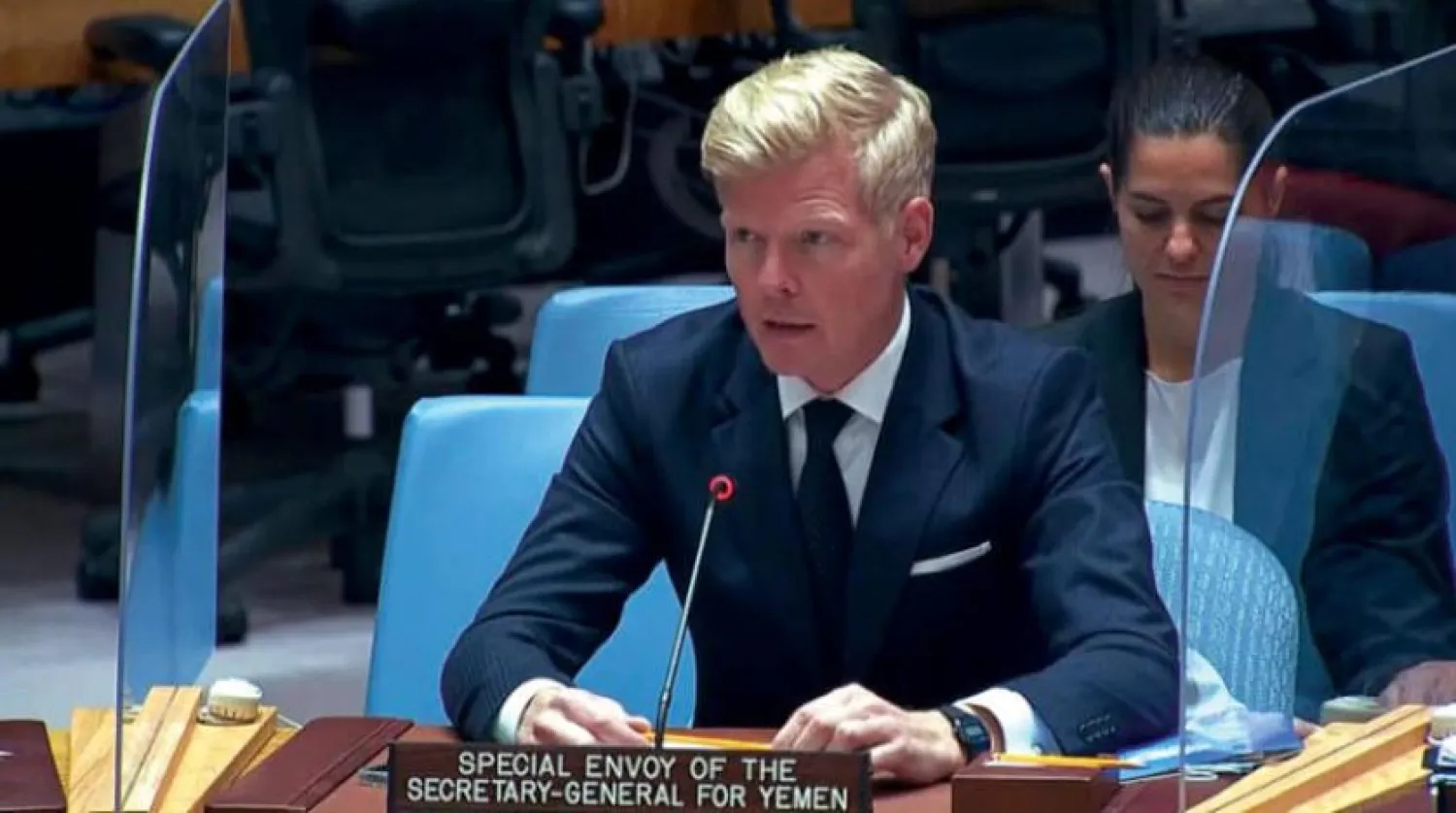
UN envoy Hans Grundberg speaks at the Security Council session (UN)
TT

Yemen Insists on Ending Taiz Blockade, Achieving Peace According to the References

UN envoy Hans Grundberg speaks at the Security Council session (UN)

The Yemeni government renewed its call to the international community to pressure the Houthi militias to end the Taiz siege and abide by all the ceasefire terms.

Yemen's representative at the UN, Abdullah al-Saadi, affirmed the government's keenness to achieve a comprehensive and sustainable peace to end the conflict and support the efforts of the Special Envoy of the UN Secretary-General to Yemen Hans Grundberg.

Speaking at the Security Council's session on the developments in Yemen, the US Permanent Representative, Linda Thomas Greenfield, said there is a reason for hope thanks to the extension of the truce, describing it as "the best opportunity for peace."

However, she noted that difficult work lies ahead, drawing attention to President Joe Biden's trip to the region next month, calling for taking advantage of this unique moment to consolidate recent gains and lay the foundation for a long-awaited political solution.

"We can and must capitalize on this unique moment to solidify recent gains and lay the groundwork for a long-awaited political resolution to the conflict," she asserted.

The Envoy described the next two months as "critical to long-term peace efforts," adding: "We urge all parties to cooperate fully with Special Envoy Grundberg as he builds on the truce to launch a comprehensive and inclusive political process."

Grundberg expressed optimism about the truce, saying it had been holding for two and half months, which seemed unimaginable at the beginning of the year.

He touched on the achievements of his office during the past month, detailing the benefits of maintaining the truce.

Grundberg said he awaits Houthis' response to his proposal to lift the siege on Taiz, urging them to reply "without delay."

Waiting for the Houthis

The UN envoy expressed fears of the collapse of the truce, saying recent weeks have shown the ceasefire's fragility and that implementation delays might threaten to unravel it in its entirety.

"Resorting to transactionalism, threatening to condition the implementation of one element of the truce against another, and using escalatory media rhetoric undermines the truce."

Grundberg referred to the contentious issues that have emerged during recent discussions, such as revenue management, civil sector salary payments, travel documents, and a more durable ceasefire.

He stressed that recent discussions included the "need to transform the truce into a durable ceasefire with an outlook to longer-term security arrangements; and an urgent call for the payment of public sector salaries and the management of revenues, monetary policy coordination, and reconstruction."

"Over the next month and a half, I will pursue two main lines of effort. First, I will work with the parties to ensure the implementation and consolidation of all the elements of the truce, including the opening of roads in Taiz and other governorates. Second, I will work to achieve more durable solutions to pressing economic and security needs," he asserted.

The Yemeni representative described the truce as a step toward a comprehensive ceasefire and the resumption of consultations to reach a political settlement based on the three references represented by the Gulf initiative and its executive mechanism, the outcomes of the comprehensive National Dialogue Conference, and the relevant Security Council resolutions.

Saadi said that the decision of the Presidential Leadership Council to extend the truce for two months was based on its rejection of the use of humanitarian needs as leverage.

However, the Houthis continue to renege on their commitments, said the diplomat, adding that they have planted landmines indiscriminately, violate the truce daily, and are using the Safer oil tanker as a bargaining chip.

He accused the militias of continuing to renounce their commitments and obstructing international efforts to move forward.

The Yemeni envoy referred to the intransigence of the Houthis on Taiz, saying they seized over YR90 billion from taxes and customs revenues of oil derivatives in Hodeidah port and refused to pay the salaries of public sector employees.

Saadi added that the Yemeni government has adhered to restraint, despite the insurgents’ daily violations on various fronts.

He stressed that their repeated violations of the UN truce put the international community and the Security Council before a test, calling for pressuring the militias to respond to peace efforts.

"Peace cannot be achieved without a genuine, true partner," said the envoy.

Reminder to end the siege

Saadi said that more than four million people are still displaced from Taiz, describing the Houthi siege as "a war crime, a crime against humanity, and a flagrant violation of laws and international conventions."

He accused the Houthis of recruiting children in their summer centers, describing it as a "flagrant violation of childhood rights, national laws and legislation, and international treaties."

He said that, unfortunately, the international community remains silent, ignoring the dangers of this crime on Yemen, the region, and the world.

Saadi reiterated the Yemeni government's full support for the UN efforts to address the issues of the Safer oil tanker to avoid the impending environmental, humanitarian, and economic catastrophe.

The Council must act swiftly to ensure the Houthis abide by the United Nations plan, he said, adding that the international community needs to fund and implement the plan to avoid a disaster that will cost billions of dollars.



Israeli Leaks Test Prospects for Gaza Deal’s Second Phase

A young girl stands in front of tents that burned after candles were lit for lighting at a displacement camp in Gaza City on Friday (AFP)
TT

Israeli Leaks Test Prospects for Gaza Deal’s Second Phase

A young girl stands in front of tents that burned after candles were lit for lighting at a displacement camp in Gaza City on Friday (AFP)

A stream of Israeli leaks has highlighted moves toward alternative scenarios in Gaza if the disarmament of Hamas is not carried out soon.

The options being floated range from freezing reconstruction across the enclave and limiting rebuilding to areas under Israeli control to the prospect of renewed military operations.

Experts who spoke to Asharq Al-Awsat described the leaks about alternative plans to confront Hamas as pressure tactics and contingency plans, saying they reflect expectations that the main plan to disarm the resistance will not be implemented immediately.

They said such measures further complicate the path of the second phase, making it, even if launched, a lengthy process due to Israeli obstacles.

Israel’s Yedioth Ahronoth newspaper reported on Friday, citing sources, that the army is preparing alternative plans to carry out a new military operation in Gaza to dismantle Hamas infrastructure if an international force fails in its mission.

This followed earlier Israeli talk of starting partial reconstruction in the southern city of Rafah before Hamas is disarmed, according to Israel’s Channel 12. That proposal contradicts efforts by Arab states to pursue a comprehensive reconstruction of Gaza.

The leaks came after a meeting last week between US President Donald Trump and Israeli Prime Minister Benjamin Netanyahu.

Israel Hayom reported at the time that the two had agreed on Jan. 15 as the date to begin the second phase of Trump’s Gaza plan, with a two-month deadline to dismantle Hamas’ weapons, amid presidential threats against the Palestinian movement if it fails to comply.

Mokhtar Ghobashy, Secretary General of the Al-Farabi Center for Strategic Studies, stated that the second phase of the Gaza agreement is inherently complex and that Israel does not want to enter it except on terms that serve its interests.

He said this became clear after the Trump-Netanyahu meeting, noting that there appears to be an agreed path allowing the launch of the second phase, but at a slow pace. Any acceleration, he said, would depend on the interests achieved by both sides, not just the Palestinians.

Barakat Al-Farra, a former Palestinian ambassador to Egypt, said that the repeated Israeli leaks since last week’s Trump-Netanyahu meeting indicate attempts and contingency plans aimed at complicating the second phase, even if it begins, and that its implementation would be delayed due to Israeli obstacles.

Amid the Israeli leaks, the foreign ministers of Saudi Arabia, Egypt, Jordan, the United Arab Emirates, Indonesia, Pakistan, Türkiye and Qatar issued a joint statement on Friday calling for the implementation of Trump’s Gaza agreement.

They stressed the need for the immediate, full and unhindered entry of humanitarian aid into Gaza through the United Nations and its agencies, as well as the rehabilitation of infrastructure and hospitals and the opening of the Rafah crossing in both directions.

The eight ministers emphasized the urgent need to immediately launch and expand early recovery efforts, including providing permanent and dignified shelter to protect residents from harsh winter conditions.

The statement also renewed the eight countries’ full support for UN Security Council Resolution 2803 and for the comprehensive plan presented by Trump.

The ministers said they are committed to contributing to its successful implementation in a way that ensures the sustainability of the ceasefire, ends the war in Gaza, secures a dignified life for Palestinians, and leads to a credible path toward Palestinian self-determination and statehood.

Resolution 2803 was adopted by the Security Council in November and welcomed Trump’s 20-point plan to end the Gaza conflict, which was issued on September 29, 2025.

Despite the end of the war after the ceasefire agreement entered into force on Oct. 10, 2025, living conditions have not improved significantly due to Israel’s failure to meet its commitments under the deal.

These include allowing the agreed-upon quantities of food, relief, and medical supplies, as well as mobile homes, and opening border crossings.

Ghobashy said the joint statement by the eight Arab and Islamic countries extends pressure efforts to accelerate the move toward the second phase and to enforce Israel’s delayed commitments from the first phase, particularly those related to opening the Rafah crossing in both directions and increasing the flow of aid.

Al-Farra, meanwhile, said mediators have no option but to continue applying pressure to prevent any further complications for the second phase, predicting that 2026 will not differ from previous periods since the Gaza agreement began in October.


Hadhramaut Official Says National Shield Advances, STC Withdrawal Leaves Security Gap

Residents of Al Mahrah governorate voiced support for Yemen’s presidential decisions (Saba News Agency)
TT

Hadhramaut Official Says National Shield Advances, STC Withdrawal Leaves Security Gap

Residents of Al Mahrah governorate voiced support for Yemen’s presidential decisions (Saba News Agency)

A Yemeni local authority official confirmed that the National Shield forces had taken full control of the 37th Brigade camp in al-Khasha and pushed on to the city of al-Qatn, moving toward the strategic city of Seiyun in Hadhramaut.

Abdulhadi al-Tamimi, assistant undersecretary of Hadhramaut governorate for valley and desert affairs, told Asharq Al-Awsat that withdrawing forces loyal to the Southern Transitional Council had left a security vacuum at several military sites, saying local authorities, in coordination with residents, were working to address and fill the gap.

Al-Tamimi, who is in Hadhramaut, stated that forces from the Hadhramaut Tribes Alliance and the Hadhramaut Protection Forces are preparing to move toward the coastal area, specifically Mukalla, to support the Hadhrami Elite Forces in maintaining security and preventing clashes with withdrawing STC forces.

The Hadhramaut official thanked Saudi Arabia for its support of Yemen, and Hadhramaut in particular, which he said had endured difficult times.

“We welcome our brothers in the National Shield forces and salute the support of our elder sister, the Kingdom of Saudi Arabia, under the leadership of the Custodian of the Two Holy Mosques and the Crown Prince and Minister of Defense, for supporting Yemen and backing Hadhramaut, which lived through difficult days due to the invasion of hordes of STC militias into the Hadhramaut Valley and Desert,” he said.

“Those areas had been far from the conflicts Yemen went through and were spared thanks to the wisdom of their people, but this time they came treacherously, seized control of the First Military Region and wreaked havoc there.”

Al-Tamimi stated that the National Shield forces moved at dawn on Friday, following the failure of all de-escalation efforts and attempts to persuade STC leaders to withdraw.

“Unfortunately, many of the STC forces present did not comply with the request to withdraw, leave their weapons and return from where they came, so clashes occurred with support from Saudi air power, and control was taken of the major base, the 37th Armored Brigade camp,” he said.

He added that the forces then advanced to al-Qatn and were heading toward Seiyun, noting that several areas where STC forces had been present were hit by airstrikes, forcing them to flee, most notably the First Military Region.

Al-Tamimi said the rapid withdrawal of STC forces left a security vacuum at camps such as al-Suwayri.

He added that there was also a separate movement on the Hadhramaut, Plateau by the Hadhramaut, Tribes Alliance, led by Sheikh Amr bin Habrish, and the Hadhramaut, Protection Forces, which were joined by many Hadhrami officers and commanders after they took control of the Ghayl bin Yamin camp.

“We are preparing to head to the Hadhramaut, coast to reinforce the Hadhrami Elite Forces there so they are not attacked by the withdrawing force,” he said.

Al-Tamimi stated that the local authority had instructed all districts to form emergency committees to address the situation and secure vital areas until the National Shield forces arrive.

Meanwhile, hospitals in Seiyun received eight wounded people and one fatality as a result of the military developments in Hadhramaut, on Friday, according to local sources.

The Second Military Region issued a statement saying that camps and military sites under its command would remain fully under its responsibility, describing itself as part of the military institution.

The commander of the Second Military Region had previously declared loyalty to the STC, while the statement suggested a shift in position.

The Second Military Region said the Hadhrami Elite Forces “have carried out their national and security duties since their establishment, pledging full commitment to protecting the Hadhramaut coast and its people, maintaining security and social peace, and safeguarding public and private property.


Sudan: How One Hospital Saved Thousands of Lives Amid War

Al Nao Hospital Director Dr. Jamal Eltaeb (Asharq Al-Awsat)
TT

Sudan: How One Hospital Saved Thousands of Lives Amid War

Al Nao Hospital Director Dr. Jamal Eltaeb (Asharq Al-Awsat)

As Sudan’s war dragged on and fighting engulfed the capital Khartoum, the health system collapsed almost entirely. Hospitals shut their doors one after another, until only a single facility remained in operation in the city of Omdurman.

Al Nao Hospital, perched west of the city on the front line of fierce military confrontations, became the capital’s last functioning emergency hospital, receiving the wounded, responding to urgent cases, and saving thousands of lives under relentless fire.

Despite severe security and psychological pressure, a small group of doctors, health workers, volunteers, and technicians held out to keep the hospital running amid indiscriminate shelling, falling rockets and artillery rounds, severe shortages of supplies, power and water outages, the collapse of communications, and an ever-increasing flow of emergency cases.

Throughout the siege and restrictions imposed on the hospital, doctors, medical staff, and volunteers treated the wounded using just three worn-out ambulances.

Their meals were limited to beans and lentils for breakfast and dinner, as no restaurants were operating in the surrounding area, which was saturated with the smell of blood and gunpowder.

Their efforts earned them the Aurora Prize for Awakening Humanity, which is awarded to individuals who risk their lives, freedom, or health to save others.

Harsh days

The field hospital demonstrated its ability to function in the darkest of times.

“I was deeply affected by the deaths of children, and they were in large numbers,” hospital director Dr. Jamal Eltaeb told Asharq Al-Awsat.

“We were receiving more than 100 cases a day, sometimes within a single hour, around 4,000 a month, with injuries ranging from severe to minor, and we treated large numbers of wounded.”

Eltaeb said the hospital began operating on April 17, 2023, just days after the outbreak of the war, through an initiative launched by young volunteers and with extremely limited capabilities to treat the wounded.

“The injuries caused by indiscriminate shelling shook me deeply, especially among children and women,” he said.

“The deaths of young children were the most painful. Even if you are a doctor, you never get used to seeing children with amputated limbs or their abdomens torn open.”

Drowning in chaos

While the streets of Omdurman sank into chaos, the hospital remained alive with activity.

“We worked with the medical staff available and the limited medicines we had,” Eltaeb said. “The Dutch organization Doctors Without Borders provided us with major support.”

He added that after the war began, he moved from Khartoum to Omdurman as a volunteer, before Khartoum State’s health ministry personally asked him to formally manage the hospital in July 2023.

Alongside colleagues Dr. Amir Mohammed Al-Hassan, a specialist in internal medicine and cardiology, and Dr. Yasser Shamboul, a specialist in internal medicine, he began work with limited resources.

“Ministries and institutions were absent,” Eltaeb said.

“The wounded, the sick, the elderly, and children accept no excuses. They just want someone to treat them.”

Painful scenes

In February 2025, a powerful explosion rocked a popular market in Omdurman, quickly flooding the hospital’s emergency room with bodies and injured victims. “That was one of the most difficult days,” Eltaeb said.

“Sabreen Market was crowded with shoppers. We received around 170 injured people in less than two hours, transported by trucks because there was no ambulance service.”

Those who attempted to help were not doctors or health workers, he said, leading to chaotic transport that mixed the dead with the wounded.

Hospital staff sorted the bodies from the living inside the trucks and confirmed 48 deaths, alongside patients with varying injuries, some of whom lost limbs or were left with permanent disabilities.

“But thank God, we saved the lives of the rest,” he said.

The hospital itself came under indiscriminate shelling, yet doctors and medical staff insisted on continuing their work.

Eltaeb said several hospital workers were killed by shelling and rockets, one volunteer died inside the adjacent mosque, two security guards were killed, and a soldier was wounded by a sniper’s bullet inside the hospital.

Aurora humanitarian prize

The Aurora Foundation for Awakening Humanity awarded its 2025 prize, worth $1 million, to Dr. Jamal Eltaeb in recognition of his efforts managing a hospital that served as a final medical line of defense in Khartoum during the armed conflict.

The prize is one of the world’s leading humanitarian awards, honoring those who risk their lives, freedom, or health to save others and alleviate suffering in situations of conflict, crimes against humanity, or human rights violations.

“I do not know who nominated me for this prize,” Eltaeb said. “I was selected from among 880 nominees without my knowledge. When the shortlist was reduced to 25 people, I learned that I had been nominated.”

He said the prize committee searched for him by sending inquiries to hospitals across Europe, looking for a doctor named Jamal Eltaeb. A colleague in anesthesia in London emailed a message to a fellow doctor at Al Nao Hospital, who forwarded it to him.

“When I read the message, I thought it was some kind of joke and did not reply,” he said. After being encouraged to respond, he shared his contact details and received a call the following day, as the shortlist narrowed to 15, then four, before he was named the final winner.

“The prize does not represent me personally,” Eltaeb said. “It represents the hospital family, the doctors, administrators, and workers. I was only leading them. I am no more deserving of this prize than they are.”